Ever enrolled in instructional design certifications and elearning classes but you still feel that there are a few things missing? Maybe this can help you.
Thanks to Ken Ronkowitz for posting this on Facebook. When I read this, I thought it did explain a lot of tools that are needed, and where there are gaps. One of my first blog posts here on TechCommGeekMom was about how I didn’t have access to the tools to put to practice much of what I had learned on a foundational basis. Between experience and education, I had most of the abstract tools needed to become an instructional designer, but evidently not enough of the physical tools described (although I had most of them). The other problem, which I’ve mentioned many times before is that even getting all or most of these skills in takes time, and even once you have them, there’s no such thing as an entry-level instructional designer position. Believe me, I looked for four or five years and gave up. It’s not that what is being outlined here is unreasonable, but gaining the knowledge outlined here still takes a lot of time and effort that yes, a certificate isn’t going to necessarily teach you.
Since the beginning of the Great Recession in 2007, the history major has lost significant market share in academia, declining from 2.2% of all undergraduate degrees to 1.7%. The graduating class of 2014, the most recent for which there are national data, included 9% fewer history majors than the previous year’s cohort, compounding a 2.8% decrease the year before that. The drop is most pronounced at large research universities and prestigious liberal arts colleges.
This is an article that an acquaintance of mine had posted on Facebook, and it stands to make another positive argument in favor of history majors (like me). I’ve said many times that I was not suited to do a traditional English or Journalism major because I really didn’t want to get bogged down in literature–not that literature is problematic, but it’s not for me. Whereas understanding the finer details of grammar, and doing the research…ah, that’s where a history major’s strengths come into play, and help make better technical communicators.
Read this article, and tell me what you think in the comments below.
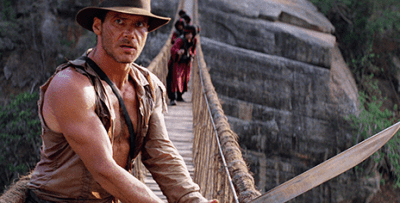
Taking on new contracting positions is always an adventure. Indiana Jones knows all about that!
It’s been a quiet start to 2016 for me, even though there have been some things going on for me “behind the curtain”. I wasn’t ready to share just yet, but I think I am now, since things have settled down for the moment.
My contract as a knowledge management specialist ended early. The projects that they kept saying to me, “They are coming…we’re waiting for approval…” fell through. Two of them. They also didn’t have any other work for me to do, so understandably, they cut the contract short. Unlike some other jobs, I was greatly relieved to be released. I did not feel that this particular position and company was a great fit. Even though I truly tried to give it a chance, I remember not having good feeling about the place from my first day of work there, and my gut instincts were right. It wasn’t a good match in the end, and the fact that they didn’t plan well for my presence there proved that.
In the meantime, I had two events that changed the picture rather quickly.
TechCommGeekMom speaking at the PANMA/STC-PMC February 2016 meeting (Photo courtesy of Timothy Esposito for STC-PMC)
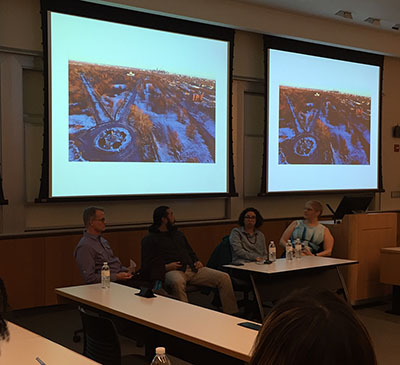
First, I was invited to be a panelist/presenter for a meeting that combined the Philadelphia Area New Media Association (PANMA) and the STC-Philadelphia Metro Chapter memberships. The meeting was about freelancing and contracting. Each group contributed two speakers, and I was one of the two representing the STC (the other was my friend, David Calloway). I was the last one to present or speak, and to be honest, I came completely unprepared. I thought it’d be a quick introduction thing, and then moderators would ask questions based on our experiences and background. (I guess I’ve been watching too many American political debates lately.) I was glad that I went last of the four presenters. Although the other three presenters covered much of what I would’ve said, I still had a few things to contribute. David and I took the stance of being contractors rather than freelancers. And as you might remember, several months ago I started my own freelancing company, but it hasn’t quite taken off yet.
But I will admit, listening to the others, I had a big realization of my own that night. I’ve been a contractor for several years, but not of my own choosing. I’ve tried finding full-time employee jobs, and it hasn’t happened in years. I think the last time I was not a part-time person or a non-contract person, it was still the 20th century! Yet perhaps, without my knowledge, I’ve already been a freelancer by default of being a long-term contractor.
That was my “A-HA!” moment, as Mitchell Levy likes to call it. I realized that yes, perhaps I have been a freelancer all along, and perhaps it really isn’t so bad to constantly be getting contract jobs. After the meeting, I told my husband about the discussion, and he pointed out that there was great opportunity in being a contractor. The biggest thing he pointed out was that each contracting job was an opportunity to learn new things. I would learn more about different industries, and often I’d learn more about new software, new procedures, and generally pick up a few new skills. I would also learn more about myself, namely what I’m good at, what I’m not as good at, and what I actually like doing. The more I thought about it, I realized that he was right. These are all opportunities to hone different parts of myself, both in improving what I do well, learning new things, and gaining insight about what is best about my capabilities and how to use them.
Group of PANMA and STC panelists, February 2016 (Photo courtesy of Timothy Esposito for STC-PMC).
Now, not everyone can be a contractor. It’s not easy because of complications of being a non-employee, thus you don’t get the same rights and benefits, like affordable health insurance, as a contractor. Some agencies that contract out do offer these benefits, but they are usually at a higher rate than at a large company. But, at the same time, there are certain flexibilities that a contractor has. If a contractor is careful with personal finances, he/she can take time off, or work more than one position over time. Granted, in 99.99% of cases, if you don’t work, you don’t get paid. So, for example, when I go to the STC Summit in May for about a week, I won’t be paid for “paid vacation”. In fact, a contractor doesn’t get any paid vacation. You get paid for the hours that you work. So, that can be good, and can be bad. If you are a good contractor, you communicate these occasions with your manager, and you ensure that you are caught up with your work to be able to do this, it provides a little flexibility that an employee doesn’t have.
I’ve lamented the woes of being a consultant recently, and it was especially because I was in a bad situation. It was not a good fit, and the worse parts of being a contractor were at their absolute worse. But now that I’ve been away from that, with the help of this PANMA/STC-PMC panel last week, I’m starting to change my attitude a little bit.
With that in mind, I took a new job that started this week…as a contractor. I will be working for a global insurance company as a content writer/copywriter for their global self-service websites. This is a big change for me, because while you’ve known me as a social media writer, I really haven’t done any writing for a company this way before. I originally was reluctant to take the job, as it’s a far commute than what I’m used to and I’m taking a significant pay cut to do this job. But, I saw it as an opportunity to actually put my technical writing, editing, and UI/UX experiences to work in a different way, so it’s worth a try. After all, the contract is only for six months with a possibility for extention. Unlike the last position I took in which I had a sinking feeling about it (and my instincts were right about it), I have a better feeling about this position. After completing my first day, I think it’ll be a challenge to do things from a different perspective, but I liked the group of people I’ll be working with, the environment was more inviting, and I could tell that the work we’d be doing is much more in line with my experiences. While I’ll be learning to do copywriting the way they want, I’ll still be using skills I’ve acquired from all the conferences, webinars, grad school, and social media experiences I’ve had. In other words, I think this is a much better fit, and I think I can learn something positive from this position, which makes me feel much better about taking the position. Everyone was speaking tech language that I understood, and I was deep in the mix with information architects and visual designers as well as spending a lot of time with the other copywriter on my first day. I think it’s going to be a good thing!
I’ve also been continuing to work on a part-time basis with my old content strategist/management job at BASF. It’s my “moonlighting” job, as I call it, but it helps keep those skills fresh at the same time while working with another company that I truly like.
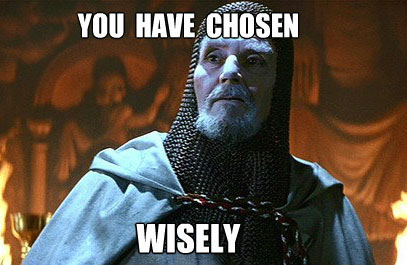
See? Even the old Templar Knight agrees with this attitude change.
These next months are going to be obviously very busy, but I think they’ll provide some good insights into something new for me. I’ll be able to truly write blog posts from a technical writing and UI/UX perspective based on new experiences. Hopefully, future contracting positions will also be providing great learning experiences along the way. Perhaps embracing being a contractor means that I will be more of an adventurer than I thought.
Rey and BB-8 are trying to find their way, too, in 2016.
While I’ve reviewed what’s happened in 2015 in my recent posts, it’s time for me to look ahead, and see what I need to plan for this year.
I admit that last year, I had big plans. I knew that I wanted to sample some new conferences so that I could have some new experiences and meet new people. I also knew that I wanted to try to launch my own consulting company. Additionally, I knew I needed to learn something new to enhance my skills. I achieved all these goals on some level, so that’s good. However, it’s more difficult this year. If last year was a transitional year, this seems to be more of a transitional year than before. Last year, I had some direction on what I wanted–and needed–to do. This year, I really don’t know where to go, and that’s problematic.
While I earned a mini-MBA in digital marketing last year, I don’t feel strong enough to take on a content marketing job. I could certainly try, but most of the job listings need someone with a stronger marketing background than a digital background. While I understand marketing concepts, my experience fails me on that front. I’m open to taking more coursework in something to enhance my job seeking opportunities, but…in what? Two avenues that I’ve considered is learning more about Agile/Scrum, and the other is looking at getting a certificate in localization practices. I think both would be beneficial, and are things that I’m interested in, but I don’t know how much they would actually help me in the job market where I’m at. I’ve thought about getting some coursework in project management–which is what originally brought me into the IT world almost 20 years ago. Project Management has morphed quite a bit since that time. I’ve also thought about learning more about either WordPress or AEM development, which I think would be good, but I’m not sure where to find the right education for that, or know if I’m up to it, since I’m not really a developer. I’m not sure if any of these are the right direction, either.
I launched my company, but I’ve hardly gotten it off the ground. Part of the problem is that I know I need to focus on what I’m best at, and figure out what I can offer that other consultants can’t. I’m not sure what that is quite yet. I think I have a lot to offer, but honing into what makes me special, unique, and valuable to a client is much harder to define, especially when you are trying to figure it out about yourself. I also need to figure out how to find clients–that’s important, too! If I can get that off the ground more, I’d love that. I’m open to any part-time or full-time projects–even being the sub-contractor for someone else. I’m very open to remote possibilities. I don’t know where the opportunities lie. I know they are out there, but I don’t know how to tap into it.
I’d like to continue trying out new conferences, and perhaps go back to some that I’ve already attended in the past. I’m already set to attend the STC Summit this year, as I’ll be a workshop speaker. I’ll also be attending the STC-PMC Conduit conference–for the first time strictly as an attendee, and not a speaker! But other conferences? A lot of it has to do with time and money. Money is something I don’t have a lot of, and time–well, I don’t know what my time is going to look like a few months from now, let alone later this year. Perhaps I’ll go to the IEEE ProComm which will be in Austin, Texas in the Fall. I’m not sure yet. I thought about going to the Big Design conference in Quito, Ecuador (I heard it’s going to be great, and an opportunity for me to visit cousins-in-law at the same time), but it’s very close to the STC Summit, so I don’t know if I can swing two conferences so close to each other time-wise or financially.
I think the biggest issue, as you can sense here, is that I feel direction-less. It’s almost a dilemma between having too many choices and not enough choices. It’s one of those times that I wish I was a kid again, and someone could see through the clouds better than I could, and help point me in the right direction. But alas, I don’t have such a luxury. I have to figure this out for myself.
You can see that I have ideas, and I’m open to suggestions, but there are too many unknown factors this year that prevent me from committing to anything right now. I don’t know what direction my career is going in right now. Last year was the year that I thought I would turn things around and start in a new direction, and it would be a clear path. I think I had some good ideas last year–and they were, and I could try to continue with them, but I’m not sure how to do that.
So where do I go from this point? As I said, I’m certainly open to suggestions or leads. I have a concept in my head of where I want to go, what I want to do, but I don’t know how to get there. There are no Google Maps to take me there. If you have felt like you didn’t have any direction in your career before proceeding towards next steps, what did you to break out of that rut?
Include your comments below, as I’d really like to hear about some ideas that might benefit me, but could also help others who are facing the same dilemma as I am.
General Leia says, “Don’t worry, kid. You’ll figure it out. The Force is strong with you, Padawan.”
This is not to say I’m not optimistic about this year. I will say that over the past several years, I’m glad that I’ve built a great support network professionally around me who can certainly lift me when I’m down, and I’m grateful for that. Also, who’s to say that I have to set out any goals right now? When I decided to lose weight and get healthy, I didn’t make the plan in January, but rather in May or June of that year. Who’s to say that I won’t have this figured out a little better in a few months? Time will tell, but for now, I’m hoping the Force will provide me with some direction….
“The actual context and the state of content is going to be so different to anything we can envisage at the moment–where the interplay between user and the provider will be so in simpatico…it’s going to crash our ideas of what mediums are all about.”
–David Bowie, 2000
The world is mourning the loss of an incredible musician and artist who made a huge impact on the world. David Bowie was always thinking outside the box, always changing and adapting his style and music, but was always true to himself–and admired for his boldness in doing so.
One of the things that I always thought was very cool about David Bowie beyond the music, fashion, and Ziggy Stardust makeup was that he was an Internet pioneer. No, really, he was! I remember many years ago reading about how much he was playing and investing in websites and creating content for websites. Some of the websites and content stuck, and some of it didn’t, but Bowie wasn’t afraid to give things a try. The best example I can think of off the top of my head was a children’s music site. Bowie’s daughter is about a year older than my own son, so I thought it was pretty cool that he was curating musical content that was age appropriate for our children, but not so dorky/corny stuff that parents wouldn’t want to listen to it as well. It was an amazing site that closed down later, but it was a significant step towards digital music content as we know it now. He may have done some other experimental sites with music, but I was only tuned into the children’s music at the time.
If you do a search on “David Bowie Internet Pioneer”, you’ll see many articles out there right now telling you more details about his heavy involvement. He knew that the internet was all about CONTENT, and he tried to be one of the earliest content providers.
One of the things that popped up in the many memorials to him was this interview about the role of the Internet and content and the wide possibilities. The interview below was done in the year 2000, just as internet access was starting to become more mainstream (AOL was the big provider at the time, to give you some perspective), and he was SO ahead of his time.
Hopefully, as technical communicators, we can not only learn how to be creative individuals like Bowie was with his music, art, and fashion, but also think beyond our current scope of thinking to what content–not just the arts that he represented, but much more and beyond–can truly be, and have a better understanding of what our relationship to content should be.

 Ever enrolled in instructional design certifications and elearning classes but you still feel that there are a few things missing? Maybe this can help you.




 TechCommGeekMom
You must be logged in to post a comment.