Posted in Uncategorized

How to write good hyperlinks — Write Like a Human — Medium

Click here. Find out more. Check this out.

Source: How to write good hyperlinks — Write Like a Human — Medium

Thanks to Amy Thibodeau for posting this on Facebook in the Content Strategists group.

This is a short but sweet article to help improve how to write hyperlinks in a more user-friendly manner.  This is something I work on for myself, but it’s also something I try to teach content providers when I edit and post content.  Much of the world is fairly digitally literate now, that if they see a hyperlink, they know it’s going to take them somewhere else.  The guidance here is easy to follow, and can help provide some great perspective on how to make hyperlinks easier to use for your users.

What do you think? Are you still part of the “click here” movement? (I know I’ve been working on breaking that habit–I don’t like it!)  Include your comments below.

–TechCommGeekMom

Posted in Uncategorized

The Double Vocabulary of English | Mental Floss

Why does English have so many words that have twins? Here’s how we got to have two vocabularies, one based in Germanic roots, and one based in Latin.

Source: The Double Vocabulary of English | Mental Floss

As someone who thinks that she missed her calling by not studying and getting degrees in linguistics, I find this a fascinating little five minute video history of why English has more than one word for many verbs and nouns.  It’s said that English is complicated because of instances like this, but perhaps it’s actually richer for it.

What do you think of this video? Include your comments below.

–TechCommGeekMom


Posted in Uncategorized

Content on Content on Content — Medium

I’m about to get real meta on you: the article you’re about to read was made from a video, that was made from the making of an article…

Source: Content on Content on Content — Medium

This was an interesting article, as it talked about just what the title says–making content that was made from content, but was made from previous content to that.  The article is really about taking all the information you may already have, and how to break it down and create new content as a means of content strategy. It’s hard for me to explain as cleanly as the author explains it, so I recommend you read this article directly.  It’s not really a new approach, but I think it’s another perspective to add when thinking about content creation and curation.

What do you think? Include your comments below.

–TechCommGeekMom

Posted in Uncategorized

A new model for content strategy | Content Strategy Inc.

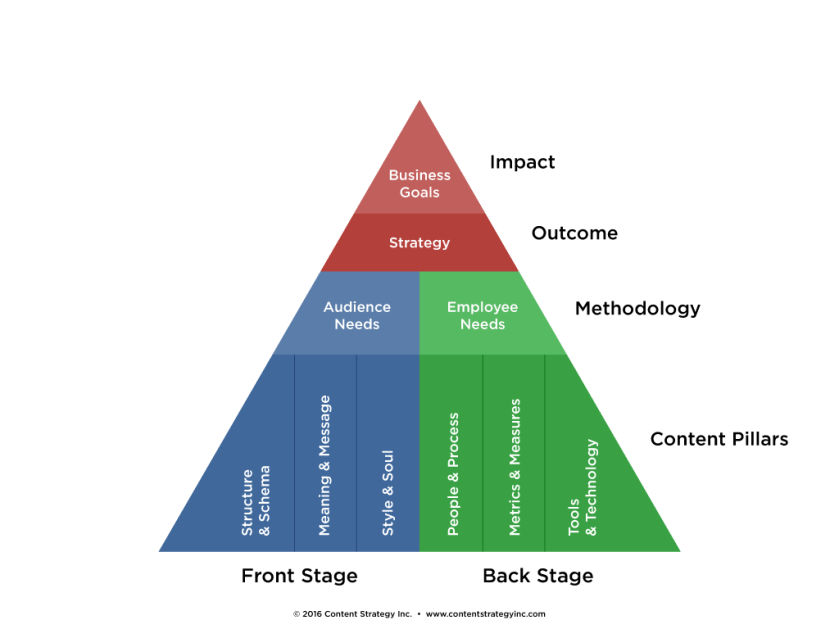
We set out to create a new content strategy model that shows the different aspects of content strategy, emphasizes the holistic nature of content strategy, points to the impact of content strategy, doesn’t use industry jargon, is applicable in different situations, is helpful to our clients, and has a simple, memorable framework.

Source: A new model for content strategy | Content Strategy Inc.

I know I got this from someone’s posting on LinkedIn (I’m sorry, I forget who!), and this seems like a really good analysis of what content strategy needs to include. I like that the author says that she and her team figured out that they have to look at both the audience and the employee needs of the equation to have a balanced picture.  This appears to be a good foundation to start one’s strategy.

What do you think? Do you like this model? What are the positives and negatives of this model to you? Include your comments below.

–TechCommGeekMom
Posted in Uncategorized

History isn’t a ‘useless’ major. It teaches critical thinking, something America needs plenty more of – LA Times

Since the beginning of the Great Recession in 2007, the history major has lost significant market share in academia, declining from 2.2% of all undergraduate degrees to 1.7%. The graduating class of 2014, the most recent for which there are national data, included 9% fewer history majors than the previous year’s cohort, compounding a 2.8% decrease the year before that. The drop is most pronounced at large research universities and prestigious liberal arts colleges.

Source: History isn’t a ‘useless’ major. It teaches critical thinking, something America needs plenty more of – LA Times

This is an article that an acquaintance of mine had posted on Facebook, and it stands to make another positive argument in favor of history majors (like me).  I’ve said many times that I was not suited to do a traditional English or Journalism major because I really didn’t want to get bogged down in literature–not that literature is problematic, but it’s not for me.  Whereas understanding the finer details of grammar, and doing the research…ah, that’s where a history major’s strengths come into play, and help make better technical communicators.

Read this article, and tell me what you think in the comments below.

–TechCommGeekMom