I knew that my little blog’s birthday was coming up soon (I always remember the month, but never the day), but when WordPress sent me the following note:
I received my reminder that it was today, March 9th! (One of these days, I’ll have to look up this blog’s horoscope.) As many know, this started as a grad school project, and here it is, four years later, and I’m still here.
Four years of blogging and curating content for this blog have yielded over 39,000 views (and it’s still growing) and over 1100 posts on topics of m-learning, e-learning, technical writing and editing, content strategy, digital marketing, localization issues, and so much more. That’s a LOT for a little niche blog, wouldn’t you say? Not bad for a blog which would be a preschooler if it were human.
But lately, it’s felt more like that four years is dog years–like I’ve been writing this for 28 years instead. I know as a joke, I said I was going to be closing down this blog about a year or two ago. No, I’m still not going to be shutting it down, but man, it’s hard to keep up now. You’d think after posting 1100+ posts that it would be enough, but noOOOOooo. There are still requests for more, and it’s hard to keep up. Life changes in the background. I’m not a grad student anymore, and I’ve now been through several positions since I started this blog. The blogging burnout is real.
My main concern is that I can’t keep up with a schedule of posting an original blog post every week. Part of that is coming up with original content! This time last year, it was a little easier because I was taking my digital marketing course, so I had something to spark my mind and comment about. This year, I’ve started a new job in copywriting and editing, and it’s only my first week, so I’m hoping that it will provide something for me to write about in time. You’ve probably noticed that I’ve written a lot about careers in tech comm–or in general–lately. I’m trying to figure out how to start planning ahead a little bit to move my career forward, and yet I feel like some of my more recent steps have been steps backwards. It’s hard to write about things you aren’t passionate about, after all. I still have a passion for tech comm, and I’m so happy to be part of this community. Yes, I’m tapped out of ideas, unless someone can give me a topic to write about.
So, you might not see quite as many posts in the next year or so, but that’s because when I do curate content or post something original, I want it to have some sort of value or be something interesting, at least. It needs to be helpful or insightful, if I can help it.
Perhaps the maturity of this blog is in that I don’t want it to be full of too much fluff. I want some substance to it now and then, and I try to provide that, as well as provide an outlet for community discussions. I’m grateful for those of you who have chosen to comment and join the discussions here on TechCommGeekMom, and hope that you will continue to help us all explore difference perspectives and experiences.
After four years, I suppose I’m not as much of a beginner technical communicator as I was when I started this blog, but it still feels like it most of the time. There are concepts I understand, but haven’t implemented, so I can’t always speak with any authority. This applies to my “outside world” life too. For example, at my current position, I’m thinking that employing some sort of single-sourcing process for their content would help this company tremendously, but they aren’t thinking about it, and I wouldn’t know how to go about making suggestions on how to do it since I’ve never done it myself on any scale. But I know my mind is in the right place with that. So, I can’t say much on that topic, for example.
Time will tell how TechCommGeekMom continues. I always have big plans, but I can’t always make them happen due to time, money, and circumstances. I would still like to have a podcast/videocast feature at some point, but I just haven’t got the time to get that organized at the moment. But someday…
I would love to get fellow technical communicators to guest blog on here, too. I don’t let just anyone post on here, but if you would like to write a blog post, but don’t want to set up a blog, consider posting here. I would love to have other voices on here! If you are interested about talking about a tech comm topic, let me know.
I’ll also try to include more about some of the things I’m doing soon. For example, I will be attending this year’s STC Summit and Conduit, the STC-Philly Metro Chapter’s Mid-Atlantic Technical Conference. I’ll be tweeting up a storm, I’m sure, on @TechCommGeekMom, but perhaps this year I’ll post more photos so that you can get a feel for the conferences and the great people who I see each year at these various conferences. These are definitely the movers and shakers!
Lastly, I want to thank all my readers. Without you, there is no TechCommGeekMom. I’d just be a geek mom instead. I appreciate your patience with me, as this blog is always a work in progress. I try to be as honest as I can be, sharing the best and the worst of my experiences, and I hope that’s something you come back for from time to time.
“Just give her a topic, you know, just cawfee tawk…like single sourcing is not a new dating service…talkst amongst yerselves….”
In the meantime, if you have any ideas of something you’d like to see on TechCommGeekMom, please let me know! Help me make this blog the kind of blog you like to return to, and let me know what kind of topics you are interested in reading about in the tech comm field!
Taking on new contracting positions is always an adventure. Indiana Jones knows all about that!
It’s been a quiet start to 2016 for me, even though there have been some things going on for me “behind the curtain”. I wasn’t ready to share just yet, but I think I am now, since things have settled down for the moment.
My contract as a knowledge management specialist ended early. The projects that they kept saying to me, “They are coming…we’re waiting for approval…” fell through. Two of them. They also didn’t have any other work for me to do, so understandably, they cut the contract short. Unlike some other jobs, I was greatly relieved to be released. I did not feel that this particular position and company was a great fit. Even though I truly tried to give it a chance, I remember not having good feeling about the place from my first day of work there, and my gut instincts were right. It wasn’t a good match in the end, and the fact that they didn’t plan well for my presence there proved that.
In the meantime, I had two events that changed the picture rather quickly.
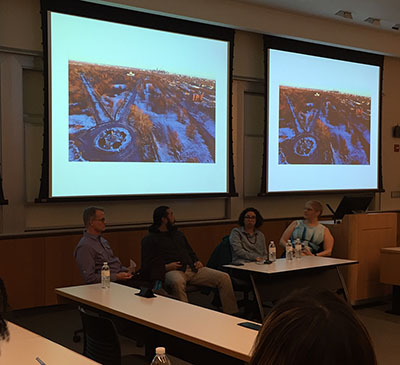
TechCommGeekMom speaking at the PANMA/STC-PMC February 2016 meeting (Photo courtesy of Timothy Esposito for STC-PMC)
First, I was invited to be a panelist/presenter for a meeting that combined the Philadelphia Area New Media Association (PANMA) and the STC-Philadelphia Metro Chapter memberships. The meeting was about freelancing and contracting. Each group contributed two speakers, and I was one of the two representing the STC (the other was my friend, David Calloway). I was the last one to present or speak, and to be honest, I came completely unprepared. I thought it’d be a quick introduction thing, and then moderators would ask questions based on our experiences and background. (I guess I’ve been watching too many American political debates lately.) I was glad that I went last of the four presenters. Although the other three presenters covered much of what I would’ve said, I still had a few things to contribute. David and I took the stance of being contractors rather than freelancers. And as you might remember, several months ago I started my own freelancing company, but it hasn’t quite taken off yet.
But I will admit, listening to the others, I had a big realization of my own that night. I’ve been a contractor for several years, but not of my own choosing. I’ve tried finding full-time employee jobs, and it hasn’t happened in years. I think the last time I was not a part-time person or a non-contract person, it was still the 20th century! Yet perhaps, without my knowledge, I’ve already been a freelancer by default of being a long-term contractor.
That was my “A-HA!” moment, as Mitchell Levy likes to call it. I realized that yes, perhaps I have been a freelancer all along, and perhaps it really isn’t so bad to constantly be getting contract jobs. After the meeting, I told my husband about the discussion, and he pointed out that there was great opportunity in being a contractor. The biggest thing he pointed out was that each contracting job was an opportunity to learn new things. I would learn more about different industries, and often I’d learn more about new software, new procedures, and generally pick up a few new skills. I would also learn more about myself, namely what I’m good at, what I’m not as good at, and what I actually like doing. The more I thought about it, I realized that he was right. These are all opportunities to hone different parts of myself, both in improving what I do well, learning new things, and gaining insight about what is best about my capabilities and how to use them.
Group of PANMA and STC panelists, February 2016 (Photo courtesy of Timothy Esposito for STC-PMC).
Now, not everyone can be a contractor. It’s not easy because of complications of being a non-employee, thus you don’t get the same rights and benefits, like affordable health insurance, as a contractor. Some agencies that contract out do offer these benefits, but they are usually at a higher rate than at a large company. But, at the same time, there are certain flexibilities that a contractor has. If a contractor is careful with personal finances, he/she can take time off, or work more than one position over time. Granted, in 99.99% of cases, if you don’t work, you don’t get paid. So, for example, when I go to the STC Summit in May for about a week, I won’t be paid for “paid vacation”. In fact, a contractor doesn’t get any paid vacation. You get paid for the hours that you work. So, that can be good, and can be bad. If you are a good contractor, you communicate these occasions with your manager, and you ensure that you are caught up with your work to be able to do this, it provides a little flexibility that an employee doesn’t have.
I’ve lamented the woes of being a consultant recently, and it was especially because I was in a bad situation. It was not a good fit, and the worse parts of being a contractor were at their absolute worse. But now that I’ve been away from that, with the help of this PANMA/STC-PMC panel last week, I’m starting to change my attitude a little bit.
With that in mind, I took a new job that started this week…as a contractor. I will be working for a global insurance company as a content writer/copywriter for their global self-service websites. This is a big change for me, because while you’ve known me as a social media writer, I really haven’t done any writing for a company this way before. I originally was reluctant to take the job, as it’s a far commute than what I’m used to and I’m taking a significant pay cut to do this job. But, I saw it as an opportunity to actually put my technical writing, editing, and UI/UX experiences to work in a different way, so it’s worth a try. After all, the contract is only for six months with a possibility for extention. Unlike the last position I took in which I had a sinking feeling about it (and my instincts were right about it), I have a better feeling about this position. After completing my first day, I think it’ll be a challenge to do things from a different perspective, but I liked the group of people I’ll be working with, the environment was more inviting, and I could tell that the work we’d be doing is much more in line with my experiences. While I’ll be learning to do copywriting the way they want, I’ll still be using skills I’ve acquired from all the conferences, webinars, grad school, and social media experiences I’ve had. In other words, I think this is a much better fit, and I think I can learn something positive from this position, which makes me feel much better about taking the position. Everyone was speaking tech language that I understood, and I was deep in the mix with information architects and visual designers as well as spending a lot of time with the other copywriter on my first day. I think it’s going to be a good thing!
I’ve also been continuing to work on a part-time basis with my old content strategist/management job at BASF. It’s my “moonlighting” job, as I call it, but it helps keep those skills fresh at the same time while working with another company that I truly like.
See? Even the old Templar Knight agrees with this attitude change.
These next months are going to be obviously very busy, but I think they’ll provide some good insights into something new for me. I’ll be able to truly write blog posts from a technical writing and UI/UX perspective based on new experiences. Hopefully, future contracting positions will also be providing great learning experiences along the way. Perhaps embracing being a contractor means that I will be more of an adventurer than I thought.
“The actual context and the state of content is going to be so different to anything we can envisage at the moment–where the interplay between user and the provider will be so in simpatico…it’s going to crash our ideas of what mediums are all about.”
–David Bowie, 2000
The world is mourning the loss of an incredible musician and artist who made a huge impact on the world. David Bowie was always thinking outside the box, always changing and adapting his style and music, but was always true to himself–and admired for his boldness in doing so.
One of the things that I always thought was very cool about David Bowie beyond the music, fashion, and Ziggy Stardust makeup was that he was an Internet pioneer. No, really, he was! I remember many years ago reading about how much he was playing and investing in websites and creating content for websites. Some of the websites and content stuck, and some of it didn’t, but Bowie wasn’t afraid to give things a try. The best example I can think of off the top of my head was a children’s music site. Bowie’s daughter is about a year older than my own son, so I thought it was pretty cool that he was curating musical content that was age appropriate for our children, but not so dorky/corny stuff that parents wouldn’t want to listen to it as well. It was an amazing site that closed down later, but it was a significant step towards digital music content as we know it now. He may have done some other experimental sites with music, but I was only tuned into the children’s music at the time.
If you do a search on “David Bowie Internet Pioneer”, you’ll see many articles out there right now telling you more details about his heavy involvement. He knew that the internet was all about CONTENT, and he tried to be one of the earliest content providers.
One of the things that popped up in the many memorials to him was this interview about the role of the Internet and content and the wide possibilities. The interview below was done in the year 2000, just as internet access was starting to become more mainstream (AOL was the big provider at the time, to give you some perspective), and he was SO ahead of his time.
Hopefully, as technical communicators, we can not only learn how to be creative individuals like Bowie was with his music, art, and fashion, but also think beyond our current scope of thinking to what content–not just the arts that he represented, but much more and beyond–can truly be, and have a better understanding of what our relationship to content should be.
Florence and The Machine think that TechCommGeekMom’s Top of the Pops 2015 is smashing. (Source: telegraph.co.uk)
I always find it interesting to see what stories people end up gravitating to each year on TechCommGeekMom, and along with other year-end summaries, I like to figure out what were the most popular blog posts for a given year. Sometimes, it’s something that’s archived from an earlier year. That’s good, because I try to write or post things that will have long-term relevance as often as possible. However, I’m usually interested in what was written THIS year that came out to be the most popular of all original information posted that wasn’t an archived post or a curated topic posted.
What’s interesting to observe from a statistical perspective is that the top three almost tied for first place–#1 has one more view than the next two, which are tied.
I’m also pleased to see that most of my most popular posts this year were ones that came from the heart, based on personal experiences or observations. I’ve often argued that social media is a medium in which people discussed things and could more closely relate to each other because there is the ability to have more personal experiences and have the opportunity to connect and respond. The fact that many of these top blog posts relating to my job woes, trying to provide DIY training for myself, and trying to take positive steps towards the continual advancing of my career are relatable topics–that I’m not the only one going through these feelings and experiences. I almost always try to open up conversations with my blogs–for better or worse–and the reflection of the top original posts for 2015 reflect that.
The last one I listed was something personal that I wanted to include. This showed a big part of my weight loss and self-improvement journey I’m on right now. I’m still on that journey, having made a bold move in the last few weeks (something that I may write about soon, but not yet). I was glad to see that truly personal topics matters, and that even when relating it to something in technical communications, people responded positively towards it. My weight loss journey is a deeply personal one, and something that I don’t have to share, but I do, simply because I think all of us can relate to a non-tech comm struggle like that easily.
What will 2016 bring? Stay tuned…plans, resolutions, and predictions coming soon!
The last few weeks–in fact, the last couple of months–have been so busy for me that I can’t always finish what I need to get done. One of the things on my long to-do list has been writing up a review of the new RoboHelp 2015 release. I shouldn’t have waited, because let me tell you–there are some great things happening with this updated product! Additionally, Adobe has already released an update, which I will include details from that as well in this review.
Back in May, Adobe held a preview press conference to let us know what’s new in Robohelp (2015 release). It was hosted by Maxwell Hoffmann, one of the Technical Communications Suite (TCS) product evangelists for Adobe. I know Maxwell fairly well, as I first had a chance to work with him on the webinar I did for Adobe three years ago, and I know he knows and understands the TCS products very well, especially since he worked for some of these products before they were originally acquired by Adobe! He’s also a master storyteller and pays a lot of attention to what technical communicators have to say, so he’s excellent at explaining the benefits of features to users.
The first thing that Maxwell noted was that like the newest release of Framemaker, the naming convention for current and forthcoming releases from now on will be reflected in year instead of version 12, 13, etc. This allows for some consistency, and it’ll be easier to know if you have the latest version based on the year it was released.
Going forward from that, Maxwell explained that RoboHelp (RH) now offers a new degree of usability to both help authors and their users. There are several new features going on in the 2015 release that I have to tell you, truly impressed me, and I think you will find to be great upgrades as well. The highlights of these new features include:
A brand new user interface
Best in class multi device publishing capabilities
Dynamic Content Filters that enable end users to quickly find relevant content
Single-click mobile app creation workflow
Miscellaneous productivity enhancements
Let me go into more detail about each of these highlights.
Brand New User Interface
Even though RH was already able to have its configuration customized by the user, many of the icons were rather small and hard to see–the interface had a lot going on in one screen. Even so, one of the advantages of RH has always been that you didn’t have to work with code in RH. The new interface, when demonstrated, was significantly cleaner and more concise. Not nearly as busy looking as its predecessor! The interface has a much simpler look that resembles modern MS Office interfaces with the task ribbon, project manager window/frame, and the main designing frame. The icons are larger and much clearer to figure out what they are. You also have a choice over the user interface being light or dark, and with or without color. It’s totally customizable to your preferences. Nice! Maxwell noted that it’s also helpful if you have two instances of RH running to keep different projects straight.
The commands are clustered in the tab ribbons. As the different tab ribbons were demonstrated, I could see this was so much easier to decipher! There is also an icon in the first two tabs called “Pods” which can help you manage the pods you are working on. The ribbons allow you to see all the commands readily available to you in a consistent manner. All the tab ribbons seem consistent with MS Office-style ribbons, so new users should be able to adapt easily to these command choices.
The new Output tab ribbon, which contains one of the most frequently used clusters of tools, replaces the single-source layout pod that was in previous versions of RH. The Primary Output tool icon within the Output tab is customizable so that you can choose what outputs you want to use if you have a certain set of outputs that you standardly use. You can still do output of individual things as well, and the generation of output is faster now. There is also a great “Primary Output View” which allow you to prototype and see what your output will look like before you actually publish.
The area circled in red shows the customizable Primary Output tool, which provides a one-touch customizable option to publish to your primary outputs.
There are several other interface features that are great enhancements. The Quick Access Toolbar used to display your favorite, most commonly used commands can be easily and quickly customized. The tabs will reformat with window resize, and the ribbon can also autohide.
Within the workspace, table creation is similar to MS Word. Tables can be created in color, and have greater flexibility. When creating a table, just like Word, RH creates a specific tab for formatting and layout tables when needed. When creating content, commands that don’t make sense will gray out. Keyboard tips and shortcuts can be customized. The opening window is much more graphical and easier interface to use to start projects. When opening up a file, it will remember what documents you had open. Of course, if you are used to the old interface, this is an option as well.
With the update released in late August, the layouts have been optimized
Boy, Adobe has really gone all the way with making RH an easier, more user-friendly tool to use! If nothing else, this was the one improvement that in my eyes that impressed me the most, because I think this new, user-friendly layout is much less intimidating than the old one, which will help those who are new to the product or not as proficient on the product more willing to use it.
Best in Class Multi-Device Capabilities
RH now has new dynamic content filters that empower users by allowing them to find revelvant content faster. Adobe created brand new HTML5 layout enhancements which include:
The ability to easily show or hide widgets such as the Table of Contents (TOC), Glossary, Index, or Filter panes
Configure media query boundaries for different screens
Support native social media widgets
Flip to Right-to-Left (RTL) layout by changing language in single-source language
Show or hide branding band for mobile output
The HTML5 responsive layout has easy off/on icon control in layout, which is different from previous RH versions due to the clearer icons in the toolbar. Search enhancements include:
The ability to have topic descriptions and control what that text is to make the description more meaningful.
Breadcrumbs are now also part of the descriptions.
Output search results are available in a collapsible left panel for easier navigation.
Native social media widget control allows Facebook and Twitter icons to appear on the output so that you can share the information. This is displayed as an arrow on the side that can pop out the content as needed, so it’s not in the way, yet still available.
Flip layout to right to left with language attribute for Arabic and Hebrew. This will also work with linked or imported RTL Framemaker documents.
Generate faster, better responsive HTML5 output. Faster loading times reduced by half, smaller sized output–2MB less for every 100 topics, and no flickering screen are the result.
You can maintain the Table of Contents state in the left column, and in fact, you can expand more than one section at a time within that section.
Cleaner HTML5 coding.
Some other bonuses are that custom fonts can be embedded when generating high fidelity ePub, and more skins have been added for output formatting to provide more flexibility and to accomodate for RTL projects.
Dynamic Filters and Faceted Navigation Improve The End-User Content Consumption Experience
The new HTML5 layout and contextual search results can let your end users quickly navigate to the relevant content through dynamic filters. Based on existing conditional tags/expressions functionality, users can use the tags/expressions OR/AND at the build time and display these tags/expressions for dynamic filtering by the end users.
Tags can be grouped and filters shown in a two-level hierarchy. All the content is dynamically filtered (TOC, Index, Topics, Search Results etc.). You can choose a display name for both tags and expressions, which works for merged projects as well. Tags can be shown in the output for better testing (Maxwell said that Adobe is most likely the only one doing that with its product), which is currently supported ONLY in responsive HTML5 output and mobile apps.
Enhancements include the ability to enable a single selection or multiple selections of the tags in final output, and enhanced CSH support through a dynamic content URL, so the filter choices are actually seen in the URL of the output, which is great. In the demonstration given, Maxwell showed how you can navitgate through filtered content so only certain things show for certain audiences, which I thought was a great use of this feature.
Content Centric Apps (developing mobile apps)
Robohelp can publish content as mobile apps for iOS and Android which can be read remotely or downloaded directly on your device. Adobe has made it super easy to create mobile app for your documentation by using a PhoneGap:Build/CS subscription to generate multiple apps for both Android and iOS. (PhoneGap is considered an inexpensive subscription.) Mobile apps can easily be downloaded by scanning a generated QR code that can be shared, although a URL that can be shared, too.
Miscellaneous KEY enhancements
There are several extra enhancements that don’t fall under the other main categories, but are still equally important.
Users will be able to work more productively with a ribbon UI and enhanced search functionality, including bi-directional and multiline searches. The support for languages like Arabic and Hebrew, which was a major feature upgrade in FM 2015, is also included in this RH release. As of the new update released in late August, Farsi is also supported.
The “Find & Replace” functionality and searching abilities are significantly improved. Key enhancements include the ability to find results in Design Mode and open the files directly from search results.
Search scope has been extended, so you can also set the search scope to a current project, specific folders, the current window (including TOC/Index, etc. which is new), and all open files (also new), as well as do a multi-line search.
The standard keyboard shortcut of “Ctrl-F” now works to help do searches.
There are now separate tabs for find and replace. In the demonstration given, we were shown that you can find and replace within design mode instead of the HTML mod. There’s also the ability within the find/replace that if you have a long list of items, and you want to find where a specific item in located within that list, then you can go into the Project tab and click on “locate item”, and it will take you directly to the page in design mode. Really nice!
Search direction support–both forward and backwards– is available. You can also search within the source code as well through the line numbers listed in the search lists, which makes this feature very flexible.
Conditional text control has been improved with tagged output so that you can see what is conditional or not for QA purposes. Before, RH had slashed color tags that made it difficult to read and not always an exact match to what the conditional tag was. Now, it has a more intuitive conditional build tag display that is much easier to read text while editing–the overline color exactly matches the tag. The overline is used as a conditional indicator with better readability than cross hatches, the color of the overline is exactly that of the tag, and easy to figure out the tag boundaries.
Support is now provided for named expressions.
Other enhancements enhancements at the time of the release included miscellaneous search enhancements, better scripting support, remember project state, and “find now” works in project manager frame.
Within the update release in late August, some additional enhancements were made in addition to those already mentioned above. Windows 10 support, online video derived from HTTP URLs can now be embedded in RH output, playback settings for multimedia are available, and more than a dozen bugs have been fixed. They’ve evidently been working hard at Adobe to add such features in a short time since the May release!
Pricing
Pricing & Availability on June 2 (in USD and AUS):
Product
Full Price
Upgrade from last release
Upgrade from 2 releases
Subscription Price
Languages Supported
RoboHelp 2015
$999
RH 11: $399
RH 10: $599
$29.99/mo
English, French, German, Japanese
Technical Communications Suite 2015
$1699
TCS5: $699
TCS 4, 3, 2 or 1: $1199
$49.99/mo
English, French, German, Japanese
TCS 2015 Release includes RoboHelp, FrameMaker, Captivate, Acrobat, and Presenter–all at a price that is 57% less expensive that buying all products individually. It’s something to consider!
I think the thing that impresses me the most out of all the great new features truly is the new interface. Having a simpler, more user-friendly interface is going to bring more users–especially new users–towards this already powerful product. The continuing development on content design flexibility and inclusion of mobile output helps Adobe keep this product as one that will assist technical writers with creating more user-friendly help guides for customers.








 TechCommGeekMom
You must be logged in to post a comment.