2012 has been the inaugural year of TechCommGeekMom.com. What started initially as both a class project as well as a personal project with no expectations other than to get a good grade and have a form of expression has blossomed into something else. Who would have guessed? I’ve been blessed that I’ve gained a lot of support over the past nine months that I’ve been writing TechCommGeekMom. Evidently, the combination of both my original posts as well as my curated posts are seen as worthwhile reading! I truly appreciate the support.
Since this is the time of year when everyone does year-end reviews, I thought I’d list the top blog posts of 2012 here (at least at this writing) from TechCommGeekMom. Just to clarify the selection process, these were based on the posts that I wrote myself, not on any curated content (some of that got high marks as well). It also does not include my home page.
So, here are the top ten posts of 2012:
1) Upgrade Time! PREVIEW of the NEW Adobe Technical Communications Suite 4!
I have to thank Adobe for the “Adobe bump” on this article. This preview of the Adobe Technical Communications Suite 4 package was made possible by Adobe, as they allowed me to sit in on the preview presentations of the product, and subsequently promoted this article not only on the web, but also for some of their print marketing materials later. Thank you, Adobe!
2) Project Tin Can: Good Communication or just a Tin Can Alley?
Project Tin Can was a hot topic in m-learning this year, and I had the chance to listen in on several conversations and learn about Tin Can highlights myself, and was glad to pass this information along.
3) Whitepaper: The Future of Mobile Learning: Empowering Human Memory and Literacy
I’m especially proud that this particular article was among the top posts this year and that it was so well received. It was originally a paper that I wrote for one of my grad school classes, and I was encouraged by Mayra Aixa Villar (who was my editor for the paper as well as one of my references) to either present at a conference or publish as a Whitepaper. I chose the latter for the sake of ease and time, and really happy that this was so well received.
4) What Hurricane Sandy Taught Me About Mobile Technology and Social Media
Mobile technology is what got me through the hurricane, and got a lot of other people through the hurricane. This kind of technology wasn’t available when Hurricane Katrina hit greater New Orleans area, but it made a world of difference when Hurricane Sandy hit and its aftermath. If anything, hopefully both weather events have taught us how we need to upgrade what we have for continued better communications so that we can minimize all damages.
5) The Meaning of Graduating with a Masters in Technical Communication
This was a big year for me in technical communications, especially because I finished earning my credentials. It took two and a half years of hard work in between both full- and part-time work, running a Cub Scout den, and being a mother to child with Asperger’s, but I did it. Graduation day was a big event in my life. I still miss going to school, and it seems surreal that I’m not still studying, but it was all worth it.
6) Being a specialist or a generalist? Which is better for a technical communicator? As is often the case, this blog has often been a place where I would explore some of my own concerns about my career as a technical communicator, and I was glad to see that the conundrum I had in this article was relatively universal in the field. I also appreciate TechWhirl promoting this article, because I think it’s something that should be addressed as technical communications continue to change.
7) What did you do to get that Tech Comm job?
This recent posting was the result of everything that’s been done thusfar on this blog and more. I did my best to outline the pointers that I felt would help others, and in the process helped me obtain the new job that I’ll be starting in a week. It was also featured in TechWhirl.
8) Be a warrior with Technical Communications Suite 4!
This was a post that promoted the new Adobe TCS 4 package and subsequent webinar done by my friend, Ankur Jain. I guess a lot of people were excited about the new software to have clicked on it so much!
9) Digital Tablets for Kids–Child’s Play, or should we take it seriously?
My perspective of digital tablets for children and review of some of the latest tablets made especially for kids made this post a popular one. This was an occasion to flex my GeekMom muscles more than my TechComm muscles.
10) My response to RJ Jacquez’s question: Will Tablets replace PCs? RJ Jacquez, tech comm blogger extraordinaire and m-learning revolutionary, is one of my earliest followers as well as someone who I consider one of my mentors. The sign of a good teacher is having one of your “students” challenge or discuss ideas that have been put forth by the teacher, and that is what this post reflects.
There are so many more posts that also got some great traffic, but these were all the top ones for this year. I appreciate that so many of you have come to visit this site or follow this site regularly. Please enjoy reading–or re-reading–these posts, and feel free to peruse through the rest of the archives. There are almost 240 posts on this website at this writing, so there is plenty of content to read and enjoy–or hopefully learn and share!
As I’ve mentioned before, with my new job starting in about a week, I’m hoping to be able to keep up with posts when I can, and hopefully the new job will incite ideas for new posts in the next year to come! This blog has literally taken me places I’ve never expected to be, and I hope you continue to enjoy the trip as much as I have. More on my reflections about the year soon.
As the news continues to spread that I finally got a full-time job after a year of searching, one of my friends from Adobe suggested that I should write a post about how I got the job, with the purpose of encouraging others that they, too, can find a tech comm job.
Well, I won’t lie. It wasn’t easy. And my path may not be the right path for everyone, but I think there are some universal elements that can be recommended here. As this blog has often been a testament of my job searching woes and questioning what seemed to work and what didn’t, all I can do is recall what seemed to work for this particular interview that got me the job, and what lead me to that moment. In a nutshell, it was a lot of hard work.
Let me first start by bringing this recent article to your attention:
The article explains that in the US, while there isn’t a lack of unemployed workers, there is a lack of skilled workers in specific professions, and that employer demands of finding such workers instead of making a small investment in training otherwise competent workers is contributing to the problem. Gone are the days when, if you had half a brain and could learn how to do things, your employer would hire you and train you on that specialty. Most of my career was done this way. After college, I had a degree in hand, and could show that I could speak, write well, and think on my feet, so I was trained as a consumer affairs rep for a national manufacturing company. I would pick up different skills as I went from job to job, learning and gaining skills as I went along, eventually even shifting from a client services career to an IT career. But when I returned to the workforce after a brief stint away to be a stay-at-home mom, I found that wasn’t always the case anymore. In the last year or two, I can tell you that I KNOW this isn’t true anymore, or it’s a rarity. The article above mentions the loss of the time honored tradition of apprenticeships, something that may need to have a comeback. I supposed that internships are similar to apprenticeships, but they are far and few between as it is, especially for a mom like myself trying to get back into the workforce to help the family finances. Most are for school credit, instead of a small wage to learn a skill or craft. Possibly good for some students, but not that good for the rest of us who have to support ourselves or family.
In a sense, I had to create my own apprenticeship. In economic hard times, necessity is the mother of invention, and this mother needed to invent a new career out of necessity. My first full-time job after the onset of motherhood gave me the direction–technical communications. From there, I had to figure out how to better establish myself as a technical communicator, and eventually become one in the field.
So as not to bore you with my long story of how I finally arrived at this moment of getting a job, I’ll cut to the chase of what I think helped me in the end.
1) Don’t be afraid of being a multi-specialist or generalist. I know that several weeks ago, I questioned this, because this seemed to be a huge roadblock for me. In the end, it was the fact that I was a multi-specialist, I think, that picqued the employer’s interest. Yes, I could work on a CMS system, but I also know a lot about m-learning, social media, web design and yes, I can write. I think that the more I discussed what I knew about each topic, the more I could see eyes of the interviewers light up.
2) Create an e-portfolio of your work. This was really helpful for me. As much as I could say that I could write, create audio and video files, understood web design, and understand social media, I had PROOF. My e-portfolio could provide samples of most of my skills so that employers could see for themselves. While my e-portfolio originally started as my capstone project for graduate school, it has been enhanced and appended several times after graduation to appeal to prospective employers as well as those who just want to understand my work.
3) Get an education. You don’t necessarily need to go out and get a Masters degree like I did, but if you feel deficient in any field and there is any course available that will allow you to gain some new skills, take advantage of it. Even if I had only taken that first introductory course in grad school, I feel like I would have gotten ahead more than if I didn’t take that class. I knew when I was first unemployed that I had a lot to catch up with when it came to technology, so I took advantage of my state’s re-employment program that allowed workers to enhance their skills. It paid for the first three courses of my graduate certificate that eventually was transferred into my degree. But there are lots of great courses too, at local community colleges, continuing education programs, and oh yeah–online! Learning more always gives you more to provide a prospective employer.
If you are looking for a technical communications position specifically, there are several accredited schools who offer online programs for certificates, undergraduate degrees, and graduate degrees. Look at the ID/TC Education Resources in the menu bar above for some suggestions. Being a product of one of these online degree programs, I do recommend NJIT’s MSPTC program, as it did help me get to where I am and prepared me for this.
Or, educate yourself, and teach yourself a new skill. Take advantage of trial offers to use software you haven’t used before, but see what is prevalent in the field. For me, it was Adobe’s Technical Communications Suite. (As a technical communicator, you can try it out too if you click on the ad on the right column at the top!)
4) Get involved in social media. While I had always been someone keeping up with friends and family through social media, I also made a conscious decision during my job search to use social media to gain an advantage in the workforce. How? If I could keep up with trends going on in the field, then I could speak more competently about changes going on in the field than if I just stayed stagnant where I left off. In the past year, I’ve learned so much about technical communications and e-learning/m-learning issues that were never discussed in the classroom. Also, don’t be afraid to start a blog like this one. It allows others to understand how your mind thinks as well as what is important to you. It’s a great addition to the e-portfolio. It can also be a resource in finding positions as well, as many employers and groups are posting job vacancies through social media channels now.
5) Get a part-time job in the meantime. While I was trying to find that great full-time job, I actually held two short-term part-time jobs. One was as an assistant webmaster to a local academic publisher, and the other was teaching a virtual course in technical and business writing to a corporate office in Asia. While they weren’t exactly traditional tech comm jobs per se, they both helped me keep some of my skills fresh, and let me look at other industries beyond those I already had experienced.
6) Network with other tech comm professionals. You always hear how one should network, and it’s true. Just so you know, networking does NOT come naturally to me at all–not even close. In fact, I really don’t like networking, but I forced myself to do it, and I’m glad I did. I signed up with the STC while still a student, and attended one or two events that were local to me, and I was able to make some valuable connections. Similarly, networking is an extension of social media. While I did use social media to educate myself on the latest topics of the field, I also used it to get to know other tech comm professionals. When I went to Adobe Day at Lavacon a couple months ago, it allowed me to instantly connect with more people because I had gotten to know them online, and for that, I’m grateful. I’ve also kept in contact with my professors and several classmates through social media, and that’s helped with networking as well. While it wasn’t the case for this particular job, my last full-time job came about from networking with a classmate who helped get my resume in front of the right person at her office. Even the teaching job was found because one of my professors posted it on LinkedIn. You never know what connections you can make that will either lead to a job, or provide you with an excellent support system to help get you through.
7) Create a functional resume instead of a chronological one. I had a recruiter tell me that a chronological resume that I was submitting wasn’t telling him anything about my abilities, especially since my career was going in a zig-zag direction between jobs. On top of that, my last two jobs, which were part-time, didn’t really say much about my ability as a technical communicator necessarily. He suggested that I create a functional resume rather than a chronological resume to send out to his clients. I balked at first (which I often do when I think I already have something good), but I did it anyway, and I’m glad I did. This is part of what the recent interviewers liked most. I was able to lay out what skills I had in both a broad sense, and then with specific examples of what I did with those skills. The places where I did them and when I did them didn’t matter as much as me being able to do them. My actual skills were able to shine more than where I was last. I still have a chronological resume for those that insist on that type, but more often, I would sent the functional one instead, and I got a better response for jobs that were more in line with what I was looking for as a result.
I’m sure there are plenty of other factors that contributed to me landing this position, but I think these seven items were key for me, and they can easily apply to someone else.
In the end, it boils down to making an effort to put yourself out there, not only with resumes on various job engine websites, but also making something of yourself that can make you stand out a little more, thus providing you with that slight edge over someone else that can land you the position. If you don’t put yourself out there, then no one will ever know who you are or what you are capable of, and that’s self-defeating. Even after taking a year to get a job, I would still pursue all of these steps to seek a job, as I know they are steps that do give me an edge above the rest.
If you are job searching for a technical communications or instructional design position, try some of these if you haven’t already, and good luck!
It became very apparent to me in the last week that I could not live without mobile technology. You would’ve thought that I would’ve learned it during the aftermath of Hurricane Sandy. But it hit home much more for me this past week, and I’ll tell you why.
My husband went off on a trip to visit his family in South America. He hadn’t been there since 1997–a time where we had been merely dating. He was away for nine days. Now, for those who are separated from loved ones often enough, nine days might not seem like a lot. My husband and I have been apart for two to three days at a time, but we have never been apart for as long as nine days since that last trip he made in 1997 below the equator. We also didn’t have a child to consider at the time he last went on such a long trip–a sign of times changing. I hate the idea that we were going to be separated for so long.
The other sign of the times changing was that as much as I missed him terribly, I was able to communicate with him while he was down there. Now, the last time he went down there, he and I would sometimes talk by email or by Windows Messenger, but it wasn’t frequently, just because internet connectivity was limited down south, and it was expensive even back then. I wasn’t on a cable coaxial connection back then, but rather a dial-up modem, so time was money.
Internet infrastructure and technology has improved over the last 16 years, fortunately for us. This time, while we did use email, we also texted and used Facetime. We could send photos and video to each other in real time. How? I made sure that my husband brought his smartphone and my extra iPad on the trip, not only to help keep him entertained on the plane with digital movies, books, magazines and games, but so that we had a way to communicate easily too. My father-in-law had installed wifi at his house (it helps that my younger brother-in-law, who still lives with his father, is a computer geek), and so my husband and I could share live conversations on Facetime (he’d call up my iPhone). We’d also be texting each other when needed for quick bits of information during the day, emailing and instant messaging as well. It helped ease how much I was missing him during the trip.
What definitely convinced me that I could never live without mobile devices was the night that my husband was returning from his trip. He was at the airport which had wifi (although it was not strong and somewhat spotty), and to kill some time late at night before his flight, my husband called me on FaceTime to have a video conversation. We could talk more freely than we had during his last trip away. He was amazed at the clarity of the video communication, and there was a moment while we talked when I could see in his eyes that he missed me as much as I missed him. It happened faster than fast, but it was something that could never be communicated with words in a text, email or instant message. It might not even be communicated the same way in a digital photo or video. It was talking in real time that captured it, and it was captured in my brain forever. That’s something that can’t be done that easily with a desktop or laptop. I don’t think that moment would’ve even been possible with a laptop–it would’ve had to have been done with a smartphone or tablet to have happened.
I talk about how mobile technology is the wave of the future–or really, the wave of NOW–in e-learning. I still believe that. But the other night, hours before my husband began his journey home, I learned an important part of mobile technology. Mobile technology is not only to be able to capture video, audio, photos or have a conversation of an event going on anyplace, anytime, but the actual impact of being present for learning in real-time during such an event is everything. It’s the next best thing to being there in person. A conversation between a person in a South American airport and another sitting on a couch in Central New Jersey using streaming video and audio wouldn’t have been possible years ago. It is now.
Criticisms of m-learning often relate to the use of social media, implying that there is a lack of real communication between people because of the presence of social media. I disagree. If anything, it’s helping to bridge the gap, so that moments like my video conversations with my husband can be possible. They don’t have to be between family members, but they can be with colleagues on a project just as easily. Yes, video conversations have been around for a long time too, but not like this. If my husband had wifi in other places he travelled while visiting his family, he could show me in real-time what was happening around him. Now, the wifi infrastructure down there isn’t even close to what we have up in the States, and even here in the States, as I have mentioned before, we could have better support and availability of wifi around the country for better communication. Just think about that for a moment. If wifi infrastructure was strengthened globally, we truly could have a better “anytime, anywhere” experience not only to talk to each other but to learn from each other.
You will never be able to take a mobile device away from me, that’s one thing I’ve learned for sure!
How one indie studio is killing crunch and sharing profits…
Thanks to @cfidurauk for pointing me to this article.
One of the tough things about being a mother in any industry is how to balance responsibilities of being the primary caregiving parent and giving full attention to a job/career. Ann-Marie Slaughter, formerly of the US State Department and now back at Princeton University, wrote a controversial article for The Atlantic magazine (I think it was the Atlantic) which gave her case of while she had it all, she felt she really didn’t.
In this day and age, we need to rethink and rework what the work process is. I’m sure the hours of “9 to 5” were based on daylight hours during the 19th century or something. I’ve always tried to work different hours than that–usually earlier hours so that I could be home at a reasonable hour for my child. Additionally, I have found that there are very, VERY few things in this world that depend on work being done RIGHT NOW or needed to be done YESTERDAY. (Immediate emergency medical care is the only thing I can think of that is THAT urgent.) I applaud Lady Shotgun for their endevour, and hope that more and more people–not just moms, but dads too–start thinking in the terms that this outfit set up shop. If I could find a place like that which could use the skills that I can offer and paid decently, and had the flexible hours that are presented here, I would jump on that bandwagon in a heartbeat.
As technical communicators and e-learning/m-learning specialists, this seems like it should be a viable work solution for so many of us–all parents alike. There are rare instances that documentation has to be out THAT quickly because someone’s life is in jeopardy. Lady Shotgun should be a model for us going forward.
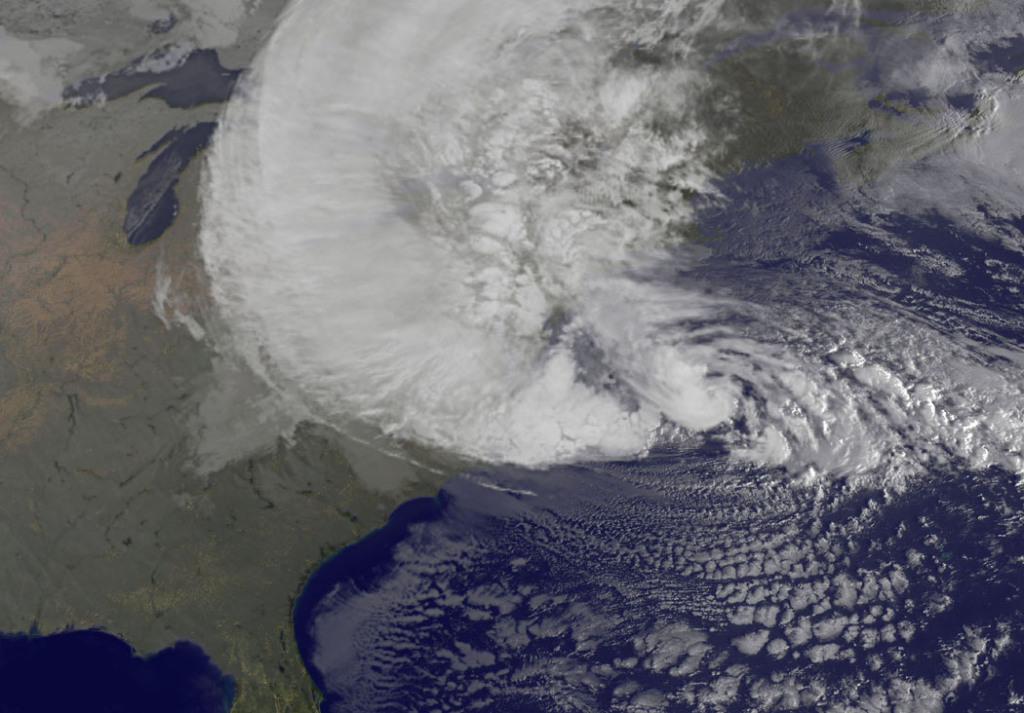
Hurricane Sandy satellite photo as it hit New Jersey
Hello all, and excuse my absence of late! If you hadn’t heard (ha!), Hurricane/ Superstorm Sandy hit the eastern coast of the United States, and headed straight for the state of New Jersey in particular. That means it hit where I live.
I initially started to write this while I was sitting in my car, writing on my iPad while my iPhone was getting recharged using the car battery, but I’m finishing it up on my laptop almost a week later. Hurricane Sandy hit my home, and we were without power for almost four days. A tree fell on our house, but fortunately not through the roof. There was a state of emergency in my town for a couple of days whereby no one was allowed in or out of town. Unless you were emergency personnel, you were not allowed to drive the streets. While we were lucky to get power within a few days (especially with very cold weather setting in), there are still thousands without power where I live, and even those who have lost their homes entirely. I was actually one of the lucky ones. So, you can understand why I might have had other things going on this week. 😉
My house the day before the storm.
Originally, I really struggled with an idea of what to write about this week, but this hurricane made some things very clear, and they are things that needs to be strengthened as a global necessity, not just as a local necessity. This storm made the following very evident to me: mobile technology and social media are critical in this day and age.
I only knew what was happening in the “outside world” and was able to make connections with my cell phone–a smartphone. Granted, the 4G network was incredibly slow, especially in the beginning, because everyone locally was doing the same thing. Something was better than nothing. Since I didn’t have power for my TV or radios, my phone was everything. It made me wish I had a MySpot mobile wifi connection created from my cell phone so that I could transmit the wifi signal to my other devices, but having at least the 4G did the job.
My house after the storm.
In the end, everyone who knows us had a way of knowing that we were okay. Between my husband and I, we texted my brother-in-law, my father-in-law in Ecuador was able to call my husband, and I had sent notes on Twitter and Facebook to let people know we were okay. There wasn’t much more that I could do. Until we had full power and Internet capabilities, I could only recharge my phone on a car recharger and send out the occasional note to update our status on social media. Saving battery life was essential to make sure that we could always be able to communicate. So writing up a blog entry was less important than making sure that our loved ones knew what was going on around us.
We were without electrical power for almost four days, and they were four of the longest days and nights I can remember. You have to remember that I live in a first-world country, where having constant supplies of electricity not only for powering things is commonplace, but it also runs things needed for basic survival, such as keeping perishable foods cold, and providing heat on cold nights (and we had some very cold nights). At my house, having had some Scouting training (I was a den leader for my son’s Cub Scout group for almost 5 years), and just even having a fireplace, we had some advantage. We had done some preparation so it wasn’t so terrible–just terribly inconvenient. There are others, such as my sister, who didn’t have power for more than a week. (She stayed with my parents who had power restored quickly.) There are still work crews from all over the Eastern Seaboard and the MidWest who have come in and have worked around the clock, and continue to do so to still get the rest of New Jersey power again. It is still not done. We’ve become a society that is dependent on its electricity, for sure. But we also have become a society that mostly depends on the power of internet connectivity and having means of communication powered by electricity.
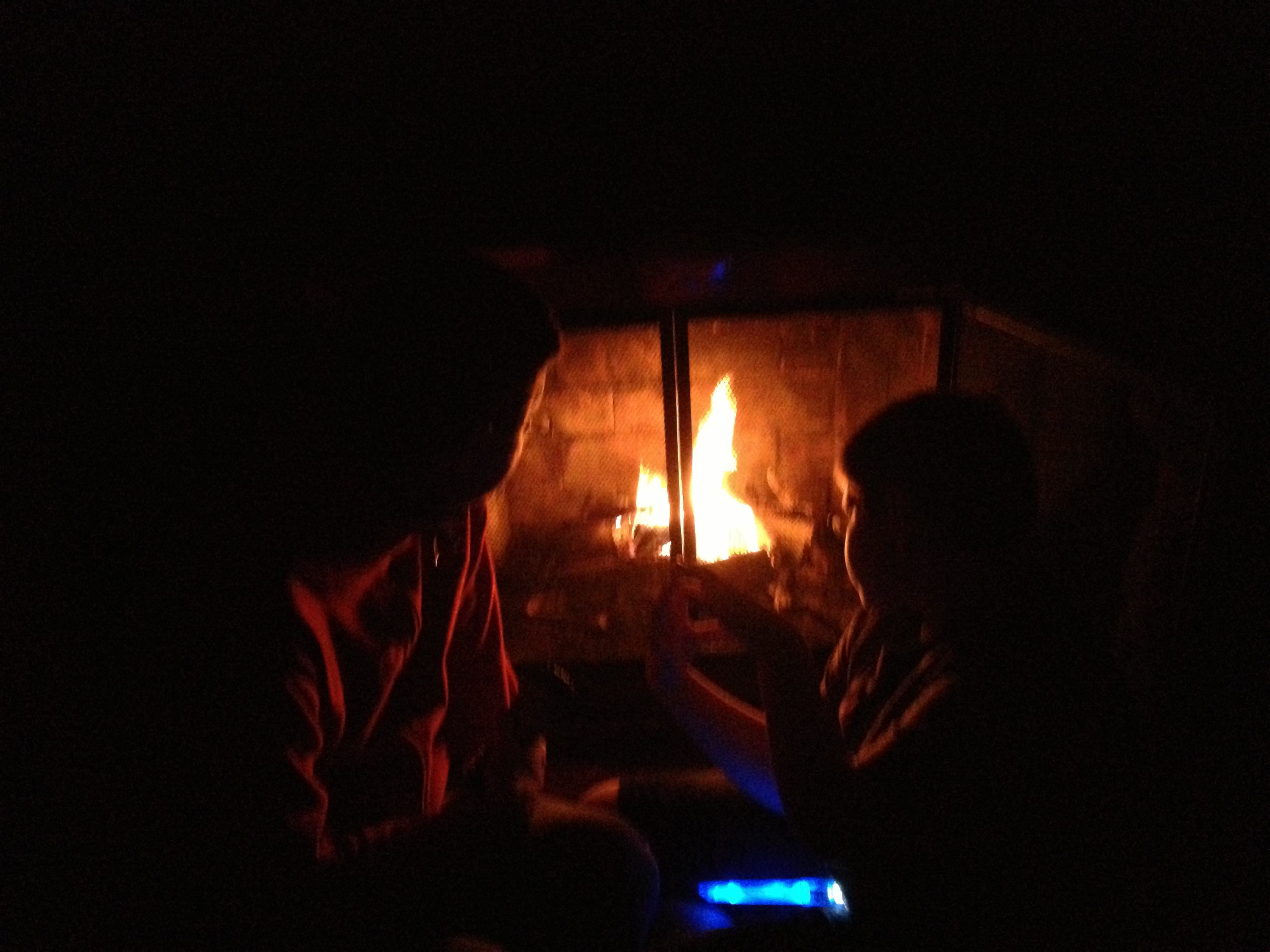
My husband and son keeping warm by our fireplace while we had no power.
Every day that we’ve had with power since it’s been restored, I’ve tried to remind myself about the many people in my state who have lost their homes and/or still don’t have power. I was greatly inconvenienced, but in the end, even with the tree falling on my house, I was still blessed and one of the lucky ones. My town, overall, didn’t sustain the kind of damage that other towns did. The big pond/lake and our town was drained before the storm in order to prevent flooding, and that worked. We didn’t have the water damage or flooding that other places did. Most of the damage we had was due to wind damage, so there were a lot of downed trees that took down power lines. Once trees began to be removed, and crews fixed the wires, then things started to get back in order. As I write this, there is still gas rationing in part of the state, which people need for their cars or even for generators to power their houses until regular service is restored. We’re not quite back to “normal,” but we are fairly close. Schools are starting to open back up for classes tomorrow after a week’s absence, many are returning to work, and shops are opening up again. New Jerseyans may have never been through something like this, but we are a resilient group of people. There is an expression that was often said well before the storm of “Jersey Strong.” That, we are.
But during this storm and its aftermath, I’ve had a lot of time to think about the importance of mobile technology and social media. Through SO much of the storm, my mobile phone was my lifeline to the outside world. Not only could we tell people that we were okay, but if we had been in serious trouble, it was our lifeline out. We would get messages and updates from friends and other resources through our phones. Was the storm over? I could track the storm either through the Hurricane Red Cross app or the Weather Channel app. Was it safe to go out? I’d receive text messages and emails from my town government to let us know what roads were blocked due to downed trees or wires. Where were there shelters if we needed heat, a warm shower and a solid meal? I could find that out as well. What markets had reopened after the storm for food, which gas stations were open with shorter lines, and where could we recharge our devices so we could continue to stay in touch and know what the news was? Different friends who had ventured out told me through social media. Having mobile devices and connectivity made knowing all that information possible. When we needed to have the tree removed from where it was leaning on our house, my husband called up our local tree guy, and his crew was out the very next day. And in a totally 21st century way, having mobile devices kept us entertained at night, as I had loaded up some old episodes of our favorite television programs on my old iPad for my son, and on the new iPad for me. (During the day, we’d be cleaning up our yard and doing other things that would take advantage of the daylight.) Without these modern technological conveniences, it would have been a lot more difficult to get through those days.
But it also got me to thinking about how that technology could have been even better, and where greater improvements could be made. Two things from the technological side were apparent to me. First, connectivity could be improved on a global level, not just at a local level. More communications infrastructure and stronger communications infrastructure are needed to create reliable wireless hotspots. While 4G connectivity was available, it was spotty, and not always reliable during the storm. My husband does not have 4G on his phone, although I have it, so we were solely dependent on my phone for information. A secondary but equally important problem was, however, that using 4G exclusively drained the battery of my phone quickly, especially when the 4G service was very slow. In a stressful and possibly dangerous situation like this storm, that’s a bad thing. I know there are several cities that have wifi service throughout the town, such as Philadelphia. We have many wifi hotspots, but they are not well connected between them, and they don’t reach to households around here. I found, once we had power and connectivity restored, that wifi connectivity on my phone or other mobile devices did not devour battery power on my mobile devices as much as the 4G did.
I started to think of places far, far away from me–and realized this is a global need. How are children in remote places supposed to get electrical power, more specifically battery power for a smart device? And even if there are miraculous power sources for these devices (which there are not at this time, especially in certain regions of the world), how would these children connect to the rest of the world? Both improving battery life/power sources for mobile devices and improving the infrastructure for internet communication are key. It all needs to be set up in such a way that it doesn’t cost a fortune, is readily accessible, and can literally weather anything. It should be similar to using a radio–we can still get AM and FM signals, but we need a wifi version of this. I know that the network services in our area, especially AT & T and Verizon, said they were doing their best to provide and repair the 4G and LTE services damaged from the storm. Okay, I understand that. But in the US, as well as everywhere else globally, we need to start thinking about how to step up the technology so that getting wifi signals are as common as getting an FM signal on a radio. I’m sure that this is technology that is being worked on, but I feel like this storm proved that point very much. Perhaps the internet access providers needed to get ready for the storm by temporarily increasing the network bandwidth and boosting those wifi signals already present. I’m sure that I will be charged an arm and a leg for the amount of data I did use during this time, and the provider companies won’t be giving any storm discounts of any kind under the circumstances.
The other thing that became highly apparent was the importance of social media during this time. It was one thing to receive text messages and emails from my local government (I signed up for emergency messages), loved ones and friends, and to have access to a tiny web browser on my phone, but social media, especially Facebook and Twitter were essential! It was an easy way for me to check in with everyone who needed to know how my family was doing, but also for me to know how all my friends and family were faring as well. Even now, those family members and friends who are still without power are posting status updates letting us know that they are safe, with family or friends with power, or if they are toughing out another cold night. As I mentioned earlier, it was through social media venues that I could see the scale of the storm, through various messages posted on a continual basis. We found out that our local supermarkets were open through Facebook with fresh food, warm place to stop, and outlets to recharge our devices. It allowed communities to come together–multiple communities–to help each other. As I write this, it continues to be working. Posts on Twitter and Facebook are still working to gather supplies for those who are in more trouble than us, provide information for those who seek a safe shelter until their home is habitable again, and moral support, too, for each other. The power of social media is incredible.
When I took my social media class last spring, there were several purpose categories in which social media communications fell, namely broadcasting the self, the netizen, participatory culture, or how social media related to work/labor. To me, there were instances were all these purposes were used during this storm. Social media users broadcast about themselves, providing status updates on their well-being. The netizens were the local governments and other information providers such as internet news agencies, or even Twitter feeds of local government leaders (like Newark mayor Cory Booker) who kept apprised of his city’s situation by staying in constant contact through Twitter to help citizens who had extra needs. All social media users who got through the storm were part of a participatory culture, namely, they were part of the group of “storm survivors” that grouped together. It related to work because we could see how the power companies and other service companies were keeping their customers informed about the progress they were making with restoring power, and would ask customers for feedback on which areas needed more help. Even if one barely posted anywhere on any social media outlet, one could easily understand the breadth and width of this storm’s impact merely by reading the feeds coming from these outlets. I had more information that my husband at any given time because I was looking at all of this and absorbing it, whether it was for personal safety or just for information. It was invaluable, and truly emphasized the importance of social media not only now, but going forward.
Mobile technology and social media were essential in helping my family get through this storm, and it benefitted millions of others through this storm as well. Both of these things continue to be vital as the job is not done in recovering from the storm.
As technical communicators, I think you can see my point, but there is yet another point in which technical communicators are vital in pushing our agendas in our field. That is, helping to provide concise, cogent, correct, and clear information for our end users. One of the problems that I encountered with various apps and communications was that they were so poorly written and explained that sometimes it was difficult to understand the information being provided. This is part of why social media was so vital–there was more of a conversation among users to clarify what a website said, or what a communication said. So many who were providing the information were clearly not writers or natural communicators, and this in itself could be dangerous in certain situations. I’m hoping as we recover from Hurricane/Superstorm Sandy, as a technical communicator, I can try to push the agenda that experienced social media writers and technical writers are needed so that information is provided in a clear way that all people can access it easily, whether there’s an emergency or not.
I hope that technologists are working to make the means of communication stronger with stronger internet connectivity that doesn’t require much power, and that smart devices available can have stronger battery power so that recharging as often isn’t necessary, especially when needing to rely on those communication networks for information. I think social media has proven itself as a strong communication tool during this storm, and it has reinforced the notion to me that I need to continue to stay tied to it, because it’s not only connected to my career livelihood, but my livelihood at large.
Right now, I just have to try to recover and try to get life back to “normal.” Appreciating mobile technology and the power of social media make me glad to live during a time when we have these available to us. Now, I need to get back into the swing of being more technologically immersed after being mostly “off the grid” for almost a week.

 2012 has been the inaugural year of TechCommGeekMom.com. What started initially as both a class project as well as a personal project with no expectations other than to get a good grade and have a form of expression has blossomed into something else. Who would have guessed? I’ve been blessed that I’ve gained a lot of support over the past nine months that I’ve been writing TechCommGeekMom. Evidently, the combination of both my original posts as well as my curated posts are seen as worthwhile reading! I truly appreciate the support.







 TechCommGeekMom
You must be logged in to post a comment.