What? You say this Adobe Workshop is free? Then I reckon I oughta sign up now….
While I was unable to go to the STC Summit last year, I am looking forward to going to Anaheim this year to not only being a presenter at the STC Summit, but also to learn and connect with other technical communicators again!
I realized that one of the events I’ve always liked attending is the Adobe pre-conference event. They always have great information to share. However–what’s this? No Adobe Day this year? Nope. But wait…there’s something better.
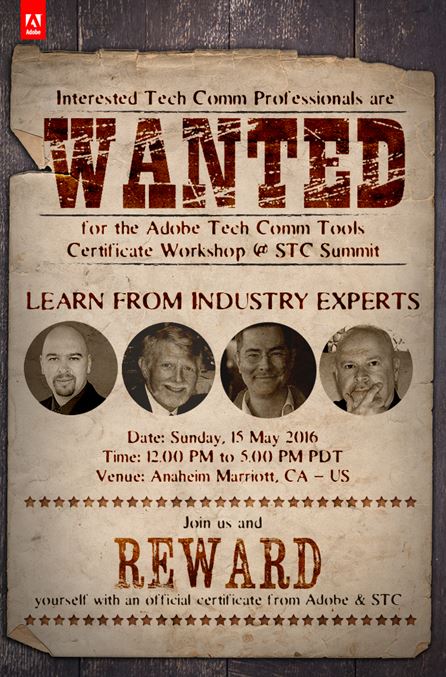
(Click on the wanted poster for more information)
That’s right! Saddle up, and gain some skills through this FREE Adobe Tech Comm Tools Workshop! This looks like a great event, cowboys and cowgirls! There are industry leaders leading the workshop, you earn a certificate for participating (which you can include on your resume, it’s that good), and lunch and snacks are included in the afternoon. And did I mention it’s free? Who says you can’t get a free lunch AND a free certificate? Evidently not Adobe!
Oh, did I also mention that even if you can’t attend to earn the certificate, you can still follow along on my Twitter feed found at @techcommgeekmom that day, as I’ll be tweeting highlights of the event for all who come to the Twitter corral!
If you don’t comply, you can’t register. But these are easy terms to deal with, Sheriff.
Now, there are some caveats in registering, namely that you have to bring your laptop, and download the Adobe Tech Comm Suite Release 2015 Trial Version (if you don’t already have the full version). Other than that, it should be like riding into the sunset.
This is a great opportunity for those who would like to either get to know the Tech Comm Suite better, or brush up on some skills. Space is limited so you should register as soon as possible to get your seat on this great event!
(My apologies to those who are more sci-fi savvy for mixing my space westerns together. Firefly and Cowboys and Aliens were the first things I thought of!)
Rey and BB-8 are trying to find their way, too, in 2016.
While I’ve reviewed what’s happened in 2015 in my recent posts, it’s time for me to look ahead, and see what I need to plan for this year.
I admit that last year, I had big plans. I knew that I wanted to sample some new conferences so that I could have some new experiences and meet new people. I also knew that I wanted to try to launch my own consulting company. Additionally, I knew I needed to learn something new to enhance my skills. I achieved all these goals on some level, so that’s good. However, it’s more difficult this year. If last year was a transitional year, this seems to be more of a transitional year than before. Last year, I had some direction on what I wanted–and needed–to do. This year, I really don’t know where to go, and that’s problematic.
While I earned a mini-MBA in digital marketing last year, I don’t feel strong enough to take on a content marketing job. I could certainly try, but most of the job listings need someone with a stronger marketing background than a digital background. While I understand marketing concepts, my experience fails me on that front. I’m open to taking more coursework in something to enhance my job seeking opportunities, but…in what? Two avenues that I’ve considered is learning more about Agile/Scrum, and the other is looking at getting a certificate in localization practices. I think both would be beneficial, and are things that I’m interested in, but I don’t know how much they would actually help me in the job market where I’m at. I’ve thought about getting some coursework in project management–which is what originally brought me into the IT world almost 20 years ago. Project Management has morphed quite a bit since that time. I’ve also thought about learning more about either WordPress or AEM development, which I think would be good, but I’m not sure where to find the right education for that, or know if I’m up to it, since I’m not really a developer. I’m not sure if any of these are the right direction, either.
I launched my company, but I’ve hardly gotten it off the ground. Part of the problem is that I know I need to focus on what I’m best at, and figure out what I can offer that other consultants can’t. I’m not sure what that is quite yet. I think I have a lot to offer, but honing into what makes me special, unique, and valuable to a client is much harder to define, especially when you are trying to figure it out about yourself. I also need to figure out how to find clients–that’s important, too! If I can get that off the ground more, I’d love that. I’m open to any part-time or full-time projects–even being the sub-contractor for someone else. I’m very open to remote possibilities. I don’t know where the opportunities lie. I know they are out there, but I don’t know how to tap into it.
I’d like to continue trying out new conferences, and perhaps go back to some that I’ve already attended in the past. I’m already set to attend the STC Summit this year, as I’ll be a workshop speaker. I’ll also be attending the STC-PMC Conduit conference–for the first time strictly as an attendee, and not a speaker! But other conferences? A lot of it has to do with time and money. Money is something I don’t have a lot of, and time–well, I don’t know what my time is going to look like a few months from now, let alone later this year. Perhaps I’ll go to the IEEE ProComm which will be in Austin, Texas in the Fall. I’m not sure yet. I thought about going to the Big Design conference in Quito, Ecuador (I heard it’s going to be great, and an opportunity for me to visit cousins-in-law at the same time), but it’s very close to the STC Summit, so I don’t know if I can swing two conferences so close to each other time-wise or financially.
I think the biggest issue, as you can sense here, is that I feel direction-less. It’s almost a dilemma between having too many choices and not enough choices. It’s one of those times that I wish I was a kid again, and someone could see through the clouds better than I could, and help point me in the right direction. But alas, I don’t have such a luxury. I have to figure this out for myself.
You can see that I have ideas, and I’m open to suggestions, but there are too many unknown factors this year that prevent me from committing to anything right now. I don’t know what direction my career is going in right now. Last year was the year that I thought I would turn things around and start in a new direction, and it would be a clear path. I think I had some good ideas last year–and they were, and I could try to continue with them, but I’m not sure how to do that.
So where do I go from this point? As I said, I’m certainly open to suggestions or leads. I have a concept in my head of where I want to go, what I want to do, but I don’t know how to get there. There are no Google Maps to take me there. If you have felt like you didn’t have any direction in your career before proceeding towards next steps, what did you to break out of that rut?
Include your comments below, as I’d really like to hear about some ideas that might benefit me, but could also help others who are facing the same dilemma as I am.
General Leia says, “Don’t worry, kid. You’ll figure it out. The Force is strong with you, Padawan.”
This is not to say I’m not optimistic about this year. I will say that over the past several years, I’m glad that I’ve built a great support network professionally around me who can certainly lift me when I’m down, and I’m grateful for that. Also, who’s to say that I have to set out any goals right now? When I decided to lose weight and get healthy, I didn’t make the plan in January, but rather in May or June of that year. Who’s to say that I won’t have this figured out a little better in a few months? Time will tell, but for now, I’m hoping the Force will provide me with some direction….
Florence and The Machine think that TechCommGeekMom’s Top of the Pops 2015 is smashing. (Source: telegraph.co.uk)
I always find it interesting to see what stories people end up gravitating to each year on TechCommGeekMom, and along with other year-end summaries, I like to figure out what were the most popular blog posts for a given year. Sometimes, it’s something that’s archived from an earlier year. That’s good, because I try to write or post things that will have long-term relevance as often as possible. However, I’m usually interested in what was written THIS year that came out to be the most popular of all original information posted that wasn’t an archived post or a curated topic posted.
What’s interesting to observe from a statistical perspective is that the top three almost tied for first place–#1 has one more view than the next two, which are tied.
I’m also pleased to see that most of my most popular posts this year were ones that came from the heart, based on personal experiences or observations. I’ve often argued that social media is a medium in which people discussed things and could more closely relate to each other because there is the ability to have more personal experiences and have the opportunity to connect and respond. The fact that many of these top blog posts relating to my job woes, trying to provide DIY training for myself, and trying to take positive steps towards the continual advancing of my career are relatable topics–that I’m not the only one going through these feelings and experiences. I almost always try to open up conversations with my blogs–for better or worse–and the reflection of the top original posts for 2015 reflect that.
The last one I listed was something personal that I wanted to include. This showed a big part of my weight loss and self-improvement journey I’m on right now. I’m still on that journey, having made a bold move in the last few weeks (something that I may write about soon, but not yet). I was glad to see that truly personal topics matters, and that even when relating it to something in technical communications, people responded positively towards it. My weight loss journey is a deeply personal one, and something that I don’t have to share, but I do, simply because I think all of us can relate to a non-tech comm struggle like that easily.
What will 2016 bring? Stay tuned…plans, resolutions, and predictions coming soon!
“What kind of training is this?” “COMPLIANCE TRAINING, SIR!” (Boom-chaka-laka, boom-chaka-laka, boom-chaka-laka, boom!)
I’ve recently taken on a new “adventure” working for a large pharmaceutical company. Now, I’ve worked for pharmaceutical companies before, but it’s been more than 20 years since my last job in the industry. One of the things I’ve been getting bombarded with in the past few weeks is that I have to do a lot of compliance training. This is not the first time I’ve had to do compliance training.
In the last two full-time positions I held, I had to do compliance training in the finance and chemical safety fields, even though my position had nothing to do with the everyday responsibilities of creating and handling chemicals, or handling financial transactions of any kind. But, because of strict regulatory rules on the international, federal, and state levels, I have to do this training. It’s the same with the pharmaceutical field, since that’s yet another highly regulated field.
Now, I will say this much–because of the work that I’ve been hired to do, there actually were several pieces of the compliance courses that applied to me, so that was fine. No matter where you go, especially if you work for a very large corporation, whether you are an employee or contingent worker/consultant (which I always am the latter), you still have to take all these compliance courses regardless of your position in the company to comply with all these regulatory groups. It’s just par for the course.
The information is usually incredibly dry, boring, and lifeless information–at least for me. It’s usually just a course that covers various policies, and you have to pass some sort of quiz to “certify” and help the company be in compliance with these regulatory rules. The courses are usually (but not always, as I’ll explain in a moment) a flat narrative that’s done in Captivate or Articulate, with small little quizzes in between to help you review and retain the information for the final test at the end. Considering that the information is usually so boring, and you may have several hours of it ahead, I usually don’t mind this training because usually there’s a narrator reading the information while showing some images relating to the topic, and it makes it easier for me to remember so I can pass the test.
After having already done four hours of compliance training and passing the test with a 97% (I missed one question) during my first week, I was given additional training that had to be done in the next few days. Of the nine courses I was given to do, only one was an Articulate course (I know it was because the server name in the URL said “articulate.com” in it), and that one made sense, and definitely applied to me.
However, the other eight courses I was given weren’t really courses at all. Since these “courses” were all handled on an LMS (learning management system), I thought I’d be jumping into legitimate courses. I was sadly mistaken. Each of these “courses” was simply the SOP (standard of procedure) policy document that I was expected to read in depth. All these documents were not written in plain English in a user-friendly format. They all were in legal-ese or pharma-talk–or both. This made the process of reading them a little harder for me to digest. Additionally, while there were only two or three documents that were less than ten pages, most were well over twenty pages–even over thirty pages for one or two of the documents. Some documents had a summary at the end, to which I thought, “Why didn’t they just show this at the beginning of the document? Then the rest of it would’ve made sense!” But most did not. With all of these eight documents, there wasn’t any kind of assessment to see if I understood the material. I just had to provide an electronic signature at the end that I read the material.
While I did my best to diligently read the material, it was much worse than dealing with the boring interactive courses. And other than me signing something electronically to say that I had, indeed, read the material, there was no way for the company to know if I understood it. Much of this could’ve easily been short Captivate/Articulate courses that would have not only made the information a tiny bit more interesting, but also there could be a way to assess that there was some semblance of comprehension.
Somewhere along the line, I had read later that in some instances, companies are in compliance as long as they have a policy and that each worker has read the policy and signed off that they read the policy. That sounds easy enough–read the material, and sign that you read it, and you’re done. But is that right?
I thought about this a lot after I finished this second round of compliance training, because reading almost 130 pages of technical jibberish on mostly common sense policies wore me out. I also felt that something was terribly wrong about this procedure. I might not have ended up doing instructional design as I originally set out to do when I started in tech comm (see early posts of TechCommGeekMom), but there were circumstances that bothered me about training employees this way, especially if they had to adhere to regulatory compliance training.
The first thing that came to my head was that as bothersome and boring as they were (sorry, instructional designers), the interactive courses were better. Students could see examples more clearly from images, for example. Or, in my case, seeing images, reading words, and hearing a voice read the technical gobbledygook connected with me better than reading pages and pages and pages of long-winded text. I partially blame my own abilities to learn this way because of my own learning disabilities, but at the same time–am I alone? I’m sure there are some out there who would rather read lots of text to understand information, but I have found that adding multimedia has always made a difference in learning.
I started to wonder if I was an anomaly in finding that I learn better this way. I know there are entire books, courses, and university degrees dedicated to this topic–what’s the best way to teach an adult? Is it any different than teaching a child or youth? Is reading text better than e-learning instances? Is reading text better than having an interactive, multimedia experience? In the case of the documents, I found that I was easily bored by the material to the point that I was more easily distracted, making me only skim the pages rather than read them in great detail after a while–especially with the thirty-page documents. It’s good that the company has policies on specific topics that are available for employees to read, but can employees easily relate to the policy information? How can we ensure that? Is just having them read the policy enough?
To say the least, I was rather disappointed with this method of training of reading text and electronically signing that I completed the reading. My own studies in e-learning made me realize how we are lucky to live in an age where we can make use of voice, images, video, and other multimedia tools that can help enhance the learning process, and in effect, allow learners to better retain the information by making it more relatable–even the boring, compliance information. I’ll bet that I still retain some of the information about financial transaction handling and chemical safety in the inner recesses of my brain because of interactive training. I remember much of what I just learned about drug safety and marketing compliance from my initial training. But what was in those documents. Don’t remember. Not a clue. I think much of it was the same as the stuff in the original compliance training, which also made me question why I had to do it again when I passed that original training. But was reading text and signing effective training? No. Did it fulfill compliance rules? Yes.
Whether it’s this company I’m at, or other companies, having workers understand regulatory compliance policies is important. They are procedures that keep us safe physically and ethically to ensure the best standards for all. So why not take the time to ensure that ALL policies that you feel are important are delivered in a way that helps to insure that employees understand ALL the information? That just seems like common sense to me.
What do you think? What are your experiences with these types of corporate or compliance training? What kind of learning worked best for you? Should companies put a good effort to make all the learning more learning-accessible? Add your comments below!
The farmer and the cowman–I mean, the academian and the practitioner should be friends…
I attended the IEEE ProComm at the University of Limerick, in Limerick, Ireland last week. I was absolutely gobsmacked months ago when a presentation proposal I sent in for this conference was actually accepted. I figured, why not? I’m always looking to expand my tech comm circle, so I had hoped that this would help in this endeavour. I made some great new connections, and I was glad for that, and I certainly enjoyed the sessions I attended.
One thing that was very different about this conference, unlike the other tech comm conferences I’ve attended thusfar, was that this particular conference focused more on the academic side of tech comm. I found out, through inquiry, that while all were invited to this conference, there was definitely a very strong bent toward academia. There is nothing wrong with that, but the depth of this academic frame of mind is not something I’ve dealt with since I graduated from NJIT three years ago. I understand that academia has its own rules and ways of doing things, but it was definitely…different. Not in a bad way, but different.
Up until this point, I had attended what I’ll call “practitioner” conferences. I’ve chose the word “practitioner” rather than “professional” because in the end, we’re all professionals at what we do in the technical communications, whether we teach and do research, or are out in the corporate world making things happen. Thus those out there in the corporate world I’m choosing to call practitioners. Some practitioners do teach, and some academians do corporate work, but they don’t always overlap. I wanted to clarify this before I move on with my narrative here…
Anyway, as I started to say, up until this point, I had attended conferences that had a stronger practitioner’s bent to them. Most speakers would be people who had been out there battling it out in the corporate masses, and sharing their experiences and knowledge attained from those experiences with others. I often attribute the fact that I got my last job with BASF because of information that learned through one of these practitioner events, because it was something that the company could use beyond analytical theories. Speakers at these practitioner conferences are those who are in the trenches every day, putting to practice all those theories about content strategy, revising them, applying them to businesses globally.
So, attending a mostly academic conference like the IEEE ProComm was a bit eye-opening. Many of the talks were summaries of research that had been done on a variety of topics, and peer reviewed, which was all well and good. I found that the sessions that I could connect best to were the ones that were given by practitioners, practitioners who were also academians, or academians who had a foothold as consultants outside of the academy. There were plenty of sessions whose topics were relevant to the corporate world, but they failed to deliver completely on something new or to provide any revelations to me. There were also summary sessions that provided research conclusions which were incorrect or inaccurate from practitioner perspectives, or elicited the feeling of “…and why are you researching this topic again, and what is its relevency?”
I spent a good part of my time networking with people who happened to be practitioners studying for advanced degrees or had an advanced degree. I particularly connected with one woman who happened to come out of the same NJIT program that I did. (We weren’t classmates, as she started the semester after I graduated, but we knew or had many of the same professors.) She’s been a practitioner much longer than I have, and as she had recently graduated from the NJIT program. NJIT people rarely attend these conferences, so if we do find each other, we tend to flock together a bit. She and I spent a lot of time comparing notes from our experiences and concerns that we had not only about our own program, but other programs as well.
The main gist of our conclusions was that this disparity between the academy and those in practice was discouraging. We both felt that while there were several technical communications programs that did help with job placement and practical experience while still in the studying process, not enough were. Additionally, some of the information that was being given to students about the realities of working in tech comm weren’t accurate or up to date. This is a disservice to both those who do research and especially to students who have to go out in the “real world”. In order to not make it sound like I’m placing any blame on academia alone, practitioners also have a responsibility to be active in helping to groom future technical communicators as well. My NJIT colleague and I talked about we might be the first two members of an alumni advisory committee that we’d like to start (of course, NJIT doesn’t know this yet), because we felt that we could bring back our experiences either as instructors or merely as advisors to help professors and students keep up to speed with what’s happening outside the virtual or literal campus walls.
Now, in saying all this, I don’t mean to step on ANYONE’s toes in this discourse. Far from it! While I’m sure you can tell that I lean on the side of being a practitioner, this doesn’t mean that I don’t understand the academic side at all. I’ve been there. I’ve taught, too. However, there were just too many conversations in which I wanted to say to a few professors that only teach and do research, “REALLY?? Are you serious?”, knowing well that they were serious. I understand that many universities also have a hard rule about the need to do publish and research to keep one’s professorial job, so that can’t be easy to balance all of it.
Aunt Eller meant business when she had to “encourage” everyone to get along.
When I first started meeting people at the ProComm conference, they assured me, as a first-time attendee, that this was a friendly group and it was easy to get to know others. This proved to be true. Just like the STC Summit and other conferences I have attended, the people were friendly, helpful, intelligent, and eager to “talk shop” with each other. I welcolmed that, and have found that these sentiments seem to be universal with all technical communicators. However, as time went by, that difference and angst between the academians and practitioners, while mild, was still palpable. The entire conference, I had a song running through my head from the American musical, “Oklahoma” called, “The Farmer and The Cowman (Territory Folk)”. (If you haven’t seen the musical before, you can watch the YouTube video of the song.) Essentially, the message of the song is that the two groups really had the same interests at hand in the end, and they needed to learn to cooperate more to make the goal of being the new state of Oklahoma work. I’m hoping that my role in this, on some level by opening up this conversation, is that I play the role of Aunt Eller from the same musical. She gives the advice at the end of this song by singing,
I’d teach you all a little sayin’
and learn the words by heart the way you should,
I don’t say that I’m no better than anybody else,
but I’ll be danged if I ain’t just as good!
😉
The Living Bridge at the University of Limerick. Looks like a good place to start.
While I don’t think our difference as as strong as the farmers or the cowmen of Oklahoma, I’d like to think that we can come together much more easily and bridge that chasm more quickly and completely. We all have the same goal, after all–to continue to make technical communications a top notch field and create superior technical communicators. How can we go wrong with a goal like that?
My own view is that more needs to be done to connect academia with practitioners. I know that the STC-PMC, for example, has been very active in the past year working with technical writing students at Drexel University in Philadelphia. They are always looking for more local schools to connect with. I’m sure there are other outreach programs out there, but how many exactly, whether it’s through STC or IEEE or any other professional group out there? I know that I’m going to try to reach out to my own program at NJIT in the next week and see if I can offer any help. What can you do?
What do you think? I know a lot of my readers fall on both sides of this issue, and several straddle both. I’d love to hear what you think, and let’s get the conversation started on this!







 TechCommGeekMom
You must be logged in to post a comment.