Thanks to Madonnalisa Gonzales Chan for posting this on the Content Strategists’ group on Facebook. This is an excellent article that starts to delve into the idea of how one would create UX content to interact with people. As I’ve been working in UX creating some of this style of text (but definitely not anywhere close to this deep), I found this fascinating, and the journey that the author took in exploring this brought up points that I hadn’t thought of, as well as points I could relate to.
What do you think? Where do you see conversational design going as we start to write more content for help, IoT, and other content outputs? Put your comments below.
This was an interesting article, as it talked about just what the title says–making content that was made from content, but was made from previous content to that. The article is really about taking all the information you may already have, and how to break it down and create new content as a means of content strategy. It’s hard for me to explain as cleanly as the author explains it, so I recommend you read this article directly. It’s not really a new approach, but I think it’s another perspective to add when thinking about content creation and curation.
“The actual context and the state of content is going to be so different to anything we can envisage at the moment–where the interplay between user and the provider will be so in simpatico…it’s going to crash our ideas of what mediums are all about.”
–David Bowie, 2000
The world is mourning the loss of an incredible musician and artist who made a huge impact on the world. David Bowie was always thinking outside the box, always changing and adapting his style and music, but was always true to himself–and admired for his boldness in doing so.
One of the things that I always thought was very cool about David Bowie beyond the music, fashion, and Ziggy Stardust makeup was that he was an Internet pioneer. No, really, he was! I remember many years ago reading about how much he was playing and investing in websites and creating content for websites. Some of the websites and content stuck, and some of it didn’t, but Bowie wasn’t afraid to give things a try. The best example I can think of off the top of my head was a children’s music site. Bowie’s daughter is about a year older than my own son, so I thought it was pretty cool that he was curating musical content that was age appropriate for our children, but not so dorky/corny stuff that parents wouldn’t want to listen to it as well. It was an amazing site that closed down later, but it was a significant step towards digital music content as we know it now. He may have done some other experimental sites with music, but I was only tuned into the children’s music at the time.
If you do a search on “David Bowie Internet Pioneer”, you’ll see many articles out there right now telling you more details about his heavy involvement. He knew that the internet was all about CONTENT, and he tried to be one of the earliest content providers.
One of the things that popped up in the many memorials to him was this interview about the role of the Internet and content and the wide possibilities. The interview below was done in the year 2000, just as internet access was starting to become more mainstream (AOL was the big provider at the time, to give you some perspective), and he was SO ahead of his time.
Hopefully, as technical communicators, we can not only learn how to be creative individuals like Bowie was with his music, art, and fashion, but also think beyond our current scope of thinking to what content–not just the arts that he represented, but much more and beyond–can truly be, and have a better understanding of what our relationship to content should be.
My friend, Parth Mukherjee of Jifflenow, created an excellent SlideShare presentation that he shared at the STC India conference while still at Adobe, but shared recently on LinkedIn. While I didn’t attend the conference, he created a great conversation about the role of content in marketing that still applies now, and is highly relatable for technical communicators and digital marketers alike.
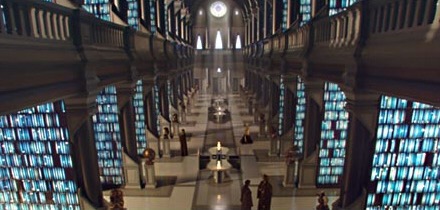
Does this look a little familiar? This is the Jedi Academy Library. Taking from the old to the new, for sure.
One of the first places that I went to during my holiday in Ireland was to University of Dublin, Trinity College. Why would I visit there? Trinity College is a world-famous university the likes of my “hometown” of Princeton or more close by, Oxford or Cambridge. The renowned Book of Kells exhibit is at the college, and part of the tour is the university’s Old Library. When people see photos of the Old Library, they recognize it instantly, and it’s a book lover’s fantasy room with books stacked from floor to ceiling on two floors. Rumor has it that the library of the Jedi Academy in the Star Wars films was based on the look of this library. To see the room in person is truly a sight to see.
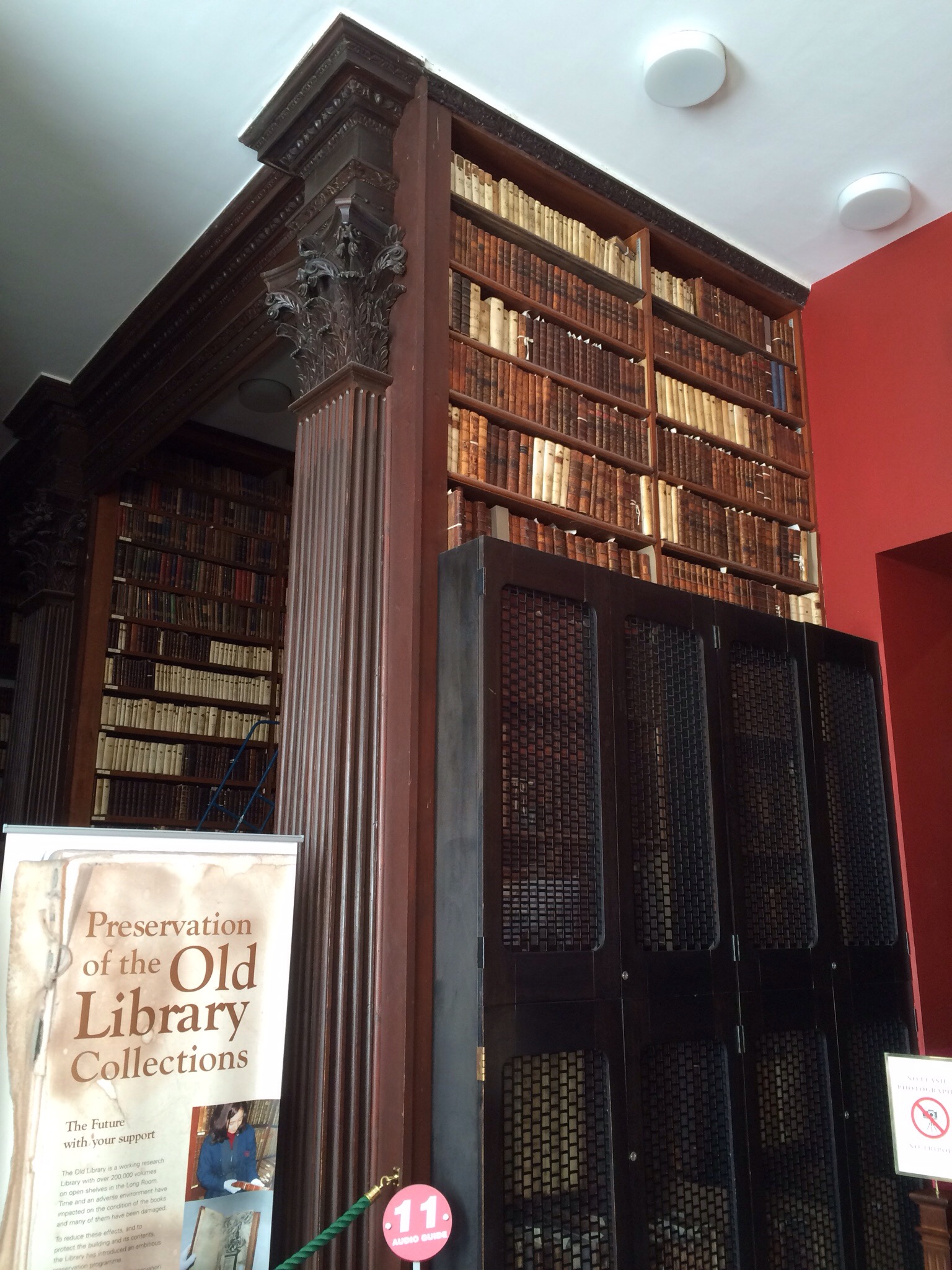
This is just before the entrance of the library.
At the entrance of the library, there were several shelves of dusty books stacked in bookcases that reached to the ceiling, with a sign in front (as seen in the photos) that restoration work was still being done to preserve the library and its contents. To put this photo in perspective, I’m guessing that the door well, which you can barely see from the right corner, is a normal-to-tall door well of about 8 feet tall, and the rope blocking these shelves barely seen on the bottom right is the normal hip height, so the ceiling has to be at least a good 13-14 feet to the top! As you can see, there are even a lot of books here!
Inside the Old Library, looking towards the entrance.
Once in the Old Library itself, I looked at all the old books, marvelling at the sheer enormity of so many books in one place. I wondered how old some of these books were! The historian in me wanted to find cool books to see perspectives from another day and age, and lovingly leaf through pages of an old book. Then the technical communicator in me stepped in and took over my brain. I wondered if anyone could still access and read these books at all. I wondered if any of it had been digitized for current use, because all of the books looked like decorations now. How do we know what books are still in here? Had anyone done an audit? How relevant is any of the information? What is worth keeping in some form, and which items are, as I said before, purely decoration or kept in perpetuity? The historian in my returned in my head, wishing I could head up a restoration project of this kind to digitize every last book in that room. Why, if most likely 99% it is outdated? It’s because in auditing the content, sometimes you find a gem of information or data that has gotten lost in the shuffle, and ends up being a great piece of information that provides the missing piece to a puzzle.
TechCommGeekMom selfie in the Old Library.
In this modern age, this is something I think we need to keep in mind. Content audits are important in a content strategy. You don’t want to include information that isn’t relevant anymore, naturally. That’s a waste of space and the end-reader’s user of time. That’s logical. However, should you throw away all the information once you have deemed it non-usable at this time? I don’t think so. There will come a day when the manual of an old product will be needed to service that item–as an antique, and the manual will be helpful. Understanding our content past, just like any other piece of literature or antique artifact, is a connection to understanding how we have progressed, how we can improve, and where we have made mistakes. It can also provide clues to why we have the content we have now–did someone leave something out in more recent versions that might have been thought to be irrelevant during that edition, but older editions are relevant now? You never know unless you get the entire picture, and see what treasures you may have at your fingertips. They could be the key to success.
What do you think? Is keeping old content–at least, archiving it–a worthy endeavour? Post your comments below.

 I made my website conversational. Here is what I learned.





 TechCommGeekMom
You must be logged in to post a comment.