Since the beginning of the Great Recession in 2007, the history major has lost significant market share in academia, declining from 2.2% of all undergraduate degrees to 1.7%. The graduating class of 2014, the most recent for which there are national data, included 9% fewer history majors than the previous year’s cohort, compounding a 2.8% decrease the year before that. The drop is most pronounced at large research universities and prestigious liberal arts colleges.
This is an article that an acquaintance of mine had posted on Facebook, and it stands to make another positive argument in favor of history majors (like me). I’ve said many times that I was not suited to do a traditional English or Journalism major because I really didn’t want to get bogged down in literature–not that literature is problematic, but it’s not for me. Whereas understanding the finer details of grammar, and doing the research…ah, that’s where a history major’s strengths come into play, and help make better technical communicators.
Read this article, and tell me what you think in the comments below.
Just like the Guardians of the Galaxy, STC members might be a rag-tag bunch, but we get the job done.
I was moved by a series of articles recently written by my friend, Larry Kunz. The most recent of the three, “Why is it so important that the STC survive?” was the first that I read from a series he had recently produced (there are links within the article above that links you to the others). It seems that Larry has struck a nerve with his article, as while he provided some points to support the continuation of the STC, there were counter-arguments in the comments that it’s not the same organization that had some pull in the field in years prior.
As someone who has only been a member of the STC for about four or five years, and is still a relative newcomer to the technical communications field, I find that there is great value in the STC. As Larry pointed out, it’s a group that has become my tribe as well. I have rarely been anything but supported within this group at large. As a new technical communicator at an advanced age, I was welcomed with open arms, which is something I don’t think most groups would necessarily do. Others want the young kids to be joining, or they want to hang out with their professional contemporaries. So, onboarding into this group was easy. That’s a compliment to the group as a whole. I was scared to join a well-established group, and it’s been nothing but good all the way around.
Now, some of the counter-arguments have been that while the STC provides some great networking and other benefits, it boils down to the infrastructure of the association breaking down over time. That might be. My understanding is that several years ago, before I joined, there were some serious financial and “political” issues going on with the STC, both at the international level and the local level. I know for my own chapter, one of our members worked fiercely to keep it up and running during those lean years, and it took time to rebuild it into the Platinum community that it is today. It was also argued that other conferences that didn’t exist decades ago are now starting to take over.
Here are some of my thoughts about the whole thing:
First, there needs to be an analysis of what these other conferences are offering that the STC is not. Why are people flocking to these other conferences? What do they offer than the STC does not? Are they truly taking away from the STC, or appealing to a different group? I’ve been to a few of these conferences, and they are a little different, but they are usually more specialized–like focusing on content strategy, whereas the STC tries to embrace a broader audience and more topics. Lavacon and Information Development World, for example, do concentrate on content strategy and content marketing, yet there is more to technical communication than just topics. There is UX/UI design, there is technical writing, there is social media, there is e-learning…there are a lot of things that are covered under the umbrella of technical communication. I’m sure that the Summit program committee does its best to appeal to as wide an audience as possible, and they also offer accessible presentations for all experience levels. The STC Summit was also compared to TCWorld in Europe. While TCWorld might be bigger, it’s also drawing in a different audience. What is drawing people to that? Perhaps we need to figure out what they are offering that the STC is not, and start figuring out how to compensate.
Second, speaking of accessibility, I have found that some of the specialized conferences I’ve attended were over my head. They were so specialized and high level, marketing towards the managers and experienced practitioners, that as a relative newbie I had difficulty keeping up with the presentations. Does this mean I’m stupid? I hope not, although when I walk out of them, I feel like it. One of the benefits of the STC Summit, to me, is that it while it doesn’t “dumb down” presentations, it does offer information that’s more palatable for beginners and intermediates like myself while helping those who’ve been in the industry for a long time learn how to keep up with new technologies and ways of doing things.
Third, the technical communications industry is going through big changes right now. As was mentioned in Larry’s articles, some of these other conferences didn’t exist twenty years ago. Do you know what else didn’t exist twenty years ago? Much of what we do today in technical communication! Yes, we still have technical writing, but back then, it was still mostly paper-based documentation. (I know because many of my positions since then has been converting paper processes to web processes.) The Internet has exploded. We barely had web design, let alone responsive design. There were no mobile devices the way we know it now. Video, audio, and 3-D animated images didn’t have to be included in documentation back then. Technology and the way we access information has changed drastically in the last twenty years. Because of this, technical communication has changed, and I wouldn’t be surprised if the STC is still trying to catch up with the changes as best as they can, and again, appeal to as wide an audience as possible. Heck, even within the last five years, there have been huge changes, and it’s a matter of keeping up with it. You’d be surprised to know how many technical communicators still aren’t on board with writing for mobile, even though it’s been on the forefront for the past few years.
Fourth, is it possible that prior generations who aren’t as active in STC now or have left are to blame for not bringing in more members over time? I know that bringing in members now is a big push, but what about during those lean times? Could it be that many members were lost during those years? Also, there isn’t any consistency in recruiting, at least at schools, from my observations. I’m aware of some academic tech comm programs that have great student chapters. My graduate school tried to get a chapter off the ground, but since it was a virtual program, it made it difficult. I can probably count on just a few fingers how many of us are in the STC from my school during the years that I was there. Some were active, some not so much. One of my classmates is a chapter president, and I’m running for office in my chapter. But that’s it. The fact that the STC is reaching out to other associations on the local, national, and international level is encouraging, because many people do belong to more than one association, and it’s a great recruitment tool. But we need to encourage members in the STC to be ambassadors, and continue to promote what the STC stands for.
I’m sure the next point is, “What does the STC stand for?” I don’t know the answer to that. But perhaps that’s the point–as the body of people who represent it, we need to vocalize what our needs are more to the STC main office so that they can better serve our needs and advocate for us. There are still walls to be knocked down in this field, and advances to be made, but they can’t do that from inside their bubble in Fairfax, Virginia. Part of the reason that I’m in the STC is because I live in a bubble, too. There are very few STC people or people who identify themselves as technical communicators in my area. I need STC events to help me meet other tech comm professionals, but also see what’s going on in the tech comm world. Unless the STC office is told what our needs are, it can only do its best at making educated guesses as to how to help us. After all, it is an advocacy group, and that’s what it’s out there to do–advocate for us, and help us get the resources we need to be better technical communicators.
I could go on for pages more, but I think you get the idea. The STC is like a church, in the sense that the church is made of up of the people–the community–and its beliefs, not the building. The STC is made up of many bright, resourceful people, and its survival depends on the support, participation, and belief in the technical communication industry as a community. I chose to get involved with the STC, and while my bandwidth is limited, I am always open to helping others and supporting others in their tech comm endeavors. I wish I could do more, and in time, I will. But rather than criticizing the STC, do something about it! If you feel that not enough emphasis on DITA practices is given in presentations, then tell the STC! If you feel like you’ve heard more than your fill about content marketing (like I have), say something! Don’t sit there and complain about it. Be the change.
What do you think? I suggest reading Larry’s articles first, then mine, then please (respectfully) include your comments below. Be part of the conversation. Perhaps based on the comments, we can draft something to address to Chris Lyons, the CEO of the STC, to help their efforts.
P.S. If it weren’t for the STC Summit, I wouldn’t have actually met Larry Kunz in person for the first time. Larry’s been a fantastic supporter of TechCommGeekMom for a long time via this blog and social media, and it was an opportunity to strengthen our connection by meeting in person at a shared beloved event. I look forward to both of our blogs continuing to provoke conversations within the tech comm community.
There’s a viral video that just came out that I just love, not only because it’s funny, but it appealed to the geek in me. It’s a woman who bought a fun item for her own enjoyment, and was getting a kick out of how funny it was and how it made her laugh. What can I say? The Force was with her:
Watch here:
It’s a contagious video because it’s so silly, and as she said, it’s the simple joys of life that makes it worthwhile. She has so much fun with the mask, and you can’t help but laugh along with her. My husband and I were laughing so hard we had tears in our eyes.
But wait…did you catch that first part of the video? While she had not intended this to be a marketing video, this ended up being a great marketing video with great content. Where did she get that mask? She got it at a department store chain called Kohl’s. And with this video going viral as quickly as it did, Kohl’s picked up on her video and this woman’s love of Star Wars, and essentially got free advertising! Not only that, but they took it a step further:
Kohl’s was smart! They not only picked up on her mention of the store and how she was a frequent customer, but also on how much one random item at the store brought her so much joy. She had provided fantastic content that reflected well on the store! Fortunately for her, they recognized this, and did something nice by giving her all those gifts as a thank you.
Why do you think that Kohl’s did all that? As I said, they realized the value of this social content. It was all in the storytelling. People who love Star Wars items–and there are lots of them–would especially relate to this story. Even people who didn’t like Star Wars would get a good laugh from watch this woman play with her mask. Kohl’s wasn’t selling anything directly by posting these videos. (Although when I played the videos later, I did see some marketing overlays trying to sell the masks at Kohl’s did pop up, but it was still after the fact.) They did show, in showing their appreciation to the woman, that there were lots of other Star Wars things they sold as a means of indirect selling. Kohl’s showed that they appreciated the value of her sharing her good experience not only with finding her mask, but that she wasn’t discouraged because she had to return some items simply because of sizing issues, and she still found something else she liked. They showed the value of a satisfied customer, which has more value than almost any other kind of marketing or advertising. The gifts were even intended, if you think about it, as a way of keeping her as a value customer.
“Chewie, this is content marketing through social media at its best.” “RAWWR!”
This is a great example of the power of social media through content and content marketing. The woman was simply sharing her experiences on video through her Facebook account, the video went viral, and as a result, she received all these gifts from the store itself to ensure that she continues to be a valued customer. Kohl’s found appropriate content from a customer that I’m sure will be helping to boost sales for a bit–at least with the Star Wars merchandise–for a while. I’m sure she never expected the attention that she’s gotten, but due to the Kohl’s gift, she extremely glad she shared it!
You never know where good content will come from. This is a great example to show that it can come from anywhere if you have the opportunity to make it or appreciate it.
What do you think of this event? Include your comments below.
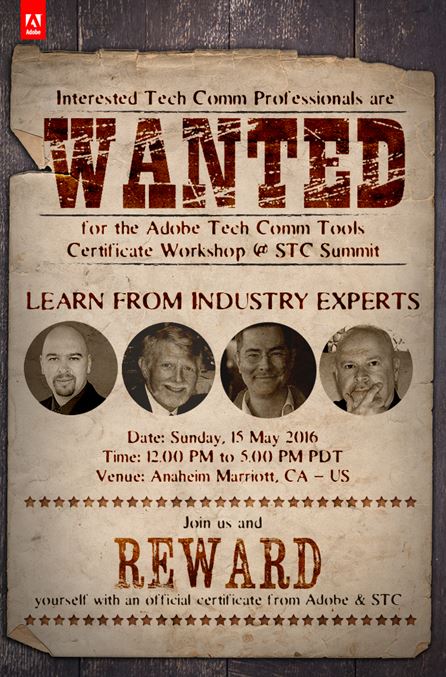
What? You say this Adobe Workshop is free? Then I reckon I oughta sign up now….
While I was unable to go to the STC Summit last year, I am looking forward to going to Anaheim this year to not only being a presenter at the STC Summit, but also to learn and connect with other technical communicators again!
I realized that one of the events I’ve always liked attending is the Adobe pre-conference event. They always have great information to share. However–what’s this? No Adobe Day this year? Nope. But wait…there’s something better.
(Click on the wanted poster for more information)
That’s right! Saddle up, and gain some skills through this FREE Adobe Tech Comm Tools Workshop! This looks like a great event, cowboys and cowgirls! There are industry leaders leading the workshop, you earn a certificate for participating (which you can include on your resume, it’s that good), and lunch and snacks are included in the afternoon. And did I mention it’s free? Who says you can’t get a free lunch AND a free certificate? Evidently not Adobe!
Oh, did I also mention that even if you can’t attend to earn the certificate, you can still follow along on my Twitter feed found at @techcommgeekmom that day, as I’ll be tweeting highlights of the event for all who come to the Twitter corral!
If you don’t comply, you can’t register. But these are easy terms to deal with, Sheriff.
Now, there are some caveats in registering, namely that you have to bring your laptop, and download the Adobe Tech Comm Suite Release 2015 Trial Version (if you don’t already have the full version). Other than that, it should be like riding into the sunset.
This is a great opportunity for those who would like to either get to know the Tech Comm Suite better, or brush up on some skills. Space is limited so you should register as soon as possible to get your seat on this great event!
(My apologies to those who are more sci-fi savvy for mixing my space westerns together. Firefly and Cowboys and Aliens were the first things I thought of!)
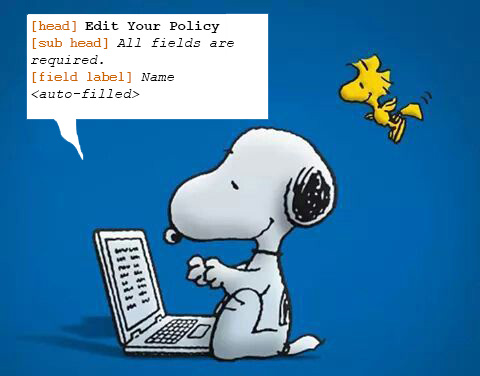
Snoopy and Woodstock are writing the copy deck. It’s a lot of work, but they are learning a lot!
While I’ve spent years blogging and talking about being a technical writer, I haven’t actually been a technical writer except for doing projects in grad school–until now.
In the last two months, I’ve started a position as a content/technical writer for the UX/UI Design team of a large company, working on their global self-service portal. The position was available shortly after my last contract gig ended prematurely. While I’m not enjoying the extra long commute, and I took a pay cut to remain employed, I have to say that I am learning a lot while applying a lot of the “theory” that I know.
Up until now, I’ve been more caught up in content strategy, creating the UX of websites, and making suggestions about how to utilize content rather than actually writing it. This new position has taken me in a completely new direction that I’m sure most of my readers are already familiar with, but it’s new territory for me–at least in applying what I know about it. There’s an outside vendor who creates the business requirements, who passes those along to the UX and graphic designers to create wireframes and the UI designs, and then another writer and I create the copy decks based on those. The project we’re all working on is the Company’s global self-service product (the image above is a hint of where I’m working), so there are a lot of details to consider.
My time as a knowledge management specialist in my last position was not as pleasant as I would have liked simply because I wasn’t doing that much actually related to knowledge management at all. I was brought in to do one thing, and ended up doing something completely different and something that didn’t play up to my strengths.
This is the complete opposite of that. While I will contend that I’m still very much in the learning curve of understanding my responsibilities and their expectations, the environment is much more in line with what I need to be around. Our manager has been talking about the idea of creating consistency throughout the product’s content. I’ve suggested looking into single-sourcing tools that might help us with that, but they don’t know how to wrap their heads around that idea yet. Even so, the other writer of the team and I have had some lively discussions about it. I appreciate having a voice when asking questions of why a UX designer went in a certain direction, and I get a vote when the team discusses how customers think and how they should direct the customers on the site. While I’m still learning by doing when creating new copy and editing old copy, I feel like I’ve been well-trained for this at grad school as well as from various presentations I’ve attended over the years at conferences. I’ve even had the chance to share my localization/globalization insights to the company in the hopes that we can be sensitive to better copy when the product is ready for translation.
So, this is certainly a new adventure. It’s not the direction that I thought I’d be going into, but I’ve definitely been learning a lot over the last couple of weeks, and things are just getting started. We’ll see how this progresses in the coming weeks. I finished my first copy deck last week, and I was told that I did a pretty good job for a first-timer. However the second, much bigger and more complicated deck I just completed with little guidance was ripped to shreds after spending a month writing it, with only a day and a half to fix everything. Needless to say, I was unhappy about that (spent the afternoon in tears), and it made me put all my education and self-confidence as a technical writer into question. As I said above, I know they need better processes that probably involve a way to write single-sourcing information, but the problem is that it’s not the kind of information that would eventually be published as a website, ePub or other documentation. It’s complicated to explain, but it’s a bad process. All the copy is done in Word. Need I say more?
My husband has said that there’s one thing that’s been for sure during this last year or so–I can’t say that as a contractor that I haven’t had an opportunity to learn new things, and to have very different experiences in the process. He’s certainly right about that! This latest position is one that I think will provide me with better insights into writing and developing content, and how it integrates best for a good user experience for the customer. I’m used to receiving content written by others, so it’s a great chance for me to be on the “other side” of the equation. It’ll also provide me with insight as to whether this is the kind of job for me. (I’m thinking right now that I like content strategy and management better.)
Where will this take me next? Good question–I don’t know. But there’s still a lot to learn, and it definitely contributes to my skills as a technical communicator.
What was your first writing gig like? Share your experience in the comments below!











 TechCommGeekMom
You must be logged in to post a comment.