This is an interesting article, as I think this definitely applies to the tech comm field especially. It’s not unusual for technical communicators to be brought into projects as either short term or long term contracts, so it’s built into the industry right now. I can attest to that point, but I can also attest to both looking for flexible schedules and climbing up the career ladder as the reasons why I end up job hopping a lot. I am that woman they speak of in the article! At this point in my career, it’s the only way to go if I want to stay employed at all. How many of my female readers can relate to this article as well? Do you think this is something that works for or against women? Include your comments below. –TechCommGeekMom
A strategic approach to Customer Experience is a sharp differentiator in the success and growth of companies for a simple reason – so many companies just don’t have one. Not necessarily from
Great article that’s really about common sense in understanding your customer base and how to adapt to their changing needs. While this article is really meant for marketing and digital marketing, it can easily apply to content marketing as well as how we write as technical communicators in general. Needs and interests change, and we need to adapt to them.
Disclosure: I’m also a little biased, as this was written by my cousin’s “significant other” (so he’s family to me). He’s a smart cookie, and a pleasure to talk shop with, when I get the chance! 🙂 Even so, he makes fantastic points here, family or not!
Do you agree with Dave’s assessment? Include your comments below.
As a person who is starting to approach her fifties (yikes!) in a couple years, I find this to be so true. Or for me, it’s even just letting me work from home three times a week rather than dragging myself into the office every single day. I know that my brain takes a little longer to rev up in the morning, and conks out earlier, so shortened hours would be great. I think the other thing about this study or the article–which admits that the study is a little flawed–is that for many people, responsibilities shift when you hit your forties. Many have children who are teenagers and college-age students by then, and there’s a lot going on with that. Or, after your forties, you might have more to do with aging parental care. But somehow, I think adults generally have more responsibilities once they hit their forties, and it just doesn’t let up anymore.
I know I’d welcome a shorter week, or at least shortened hours. What do you think of this article? Include your comments below. –techcommgeekmom
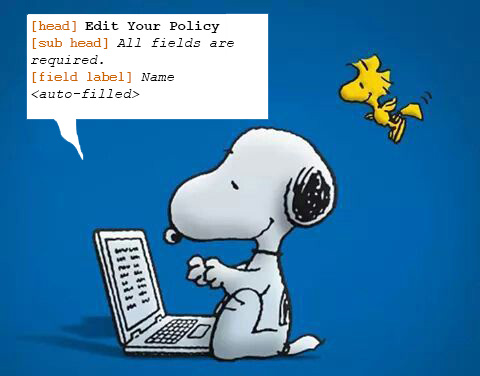
Snoopy and Woodstock are writing the copy deck. It’s a lot of work, but they are learning a lot!
While I’ve spent years blogging and talking about being a technical writer, I haven’t actually been a technical writer except for doing projects in grad school–until now.
In the last two months, I’ve started a position as a content/technical writer for the UX/UI Design team of a large company, working on their global self-service portal. The position was available shortly after my last contract gig ended prematurely. While I’m not enjoying the extra long commute, and I took a pay cut to remain employed, I have to say that I am learning a lot while applying a lot of the “theory” that I know.
Up until now, I’ve been more caught up in content strategy, creating the UX of websites, and making suggestions about how to utilize content rather than actually writing it. This new position has taken me in a completely new direction that I’m sure most of my readers are already familiar with, but it’s new territory for me–at least in applying what I know about it. There’s an outside vendor who creates the business requirements, who passes those along to the UX and graphic designers to create wireframes and the UI designs, and then another writer and I create the copy decks based on those. The project we’re all working on is the Company’s global self-service product (the image above is a hint of where I’m working), so there are a lot of details to consider.
My time as a knowledge management specialist in my last position was not as pleasant as I would have liked simply because I wasn’t doing that much actually related to knowledge management at all. I was brought in to do one thing, and ended up doing something completely different and something that didn’t play up to my strengths.
This is the complete opposite of that. While I will contend that I’m still very much in the learning curve of understanding my responsibilities and their expectations, the environment is much more in line with what I need to be around. Our manager has been talking about the idea of creating consistency throughout the product’s content. I’ve suggested looking into single-sourcing tools that might help us with that, but they don’t know how to wrap their heads around that idea yet. Even so, the other writer of the team and I have had some lively discussions about it. I appreciate having a voice when asking questions of why a UX designer went in a certain direction, and I get a vote when the team discusses how customers think and how they should direct the customers on the site. While I’m still learning by doing when creating new copy and editing old copy, I feel like I’ve been well-trained for this at grad school as well as from various presentations I’ve attended over the years at conferences. I’ve even had the chance to share my localization/globalization insights to the company in the hopes that we can be sensitive to better copy when the product is ready for translation.
So, this is certainly a new adventure. It’s not the direction that I thought I’d be going into, but I’ve definitely been learning a lot over the last couple of weeks, and things are just getting started. We’ll see how this progresses in the coming weeks. I finished my first copy deck last week, and I was told that I did a pretty good job for a first-timer. However the second, much bigger and more complicated deck I just completed with little guidance was ripped to shreds after spending a month writing it, with only a day and a half to fix everything. Needless to say, I was unhappy about that (spent the afternoon in tears), and it made me put all my education and self-confidence as a technical writer into question. As I said above, I know they need better processes that probably involve a way to write single-sourcing information, but the problem is that it’s not the kind of information that would eventually be published as a website, ePub or other documentation. It’s complicated to explain, but it’s a bad process. All the copy is done in Word. Need I say more?
My husband has said that there’s one thing that’s been for sure during this last year or so–I can’t say that as a contractor that I haven’t had an opportunity to learn new things, and to have very different experiences in the process. He’s certainly right about that! This latest position is one that I think will provide me with better insights into writing and developing content, and how it integrates best for a good user experience for the customer. I’m used to receiving content written by others, so it’s a great chance for me to be on the “other side” of the equation. It’ll also provide me with insight as to whether this is the kind of job for me. (I’m thinking right now that I like content strategy and management better.)
Where will this take me next? Good question–I don’t know. But there’s still a lot to learn, and it definitely contributes to my skills as a technical communicator.
What was your first writing gig like? Share your experience in the comments below!
In this article, Carol Fisher Saller, editor of the Chicago Manual of Style’s Q&A, provides some fantastic tips on the pros and cons of attending and editing conference, including how to decide what conferences to attend and how to approach your experience there. It reflects many of my own views, because as a consultant/contractor, I have to pay for my own way to conferences, and usually lose a week’s pay, so I have to make the trip affordable and worth the time off! While Saller speaks specifically about editing conferences, the advice easily extends to tech comm, content strategy, content marketing, and e-learning/m-learning conferences, too. Do you agree with her recommendations? Include your comments below. –TechCommGeekMom








 TechCommGeekMom
You must be logged in to post a comment.