Yael Ben-David originally posted on the Content Strategists group on Facebook, and I have to share it here. It’s a great analysis of how even one word can make a difference. When I did a stint as a UX writer, I remember sitting for hours with the digital team to debate over what word to use in a site that was functionally complex. Should we use “OK”, “Choose”, “Select”, or some other choice to indicate that the user wanted something that they selected before going to another function to make another selection? This is a great article that shows how just a couple words can make all the difference.
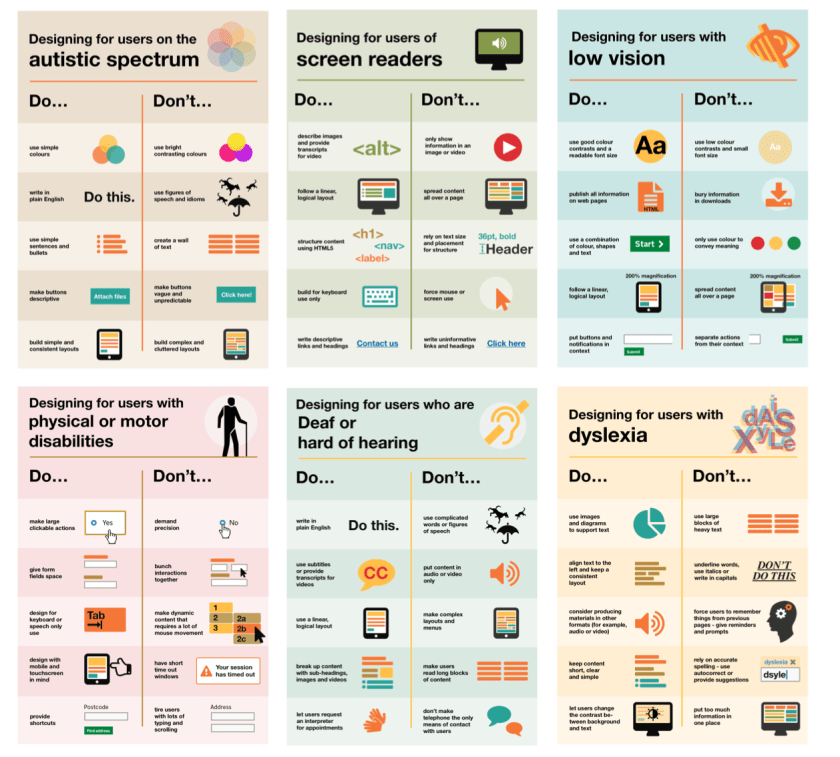
The dos and don’ts of designing for accessibility are general guidelines, best design practices for making services accessible in government. Currently, there are six different posters in the series that cater to users from these areas: low vision, D/deaf and hard of hearing, dyslexia, motor disabilities, users on the autistic spectrum and users of screen readers.
Thanks to Rachel Houghton for pointing these in my direction. I will admit that I’m not always as diligent about keeping these things in mind when I design, but these are still great guidelines to follow for various audiences who may have special needs.
Check these out, and let me know below what you think. I think these are great!
Google is challenging Microsoft’s HoloLens with a new version of its Glass augmented reality eyewear targeted at businesses, continuing a transition started two years ago for the device. Google today…
This is an interesting development, for sure. As the article says, Google Glass had a shaky start several years ago. I even fell for the craze temporarily with disastrous results that made me determine that the technology wasn’t quite ready for prime time. AR and VR have improved a bit over the years, even though it’s still a developing technology. Working in its favor is that the new Google Glass is cheaper than the latest Hololens product, but in a sense that’s not saying much, since it’s still about US$1000 (and that’s not even including my expensive prescription lenses because my eyes are so bad!).
Time will tell if Google Glass has raised the bar, or just met the bar.
What do you think of this development? Include your comments below.
Starfleet Academy isn’t going to prepare me for this.
Yup. You read that right. The crazy lady here is back to school. But not as an instructor this time. I’m back to being a student again. When I say that learning is a lifelong venture, I guess I really mean it!
In this case, I decided that in order to make myself a more viable technical communication professional, it wouldn’t hurt to step up my skills in UX Design. Since I work on a daily basis with UX designers these days, it seemed to me that with a little more knowledge, I could do what they do as well as they could, and there’s a lot of overlap in what content strategists do and what UX designers do.
Since I have a busy schedule and limited funds, I searched around for the best online program that I could find that would suit my needs, and found the website Get Smarter that offers short courses from prestigious global universities like MIT, Harvard, Yale, Oxford, and others. This particular UX Design course is given by the University of Cape Town in South Africa, which I’ve been assured by a good college friend who just finished a year doing research as a Fulbright Scholar in South Africa that it’s the Harvard or Yale of South Africa, and I’m taking her word on it.
Nonetheless, considering that I’ve had some exposure to UX and UX design through graduate school courses and through my work experiences, I was thinking this course should be a “piece of cake”, as they say. Relatively easy.
Guess again. While I understand all the concepts, and granted I’m finishing up week 2 of ten weeks, there’s a lot of work and information to mentally ingest so far. When I read that it could take 8 to 10 hours a week, I was thinking, “Nah, it can’t be that bad. I’m sure it’ll be easy since I understand and work with most of the concepts to begin with.” Nope. While I do understand the concepts, the last two weeks have been very busy, and I’ve been spending my Sundays and Mondays binge-learning my course (since classwork and projects are due on Tuesday afternoon, which is Tuesday night in South African time). So, I have to get everything done earlier than the rest of the class, as I’m the only American or non-African in the class (meaning, everyone in the class is from South Africa or other nearby countries in the same time zone). I’m the only one from the outside. And that’s okay–except for the time issue.
The course focuses on UX Design concepts, and we have discussion groups, etc. (you know I’m contributing much like I do here on this blog, just talking away,) but the course directs our projects towards creating an fictional email app. Yikes. In other words, how do I reinvent the wheel? Well, all I could do right now is use their templates for creating the business requirements, and go from there. I’m applying what I’m reading (which is a lot more than I anticipated) plus my personal experience working on Discovery and Design teams (especially of late) to my homework, as that’s the best I can do. I’m hoping my time eases up soon. I thought it would ease up immediately after CONDUIT 2019 was done, but there are still things I’m following up on post-conference, and catching up with work and life. Crazy me, thinking I should be taking a course RIGHT NOW. (Well, the cohort was starting now, and it’s a really great price…) But am I disappointed? NO. The information is clear, and well-thought out. The only disappointment is me and my performance right now. I’m usually a much more dedicated student, so I need to focus and get the job done. Having a new credential on my resume that I can put to practice relatively quickly is something that I think will benefit me as a content strategist and as a technical communicator. We’ll see how this works out at the end.
Alan Houser posted this on Twitter, and this is absolutely brilliant. Anyone who has every had to give any kind of presentation or keynote can totally appreciate this. I know since I’ve done both, I do! I’m going to have to start positioning my talks more like this, and do more inflection along these lines.







 TechCommGeekMom
You must be logged in to post a comment.