Musings and learning about technical communications issues from your TechCommGeekMom–a geeky mom who is into tech comm…since 2012.
Author: TechCommGeekMom
Danielle M. Villegas is a technical communicator who currently employed at Cox Automotive, Inc., and freelances as her own technical communications consultancy, Dair Communications. She has worked at the International Refugee Committee, MetLife, Novo Nordisk, BASF North America, Merck, and Deloitte, with a background in content strategy, web content management, social media, project management, e-learning, and client services. Danielle is best known in the technical communications world for her blog, TechCommGeekMom.com, which has continued to flourish since it was launched during her graduate studies at NJIT in 2012. She has presented webinars and seminars for Adobe, the Society for Technical Communication (STC), the IEEE ProComm, TCUK (ISTC) and at Drexel University’s eLearning Conference. She has written articles for the STC Intercom, STC Notebook, the Content Rules blog, and The Content Wrangler as well. She was very active in the STC, as a former chapter president for the STC-Philadelphia Metro Chapter, serving and chairing on several STC Board committees, and most recently was the STC Board Vice-President before the organization closed.. You can learn more about Danielle on LinkedIn at www.linkedin.com/in/daniellemvillegas, on Twitter @techcommgeekmom, or through her blog.
All content is the owner's opinions, and does not reflect those of her employers past or present.
This article came to be by way of Craig Cardimon on LinkedIn.
I’m not sure if I totally agree with the author of this writer. While yes, I do like to think that I can write decent content, as a content strategist, I don’t think of myself as a writer. Perhaps I think of myself more as an editor than a writer as a content strategist. While I do agree there has to be some foresight and deep thought into doing some copywriting, ultimately, a copy writer doesn’t always know how to format and understand how the content impact depending on context. Copy writers write. Content strategists manipulate and re-orchestrate those words that copy writers write to become something more. I don’t know that I would ever consider myself a copywriter, even though I’m probably capable of it. Copy editor, maybe, but content strategy also involves the management of the content, and understanding the user strategy or user experience of how to use that content. Copy writing doesn’t always include that.
SANTA CLARA, Calif., Nov. 13, 2014 – A new global report produced by Intel Corporation indicates that girls and women involved with “making,” designing and creating things with electronic tools, may build stronger interest and skills in computer science and engineering – which could potentially reduce the growing gender gap in these fields.
With 16 million makers in the United States alone, the maker movement – a wave of tech-inspired, do-it-yourself innovation – is extensive and rapidly expanding. Unfortunately, so is the gender gap in computer science and engineering graduates. Intel’s report, “MakeHers: Engaging Girls and Women in Technology through Making, Creating and Inventing,” explores how maker activities can serve as a gateway to computer science and engineering for girls and women, and it identifies ways to better engage girls and women in making in order to increase female representation in these fields.
Interesting article. I think girls are very much hands-on, which is why many like crafts and such. (I know that sounds sexist–it’s not meant to be. It’s merely observation.) Many of the tech comm women I know are also heavily involved with knitting, sewing, and other crafts, so it would certainly support this idea.
What do you think? I know I’d like to get my hands on some 3D printers and figure out more about them myself!
Does this look a little familiar? This is the Jedi Academy Library. Taking from the old to the new, for sure.
One of the first places that I went to during my holiday in Ireland was to University of Dublin, Trinity College. Why would I visit there? Trinity College is a world-famous university the likes of my “hometown” of Princeton or more close by, Oxford or Cambridge. The renowned Book of Kells exhibit is at the college, and part of the tour is the university’s Old Library. When people see photos of the Old Library, they recognize it instantly, and it’s a book lover’s fantasy room with books stacked from floor to ceiling on two floors. Rumor has it that the library of the Jedi Academy in the Star Wars films was based on the look of this library. To see the room in person is truly a sight to see.
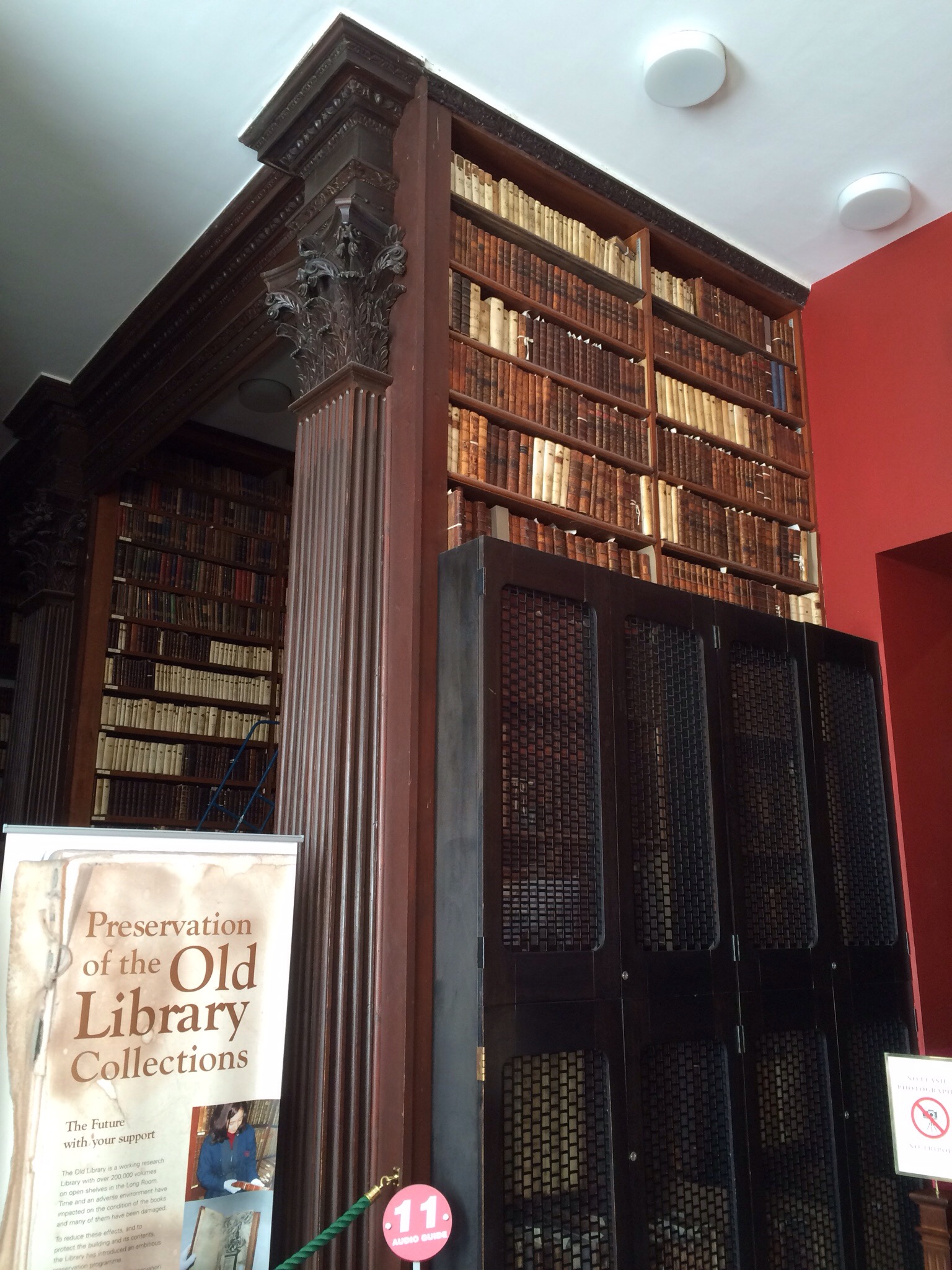
This is just before the entrance of the library.
At the entrance of the library, there were several shelves of dusty books stacked in bookcases that reached to the ceiling, with a sign in front (as seen in the photos) that restoration work was still being done to preserve the library and its contents. To put this photo in perspective, I’m guessing that the door well, which you can barely see from the right corner, is a normal-to-tall door well of about 8 feet tall, and the rope blocking these shelves barely seen on the bottom right is the normal hip height, so the ceiling has to be at least a good 13-14 feet to the top! As you can see, there are even a lot of books here!
Inside the Old Library, looking towards the entrance.
Once in the Old Library itself, I looked at all the old books, marvelling at the sheer enormity of so many books in one place. I wondered how old some of these books were! The historian in me wanted to find cool books to see perspectives from another day and age, and lovingly leaf through pages of an old book. Then the technical communicator in me stepped in and took over my brain. I wondered if anyone could still access and read these books at all. I wondered if any of it had been digitized for current use, because all of the books looked like decorations now. How do we know what books are still in here? Had anyone done an audit? How relevant is any of the information? What is worth keeping in some form, and which items are, as I said before, purely decoration or kept in perpetuity? The historian in my returned in my head, wishing I could head up a restoration project of this kind to digitize every last book in that room. Why, if most likely 99% it is outdated? It’s because in auditing the content, sometimes you find a gem of information or data that has gotten lost in the shuffle, and ends up being a great piece of information that provides the missing piece to a puzzle.
TechCommGeekMom selfie in the Old Library.
In this modern age, this is something I think we need to keep in mind. Content audits are important in a content strategy. You don’t want to include information that isn’t relevant anymore, naturally. That’s a waste of space and the end-reader’s user of time. That’s logical. However, should you throw away all the information once you have deemed it non-usable at this time? I don’t think so. There will come a day when the manual of an old product will be needed to service that item–as an antique, and the manual will be helpful. Understanding our content past, just like any other piece of literature or antique artifact, is a connection to understanding how we have progressed, how we can improve, and where we have made mistakes. It can also provide clues to why we have the content we have now–did someone leave something out in more recent versions that might have been thought to be irrelevant during that edition, but older editions are relevant now? You never know unless you get the entire picture, and see what treasures you may have at your fingertips. They could be the key to success.
What do you think? Is keeping old content–at least, archiving it–a worthy endeavour? Post your comments below.
“Alright then, you’ve proven that you aren’t a total pudding brain. Now, I want you to learn geo-quantum astrophysics next,” says the Doctor.
After a delay due to server hacks at Rutgers University, I finally got my grades while I was vacationing in Ireland. My final grade was a B+ for my Digital Marketing class! While in recent years, I have had a reputation of having a straight A average with my grad school level classes, I was not disappointed in this grade. As I may have mentioned in a previous post, I got an 82% on my final exam. The test was one where it was one shot at 50 multiple choice questions. If I hadn’t studied the quizzes and taken the quizzes multiple times to practice (they weren’t graded), I wouldn’t have passed. Most of the questions on the test were the same as the quizzes! So there’s that. Some of the questions, as they were worded, were NOT easy. Even so, with the fact that I got an 82/100, I was greatly relieved.
As for my Capstone project which involved more work and thought towards the practical application of the information we learned, I got a 95/100, or an A. I was happy about this, as this is the part of the grade I actually fretted over more. I knew it would be difficult, because I didn’t have any clear cut projects from work or situations to base my digital marketing strategy on. So, in my mind, this was an educated shot in the dark. I decided that I would base my project on something that was real for me. I’ve mentioned that I had been thinking of starting my own consulting business, and so I based my project on the idea of my proposed reality–I needed to come up with a plan to promote my fledgling company to gain brand recognition and acquire customers. That’s fairly straightforward. As I’ve mentioned many times before, I understood how to approach the digital part of the strategy, but not as clear with the marketing. So, I did the best I could, and labored over this project. It paid off. The commentary of what was missing was minimal, mostly about re-evaluating after gaining clients and reassessing the stats taken based on that. That makes sense, but let me get some clients first!
So, once the exam was averaged with the Capstone, I got an 88.5% for the class, also known as a B+. Considering that this was not an easy subject for me to study, I still think I did well. I did not think much of giving equal weight to the test and Capstone then averaging the grades. The test, while it tested students on concepts, wasn’t well written and it was not really practical. Ultimately, the Capstone project was a practical use of the information and more of a projection of what I’d really have to do in “real life”, thus it should have been worth more, because these kinds of strategies are what need to be brought into the real world. So in my mind, while it’s not official, I still got an A for the class because that was what I got for the Capstone.
So there you have it. I got a B+.
Would I take this course again? Probably. The experience was very different from doing my online Masters at NJIT. My studies at NJIT were much more structured and directed than this course at Rutgers. This online digital marketing course was 10 modules of about 10 videos per module. The information in the modules was excellent, and the instructors were top notch. I wouldn’t trade that. When I was able to go to the “virtual office hours”, the instructors were approachable. However, I had to stay super-disciplined in watching all the videos (3-4 hours’ worth of information that could be dry content at times) every week. I didn’t have the chance to interact with fellow students almost at all to exchange ideas. It wasn’t as rich of an experience as I had enjoyed with NJIT. Despite the lesser things about this course’s delivery, I know that I will definitely use this information going forward.
So, I will shortly receive my mini-MBA in Digital Marketing from Rutgers soon in the mail. I suppose the question will be–what will the next course I take be, and when? I don’t know yet. I’m the eternal learner, so I look forward to that answer, too.
I’m looking forward to exploring Galway on my own. Looks like my kind of town!
Hello readers,
As of the date this post is published, I will be taking a bit of a break here for a while. As I write this, I’m about to leave today for a 10 day trip to Ireland. I’ll be in Dublin for half the week, and then in Galway and the Aran Islands for the other half of the week. I’m very excited, and even a little nervous. I haven’t been out of the US since September 2000, and Ireland is a new country for me to visit. I’m sure I’ll get over the culture shock quickly, and I usually understand the accent as I have my GPS set to an Irish male voice speaking. 😉
Understandably, this is the first real vacation I’ve taken where there’s no husband or son, and no tech comm conference involved in many years! The history geek in me is going to be let loose to enjoy and soak up the culture! While there, I will still have my handy-dandy iPad, and if inspiration hits to write a blog post or curate a cool article, I will. But it’s not a high priority. I’ll also have my handy iPhone, and I’m planning on taking plenty of photos and video, and most likely much of it will end up on social media.
I also have a lot of exciting things going on once I return from my trip coming up, which I’ll discuss more when I get back. Some of the news isn’t official yet, so I have to wait to say anything, but I’m anxious to share with you!
Salthill beach, here I come!
So, enjoy your first half of May 2015. I’ll be missing the warm weather of New Jersey and the late arrival of Spring while it’s expected to be cooler and rainy in Ireland. I guess the tradeoff is that even in the cooler weather, Galway City is just a 20 minute walk to the beach, so I can literally saying that I plan to have some beach time! 😀 It’s time for some rest and relaxation–the rest of 2015 is going to be busy, so I need to re-charge and clear my brain for a bit!










 TechCommGeekMom
You must be logged in to post a comment.