Posted in Uncategorized

The Secret Power Of The Generalist – And How They’ll Rule The Future

See on Scoop.itM-learning, E-Learning, and Technical Communications

We’ve become a society that’s data rich and meaning poor. A rise in specialists in all areas – science, math, history, psychology – has resulted in tremendous content. But how valuable is that knowledge without context?


Despite the corporate world’s insistence on specialization, the workers most likely to come out on top are generalists – but not just because of their innate ability to adapt to new workplaces, job descriptions or cultural shifts. Instead, according to writer Carter Phipps, author of Evolutionaries generalists will thrive in a culture where it’s becoming increasingly valuable to know “a little bit about a lot.”


Meaning that where you fall on the spectrum of specialist to generalist could be one of the most important aspects of your personality – and your survival in an ever-changing workplace.

Danielle M. Villegas‘s insight:

I like this article because it’s the argument I’ve been making for several years, especially when looking for positions. I know plenty about lots of things, but I’m not a specialist in just one topic. This makes me much more flexible and able to see the bigger picture in different contexts. I would think that the ability to be that flexible would be seen as an asset, not count against me. Fortunately, the company I work for now did see that as an asset, and continues to find value in what I can contribute for them.  Many companies missed this opportunity where I know I could’ve helped them out, because they were too narrow minded in what they wanted.  Hence, this is why I advocate self-promotion as a multi-specialist. I hope more companies come around with their way of thinking sooner than later. 

–techcommgeekmom

See on www.forbes.com

Posted in Uncategorized

Technical Writing for the Cloud | Shoap Technical Services

See on Scoop.itM-learning, E-Learning, and Technical Communications

Danielle M. Villegas‘s insight:

Thanks to Craig Cardimon turned me onto this article. Much of the advice given is similar to best practice advice given for writing for mobile, but it takes it to another level. Another must-read article. 

–techcommgeekmom

See on www.shoap.com

Posted in Uncategorized

ICC2014 Observation: Too Many Communication Silos – TechWhirl

See on Scoop.itM-learning, E-Learning, and Technical Communications

Al Martine’s observations on Intelligent Content Conference 2014: The silos communicators are in are hurting their careers and their companies.

Danielle M. Villegas‘s insight:

This is a very good article by Al Martine of TechWhirl. I observed the same thing at ICC2014, yet I think Al articulates it well here. A must-read. 

–techcommgeekmom

See on techwhirl.com

Posted in Uncategorized

Careers in Technical Communication – 2014

I came across this via Viqui Dill on Facebook. This is done by Carolyn Kelley Klinger, who is a very active member of the STC. This is a great overview of the potential of tech comm in the coming year. The future’s so bright, I gotta wear shades!

Posted in Uncategorized

Douglas Adams Knew Tech Comm Before It Was Cool

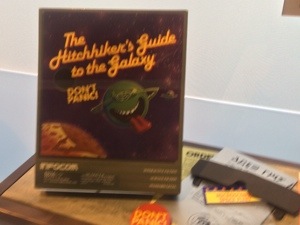
Photo taken at the Computer History Museum in California by me! Who knew it'd be back in the news?
Photo taken at the Computer History Museum in California by me! Who knew it’d be back in the news?

At the end of my trip attending the Intelligent Content Conference in San Jose, California, I had the opportunity to visit the Computer History Museum in nearby Mountain View with a group of other conference attendees. It was a great little excursion, especially for a geek mom like me. Every kind of computing device in the last 150 years (give or take) was included in this place. I felt particularly old when seeing several of the first computing toys like “Merlin”, “Donkey Kong”, and “Quiz Wiz” displayed (I had one of them, my sister had another, and I wanted the third!) I also saw some of the earliest versions of Apple and PC computers. I remember them as well. My father brought home an Apple II from the school where he was an administrator, and I remember playing some of the earliest versions of Castle Wolfenstein and doing simple computer graphics in BASIC on it. Good times.

4thDrImageAdams
Tom Baker as the 4th Doctor on Doctor Who. He later starred in Adams’ “Hyperland” video as the interface.

But one items caught my eye, which was the game shown in the image above. It was the computer game of “The Hitchhiker’s Guide to the Galaxy” from 1984. My own disclaimer is that I’ve never read the book or played the game, but I’ve watched the movie and enjoyed it. I also know that the author of the book, Douglas Adams, was an occasional writer for Doctor Who for a time, so seeing this computer game picqued my interest. I also remembered that Douglas Adams wrote and created the mini-movie called, “Hyperland”, which starred the former Fourth Doctor, Tom Baker, and talked all about hypertext theory. See my post about it here. If you haven’t watched it, you must take the time to do so, as it still stands the test of time and is well done! It occured to me that Douglas Adams really understood the idea of hypertext when he wrote “Hyperland” due in part to Doctor Who, simply because the entire show is actually all HYPERTEXT. While it seems that we are going forward in a linear way, we are actually pulled back and forth into different times and sequences–much like hypertext.  Think Elizabeth I references throughout or that the Doctor can be in several places at once–he may be in Victorian England as one version of himself, while in Victorian England as another version in another part of the country on the same day, for all he knows.  Same story of the same man (essentially), but two different directions.

But anyway, I digress. I thought it was really cool to see this old game displayed at the museum, and didn’t think anything more about it until I saw this article come out:

BBC Revamps ‘Hitchhiker’s Guide to the Galaxy’ Game

What’s this? Evidently, the BBC is revamping and re-releasing the game as a 30th Anniversary edition. Who knew that an old game written by Douglas Adams, who understood hypertext theory before it was mainstream, would stand the test of time? I’m excited that it’s out, and have played a round already. It’s good fun. Go to the link above for the article, and find the game on the BBC website. It’s a great example of the use of hypertext writing well before people started to understand how to structure content and employ reuse on the Internet. Give it a try. You’ll enjoy it!