Posted in Uncategorized

Happy Thanksgiving 2012!

Today, in the United States, it’s a holiday. Thanksgiving is a day that we Americans celebrate to remember the sacrifices that the first English pilgrims made after their first year of survival in the New World. The celebratory tradition started with those pilgrims sharing the bounty of the harvest they reaped with the Native Americans who lived in the area and taught them some of the survival skills, and gave thanks for everything that came their way. Many generations later, we Americans, use this day to remember and give thanks for what we have as Americans. We celebrate with family, friends, and a huge feast.

OK, so that’s the general idea of the holiday–or at least that’s what it’s supposed to be. The legend or fairytale has been marred over the years with the realities of those who were cast out due to religious oppression in their own country coming to this one and taking horrible advantage of the native people, eventually driving them out over time and making the Native American nation into a minority that is still, to this day, trying to culturally and literally survive. America, for all the pretty stories of pioneering, didn’t always get there in a nice and clean way with hard work. There are some ugly stories too. I just wanted to put that out there, just in case anyone thought that I was unaware of any atrocities in our nation’s history and had notions of any overly lofty American ideals.

But for a moment, let’s just run with those lofty ideals for a moment, and get back to the core idea of how Americans celebrate it now–Americans of all races, religions, cultures, ethnicities and creeds celebrate. Thanksgiving is a nice concept of a holiday, no matter how one celebrates it. I’m sure there are other holidays in other cultures that have something like it, where it’s just a day to celebrate family, friends and whatever good fortune has come by in the past year. There’s been a lot of bad things that have happened over the centuries, and even more recently. Heightened wars in the Middle East, poverty and starvation in different parts of the world, and even closer to home, the devastation of what Hurricane Sandy did to my home state and area. This is a day that I’m thankful that the worst thing that happened during Hurricane Sandy was that a tree fell on our house and ruined part of the roof, and that I didn’t lose my home or more importantly, my family.

It’s a time to realize that while no life is perfect, and all people have their own issues, that some good things can come out of life, and to be grateful for those good things, whether they are big or small.

For me, it’s been a very interesting year. While I’m sure I’ll say more as the year draws to a close, I’ll just summarize the good things I’m thankful for this year, as much of it does deal with my entry into the technical communications world. I’m thankful that there was a program at NJIT in technical communications, and that I could graduate with my Master’s degree in the topic this year. I’m thankful for the professors and students in my program who helped me get out more into the social media world to make my voice heard, and continue to support my endeavors post-graduation. I’m thankful to have met so many people through social media–Twitter, this blog, Facebook, etc.–who are professionals in the technical communications world who have mentored me as well as become my friends. I’m thankful for the opportunities I’ve had through these associations, such as the chance to go to Adobe Day, have my webinar, do the NJIT promotional video, get my teaching job or meet other professionals in person. I have learned so much, and continue to learn so much from all of them. But most of all, I’m grateful for my husband and son, for without them, none of this would be possible. Allowing me to be me, allowing me to continue to learn and grow, and supporting me every step of the way is so important to me. Without those two wacky guys of mine, I would not be in the technical communications field, and would not be continuing to pursue a technical communications career.

So, whether you are in the United States partaking in a big holiday, or it’s just another Thursday or Friday (other places, it’s Friday already from the time I’m writing this!), take a moment and remember what it is that you are thankful for, even if it’s just being glad the be able to pursue a technical communications career that is growing and expanding each day, and that you are part of the great changes that are happening in this world–one little bit at a time.


Posted in Uncategorized

Flame Wars need not apply.

I had planned for this post to be something a little more lighthearted, but my plan was changed when I received my first insulting comment on this blog. It came in, and made accusations that proved that the person hadn’t read the blog post carefully, and additionally made insult of my relationship with Adobe. I was shaken up by this comment, because it was meant to be insulting, and in no way was the criticism constructive in any way. I was taken aback by it, and when I told my husband about it, he replied, “This is ‘typical’ internet behavior these days… don’t take it personally.” I knew he was right, and but still…it truly bothers me. It certainly doesn’t seem like professional behavior.

I choose my words carefully on this blog. Every entry is not written off the cuff, and I take a lot of time to write and edit each post. I do my best to be as diplomatic as possible when writing, even if I have a very strong opinion about something. I do my best not to insult anyone or anything. I try to dish constructive criticism when I feel it’s necessary. My intentions are to put forward my own thoughts as a new technical communicator who is trying to make her way into the field, and share ideas that I find interesting or educational. If I curate something from the web from my ScoopIt account, it’s because I found something worthy of sharing with my TechCommGeekMom audience.

This blog started out as a class project in graduate school, and it has taken off to have a life of its own. I don’t claim to be an expert. I don’t claim to be highly experienced. I don’t claim that I am familiar with everything that is related to tech comm. I try to be humble with what I do or don’t know. Yes, I have some knowledge and experience, but if you want to read commentary from someone more experienced who is an “expert” in the field, please, be my guest. You can go elsewhere.

I do write a lot about Adobe on my blog, and I feel that I need to clarify that, because if this one individual is questioning it, perhaps others are as well. My current relationship with Adobe was something that happened to me by surprise. I have always been a fan of Adobe products, even before this association happened. I’ve been using Adobe products for the last 15 or so years. I wrote a case study in grad school supporting Adobe’s business practices with Flash a year ago–well before I ever started this blog. So, when Adobe contacted me several months ago, it was a total shock. It was really out of nowhere for me. All I did was promote my blog and a post on my blog that called out Adobe and its competitors for making it a little difficult for students to get their hands on tech comm software. I never expected anyone to respond. If the MadCap Software, the makers of Flare, had responded the way that Adobe had, I’m sure I would be a Flare advocate right now. Same with the makers of Lectora and Articulate. I’m new, and when I wrote that fateful post, I just knew that these software packages have the same main function, and that I needed to learn this kind of software to get a job. Plain and simple.

Out of the many companies that I named in that blog post, Adobe was the only one that actually responded. As I said, I didn’t expect ANYONE to respond– it was just a fairly well articulated rant, if I do say so myself. Evidently, someone at Adobe thought so too, and wanted to help. Since I already liked their products, how could I not respond favorably to them? When offered the chance to do a webinar for their Thought Leadership series, that shocked me as well. What the heck did I have to offer or to say? I’ve been told that because I’m new to the TC world, it was because I had a fresh perspective of the field, and it was great to get a new opinion in the mix. From there, Adobe has provided me with opportunities such as sitting in on a conference call previewing products, attending a pre-conference event hosted by them at a major tech comm conference, and promoting my blog to a global audience. Did I ask them to do that? No, not at all. Am I going to take advantage of such opportunities? Well, I would be very stupid not to do that, especially since it’s still very early in my tech comm career!

Adobe is an advertiser on my page, but they aren’t paying me a salary. I am not employed by Adobe at all. (Although I wish I was! I’d be a great product evangelist!) I would love to have additional advertisers on this blog, as I totally embrace diversity in products and software if it helps get the job done. If Apple, Google, Microsoft, MadCap, Lectora, Articulate, TechSmith or any other software or hardware vendor wants to establish a business partnership to advertise on my blog, I welcome the opportunity! These are among the best of the best, and there are plenty of others out there as well that I’d be happy to include. Adobe happens to be the first to take advantage of my offer there on the right column.

Adobe is like the Doctor Who in my life. They came in unexpectedly, have taken me places and given me opportunities that I would not have had without them, and so there is a certain amount of loyalty they’ve earned from me. Is that so wrong in that context? I don’t think so. Unless they do something really ugly and downright horrible to me, I have no reason not to support them, especially in light of them supporting me and this very young blog that’s only 7 months old. They have never told me or asked me what to write on this blog. They have supported my independent thinking. This is not an Adobe blog. Perhaps it leans towards a “fan blog” sometimes, but it’s not solely concentrated on this.

TechCommGeekMom addresses technical communications, m-learning, e-learning and educational technology from my perspective as a new technical communications professional who is trying to make her way into this field and make a difference. While TechCommGeekMom is meant to be a place where I can share my thoughts and concerns, others can as well. Differing opinions are welcome if they are done in a fair and constructive manner. This blog is meant to embrace and discuss the best practices in the tech comm and e-learning fields as they move forward. If you don’t like what you read, that’s your prerogative, and you can go elsewhere. But I’m not going to change how I write or who I am for anyone. I hope that my regular readers, as well as newer readers, will appreciate my position, and embrace it by continuing to visit this blog.

As a mom, I’d like to quote Thumper in the movie, Bambi,

Posted in Uncategorized

Remote and Mobile are not the same thing…but could or should be.

TechCommGeekMom is back! I’m sure you didn’t notice that much, but I was away for a week at the beach (or as we Jersey gals say, at the shore) in South Carolina, and while I wasn’t totally away from technology the whole week, I didn’t stay in touch with it as much as I usually do either. Hopefully, I can make up for some of that this week!

Just because I was away, it didn’t mean that I wasn’t thinking about tech comm, e-learning or m-learning while sitting on the beach. Quite the contrary. I had things going on related to all those topics that I still needed to keep up. And sitting by the ocean, listening to the waves, as well as traveling in lots of places far from home and working somewhat remotely got me thinking about the topic of working remotely and mobility, or rather mobile working.

I was actually put to the test in some respects during the trip. There was some important business correspondence that was going on during the week, and I had only my iPhone and trusty iPad, and spotty wifi to enable me to communicate with the “outside” world. I didn’t have the comforts of working from home with my laptop and reliable wifi connectivity that I have at home. (I do live in “Einstein Alley”, after all, so reliable wifi is almost a requirement where I live!) If I went to one of the Starbucks near where I was staying, then there was good wifi, and I could catch up with some of that correspondence. But if I was in my hotel room, it depended on the time of day and which room I was in, which was not exactly convenient.

As we travelled down some country roads before hitting the main highways on our way home, I started to think about mobile learning in these areas. How, in many respects, is this area that I was traveling through any different from any other remote area of the world, where education isn’t always cutting edge, and computers are difficult to access? The mom in me thought deeply about the educational part of this. If I lived in an area that was distant from a lot of technological access, but wanted the best education possible for my child, how would that be achieved?

My imagination first made me think about remote education. What is that? It could be online learning, or even just something static, like the equivalent of a correspondence course. How would that work in a classroom or standard educational system that is not near any major towns? Connectivity is the key for that. Having that connectivity would be greatly needed for the students to learn. Learning about what is happening in the “outside world” will open the minds of students not only to new ideas, but also how to bring those new ideas to their community. For example, would learning a new technology help with growing crops or improving productivity in some sort of service or manufacturing process prevalent in that community? I’m sure it would.

In my opinion, the Internet has always been an educational wonderland, much like how television and radio opened up possibilities and expanded our knowledge of the world. To deny that to the students of today would be a disservice, especially since so much more information is available through the Internet than radio or television alone. How does something work? A student can watch a YouTube video about it.  Who was Salvador Dali? A student can find Wikipedia and other sites that talk about the artist and see photos or video of his works.  Confusion about how to do algebra? Students can watch a video on Khan Academy. Newspapers from all over the world are online, and students can learn difference perspectives on world events as a result. There are so many possibilities!

But is mobile the solution to having a remote education? Yes and no. I think with the examples I showed above, a standard desktop or laptop can help achieve those activities quite easily. In many remote districts, I imagine that there isn’t the money in the school budget to provide that many desktops or laptops, but gaining that exposure would be worth the expense if it could be done.

To add mobile functionality to the mix would definitely enhance this process. Having a tablet computer such as an iPad or Kindle, or even using a smartphone would increase the learning capabilities. It would allow for more interactive learning. It would allow students to take their own video and photos to share with others. Learning could be done in the classroom, or even on a field trip or outside the confines of a classroom–including at home. All the benefits of mobile versus desktop would come to the forefront of reasons to use mobile for learning. Additionally, as smartphones are often more readily available and purchased, even in remote areas, mobile is possible and accessible in those hard-to-reach locales.

So, one has to understand that remote learning is not the same as mobile learning. Simply because one is out of reach from centers of society doesn’t mean that education about the outside world can’t be accessed, but with Internet connectivity, that experience is enhanced greatly. Correspondence courses of yesteryear (and modern day as well) show that you can be away from a learning source, and still gain knowledge needed. Online courses have been proving that in the last two or three decades as well. However, mobile enhances the e-learning experience greatly, providing greater flexibility for how a student can learn and when he or she can access information to learn. With the proliferation of smartphones and tablets exponentially growing every year, even in remote areas, mobile will enhance and promote changes in that the remote learning process, and in turn, the m-learning industry will change and grow.

So, my question to you, dear reader, as a tech comm or e-learning/m-learning professional, how are YOU going to help those learners who are far away from conventional resources? It’s something to think about when writing or creating courses or documentation that will help the end-user.  Mobile documentation is different because it can reach even more remote areas than ever before, but how it’s created and used is key in how successful it can be in helping those end-users, whether they be students or various professionals. Look at the photo that is at the top of this blog posting. How will you provide information to the inhabitants of that small island? Think about it….

Posted in Uncategorized

Video Killed the Radio Star – @TechCommGeekMom Style

I’m really excited about this! I’ve been waiting to tell y’all about this, and now I can!

A few months ago, the director of NJIT‘S Master’s of Science in Professional and Technical Communication
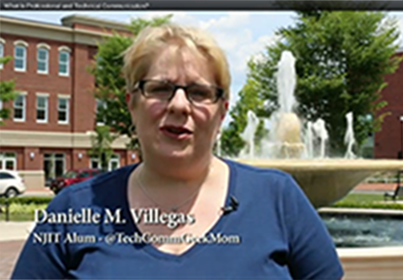
(MSPTC) program asked me if I would be willing to do a video about my experiences as an MSPTC student and graduate, and some of the opportunities the program has afforded me. Of course, I was honored that she asked me, and I said yes! So on several particularly hot days in late June and early July, a fellow graduate from the program who works for NJIT’s communications department came down to my hometown and filmed this video.

Yes, that’s really me in the flesh. Yes, those are my own words. I was just asked to talk about certain topics, and nothing is scripted at all (well, it’s scripted from my head, but nothing was memorized). I thought I was stiff during the filming, but my–I admit I’m rather animated! Just imagine what it’s like when I’m up doing a regular presentation! LOL

You can click on the image in this post (a still from the video) or you can click on this link: http://youtu.be/NN_nHOANR7k.

Or, if you’d like me to speak in person–contact me! (See the “About TechCommGeekMom” tab above.) Hey, if I can get some more speaking gigs, that would be good, wouldn’t it?

Let me know how I did in the video! 🙂

Posted in Uncategorized

Be a warrior with Technical Communications Suite 4!

One of the things that many people don’t know about me is that I have a first-degree black belt in Songham Taekwondo. I was even a state champion in weapons as a color belt for my age group. I enjoyed TKD a lot, until a knee injury took me out. What I like about taekwondo is that it’s a versatile martial art; one doesn’t spend all of the time studying forms alone, but rather a student learns basic moves that will help in other areas such as sparring and weapons. The more skills one gains, the more adept to changes when sparring or using weapons. This is what trained the ancient warrior as well as the modern day warrior.

This kind of mentality is also needed to be a technical communicator. How, you may ask? Well, like a black belt in taekwondo, one has to have many skills to get the job done. One needs to know a little bit of this and that, like technical writing, editing, and content curation–among many other skills–to produce kick-butt documentation and output.  But it also helps to have the right tools as well.

For today’s taekwondo student, one can wear various protection pads, and learn how to use weapons–including hands and feet–as the tools to achieve the end goal.  For technical communicators, there are various software tools out there.

One of the foremost products out there is Adobe’s Technical Communications Suite 4. With this latest rendition of the Technical Communications Suite, technical communicators have even more options and choices in how documentation and other technical writing output is achieved.  There are reliable standbys like Framemaker and Robohelp–both of which have been updated, but there are also additional tools as Acrobat, Captivate, Presenter, and Illustrator. Combined with the Adobe Creative Cloud Suite, it seems to me that there is nothing that can stop a technical communicator from being a tech comm warrior!

Tomorrow, on August 21st, 2012 from 10:00-11:30 AM Pacific Time, one of Adobe’s strongest tech comm warriors, Ankur Jain, is going to be presenting the What’s New in Technical Communications Suite 4 webinar,which is not only going to talk about the strengths of this tool, but also the newest and latest features to make it a more effective tool for technical communicators everywhere, including features that now allow technical communicators to bring finished products to a mobile audience. (And you know how pro-mobile I am!)

Register here: http://www.adobe.com/cfusion/event/index.cfm?event=detail&id=2051812&loc=en_us

Tell Ankur that I sent you by telling him, “I am a TechComm Warrior!” 😉