Thanks to Madonnalisa Gonzales Chan for posting this on the Content Strategists’ group on Facebook. This is an excellent article that starts to delve into the idea of how one would create UX content to interact with people. As I’ve been working in UX creating some of this style of text (but definitely not anywhere close to this deep), I found this fascinating, and the journey that the author took in exploring this brought up points that I hadn’t thought of, as well as points I could relate to.
What do you think? Where do you see conversational design going as we start to write more content for help, IoT, and other content outputs? Put your comments below.
The farmer and the cowman–I mean, the academian and the practitioner should be friends…
I attended the IEEE ProComm at the University of Limerick, in Limerick, Ireland last week. I was absolutely gobsmacked months ago when a presentation proposal I sent in for this conference was actually accepted. I figured, why not? I’m always looking to expand my tech comm circle, so I had hoped that this would help in this endeavour. I made some great new connections, and I was glad for that, and I certainly enjoyed the sessions I attended.
One thing that was very different about this conference, unlike the other tech comm conferences I’ve attended thusfar, was that this particular conference focused more on the academic side of tech comm. I found out, through inquiry, that while all were invited to this conference, there was definitely a very strong bent toward academia. There is nothing wrong with that, but the depth of this academic frame of mind is not something I’ve dealt with since I graduated from NJIT three years ago. I understand that academia has its own rules and ways of doing things, but it was definitely…different. Not in a bad way, but different.
Up until this point, I had attended what I’ll call “practitioner” conferences. I’ve chose the word “practitioner” rather than “professional” because in the end, we’re all professionals at what we do in the technical communications, whether we teach and do research, or are out in the corporate world making things happen. Thus those out there in the corporate world I’m choosing to call practitioners. Some practitioners do teach, and some academians do corporate work, but they don’t always overlap. I wanted to clarify this before I move on with my narrative here…
Anyway, as I started to say, up until this point, I had attended conferences that had a stronger practitioner’s bent to them. Most speakers would be people who had been out there battling it out in the corporate masses, and sharing their experiences and knowledge attained from those experiences with others. I often attribute the fact that I got my last job with BASF because of information that learned through one of these practitioner events, because it was something that the company could use beyond analytical theories. Speakers at these practitioner conferences are those who are in the trenches every day, putting to practice all those theories about content strategy, revising them, applying them to businesses globally.
So, attending a mostly academic conference like the IEEE ProComm was a bit eye-opening. Many of the talks were summaries of research that had been done on a variety of topics, and peer reviewed, which was all well and good. I found that the sessions that I could connect best to were the ones that were given by practitioners, practitioners who were also academians, or academians who had a foothold as consultants outside of the academy. There were plenty of sessions whose topics were relevant to the corporate world, but they failed to deliver completely on something new or to provide any revelations to me. There were also summary sessions that provided research conclusions which were incorrect or inaccurate from practitioner perspectives, or elicited the feeling of “…and why are you researching this topic again, and what is its relevency?”
I spent a good part of my time networking with people who happened to be practitioners studying for advanced degrees or had an advanced degree. I particularly connected with one woman who happened to come out of the same NJIT program that I did. (We weren’t classmates, as she started the semester after I graduated, but we knew or had many of the same professors.) She’s been a practitioner much longer than I have, and as she had recently graduated from the NJIT program. NJIT people rarely attend these conferences, so if we do find each other, we tend to flock together a bit. She and I spent a lot of time comparing notes from our experiences and concerns that we had not only about our own program, but other programs as well.
The main gist of our conclusions was that this disparity between the academy and those in practice was discouraging. We both felt that while there were several technical communications programs that did help with job placement and practical experience while still in the studying process, not enough were. Additionally, some of the information that was being given to students about the realities of working in tech comm weren’t accurate or up to date. This is a disservice to both those who do research and especially to students who have to go out in the “real world”. In order to not make it sound like I’m placing any blame on academia alone, practitioners also have a responsibility to be active in helping to groom future technical communicators as well. My NJIT colleague and I talked about we might be the first two members of an alumni advisory committee that we’d like to start (of course, NJIT doesn’t know this yet), because we felt that we could bring back our experiences either as instructors or merely as advisors to help professors and students keep up to speed with what’s happening outside the virtual or literal campus walls.
Now, in saying all this, I don’t mean to step on ANYONE’s toes in this discourse. Far from it! While I’m sure you can tell that I lean on the side of being a practitioner, this doesn’t mean that I don’t understand the academic side at all. I’ve been there. I’ve taught, too. However, there were just too many conversations in which I wanted to say to a few professors that only teach and do research, “REALLY?? Are you serious?”, knowing well that they were serious. I understand that many universities also have a hard rule about the need to do publish and research to keep one’s professorial job, so that can’t be easy to balance all of it.
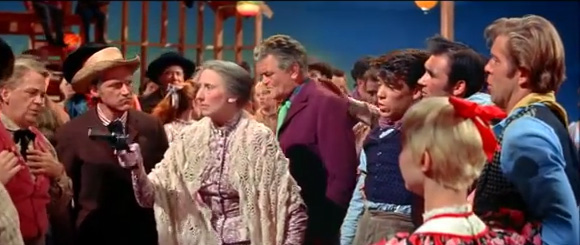
Aunt Eller meant business when she had to “encourage” everyone to get along.
When I first started meeting people at the ProComm conference, they assured me, as a first-time attendee, that this was a friendly group and it was easy to get to know others. This proved to be true. Just like the STC Summit and other conferences I have attended, the people were friendly, helpful, intelligent, and eager to “talk shop” with each other. I welcolmed that, and have found that these sentiments seem to be universal with all technical communicators. However, as time went by, that difference and angst between the academians and practitioners, while mild, was still palpable. The entire conference, I had a song running through my head from the American musical, “Oklahoma” called, “The Farmer and The Cowman (Territory Folk)”. (If you haven’t seen the musical before, you can watch the YouTube video of the song.) Essentially, the message of the song is that the two groups really had the same interests at hand in the end, and they needed to learn to cooperate more to make the goal of being the new state of Oklahoma work. I’m hoping that my role in this, on some level by opening up this conversation, is that I play the role of Aunt Eller from the same musical. She gives the advice at the end of this song by singing,
I’d teach you all a little sayin’
and learn the words by heart the way you should,
I don’t say that I’m no better than anybody else,
but I’ll be danged if I ain’t just as good!
😉
The Living Bridge at the University of Limerick. Looks like a good place to start.
While I don’t think our difference as as strong as the farmers or the cowmen of Oklahoma, I’d like to think that we can come together much more easily and bridge that chasm more quickly and completely. We all have the same goal, after all–to continue to make technical communications a top notch field and create superior technical communicators. How can we go wrong with a goal like that?
My own view is that more needs to be done to connect academia with practitioners. I know that the STC-PMC, for example, has been very active in the past year working with technical writing students at Drexel University in Philadelphia. They are always looking for more local schools to connect with. I’m sure there are other outreach programs out there, but how many exactly, whether it’s through STC or IEEE or any other professional group out there? I know that I’m going to try to reach out to my own program at NJIT in the next week and see if I can offer any help. What can you do?
What do you think? I know a lot of my readers fall on both sides of this issue, and several straddle both. I’d love to hear what you think, and let’s get the conversation started on this!
This week’s online module for my digital marketing class was about user experience (UX) and marketing. I realized after taking this module that I know a lot more about UX that I thought I did, as it’s something I do every day either at work or even with presenting this blog. I had studied UX in grad school, and I remember doing the heuristic evaluations and discussions in visual design classes, but to realize that much of this is now second nature is a little bit of a relief!
The instructor for this module was Ronnie Battista, an experience design strategist for Slalom Consulting. He explained that UX is still evolving, as there doesn’t seem to be an agreed upon definition of what UX really is.
Battista explained that people, ultimately, are the most complex interfacing systems in the world! Within all those interfacing systems, there are three general types, namely
Human, such as HCI (Human to Computer Interface), such as kiosks, devices, advertisements, and websites
Industrial, as in industrial design, which are physical objects. Best example I could relate to items that include ergonomic design.
Service, which comprises of both online and offline parts of a service experience, such as the end-to-end experience visit to a theme park to make the experience as easy flowing and enjoyable as possible.
User experience drive behavior and action, so Battista said that UX needs to address who your audience is, what does your audience need to do, and your efforts to help the audience to that. The end product needs to be user-centric. There needs to be a user design lifecycle to complete this, meaning a series of steps done in order to get from start to finish whereby management is consulted, but the client is consulted again and again until it’s done right.
Battista explained that there are many ways to create these steps, but the basic plan that is taught in the Rutgers program is this:
Contextual Inquiry , meaning “professional people watching” – seeing how people use or will use the product in action
Set design goals
Design User Interface
Evaluate design models
Build prototypes
Test Prototypes
Evaluate test results. If the test results are negative, start back at step 4 and repeat until you get it right!
This is something I’m fairly familiar with as a content strategist and web publisher–I do this with my internal clients often, and sometimes it’s a nonstop tweaking that never seems to end! Sometimes the design goals are limited by the content management system (CMS) that is used, so I have to be creative and work within those system parameters.
Battista continued to say that we have things that can work, and some challenges, but there are some things to keep in mind. Things are changing fast because business is about being fast. Big companies are having a hard time with this because it forces cultural changes. However, UX is seen as the innovation driver, and it’s becoming integral to many business/IT roles. Tool-time UX software is getting very good, as software options for UX research, design, and evaluation are exploding to the point that most of the UX work being done is commoditized. Big Data is a “Big Brother” that knows big things about you, so analytics come into play giving deeper insight almost to the creepy factor, but it can be seen as better than some qualitative insights.
In the end, it’s all about customer satisfaction and providing the customer with what he/she needs! It promotes brand loyalty. Battista gave a great example of a friend who was a diehard loyal fan of a particular car brand. When the brand wouldn’t reimburse the friend for a recalled part after two years, the friend said that they lost a customer. Coincidentally, the friend ended up in another car brand’s commercial praising his customer experience with the other brand after visiting a “confessional” booth at a dealer.
Journey mapping is needed to figure out how to create the experience. Many companies start with a system or software and work backwards, when it should be figuring out the experience and then deciding on which software or system meets that need. Battista quoted Forrester Research saying, “In order to break from their tunnel vision, complex companies need to understand their customer experience ecosystem.” Sounds familiar, doesn’t it?
Journey mapping is taking the idea of customer personas and walking through what their journey/experience is with your brand, from start to finish, whether they are happy with the product or you need to make up for disappointing the customer.
Battista said that good customer journey maps rely on these seven factors:
Establish goals and outcomes
Do not limit mapping to actions
Represent the customer perspective
Treat it as a research project
Combine qualitative and quantitative
Build to communicate
Executive ownership & governance
Going through these steps and paying attention to the details of the customer journey help with a more positive UX outcome.
So how does UX fit into marketing? Battista said it depends on how well it’s done, and it’s not always well. UX and Marketing generally are basing their evaluations on similar requirements, but perhaps from different approaches. Most importantly, though, UX should be included in the inception of the process, not at the end. He added that when dealing with agencies, you must ask what they are creating and why (understand the ROI), own the cross-channel experience (any breakdown in the total experience spoils the entire experience), REALLY understand your audience, make sure that the customer has a real voice that people will listen to, get educated (learn to understand buzzwords and trends), take control of measurement and evaluation, and exhibit self-awareness and appropriate selfless-ness. Most importantly, never forget PEOPLE.
Lastly, as part of understanding personas, he pointed out that digital natives are used to not having privacy issues the same way “old timers” do, meaning that they are more willing to share and provide information that could be seen as compromising privacy. As a result when looking at the bigger picture, there is a question of how people are digitally connected and the information they are willing to share now.
Battista concluded with the statement, “Digital strategy should be an imperative!” I couldn’t agree more!
Overall, while there were some of the deeper marketing elements that I needed to pay more attention to, as a content strategist, the basics were easy for me, as much of this, as I mentioned, is what I do on a daily basis. While I knew I had the ability, I hadn’t thought of UX strategy as being one of my strengths in my skill set. After this module, I’m thinking it is now!
I’ve got three more modules to go, a final exam, and a capstone project, so the end is getting closer! Stay tuned for the next module, which will be online customer acquisition. Since I’m starting to feel that starting my own consulting business is in the cards later this year, this will be a unit I’ll pay very close attention to.
One of the things that I hope I can do more often in 2013 is attend more tech comm conferences. There are always really good speakers, and I find that I truly learn so much from them.
Joe asked me to pass along the following information:
I’m writing this note to let you know that registration is open for the WritersUA conference….We will be in Seattle, March 7-8. This will directly follow the ConveyUX conference that I am managing for Blink Interactive.
You can find all the details here: http://writersua.com/conference. Early registration discounts end on Saturday. I’m use a different format for the WritersUA event that offers a more affordable price and a reduced time commitment….Also, I’m hosting a number of free webinars for community groups. If you belong to a group that might be interested, let me know.
Thank you, Joe
I looked at the website, and it IS one of the more affordable conferences, and I know several of the speakers presenting during the event, and they are all top notch! So, if you fancy a trip to Seattle in March for some great tech comm info, check it out!

 I made my website conversational. Here is what I learned.





 TechCommGeekMom
You must be logged in to post a comment.