My husband and I had a rare date night last weekend to celebrate our 15th wedding anniversary, and we celebrated by going to Philadelphia to see British comedian Eddie Izzard. I love Eddie Izzard’s style of standup comedy, because he mixes up intellectuality with the absurd, and it works brilliantly. If you don’t believe me, go to YouTube, do a search on him, and watch any of his routines. (Two are at the bottom of this post–read on.)
During the show, he talked about how he’s been learning several languages so he can deliver his routines in several countries. He’s already fluent in English and French, and he recently added German to his list, with Spanish, Russian and Arabic planned for the near future. That’s fairly ambitious for anyone to learn so many languages! However, as he started to use other languages, he’d run into some issue.
He’s retold the story for interviews as well, so here’s how it was described in the Boston Globe, which is better than I could muster:
Performing stand-up in another language isn’t as simple as translating the words. Particular phrases that have certain weight or provoke specific images in English can fall flat in another language. Izzard found this was true in his shows in Berlin. There is a routine in his current show about aging, how when people are young, their bodies are trim and fit, but as adults, “our bodies are like two weasels covered in gravy nailed to the back of a tractor.”
When a joke depends on wordplay like that, it tends to fall flat in translation. When Izzard does a literal German translation of it, his speech is full of spiky consonants. “It took me ages to learn to say that phrase,” he says, “and then I found once I was saying it well, the Germans would just stare at me and go, ‘What?’ There was too much wordplay. So I had to change it to, ‘Our bodies are like two washing machines filled with frogs that have been sat on by elephants.’ ”
Because he had to translate it and make sure it worked, “Force Majeure” is the first of Izzard’s shows to be completely scripted. His brother, linguist Mike Izzard, helped him make the transition into other languages.
He will have no such concerns doing his usual improvising in English. “Certain bits in English I’ve actually sorted out, ‘Well, that actually flows well,’ ” he says. ‘Whereas some bits are designed to be extemporized each night, to be improvised each night.”
What does this have to do with content strategy? It’s a huge part of it–TRANSLATION AND LOCALIZATION. Izzard found that merely translating his material wasn’t enough. It would lose its meaning and impact if translated word-for-word into German. Even during the show I was at, I heard him correcting himself a few times by catching himself using British terminology and switching it to American terminology for better understanding. As the Boston Globe article said, in order to make sure that the show he’s presenting now is fairly standardized, he had to come up with a strategy–in this case, a full script rather than only a mental outline of topics to cover in order to make the content consistent, thus making it easier to translate. By writing a script, he’s single-sourcing his content so his audiences can have a singular experience. But in translation, he realized that localization is a big part of it, whether it’s changing from British phraseology to American phraseology, or changing the story a little so it fits better in the language, as he had to do for German in the example above.
The view from our seats at the Forrest Theater in Philadelphia, PA, 3 May 2014.
As we develop our own content strategy, translation and localization need to be a big consideration, even if you don’t think it will be a concern. It can have a big impact on your message, as Eddie Izzard discovered.
And if you don’t know understand this yet, I think we’ll have to get Mr. Stevens to straighten things out. PANG! See these Izzard videos to understand the power of Mr. Stevens.–see part oneand part two. (Note: NSFW language used, but pretty funny. He did a different variation of the Mr. Stevens song for us to the tune of “America the Beautiful,” which I liked better than the version presented here in part two. Localization for the city where the US declared its independence. 😉 )
My husband found this on Digg, and shared it with me. Yes, English is crazy, but we love it anyway. 🙂 It’s no wonder that we have translation issues with it sometimes!
Watch this video and enjoy:
I could’ve have sworn that I had the video below posted somewhere on this blog as well, but I couldn’t find it. This one is great as well.
Sarah Jane Smith of Doctor Who is gazing into her crystal ball, trying to figure out why the 3rd Doctor and the Master aren’t going at it with more mobile tech.Happy New Year! Welcome to 2014!
I had set several goals for 2013, and for the most part, I achieved many of them. Due to finally having a job this past year, I was able to pay for my new kitchen outright (okay, we saved on labor costs because my multi-talented husband installed everything–and I mean everything–except the Silestone countertops), so I have a new kitchen that I love. I definitely travelled more, as I visited Atlanta for the first time in 21 years due to the STC Summit, and I got to visit Portland, Oregon again for Lavacon. I didn’t get to go to the UK, however. And I still don’t look like a supermodel yet.
My 2014 goals are still fairly ambitious, I think. I would like to build upon my web publishing experiences at work, and figure out how to become a content engineer, rather than merely a content manager. I’m hoping that attending the Intelligent Content Conference in San Jose, CA this February and attending this year’s STC Summit in Phoenix, AZ will with help with that. I’m not sure if I’ll be able to make it to Lavacon again until later in the year. I still want to go to the UK, but I think I may have to wait a little longer for that. If there’s a way to combine a vacation and a conference there at the same time, perhaps I can pull it off later in the year instead of going to Lavacon (just to vary things up a bit). I had hoped to become a certified Muse expert last year, and that didn’t happen. Perhaps I can try this year. I also got the “WordPress for Dummies” book this year, which has inspired me to become more expert at using WordPress. I currently use the version hosted by WordPress itself, but I think it might be helpful to understand how the independently managed version works, too. If I can achieve some weight loss in the process during all of this, I will consider 2014 a success. 😉
As for predictions for 2014 in tech comm, I decided that I would be a little more analytical about it. Two years ago, it seemed that the push in tech comm was that we needed to think more carefully about content management reuse of content, and think in terms of mobile content. This past year, that was extended to translation and localization of content, taking it a step further. So with those concepts in mind, what’s the next step? In my mind, it’s implementation of all of these with more vigor. Some companies are on top of this, but it wouldn’t be surprising to me if many companies–even large, global companies–are not on top of any of this yet, or on top of it in an effective way. I think about companies that I’ve worked for in the past, and how, despite their size and availability of resources, these companies wouldn’t be cutting edge in distributing content for desktops or mobile, and regional sites were not as localized nor standardized as they should be. So, in my mind, this is the year of implementation.
Another thing to consider is technology changes. Over the past few years, we’ve been adapting not only to desktop or laptop interfaces, but we’ve also been adapting to more mobile devices like smartphones and tablets. Marta Rauch, a technical communicator friend of mine who is part of the Google Glass beta testing, pointed
out that 2014 is due to be a year in which even more portable, wearable mobile devices will become relevent. These devices would include something like Google Glass or similar products, but it also would include devices like Samsung’s wristband device or devices that are synchronized with car components. She’s got a point. Components are getting smaller, and technological portability is becoming more and more mainstream all the time. How do we decide what content is most user-friendly, reuseable, streamlined, and pertinent for these kinds of mobile devices? It’s something we need to start thinking about now.
“Riker to the Tech Comm community–are you there?”
So there you have it. At least in my mind, if we aren’t all wearing Comm Badges like in Star Trek by the end of the year, I don’t know what this world is coming to. 😉 But it’s hard for someone like me to figure out where the future is going. I’m grateful there are those who are on the cutting edge that can help me figure that sort of thing out, and can educate me on the latest and greatest so that I can bring it to my own workplace, as well as talk about it here on TechCommGeekMom.
I’m sure that there will be plenty of surprises coming up in 2014. As I said, I have three conferences that I’ll be attending in the first half of the year, and I know with the continuation of this great work contract I have, I will probably be learning a lot of new things through that opportunity, too. My philosophy is to never stop learning, and I plan to continue to learn a lot more going forward in the coming year.
What are you predictions for the coming year? Am I on target, or off-base? What did I forget to mention? Let me know in the comments.
Val Swisher was the next to last individual to speak at the Adobe Day at Lavacon 2013 event. For those who are regular readers of this blog, you know that my love for all things Val Swisher has no bounds. I’ve always been able to take her easy-to-digest information, and absorb it quickly into my brain, as well as relay her knowledge to others. When I looked at Portland Gardens to compare her to, I chose Ladd’s Addition Rose Garden. While it’s not as well-known (unlike Val, who is very well-known), this particular park, according to The Rose Garden Store, was one of four rose gardens especially built from the Ladd estate, in which the design included these gardens coming together to form the points of a compass. I often think of Val as my compass, as she has never steered me wrong with her information or with the wisdom and fun that she’s shared with me one-on-one.
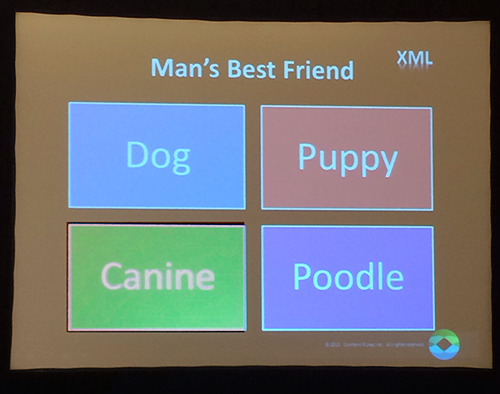
Val’s Adobe Day presentation centered on talking about source English terminology in a multi-channelled, global world, and how terminology affects structured authoring, translation and global mobile content. She started the talk by reminding us that historically, we’ve always created content, whether it’s been on cave walls, through stenography, through typewriters or eventually on word processors. In every instance, consistent terminology has been essential for structured authoring and content. Managing terminology is also essential for translation and for reuse. She stated that prior attitudes used to be that the more complicated the writing was, the more “fancy” the product was. Today, that’s definitely not true. She used the example that I’ve heard her use before, but it’s so simple itself that it’s a classic. Her example involves writing for a pet website. If multiple words meaning dog are used, there can be problem with reuse, because you can’t reuse content if you use different words.
Here’s the example Val showed.
Val pointed out that it would be an even worse situation if technological or medical terminology was used instead.
Val continued by saying that when it comes to XML, reuse , and terminology, you cannot realize the gains of structured authoring if you’re not efficient with your words. Terminology is critically important to gain more opportunities.
Val Swisher explaining how to approach content from a translation perspective.
Translation comes down to three elements– we’re trying to get better, cheaper, and faster translation output. We MUST use technology to push terminology and style/usage rules to content developers. In order to make it cheaper, we need fewer words, reused words, and reused sentences. It’s impossible for writers to know or even know to look up all term and usage rules. We MUST automate with technology. For example, “Hitting the button” is not translatable, but “Select OK” is fine! She said, “Say the same thing the same way every time you say it.”
For better translation, translation quality needs to improve and meanings need to match in order for better machine translation to be a possibility. Bad translation comes from the source itself. If the source information is problematic, then the translation will be problematic. The best way to save money and time is to say the same thing, every time, using the same words, and use shorter sentences. For machine translation, don’t go over 24 words in a sentence.
Faster translation is seen as content that takes less time to translate, needs fewer in-country reviews, and gets to market more quickly. The key to delivering global mobile content is responsive design, global mobile apps, text selection is key, and terminology is the most important element. Val showed this example of how translation in responsive design isn’t working, where the Bosch websites are not exactly in synchronization:
The mobile website on the left looks nothing like the English language version on the right.
The simpler the design is for the website–especially in mobile, the less you have to tweak it. This is especially true where consistent terminology is important, because consistency is needed for structured authoring. Creating truly faster, cheaper, and better translation enables a true global responsive design. This is not a simple task, as there is no such thing as simple, even when writing about complex concepts. Even if you think you’re not translating, your customers are, so the content needs to be very clear. The scary part of this is that some companies use Google Translate as their translation strategy, which is risky at best. To use something like Google Translate as the translation software, the content had better be tight, clear, and consistent.
One of the things I enjoy with Val Swisher’s presentations is that it all comes down to common sense, and she breaks it down into easy manageable parts for those of us–like me–who might not have thought about the context of language for structured authoring, and the consequences for not strategizing content to include translation considerations.
I highly recommend checking out Val’s blog for other great insights.
(As always, Val–if you’d like to add or correct anything here, please do in the comments below!)
International Rose Test Garden – Portland, OR Photo from content.time.com
It’s been more than a week since I attended the 2013 Adobe Day at Lavacon, and like the previous two Adobe Days that I’ve attended in the last year or so, it certainly exceeded my expectations. There’s a lot to digest and write from my notes, plus I’ve been busy with my job, so it’s taken me a while to get things started. I appreciate your patience, as I hope that these upcoming summaries will give you the full flavor of this always free, thought leadership event!
The theme for this Adobe Day seemed to change mid-campaign prior to the actual event. Originally, the day was promoted as being an event in the “City of Roses,” alluding to one of the nicknames of the hosting city, Portland, Oregon. Later, the event was touted as being “a conference at the confluence of 2 rivers,” again referencing the location of Portland. Since this was my second visit to Portland in which I had an opportunity to see much more of the city and surroundings than during my first trip, I decided that I would adhere to the original theme for my postings about the event.
As always, I find it best to start my summaries of Adobe Day with the panel discussion that ended the event, as it provides an excellent starting point for the issues discussed throughout Adobe Day. The panel discussion was titled, “Preparing Your Content for Multi-lingual, Multi-Channel Global Delivery–Challenges and Opportunities.” In thinking about this theme, it reminded me–sticking with my floral theme of the “City of Roses”–of the International Rose Test Garden in Portland. The International Rose Test Garden is the most famous of all the public gardens in Portland, having the most colors and varieties of roses found anywhere for all to enjoy. The Adobe Day panel consisted of several thought leaders in technical communication that resembled this rose garden, as it was full of variety in experiences and opinions.
The Adobe Day Panel and Moderators! From L to R: Maxwell Hoffmann, Joe Welinske, Fabiano Cid, Neil Perlin, Matt Sullivan, Scott Abel (back to us), Bernard Aschwanden, Tom Aldous, Val Swisher, Joe GollnerMaxwell Hoffman of Adobe calling out a raffle ticket number
After an audience drawing for door prizes conducted by Maxwell Hoffman of Adobe for “Made in Oregon”-type prizes, the always nimble Scott Abel (aka The Content Wrangler) moderated the panel. I will admit that questions and answers were going by so quickly as to squeeze in as much information as possible that I was unable to tell you who said what for the most part, but I’m going to provide you with the main summary of the lightning fast conversation. I’d like to thank the following people for also tweeting the event, which helped me confirm my own information as well as fill in some blanks for information that might have slipped by. I’ve included some of their findings in this post:
(Be sure to check out all the Twitter connections of these fine people and the panelists! Lots of good ideas shared by these people!)
Questions and answers were as follows:
Q: What does it means to be global ready? A: Global ready means being able to operate anywhere in the world, ready to be translated easily, and that content being to be able to be structured, simple, and consumable. Other benefits includ knowing your audience well, as this way, content will be more consumable by both native and ESL (English as a Second Language) speakers.
Q: What is the single biggest challenge preventing us from reach global audiences?
A: The current mindset, rapid change, and a lack of strategy were listed as the top challenges. It was also noted that the voice that companies use now, such as cheeky language, isn’t working. We aren’t thinking strategically, so we need to think about the whole life cycle of projects and getting out of thinking in “silos”.
Q: What can we do to prepare for both human & machine translation?
A: Simplifying sentences in a grammatically correct way is a big way to help. Sentences should be 24 words or less. We need to also decide whether to use original content or not, what kind of content, what volume, etc. Content needs good globalization methods with translation and localization.
Q: Is it possible to create consistent tone and voice that will translate well across cultures, and if so, should we?
A: We may not be able to do it for all audiences, but you need to try.
Q: What is multichannel publishing exactly?
A: It is making maximum use of technology to create translation of content. This includes writing code to code, spoken to written, etc. You need to create a single, consistent source for what you are doing. As we break content into chunks for reuse, we have to take into account corporate culture and practices.
Q: What are the biggest challenges facing organizations that seek to publish content to multiple channels?
A: The biggest challenges listed were internal obstacles, such as no one wanting to change, “this is the way we’ve always done it” attitude. The is a need to understand that times are changing, so content needs to change with the times. Content may be outdated and it need to keep up. Writers can be a problem as well, as the content we create isn’t necessarily the content we consume. Customers can consume content in ways that we (the writers) don’t, so we need to be mindful of that. The people who are consuming content today are not the people who were consuming it 5 years ago. The content that you put in your help files also has to be on Google, after all. It was recommended that writers use SEO words in Google that customers use, and that will help writers understand context and how to craft our documentation for customers, as “Google-ability” affects context. Keywords are often created post-publishing, so we need to be proactive before publishing to have the advantage. If you manage your keywords, you can help with findability.
Q: What are the not-so-obvious opportunities of multichannel delivery?
A: Opportunities taking advantage of non-text items are the best opportunities right now, such as automated graphics that adjust to a device display. A table of contents for video can actually help in documentation, since end-users don’t have a long enough attention. Indexing multimedia should be made as part of the product. Further action also need to be taken to expand on the idea of being able to start on one device and continuing on another, like Kindle, as this has not explored enough yet.
Q: What’s the biggest mistake an organization can make when moving to a multichannel global content delivery?
A: Organizations tend to look internally, instead of getting outside input, such as learning things from conferences (like @LavaCon ). Mobile delivery is very different in different countries, so we need to do it in ways other than American. We need to find balance if one aspect is overfocused. The biggest mistake is thinking that everyone is like us (Americans/North Americans). They’re not! Strategy and planning from the start is key! We need to also learn from what’s working and what’s not, and go from there. It’s important to stop and assess procedures, and then add on more. There is a strong need to clean up practices. It comes back to knowing your audience–its symbols, language, culture. Testing is the best way to see if your audience are getting the benefit of the content you are putting out, and making sure it’s usable.
Q: How does one write consistency to reap those benefits and be consistent with SEO?
A: Writers need to know what language your customer is looking for you, and find a balance between translatability and vocabulary. Metadata is important inside as well.
Q; Are there tools on the horizon that will help with those symbols, icons, etc. that could not be good for translation?
A: At this point, no software as of yet. It’s mostly people based right now, but evolving software does exist. Precise content has its benefits including accessibility as well as fluid machine translation. Interaction types (voice, touch, text) will be a big part of how you integrate with content for global audience in mobile, although it’s not limited to mobile. Consideration of various screen sizes will be key. Think your online help is the first place your users go for answers? Unless your help shows up on Google, think again.
You have to admit, it sounds like quite the conversation, and it was!
Next in the Adobe Day -Lavacon 2013 coverage: Matt Sullivan’s presentation.














 TechCommGeekMom
You must be logged in to post a comment.