NJIT’s MSPTC program in the house at #STCPMC14! L to R: Dr. Bernadette Longo, director of the MSPTC program; Jamil Wilkins, current MSPTC student; Danielle M. Villegas, MSPTC alum and STCPMC presenter.
In a nutshell, the 2014 STC-PMC Mid-Atlantic Technical Conference was better than last year, in my opinion! A slightly different format, a different day, more networking, and excellent speakers made for a fantastic event.
Okay, now for more details.
First, having been a member of the conference’s planning committee this year, I know that a lot of work went into making this event a success. Kudos to my fellow volunteers! Special care was taken to choose the best proposals submitted, and it definitely was reflected in the best of the best! There were so many great subjects to choose from that even among the presenters, some were saying to each other, “I want to go to your presentation, but I’m presenting at the same time!” I think some of the attendees also had hard choices to make, since sometimes they couldn’t decide between topics during a given session!
Nicky Bleiel, who is currently the President of the STC, gave the keynote address for the conference. She talked about flexible content with responsive design. The main message of her talk was that with responsive design, technical communicators can create and deliver a single responsive output that will work on thousands of devices, including new devices, old devices, and even ones that don’t exist yet. She showed us a few examples, such as Microsoft and Lycos websites in which the content remains the same, even though the output in different browsers changed to work with the size of a particular browser size. Many companies started making separate mobile sites, but the content was not the same as the full site. Responsive web design is Google’s preferred configuration when ranking sites. Mobile users want content parity, meaning they want everything that desktop owners have, thus they want one Web. Fluid layouts, fluid images, media queries in the coding, and stacking or collapsing grids are the key to creating responsive design.
During the first breakout session, I gave my own presentation, “Blogging Out Loud: The Basics of Blogging,” so I didn’t get a chance to see anyone else’s presentation during that time, obviously. I did have a lot of people in my room, which pleased me, and we had a great discussion during the question-and-answer time. It was a great group, and smart questions were asked.
After a lunch break filled with awards, volunteer recognition, food, and networking, I chose to attend Todd DeLuca‘s talk about volunteering your way up the career ladder. Todd kept the presentation fairly open, sharing some of his own insights about volunteering from his personal experiences and how they were able to apply to his professional life. The group attending participated by sharing ideas and experiences themselves about volunteering, bringing about a great conversation. Todd’s main idea was that it doesn’t matter how big or small the contribution, or if the volunteer opportunity is inside or outside of work. The experience fulfills you when helping others, but also fulfills you by allowing you to gain skills and experience that helps yourself. I think one idea he presented resonated with me, which was that volunteering is an offer to help, but it’s also a promise that evolves, as it’s a commitment that is followed through and builds trust. I also liked his point that volunteering is a safe environment to grow because usually there is less risk and some mistakes are expected, so the environment is often more nurturing than work. That’s a great environment to learn! Todd has been volunteering for things inside and outside of his job for years, related to tech comm as well as unrelated, and felt that he’s reaped benefits that apply to where he is professionally. I know that Todd will be speaking at the 2014 Spectrum conference for the STC Rochester chapter in a few weeks, and he’ll also be speaking at the STC Summit on this topic, so I encourage you to attend to get more details and ideas!
The last presentation I saw for the day was by Neil Perlin. Neil and I have known each other through both e-learning and tech comm social media circles for a while now, but hadn’t met before. It was a real treat to meet and chat with him, but to also hear him speak, as I know he’s rather popular on the e-learning and tech comm circuits. Neil’s talk was about emerging technologies, which is a subject he’s excited about and presents frequently. Neil covered a wide range of topics that are currently in use now and look to be expanding in the future. These topics included more mobile content that needs content strategy to steer it, more use of analytics to understand what our users need and use, using social media extensively, augmented reality, wearables, the use of the “cloud” and cloud-based tools. He also stated that there is a need for standards in order to future-proof our materials to avoid problems as technologies come and go, since it’s so hard to predict what will everyone use. He advised us to stay current by going to conferences and staying on top of general business issues and trends. Business issues can kill a technology, so staying current on your company business is a show of tech comm’s support of corporate strategy. His last bit of advice was to review your tools regularly for environmental change, accept the rise of content and social media, don’t denigrate tools in favor of writing, and embrace and help shape change!
After the conference, WebWorks and Publishing Smarter hosted a nice post-conference get-together at the Iron Abbey, a pub-restaurant down the street from the conference venue. It was a great treat of libations, appetizers, and networking further with tech comm peers.
Overall, it was a great experience. I liked the format this year because it felt more relaxed with fewer breakout sessions. Presenters weren’t rushed as they often are at events like these, and more time was allowed for networking with everyone. Perhaps it’s because I’d had a different experience last year as a total newbie that it was so different to me, but I don’t think so. The topics of the conference, the agenda, and the camaraderie of those hosting at the “City of Brotherly Love” came together into a pleasant Saturday of learning. As a smaller, regional conference I think the more intimate setting helped it be a more personalized experience for all, thus it was a big success.
(To any of the fellow speakers I reviewed here–if you’d like to add or correct anything that I summarized here, please feel free to do so in the comments area below!)
If you are in the Philadelphia area next year around mid-March, I highly recommend coming to next year’s STC-PMC Mid-Atlantic Conference. I guarantee you’ll enjoy it.
I came across this via Viqui Dill on Facebook. This is done by Carolyn Kelley Klinger, who is a very active member of the STC. This is a great overview of the potential of tech comm in the coming year. The future’s so bright, I gotta wear shades!
I admit it–I’m a tech addict, even though I can’t always afford to be one. And I’m a sucker for these kinds of ads. See this parody below, which I found courtesy of David Pogue’s Facebook feed–enjoy!:
In the past week, I’ve made two observations about how technology is going through an advancement surge. What I mean by that is that there are big changes happening, and it seems like it’s happening incredibly quickly–at least in my eyes.
The first occurrence was last week. My dad called us because he knew my husband and I had something he didn’t have–more computer knowledge than him. I found it a little ironic, my dad was my first computer teacher in the early 80s when Apple II first came out. My dad, being an educator, was progressive enough to know that these were going to be the wave of the future, and in some respects, he was an e-teacher–an early computer teacher. But here was my first computer teacher asking for help. He admitted that he had let his skills lag, and he was now “a dinosaur”, and didn’t have a clue what he was doing anymore. His desktop had died, but he wanted to retain a lot of information that was still on his old hard drive. My husband declared the desktop was indeed dead, and suggested that if my dad bought a new desktop, we could probably install the old hard drive as a secondary hard drive in the new computer, and that way he could still access the information.
I took my dad to the local Best Buy and Staples to do some comparison shopping. What struck us both is that there were next to no choices at either store for desktop models. Almost everything was either a laptop, a tablet, or one of those sleek all-in-one units. Considering that my dad wanted and needed one of those BIG desktops–not one of the compact ones, the choices were even more limited.
The irony was that once we brought the desktop back to my house to see if we could install the old hard drive into it, we discovered that it didn’t have a bay inside the casing to accomodate it, but it also essentially only had a motherboard, a power source, a fan, a Blu-ray disk drive, and the hard drive inside. That was it. It was a LOT of wasted space for something that was fairly powerful. The machine also came with the “blessed” Windows 8. I’ve had my hesitations about upgrading to it myself, but my dad had no choice, and the poor chap has been using only Windows XP and Windows 2000 up until now, so he was REALLY behind. Our solution to the hard drive issue was that my husband bought a contraption that you can enclose the old hard drive in a special case, and it turns it into a USB-connected external hard drive. So, that part of the problem is solved.
The Windows 8 solution is not. Dad is struggling to figure it all out, and is perplexed at how Windows 8 works in general. He’s not up to speed with the idea of using cloud-based apps for anything, or even using cloud-based storage. Since my husband and I are still using Windows 7 (and we’re safe for now), we can’t advise him on how to use it, even though we can give him some advice on apps and cloud-based apps in general. What’s frustrating for my dad is that my mother is even less computer literate than him (she’s been condeming computers for thirty years now), so she’s REALLY thrown by how to use Windows 8. I sent Dad some online resources including an e-book on how to use Windows 8, and he bought another book, so hopefully he’ll be the expert soon enough.
The second indicator to me that things were changing technologically was the closing of our local GameStop store. Now, to be fair, I live in a very small town–one that’s small enough that I questioned why we even had a GameStop in our town to begin with. We liked that store better than the one at the local mall because we got more personalized service, and we liked the staff there. I was only surprised to see that it had disappeared almost overnight the other day when I passed by the shopping center where it was located. I’m sure the store didn’t get enough traffic to warrant it to stay open, so that wasn’t a surprise. I was just surprised that it was done without a lot of fanfare. Related to that, since the store wasn’t there, my son was itching to get a new game for his Nintendo 3DS, and we ended up looking online for choices. Granted, my son is fussy about what games he likes and doesn’t like, so choices seemed slim. But even from my own tastes, it seemed like there weren’t a lot of choices. Here was a portable gaming system that didn’t have many games, even though it’s the most current Nintendo portable gaming system on the market. That didn’t make sense to me. As I later found out, Nintendo is working more and more on putting out games that can be accessed through the 3DS’s wi-fi connection–in other words, accessed through cloud services, and saved on the device’s flash drive or on the SD card that you can install. THAT’S where all the new games were!
As I thought about my dad’s predicament in catching up to the 21st century and my son’s need for more games, it occured to me that more and more access to media of any kind is becoming dependent on mobile services and cloud services. Really–think about it. As I was finding out from my dad, he could only install or update his Microsoft Office if he subscribed to Office 365–the cloud service. Microsoft has adopted cloud services to deliver its services, as has Adobe. Subscription services are pretty much the main way–and soon the only way–one can get access to this software and applications. It’s rare that anyone gets DVDs to install software anymore–it’s downloaded off the Web now. The same thing was happening with my son. He had better access to games for his device through Nintendo’s cloud services than if he paid for a micro-disk.
These are only two of several observations I’ve made lately that we’re going through a technology surge of sorts that are making what we’ve known and loved for years are quickly becoming obsolete. Tablets, smartphones, and laptops are pretty much the standard now, pushing mobile to the forefront even more. Touch technology is becoming more prolific, even for the all-in-one desktop computers that are out there, putting it on the same level as its mobile counterparts. Even the gaming world is getting the clue, with more games downloaded to smartphones and other mobile devices rather than buying the software. Who buys DVDs or Blu-ray disks anymore when we can download movies and other videos from Netflix or iTunes?
Cloud-based and flash-memory based technology seem to be taking over! Soon enough, DVDs, CDs, and SD cards are going to obsolete like the 5 1/2 inch floppy disks, VHS tapes, tape reels or punch cards! Seriously–think about it–in a year or two (okay, maybe a little more than that), all those things might be GONE.
It’s great that technology is advancing in leaps and bounds like it is. No one is more excited about these advances than I am, in most cases. But I wish I could keep up sometimes! It makes me feel bad for my dear dad, who is getting left in the dust by these advances. I’m sure he’s not the only one.
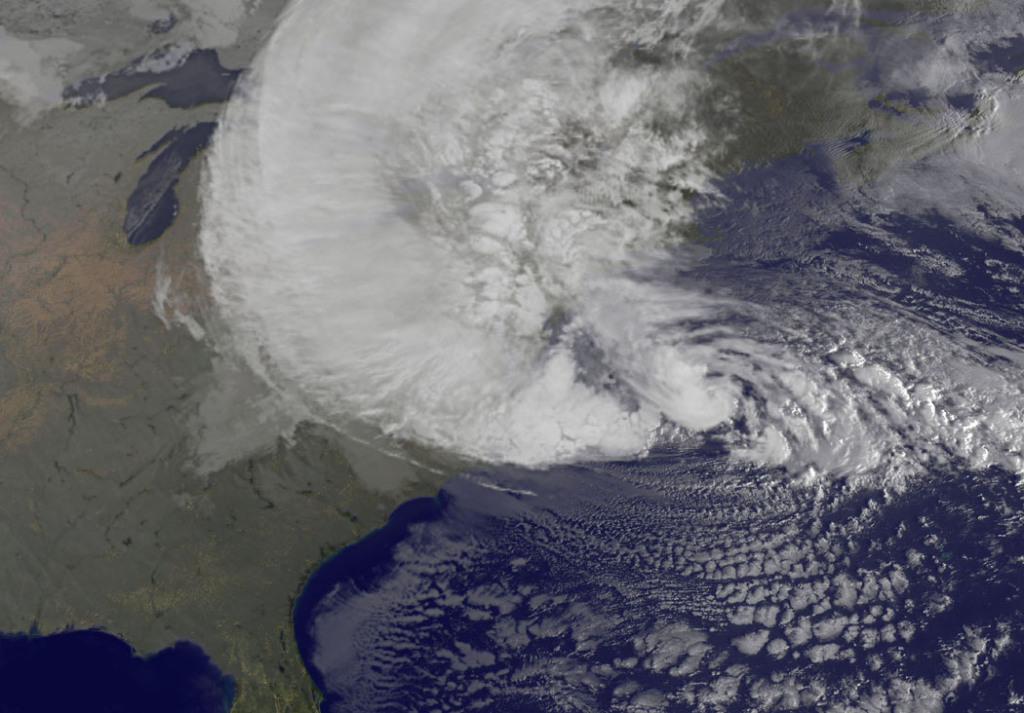
Hurricane Sandy satellite photo as it hit New Jersey
Hello all, and excuse my absence of late! If you hadn’t heard (ha!), Hurricane/ Superstorm Sandy hit the eastern coast of the United States, and headed straight for the state of New Jersey in particular. That means it hit where I live.
I initially started to write this while I was sitting in my car, writing on my iPad while my iPhone was getting recharged using the car battery, but I’m finishing it up on my laptop almost a week later. Hurricane Sandy hit my home, and we were without power for almost four days. A tree fell on our house, but fortunately not through the roof. There was a state of emergency in my town for a couple of days whereby no one was allowed in or out of town. Unless you were emergency personnel, you were not allowed to drive the streets. While we were lucky to get power within a few days (especially with very cold weather setting in), there are still thousands without power where I live, and even those who have lost their homes entirely. I was actually one of the lucky ones. So, you can understand why I might have had other things going on this week. 😉
My house the day before the storm.
Originally, I really struggled with an idea of what to write about this week, but this hurricane made some things very clear, and they are things that needs to be strengthened as a global necessity, not just as a local necessity. This storm made the following very evident to me: mobile technology and social media are critical in this day and age.
I only knew what was happening in the “outside world” and was able to make connections with my cell phone–a smartphone. Granted, the 4G network was incredibly slow, especially in the beginning, because everyone locally was doing the same thing. Something was better than nothing. Since I didn’t have power for my TV or radios, my phone was everything. It made me wish I had a MySpot mobile wifi connection created from my cell phone so that I could transmit the wifi signal to my other devices, but having at least the 4G did the job.
My house after the storm.
In the end, everyone who knows us had a way of knowing that we were okay. Between my husband and I, we texted my brother-in-law, my father-in-law in Ecuador was able to call my husband, and I had sent notes on Twitter and Facebook to let people know we were okay. There wasn’t much more that I could do. Until we had full power and Internet capabilities, I could only recharge my phone on a car recharger and send out the occasional note to update our status on social media. Saving battery life was essential to make sure that we could always be able to communicate. So writing up a blog entry was less important than making sure that our loved ones knew what was going on around us.
We were without electrical power for almost four days, and they were four of the longest days and nights I can remember. You have to remember that I live in a first-world country, where having constant supplies of electricity not only for powering things is commonplace, but it also runs things needed for basic survival, such as keeping perishable foods cold, and providing heat on cold nights (and we had some very cold nights). At my house, having had some Scouting training (I was a den leader for my son’s Cub Scout group for almost 5 years), and just even having a fireplace, we had some advantage. We had done some preparation so it wasn’t so terrible–just terribly inconvenient. There are others, such as my sister, who didn’t have power for more than a week. (She stayed with my parents who had power restored quickly.) There are still work crews from all over the Eastern Seaboard and the MidWest who have come in and have worked around the clock, and continue to do so to still get the rest of New Jersey power again. It is still not done. We’ve become a society that is dependent on its electricity, for sure. But we also have become a society that mostly depends on the power of internet connectivity and having means of communication powered by electricity.
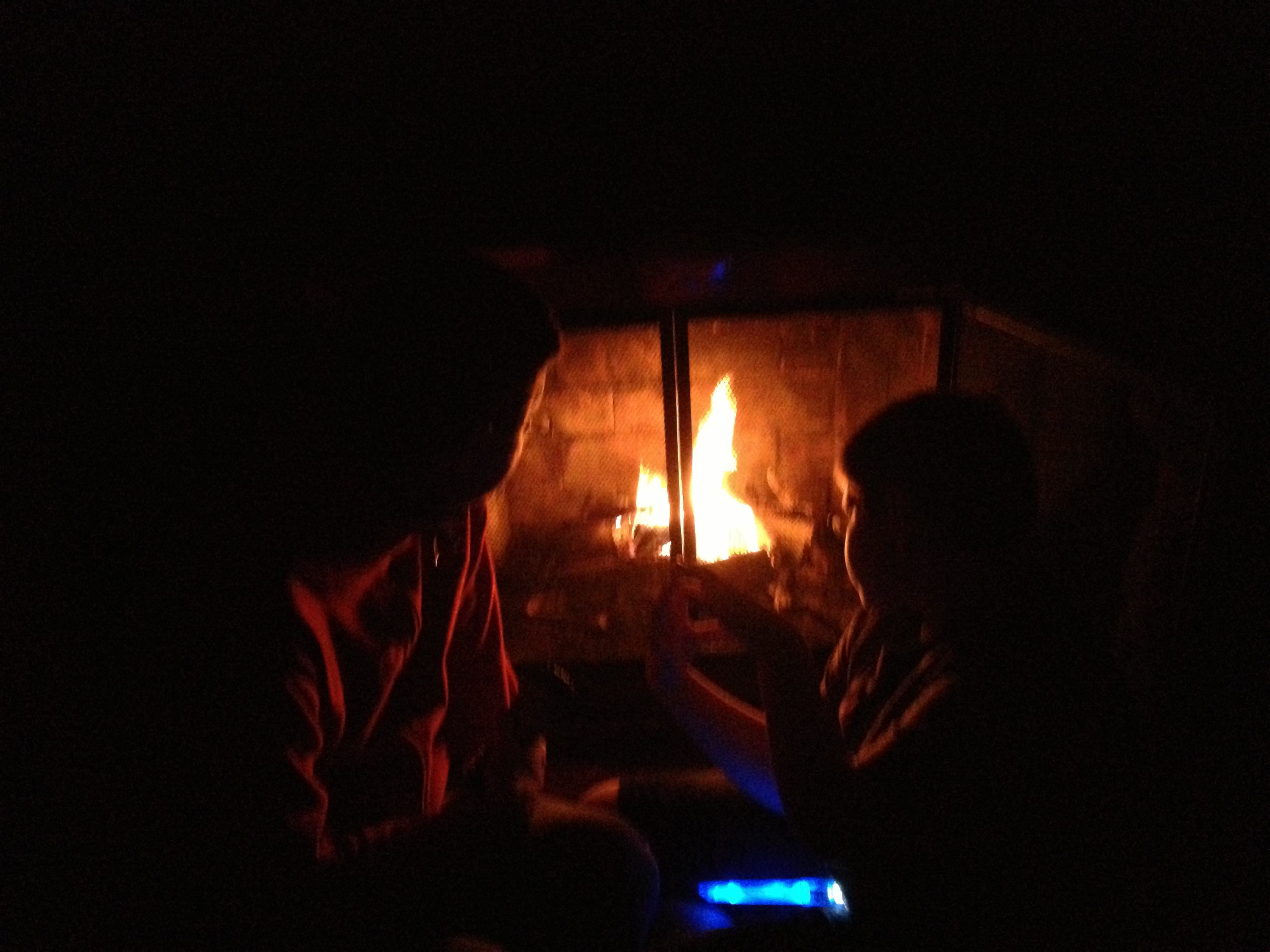
My husband and son keeping warm by our fireplace while we had no power.
Every day that we’ve had with power since it’s been restored, I’ve tried to remind myself about the many people in my state who have lost their homes and/or still don’t have power. I was greatly inconvenienced, but in the end, even with the tree falling on my house, I was still blessed and one of the lucky ones. My town, overall, didn’t sustain the kind of damage that other towns did. The big pond/lake and our town was drained before the storm in order to prevent flooding, and that worked. We didn’t have the water damage or flooding that other places did. Most of the damage we had was due to wind damage, so there were a lot of downed trees that took down power lines. Once trees began to be removed, and crews fixed the wires, then things started to get back in order. As I write this, there is still gas rationing in part of the state, which people need for their cars or even for generators to power their houses until regular service is restored. We’re not quite back to “normal,” but we are fairly close. Schools are starting to open back up for classes tomorrow after a week’s absence, many are returning to work, and shops are opening up again. New Jerseyans may have never been through something like this, but we are a resilient group of people. There is an expression that was often said well before the storm of “Jersey Strong.” That, we are.
But during this storm and its aftermath, I’ve had a lot of time to think about the importance of mobile technology and social media. Through SO much of the storm, my mobile phone was my lifeline to the outside world. Not only could we tell people that we were okay, but if we had been in serious trouble, it was our lifeline out. We would get messages and updates from friends and other resources through our phones. Was the storm over? I could track the storm either through the Hurricane Red Cross app or the Weather Channel app. Was it safe to go out? I’d receive text messages and emails from my town government to let us know what roads were blocked due to downed trees or wires. Where were there shelters if we needed heat, a warm shower and a solid meal? I could find that out as well. What markets had reopened after the storm for food, which gas stations were open with shorter lines, and where could we recharge our devices so we could continue to stay in touch and know what the news was? Different friends who had ventured out told me through social media. Having mobile devices and connectivity made knowing all that information possible. When we needed to have the tree removed from where it was leaning on our house, my husband called up our local tree guy, and his crew was out the very next day. And in a totally 21st century way, having mobile devices kept us entertained at night, as I had loaded up some old episodes of our favorite television programs on my old iPad for my son, and on the new iPad for me. (During the day, we’d be cleaning up our yard and doing other things that would take advantage of the daylight.) Without these modern technological conveniences, it would have been a lot more difficult to get through those days.
But it also got me to thinking about how that technology could have been even better, and where greater improvements could be made. Two things from the technological side were apparent to me. First, connectivity could be improved on a global level, not just at a local level. More communications infrastructure and stronger communications infrastructure are needed to create reliable wireless hotspots. While 4G connectivity was available, it was spotty, and not always reliable during the storm. My husband does not have 4G on his phone, although I have it, so we were solely dependent on my phone for information. A secondary but equally important problem was, however, that using 4G exclusively drained the battery of my phone quickly, especially when the 4G service was very slow. In a stressful and possibly dangerous situation like this storm, that’s a bad thing. I know there are several cities that have wifi service throughout the town, such as Philadelphia. We have many wifi hotspots, but they are not well connected between them, and they don’t reach to households around here. I found, once we had power and connectivity restored, that wifi connectivity on my phone or other mobile devices did not devour battery power on my mobile devices as much as the 4G did.
I started to think of places far, far away from me–and realized this is a global need. How are children in remote places supposed to get electrical power, more specifically battery power for a smart device? And even if there are miraculous power sources for these devices (which there are not at this time, especially in certain regions of the world), how would these children connect to the rest of the world? Both improving battery life/power sources for mobile devices and improving the infrastructure for internet communication are key. It all needs to be set up in such a way that it doesn’t cost a fortune, is readily accessible, and can literally weather anything. It should be similar to using a radio–we can still get AM and FM signals, but we need a wifi version of this. I know that the network services in our area, especially AT & T and Verizon, said they were doing their best to provide and repair the 4G and LTE services damaged from the storm. Okay, I understand that. But in the US, as well as everywhere else globally, we need to start thinking about how to step up the technology so that getting wifi signals are as common as getting an FM signal on a radio. I’m sure that this is technology that is being worked on, but I feel like this storm proved that point very much. Perhaps the internet access providers needed to get ready for the storm by temporarily increasing the network bandwidth and boosting those wifi signals already present. I’m sure that I will be charged an arm and a leg for the amount of data I did use during this time, and the provider companies won’t be giving any storm discounts of any kind under the circumstances.
The other thing that became highly apparent was the importance of social media during this time. It was one thing to receive text messages and emails from my local government (I signed up for emergency messages), loved ones and friends, and to have access to a tiny web browser on my phone, but social media, especially Facebook and Twitter were essential! It was an easy way for me to check in with everyone who needed to know how my family was doing, but also for me to know how all my friends and family were faring as well. Even now, those family members and friends who are still without power are posting status updates letting us know that they are safe, with family or friends with power, or if they are toughing out another cold night. As I mentioned earlier, it was through social media venues that I could see the scale of the storm, through various messages posted on a continual basis. We found out that our local supermarkets were open through Facebook with fresh food, warm place to stop, and outlets to recharge our devices. It allowed communities to come together–multiple communities–to help each other. As I write this, it continues to be working. Posts on Twitter and Facebook are still working to gather supplies for those who are in more trouble than us, provide information for those who seek a safe shelter until their home is habitable again, and moral support, too, for each other. The power of social media is incredible.
When I took my social media class last spring, there were several purpose categories in which social media communications fell, namely broadcasting the self, the netizen, participatory culture, or how social media related to work/labor. To me, there were instances were all these purposes were used during this storm. Social media users broadcast about themselves, providing status updates on their well-being. The netizens were the local governments and other information providers such as internet news agencies, or even Twitter feeds of local government leaders (like Newark mayor Cory Booker) who kept apprised of his city’s situation by staying in constant contact through Twitter to help citizens who had extra needs. All social media users who got through the storm were part of a participatory culture, namely, they were part of the group of “storm survivors” that grouped together. It related to work because we could see how the power companies and other service companies were keeping their customers informed about the progress they were making with restoring power, and would ask customers for feedback on which areas needed more help. Even if one barely posted anywhere on any social media outlet, one could easily understand the breadth and width of this storm’s impact merely by reading the feeds coming from these outlets. I had more information that my husband at any given time because I was looking at all of this and absorbing it, whether it was for personal safety or just for information. It was invaluable, and truly emphasized the importance of social media not only now, but going forward.
Mobile technology and social media were essential in helping my family get through this storm, and it benefitted millions of others through this storm as well. Both of these things continue to be vital as the job is not done in recovering from the storm.
As technical communicators, I think you can see my point, but there is yet another point in which technical communicators are vital in pushing our agendas in our field. That is, helping to provide concise, cogent, correct, and clear information for our end users. One of the problems that I encountered with various apps and communications was that they were so poorly written and explained that sometimes it was difficult to understand the information being provided. This is part of why social media was so vital–there was more of a conversation among users to clarify what a website said, or what a communication said. So many who were providing the information were clearly not writers or natural communicators, and this in itself could be dangerous in certain situations. I’m hoping as we recover from Hurricane/Superstorm Sandy, as a technical communicator, I can try to push the agenda that experienced social media writers and technical writers are needed so that information is provided in a clear way that all people can access it easily, whether there’s an emergency or not.
I hope that technologists are working to make the means of communication stronger with stronger internet connectivity that doesn’t require much power, and that smart devices available can have stronger battery power so that recharging as often isn’t necessary, especially when needing to rely on those communication networks for information. I think social media has proven itself as a strong communication tool during this storm, and it has reinforced the notion to me that I need to continue to stay tied to it, because it’s not only connected to my career livelihood, but my livelihood at large.
Right now, I just have to try to recover and try to get life back to “normal.” Appreciating mobile technology and the power of social media make me glad to live during a time when we have these available to us. Now, I need to get back into the swing of being more technologically immersed after being mostly “off the grid” for almost a week.









 TechCommGeekMom
You must be logged in to post a comment.