Posted in Uncategorized

Adobe Day @ Lavacon 2013: Scott Abel’s 5 Technologies Tech Comm Can’t Ignore

voodoodonutsignI realized as I was writing this post that this would be my 500th post on TechCommGeekMom. Who knew that so much information and thought could accumulate through original posts and curated content?  I’m also very close to my all-time 15,000 hits mark (only a few hits away at this writing). I wouldn’t have believed you if you told me that I’d hit these benchmarks when I started this blog, but of course, I’m going to keep going! I debated about what I should write for my 500th post–whether to finish my Adobe Day coverage or do something else, and in the end, it seems fitting to finish my Adobe Day coverage, because in many respects, knowing and writing about the presentation of Scott Abel, aka “The Content Wrangler”, shows how far I’ve come already in my tech comm journey from beginner to covering internationally known presenters.

Scott is one of the most prolific and vocal speakers out there on the conference circuit speaking about content–whether it be content management or other technical communication topics.  It also seems like he has written the forewords of many of the best tech comm books out there. He’s everywhere! To boot, he’s an accomplished DJ, and I found myself “bonding” with him over dance remixes and mash-ups while at Lavacon, because I always enjoy when he posts either his mash-ups or his favorite mash-ups on Facebook. (I’ll be writing a post about the relationship between tech comm and dance mash-ups in the near future.)  He is a person who is full of so much kinetic energy that you wonder when he’s going to explode, but he doesn’t. Even the time I saw him at the STC Summit last spring with a bad cold, he was still more on top of his game than a lot of people would be on a good day.  Much like Val Swisher, my love for all things Scott Abel also knows no bounds.  He knows how to stir things up at times, but there is no denying that in his frenetic pace of delivering a presentation, you learn SO much. I’m lucky that he’s so kind to be one of my cheerleaders!

ScottAbel
Scott Abel checking his files before his presentation

So when it came to thinking of a garden in Portland to use as an analogy to Scott, I had to deviate. In my mind, he’s the Voodoo Doughnuts shop located about four or five blocks away from the Chinese Garden. Scott’s talks always have lines going out the door, and like many of the Voodoo Doughnuts themselves, the unique flavors dispensed open your mind up to new and delicious possibilities and ideas, and you come back wanting more (hence, more long lines!).  They are both crazy and sweet at the same time. You can’t beat that combination.

Scott was the keynote speaker for Adobe Day as well as the moderator of the discussion panel later in the event. Scott’s topic for his talk was called, “Five Revolutionary Technologies Technical Communicators Can’t Afford To Ignore.”  If Joe Gollner went fast during his presentation, then Scott went at lightning speed, so my notes below are the highlights.

Scott started by telling us that translation is going to be an important part of automated content going forward. It’s important to understand that for the web, the World Wide Web (WWW) is equal to the “land of opportunity.” The WWW can reach a global market reaching new consumers. As American users, we forget that 96% of web users are not in the US. We don’t all speak English globally. In fact, less than 6% of the global population speaks English well, but don’t necessarily read or write it well.

Scott’s list of the five technologies the Tech Comm can’t ignore were as follows:

1) Automated Translation
Why would be need automated translation? We write for the *worldwide* web.  There are over 6000 languages in the world, so translation is a big deal for a global reach and global connection. We need to recognize that content is written for both machines and humans. Even though we write for both machines and humans, we need to write for machines first, as they are the “gatekeepers” of content, such as for searches. Everything goes through the machine first. We need to recognize that writing rules learned in elementary school are no longer sufficient for a world in which language science is needed.  We need to examine our content from the vantage point of a rules-processing engine and ensure it’s optimized for machine translation.

2) Automated Transcription
Automated transcription involves software that translates speech to text for machine use. Without transcription, content is locked and hidden from view. Transcription allows for better searchability of content.  Scott recommended Koemei as a good transcription software tool for video and general transcription, as it can help transform editable content into other languages.

3) Terminology Management
Terminology management controls words in a central place, namely the words used the most and used consistently for branding, products, etc. Terminology management is important for consistency as well as for regulatory reasons. This is an instance where seeking a global content strategist is needed to help standardize processes.  It’s best to adopt a terminology management system, such as Adobe partner and Scott’s suggestion, Acrolinx.

4) Adaptive content
Adaptive content is content that is structured and designed to adapt to the needs of your customer; it’s about substance of the content. Adaptive content adapts to the devices, e.g. laptops, GPS, and smartphones.  Customers are demanding exceptional experiences, so we need to meet their expectations, so it’s up to responsive designers to meet that challenge. Adaptive content makes it possible to publish to multiple platforms and devices.  It is content separated from formatting information. By allowing authors to focus on what they do best, adaptive content makes content findable and reuseable by others who need it. We need to rethink content, as the move to adaptive content involves work, but the ROI (return on investment) can be realized in months instead of years.

5) Component Content Management
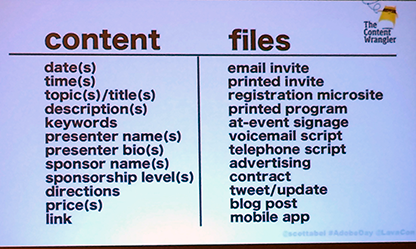
Component content management systems are needed. They focus on the storing of content components that are used to assemble documents. Components can be in all sizes, and can be photos, video, and text. It’s about managing CONTENT not FILES.

Scott provided these slides as his example to show this:
ScottAbel_ExampleA ScottAbel_ExampleB

Structured content, combined with a component content management system, supports personalized content and  targeted marketing, which in turn increases response rates. In this end, this process can save money! The key is to remember that all customers are not the same! Reusing content without the “copy and paste” methods produce the best results. You can ensure that content is consistent by seeking a content strategist who understands content and is a technologist. Implement a component management system. Scott suggested checking out Astoria Software for a good component content management system. 

At this point, Scott’s talk had pretty much finished, but in answering audience questions, he pointed out that there’s a lot more than just these five technologies to watch. He suggested that we should look out for wireless electricity, flexible surfaces, more wireless devices, wearable computing, and augmented reality as well. He also said that in order to mature as a discipline, we need to be content craftspeople, content designers and content engineers. We need to leverage using content and code. We need to think more like engineers, and less like writers and editors. Even websites that are very localized still need to be written for global purposes to improve the English used for the native speakers as well. Controlled vocabulary helps all end users!

Scott covered a LOT of information in a short amount of time, and he set the tone for the rest of the session, as the presentations that followed repeated much of the same information. (This is a good thing, because then we know that the information is valid, coming from several experienced technical communicators!)

Scott posted on Twitter than his presentation was available on SlideShare, but I have it below.

And as always–Scott, if I misinterpreted or misquoted any of the information I summarized above, please let us know in the comments!

Posted in Uncategorized

Adobe Day @Lavacon 2013 – Val Swisher Says It Starts With The Source

Ladds_1
Ladd’s Addition Rose Garden
Photo from http://www.rosegardenstore.org

Val Swisher was the next to last individual to speak at the Adobe Day at Lavacon 2013 event. For those who are regular readers of this blog, you know that my love for all things Val Swisher has no bounds. I’ve always been able to take her easy-to-digest information, and absorb it quickly into my brain, as well as relay her knowledge to others.  When I looked at Portland Gardens to compare her to, I chose Ladd’s Addition Rose Garden.  While it’s not as well-known (unlike Val, who is very well-known), this particular park, according to The Rose Garden Store,  was one of four rose gardens especially built from the Ladd estate, in which the design included these gardens coming together to form the points of a compass. I often think of Val as my compass, as she has never steered me wrong with her information or with the wisdom and fun that she’s shared with me one-on-one.

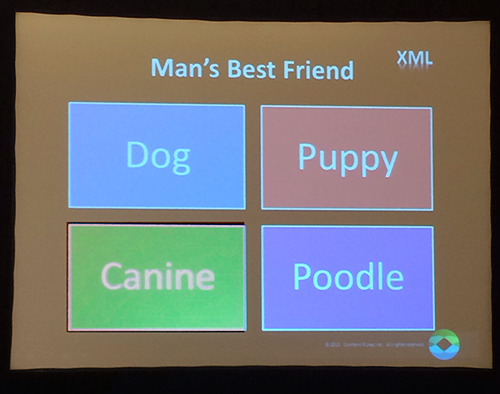
Val’s Adobe Day presentation centered on talking about source English terminology in a multi-channelled, global world, and how terminology affects structured authoring, translation and global mobile content. She started the talk by reminding us that historically, we’ve always created content, whether it’s been on cave walls, through stenography, through typewriters or eventually on word processors. In every instance, consistent terminology has been essential for structured authoring and content. Managing terminology is also essential for translation and for reuse.  She stated that prior attitudes used to be that the more complicated the writing was, the more “fancy” the product was. Today, that’s definitely not true.  She used the example that I’ve heard her use before, but it’s so simple itself that it’s a classic. Her example involves writing for a pet website. If multiple words meaning dog are used, there can be problem with reuse, because you can’t reuse content if you use different words.

Val_example_dog
Here’s the example Val showed.

Val pointed out that it would be an even worse situation if technological or medical terminology was used instead.

Val continued by saying that when it comes to  XML, reuse , and terminology, you cannot realize the gains of structured authoring if you’re not efficient with your words. Terminology is critically important to gain more opportunities.

ValSwisher
Val Swisher explaining how to approach content from a translation perspective.

Translation comes down to three elements– we’re trying to get better, cheaper, and faster translation output. We MUST use technology to push terminology and style/usage rules to content developers. In order to make it cheaper, we need fewer words, reused words, and reused sentences. It’s impossible for writers to know or even know to look up all term and usage rules. We MUST automate with technology. For example, “Hitting the button” is not translatable, but “Select OK” is fine!  She said, “Say the same thing the same way every time you say it.”

For better translation, translation quality needs to improve and meanings need to match in order for better machine translation to be a possibility. Bad translation comes from the source itself.  If the source information is problematic, then the translation will be problematic.  The best way to save money and time is to say the same thing, every time, using the same words, and use shorter sentences. For machine translation, don’t go over 24 words in a sentence.

Faster translation is seen as content that takes less time to translate, needs fewer in-country reviews, and gets to market more quickly. The key to delivering global mobile content is responsive design, global mobile apps, text selection is key, and terminology is the most important element. Val showed this example of how translation in responsive design isn’t working, where the Bosch websites are not exactly in synchronization:

The mobile website on the left looks nothing like the English language version on the right.

The simpler the design is for the website–especially in mobile, the less you have to tweak it. This is especially true where consistent terminology is important, because consistency is needed for structured authoring. Creating truly faster, cheaper, and better translation enables a true global responsive design. This is not a simple task, as there is no such thing as simple, even when writing about complex concepts. Even if you think you’re not translating, your customers are, so the content needs to be very clear. The scary part of this is that some companies use Google Translate as their translation strategy, which is risky at best. To use something like Google Translate as the translation software, the content had better be tight, clear, and consistent.

One of the things I enjoy with Val Swisher’s presentations is that it all comes down to common sense, and she breaks it down into easy manageable parts for those of us–like me–who might not have thought about the context of language for structured authoring, and the consequences for not strategizing content to include translation considerations.

I highly recommend checking out Val’s blog for other great insights.

(As always, Val–if you’d like to add or correct anything here, please do in the comments below!)

Posted in Uncategorized

Everything’s Coming Up Roses! : Why I’ll be going to Adobe Day at Lavacon 2013

Ethel Merman can't wait to go to Adobe Day at Lavacon 2013--and she's been gone almost 30 years!
Ethel Merman can’t wait to go to Adobe Day at Lavacon 2013–and she’s been gone almost 30 years!

A little more than a month from this writing, Adobe will be hosting an Adobe Day event at the 2013 LavaCon Conference on Social Media and Content Strategies. It will feel a little sentimental for me, because I felt like I had come into my own when attending the same event last year. I remember my excitement at hearing all the speakers and learning so much information from them as a newly-minted technical communicator. All the information that I soaked in during last year’s Lavacon Adobe Day was put to good use, as I was able to use the information when speaking at interviews when I was job searching. I’m confident that the information I learned at the event helped me get the job I have right now.

Now, I’m excited that Adobe is bringing the event back to Lavacon this year.  I think I’m just as excited as last year, to be honest! Having now attended two Adobe Day events (the other being the one at the 2013 STC Summit), I know I’m in for a great time.

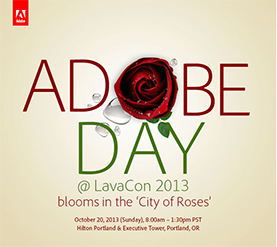
AdobeDayLavacon2013AdAdobe has adopted a theme around the location of the Lavacon Adobe Day, namely around Portland, Oregon’s nickname of “The City of Roses.”  I got to thinking about this, and it seems totally appropriate.  If you think about it, technical communicators are the gardeners and landscapers of content and technical communication. We need to sow and care for our documentation as if they are our gardens and plants.  I know that I grow with each event with my own knowledge, and that’s why I like attending them.

And how is it that we describe growing roses? I believe the expression is that roses are “cultivated”, which implies to me that they aren’t just grown, but they are carefully tended to, bad stuff weeded out, and they are pruned until they are just right, much like technical communication should be.  If these steps are done correctly, diligently, and thoughtfully, rose plants should bloom in full.  The same applies to our documentation–our gardens! The speakers at Adobe Day will be helping us learn the tools and methods we need to make our “gardens” grow!

I’ve seen many of the speakers listed for the event before, speaking about different topics. They always have fantastic insights. I’m also looking forward to seeing some other presenters that I haven’t heard from before.  The great thing about Adobe Day events is that isn’t never the same thing twice.  Topics change and shift with the times, and the talks reflect of that reality.  World-class experts helping us all learn how to make our “gardens” grow on a global scale? Priceless.  The fact that the event is FREE and that it’s not a big info-mercial for Adobe is an added bonus. Adobe makes a very concerted effort to make sure that the event is topic-centric, not software endorsement-centric.  Their goal is to help technical communicators grow in knowledge, and the thought leadership they gather for each of these events are top notch.  Who wouldn’t want to go to something like that?

As I said earlier, I feel that I grow each time that I attend an Adobe Day event.  I’ve already seen how it has helped open my mind, and that knowledge has given me a boost both in job interviews and in the workplace.  I bring back the best ideas to help me not only grow my own career, but to also help the company I work for grow with the times as well.  The last thing any company needs is to be in the weeds, and these talks definitely help with the weeding process of what best practices are to be used. The best ideas are cultivated and presented to us!

So, if you are going to Lavacon this year, or if you are going to be in the Portland, Oregon area on the morning of October 20th, I strongly encourage you to attend this great event. I’ll definitely be there in full force, and I’ll be covering the event live through my Twitter feed as well.

If you do decide to go, be sure to register at the link below, so they know you are coming. They say there’s no such thing as a free lunch, but that’s included in the event, too, so sign up here:
http://adobedayatlavacon2013.campaignsandevents.com/

See you there!

Posted in Uncategorized

TechCommGeekMom’s Excellent Adventure – A look back at STC Summit 2013

pogueaud-a1OK, I know it’s been more than a month since the 2013 STC Summit ended, but I promise this is the last blog entry I’m going to do about it. No, seriously. I mean it. I was writing up so many blog posts for the STC and about Adobe Day, that I think I got a little burnt out on writing, so I had to take a slight break for a bit, just to catch my breath, so to speak.

Even so, I’m hoping that you’ll enjoy this post which consists of images of me on the trip, just to prove I was there! Sometimes sharing the photos is much more fun, don’t you think?

Dani-at-the-Varsity1
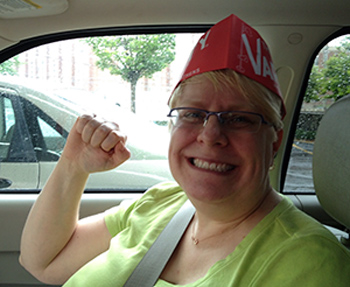
My first night in Atlanta was spent with a college friend of mind whom I hadn’t seen in person in at least twenty years! She took me to the oldest and largest drive-in restaurant in Atlanta called the Varsity. First-timers had to wear the hat! I made the best of it.
This was the greeting I had on the TV in my hotel room. I just thought this was cool. I was already feeling rather welcomed!
The Grand Hyatt in Atlanta was huge! This structure in the middle of the hotel's main lobby certainly captured one's attention!
The Grand Hyatt in Atlanta was huge! This structure in the middle of the hotel’s main lobby certainly captured one’s attention! My son even thought it was crazy seeing it through Skype while I was there.
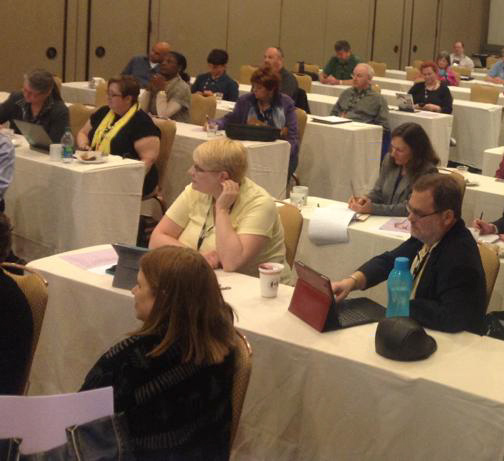
On the first day of the Summit, I had the privilege of doing the Twitter feed for Adobe Day for Adobe. Thanks,  y'all! I'm there in the center with the light yellow shirt on.  --Photo courtesy of Maxwell Hoffmann
On the first day of the Summit, I had the privilege of doing the Twitter feed for Adobe Day for Adobe. Thanks, y’all! I’m there in the center with the light yellow shirt on.
–Photo courtesy of Maxwell Hoffmann
NJCoke1
I spent my afternoon with fellow STC Summit attendee, Kim L., and we visited the World of Coca-Cola. Here’s an old bottle from my home state of NJ!
Later, on the first night of the Summit itself, all the first timers were asked to stand up during the Summit opening. Again, can't miss me standing in the middle there.
Later, on the first night of the Summit itself, all the first timers were asked to stand up during the Summit opening. Again, can’t miss me standing in the middle there.
–Photo courtesy of  STC
I was shocked, in the middle of the opening presentation, to see my name "up in lights"!
I was shocked, in the middle of the opening presentation, to see my name “up in lights”! Thanks to STC’s Kevin Cuddihy for sending this to me.
The keynote speaker, David Pogue, was fantastic. I really enjoyed his presentation.
VendorEntranceSTC13-1
Here’s the entrance to the vendor showcase…which to me, was more like walking into a tech comm wonderland!
IMG_0044-1
If I only had the supermodel figure to match…Me doing my best presentation pose of the cool typewriter that Adobe was giving away.
–Photo courtesy of Maxwell Hoffmann of Adobe.
techwhirl1
Here I am during one of my many pitstops to talk with my friends Connie and Al from TechWhirl.
–Photo courtesy of Rachel Houghton.
On the last night of the Summit, I took a "field trip" on my own, and went to see a talk by documentary filmmaker, Joe Cross. He used to weigh 100+ lbs more than he does in this photo, and the film he made was about how he lost the weight through juicing for 60 days. If you are looking for inspiration for healthy eating, find the film, "Fat, Sick, and Nearly Dead." It's an awesome movie. And yes, I got to meet Joe in person, obviously.
On the last night of the Summit, I took a “field trip” on my own, and went to see a talk by documentary filmmaker, Joe Cross. He used to weigh 100+ lbs more than he does in this photo (he’s a hottie now!), and the film he made was about how he lost the weight through juicing for 60 days. If you are looking for inspiration for healthy eating, find the film, “Fat, Sick, and Nearly Dead” and check out RebootWithJoe.com. It’s an awesome movie. And yes, I got to meet Joe in person, obviously.
Oddly enough, people would come to talk to me not about being TechCommGeekMom, but rather because of my notetaking set-up that was color coordinated! It's just a regular iPad3 and Apple wireless keyboard, but the iPad cover is by Brookstone, and there's a matching "skin" that I got for the keyboard from either Amazon or eBay very cheaply. For whatever reason, it captured a lot of attention! Hey, at least I kept my word that I would use mobile exclusively at the Summit, and I did!
Oddly enough, people would come to talk to me at the education sessions not about being TechCommGeekMom, but rather because of my notetaking set-up that was color-coordinated! It’s just a regular iPad3 and Apple wireless keyboard, but the iPad cover is by Brookstone, and there’s a matching “skin” that I got for the keyboard from either Amazon or eBay very cheaply. For whatever reason, it captured a lot of attention! Hey, at least I kept my word that I would use mobile exclusively at the Summit, and I did!

I will close this with another surprise I got, which I think is appropriate. Jamie Gillenwater did a lightning talk about 101 things to love about tech comm, which included a few quotes of mine. I was honored that she actually used some of the feedback I had sent her! Her last slide was a quote of mine, too, and considering I had forgotten that I gave her this tidbit, I thought it was pretty good, if I do say so myself! I was especially honored that she used this one, as I still find it to be true, especially after my experiences at the 2013 Summit. 

Jamie-presentation-quote1

I hope you’ve enjoyed this little photo essay. I really enjoyed my time at the STC Summit, and I really hope that I’ll be able to go next year to the conference when it’s in Phoenix!

Things have been very busy for me at work, to the point that it’s been difficult to keep up with things here on the blog. But fear not! There is always more to come on TechCommGeekMom! Stay tuned!