Posted in Uncategorized

m-Learning and Single-Sourcing Aren’t The End of the World

Does anyone remember all the hype about 13 years ago about how life as we knew it was going to be destroyed merely by the fact that most of the computing machines running around the world weren’t programmed to go beyond the year 2000 because it would reset itself to start back at 1900 again? Do you remember the mad rush to make everything “Y2K” compliant?” I do, and remember being in the thick of it. I even remember secretly bracing myself mentally, just in case Armageddon did happened. Nowadays, people are thinking about this supposed Apocalypse that will happen on December 21, 2012– about 8 months from now. Is it going to happen? And what does this have to do with m-learning and single-sourcing?

Here’s my take on it, having lived through that time from an IT perspective: nothing happened, and nothing will happen. Well, nothing catastrophic happened or will happen. If anything, the Y2K crisis brought to the world’s attention (or at least the IT world’s attention) that details are important when creating and developing software and web development. Y2K made the IT world take notice that it had to get its act together better, and if the world needed reliable, safe, easy-to-use products, then that attention to detail has to be put in from the beginning. The same thing happened with the tragedy of the attack of the US on September 11th, 2001. There was a realization that email and other digital means of communication could be used to circumvent security, and it caught everyone’s attention enough that the IT world had to step it up.

Think about how many strides have been made in since that 2000-2001 time period in the digital world! Smartphones and tablets were developed and constructed over this decade or so, and now we are a much more mobile society than before. I mean, seriously, in 2001, could you imagine yourself walking around with a tablet in your messenger bag just to read a book, do your email on the go, write papers, watch a movie, have video chats with friends around the world, or just to instant message/text friends that quickly?

When I had my first cell phone around the time of the turn of the century, it could do simple SMS messages and make phone calls, but nothing more. My iPhone is WAY more sophisticated than even my first desktop! We’ve actually gone beyond the imagination of what the Dick Tracy wristwatches of yesteryear intended to do– and then some!

We are in a really critical time in the development of the digital world right now. It’s as if nothing is impossible, especially with the huge chances that made us think about all those details around us. But that’s also the point– we have to make sure that we actually pay attention and heed the warnings of the past to make sure that all those details are included.

This brings me to m-learning. Right now, we are in a very exciting time with m-learning due to the great strides that have been made with technology in recent years. We have huge opportunities to reinvent the way things are done in e-learning on mobile devices, mostly because the medium is different than anything we’ve had before. It’s not just putting up pages and pages of content, but reformatting and rewriting to make it accessible to a wider audience. Cloud technology and wireless technology makes m-learning not only something that is portable due to device size, but accessible anywhere, anytime. Think about it– it’s a big game changer.

This brings me to the idea of single-sourcing and m-learning. It’s something that’s been on my mind lately, because as I try to learn more and more about m-learning and getting involved in m-learning, I realize that flexibility is something I need. In other words, while I am attached to my Apple products for my digital mobility, there are others who are strong devotees of Android products and there will be those who will be signing the praises of the Windows 8 mobile system soon enough. In the end, it’s three of a few of the different OS systems that will need to be able to receive the same information, but be able to communicate to each other clearly and cleanly to each other as well.

Many years ago, the Portable Document Format or PDF was invented by Adobe with the intention of inventing a common format that any OS system could read with the proper viewing tool. Today, PDFs are still used, and additional single-sourcing formats such as MP4 and MP3 for video and audio and ePub for publications are coming to the forefront. Heck, even as we speak, Flash is starting to slowly retreat in favor of a more common HTML5 format, even if all browsers and devices are not completely on board with that. I attended a great seminar the other day put out by Adobe and hosted by Maxwell Hoffman about how to use the Technical Communicator Suite–especially, in this case, RoboHelp 9 to help create ePubs for mobile devices like tablets. The main idea behind this seminar was to help users of Adobe’s Tech Comm Suite see how they could get on-board with this idea of single-sourcing through the creation of e-Pubs using the TC Suite.  Even though I don’t really know how to use RoboHelp at all yet, it was evident that this was a hot topic from the way it was presented and the questions being asked. I felt empowered to get started on trying to master this piece of software, because Maxwell made it look so easy to do, and his emphasis was not only on any particular device, but rather that this tool would be good to help develop for just about any device. Understanding how to create ePubs is an excellent stepping stone to bigger and better things! I’m sure that other companies are also realizing that single-sourcing is the way to go to connect with as many users as possible.

m-Learning is about reaching as many learners as possible in a way that’s user-friendly as well as compatible with the technology, while still being engaging. There are so many devices out there, that it’s really important that programmers and developers, as well as instructional designers and other technical communicators really take the time to care about those details so that we can truly have single-sourcing. Even just between my iPad and iPhone, I don’t always feel that apps available have the same functionality as they do on my laptop, and vice versa. Going between devices–whether mobile or stationary–should be seamless. It’s been mentioned that some companies are already on the right track with this thinking, such as Kindle. You can open up a book at one spot on your phone, then switch to where you left off on your Kindle device, then pick up again where you left off on your laptop. Much of this is done through the cloud and wireless connections. This is definitely the right idea, and going in the right direction. For me, it’s even the functionality. My Twitter doesn’t work the same way between my iDevices and my laptop, and that’s not right.  It should work the same exact way on all my devices, and Android users should have the same experience as I do. This is a really important concept for m-learning. You want to make sure that the deliverable presented is the same for everyone who comes to a course, and that’s a tricky thing to do right now.  This is why discussing and creating new standards for m-learning are so crucial. The single-source perspective is truly needed in e-learning and m-learning universally, so that the same quality of content is delivered to ALL universally.

So will I be jittering in my boots when December 21st rolls around? I don’t think so (unless there’s news of an asteroid bigger than the moon is hurtling directly towards us). If anything, I’m thinking that December 21st will be a day when it will start a new age of enlightment, and m-learning and single-sourcing will be a big part of that. We are already on our way, but perhaps there will be something on that day that will be a big boost towards a positive path.

www.startrek.com

Maybe that day will be as monumental as First Contact Day.


Posted in Uncategorized

Why we need group work in Online Learning

Via Scoop.itM-learning, E-Learning, and Technical Communications

This post is 1st in a 3 part series on the topic of group work in online learning communities. Post 2 will be about strategies for effective group work, and post 3, successful evaluation and outcom…

Via onlinelearninginsights.wordpress.com

Posted in Uncategorized

Well, that didn’t work.

Today, I was very excited to rush home from my part-time job to get to my laptop in time to attend a webinar.  I’ve decided that part of the way that will help me get ahead in the m-learning world is that I have to do a lot of listening in order to learn myself.  My graduate courses have covered a lot of ground, but they haven’t covered everything, so I might as well take advantages of free resources that are readily available to me, and do some of my own additional m-learning and e-learning.

Anyway, I just wanted to say…I was disappointed. I’m not going to name the specific webinar or who was hosting it to protect the innocent. I’m sure this host has put out plenty of good webinars, but this one wasn’t that great.  Was I benchmarking this against others I had attended? Well, sure, who wouldn’t?  When I attend a seminar in person or a webinar online, I’m just another student or learner like anyone else. I want to come out of that hour feeling that I learned something, or gained some new perspective on topics that I already know.  That really didn’t happen here.  Now, again, I’m not going to totally “diss” the presenter. It was obvious that the presenter knows his/her field well, but it was evident that he/she was asked to speak about one aspect of the field when that person was more familar with another supporting aspect of the field. I was bored by the PowerPoint slides, the information covered was not explained clearly, and the person was clearly rushing at the end, because he/she had several slides still to go and 2 minutes left on the clock.  I was bored, but I stuck with it until the end because I hoped to gain some little nibblet of information that would be new to me. Now, I’ll give the presenter the benefit of the doubt, that perhaps he/she was nervous, or was jumping on slightly unprepared, or perhaps even just rushed out of one meeting into this webinar and didn’t have a chance to switch mental gears well and it just got out of sorts. That happens.  But still, I was watching the numbers for the participants start very strong, and dwindled down very quickly in the last quarter of the alloted time, and that can’t be a good sign.

I happened to see that another tech comm acquaintance of mine was commenting on Twitter about the same webinar (again, not naming names to protect the innocent), and it was interesting when we started speaking through direct messages–offline to the rest of the world–that we were having the same experience. I had attended webinars with this other person, so I know that he/she had other similar experiences as I had. I was just glad it wasn’t me, but that maybe the presenter had not done his/her homework, and really wasn’t addressing the right audience.

I mentioned my disappointment briefly on Twitter, but chose to include no details. I had another acquaintance direct message me, and his/her reply was that many people will come online claiming to be experts, but really aren’t, and it can be a letdown. He/she continued by saying to me that some people are “knowers” and some are “do-ers”, and sometimes being a “knower” isn’t enough to be an expert and be doing presentations like that.  I couldn’t agree more.

I’ll be straight-up. Look, I’ll admit that right now, I’m more of a “knower” than a “do-er”. I’m not in denial about that, and hopefully I’ve tried to make it clear while I’ve been writing this blog that I am–in many respects–still a newbie. I was in the e-learning world many years ago, before I became a mom and tried other things, so in that respect, I was a do-er at one time, and I’m trying to become a do-er again.  For now, I am mostly a knower, but I will never admit to being a know-it-all.  This is why I know I have a lot to learn. This is why I attend webinars, and read blogs, and keep up with all the great articles that other e-learning, m-learning and tech comm professionals are posting on Twitter or elsewhere. I’m hoping that by the time I finally get the chance to DO the job of working in the e-learning and m-learning field, I will be able to DO my job even better. But will I be an expert? No, and frankly, I don’t think there’s truly anyone on the planet that know EVERYTHING about a given topic, even the foremost authorities on a given topic.  Being the daughter of an educator and being a lifelong learner, I think I will always be a learner, because the world is moving very fast, and there’s always something new to be discovered. I am knowledgeable and competent in many things–some topics more than others. I am always more than happy to share what I know well with others, and learn from others as well, and have healthy debates and dialogues on topics. That’s true learning and teaching.

Anyway…back to the webinar. Even with this webinar, I felt like basic e-learning principles weren’t being followed. Nothing about the instructional design of the webinar engaged me as a participant. I have been in webinar where I felt like, “Wow, it’s done already?” but this was not one of them. I was waiting for it to be done.  I left it feeling that I didn’t really learn anything, and that, heck, even being a newbie I could do a better job with that webinar. I am not boasting when I say that or being conceited. I try very hard not to be that way.  But, I felt that the main topic was approached with too much detail, and didn’t get to the meat of the topic. It gave me the feeling that if I wanted to do a webinar, or had to do online presentations and stuff, I couldn’t do any worse that this person.

As I thought about it more, I’ve given presentations to people anywhere as young as a Cub Scout to high-level executives in my career, and in the end, the message is the same– know what your audience expects, deliver on the expectations or do better, and like any good technical writing, keep it short, clear and concise, yet engaging. Heaven knows how many times I had to get up in front of my Cub Scout den to teach a bunch of little boys some dry subject that was required by the Boy Scouts of America, and I had to make it interesting for them. Same thing goes for grown-ups too– you’ve got to keep it moving, and even take the driest topics and make them interesting.

Nowadays, part of the drive with m-learning is that content and formatting addresses these same topics of keeping it short, clear, concise, and engaging.  With technology available today, we don’t need boring PowerPoint presentations! Even Powerpoint has the ability to include video, audio and animation. There are free programs available on the web like Prezi to make presentations even more lively, animated and interactive.  Presenters need to think of how they would be sitting in the audience of their own presentation. Do you think it’s good? Would you be interested in learning more after hearing it? What would make the presentation more interesting to you?

I’m looking forward to still watching and participating in future webinars as I learn more and more about m-learning and e-learning. I know that m-learning is growing so rapidly that it’s hard to keep up, but applying the same best practices of m-learning into webinar presentations will go a long way in keeping the caliber of the field high–and keeping my interest.

Posted in Uncategorized

The Wrath of Khan (Academy)

Khan Noonian Singh from Star Trek

KHAAAAAAANNNN!!!!

←No, not that one.

I first heard about the Khan Academy from my husband. My son, who is a high-functioning autistic, had fallen behind in his math skills because of problems with his classroom teacher (that’s a long story, I won’t get into it). Needless to say, a kid who had been doing fine in standard third grade math was still doing third grade math, and we were trying to find solutions to figure out how we could get him to catch up in a way that might interest him. My husband, in his quest to find something online, had found the Khan Academy, and had explained to me the history of the site. It sounded like a great idea, so I took a look at a couple videos on some of the simpler math concepts. It was great! I mean, what’s not to like, and why didn’t I come up with this idea myself? I liked the concept of what Salman Khan was doing, and it was easy to follow, and interesting to watch. While we didn’t introduce it to my son as we got sidetracked with other things (again, long story), I never forgot what the Khan Academy was about, and hoped that it would do very well in years to come.

Well, much to my happy surprise, it’s caught on like wildfire. It’s actually built up to a little business, and is now a leading standard in reverse classroom or “flipping the classroom” techniques. What’s the reverse classroom, or how do you flip a classroom, you may ask? (It’s okay– I didn’t know until about a week ago or so myself.) This concept is where at night, student would study and learn the new concept, and then do the homework at school. The idea is that kids would learn a new concept on their own, and then use class time for putting what they learned on their own the night before into practice with exercises, and the teacher would spend the time helping reinforce the ideas and helping to clarify what wasn’t clear. When I read what the idea of the reverse classroom was, I thought, “Brilliant! Why didn’t they do that when I was a kid in school?” I can see a lot of subjects where that would come in handy, and to hear that Khan Academy was one of the leading online resources for such learning, my main thought was how cool that had to be, and how much more fun learning would be. (Yes, even for those subjects you hated.) The CBS program, “60 Minutes” even just did a piece on Salman Khan and Khan Academy, which you can see here.

Now, like the “genius” character from Star Trek who appeared and then reappeared for a movie of epic proportions, Sal is back with a new way to distribute Khan Academy information, namely with a newly minted iPad app. It seems only natural that something like this had to be next, especially in light of the mobile learning movement that’s starting to take hold. I downloaded the app, and figured that I would review it here for you.

I looked at two courses within the program. It appears that all the content– and then some, that’s currently available on the Khan Academy website is available through the app. Now, I started tonight to keep track of what I looked at, and logged into the site. Login is either through Google (which makes sense, since Google is one of Khan Academy’s benefactors) or through Facebook. I chose to sign in through my Facebook account, and it only took basic information, nothing more, which is good. (I wish more apps that you sign into from a social media site only did that!) Anyway, the design was slick and simple. In landscape mode on my iPad, videos were listed on the left from a menu, and the video was found at the right. One feature on the iPad, you will notice in the screenshot image I have below, is that there is also a transcript of what Sal is saying in the video. I suppose this is good if you speak English but are not a native speaker, and you want to understand what he’s saying. (He speaks clearly for native English speaker, just so you know.) It also helps as a table of contents of sorts, so you can always say, “Oh, at this timestamp…” or “When he said….”, a person can find it within the video.  I found that at first, the scrolling of the transcript wasn’t working too great, but the longer I left it going through the lesson, it eventually synched up.

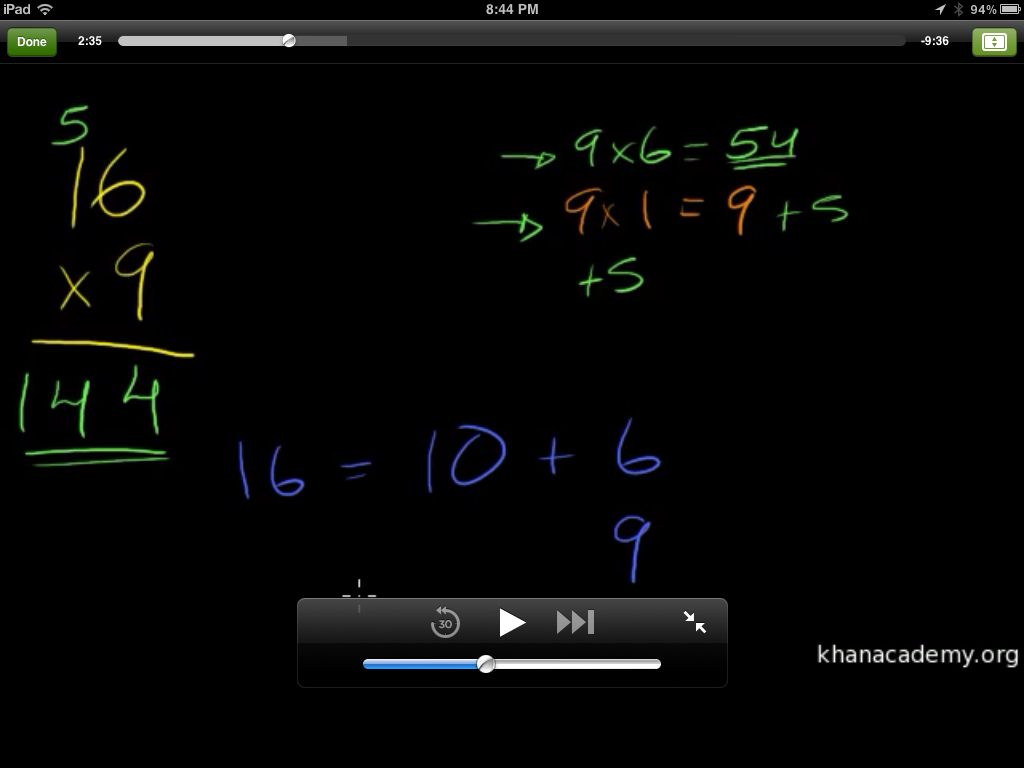
One of the neat features that I didn’t realize right off the bat, was that the video is not limited to the small screen seen above in the main interface– although what’s there is still clear. With the swish of multiple fingers, the video can expand to full screen like below:

I was glad of this feature, not only because that way, the learner can see things better, but with the full-size, larger interface, it gives the experience a homier feeling, like someone sitting down next to you with a set of colored markers and paper (albeit black paper, but hey, I’m fine with that.)

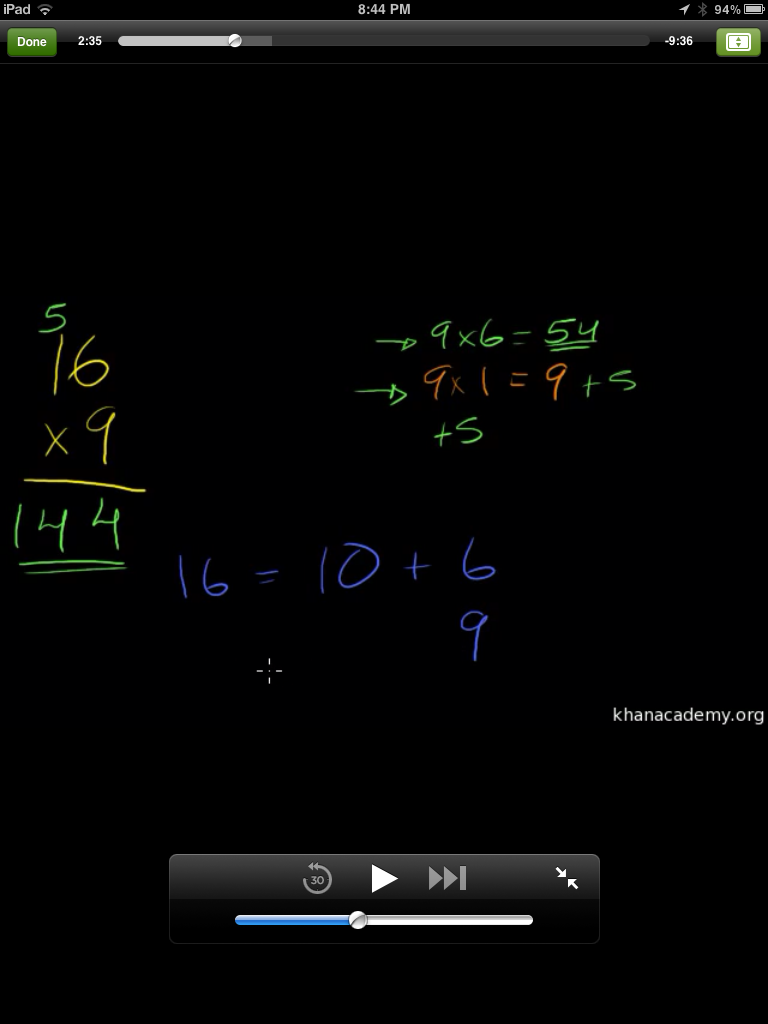
I looked at the display through a portrait view, and it looked like this:

(Sorry it’s a little smaller– the larger size image was TOO big.) You can see that the menu list is gone, but the video screen and transcript are still in place. When expanding the video in portrait format, it looks like this:

It’s still legible, and clear, and has that same comfort level as when it was in landscape mode. The screens adjust quickly between the landscape and portrait modes, which is good.

I won’t review the videos, as that’s been done before. I took this multiplication course, as it’s information that I’ve been reviewing with my son, but I also took a history lesson on Allende and Pinochet in Chile, and I thought it was well done. Sal does not show any bias towards one or the other, but does a pretty good job of presenting the facts, and actually invites the learners to draw their own conclusions, ask their own questions about the historical information. That is real teaching, my friend. A true authority will never admit to knowing it all, but will admit to being incredibly well informed, and always willing to invite curiosity, which is what Sal is doing here. He really does an excellent job.

Now, you may ask, what does this have to do with mobile learning? LOTS. Khan Academy is a rising star in e-learning right now, and by creating an app for iPad makes the courses even more accessible than ever. And just to play devil’s advocate, I accessed the Khan Academy through my iPhone’s Safari browser, just to see if everything would be teeny weeny and a waste of my time, but since all the videos are saved on YouTube, it’s very accessible. In fact, on the Safari browser, the site switched to a mobile browser version of the site, provided the same main menu of topics and videos, and upon choosing the video I wanted, I could still view the same videos pretty clearly. So even if a student didn’t have an  iPad or computer at home, if they or one of their parents had a smartphone, they could still access the information fairly easily.

So, is there a wrath of Khan? Not really. The only wrath that Salman Khan might have is what motivated him to start his non-profit academy in the first place– a passion to be able to provide basic (and not so basic) educational information to masses of learners all over the world by an easy means of communication at an affordable rate. (Who can’t afford free? Only cost is the computing device used, and many have access or have one.)

And isn’t that what mobile learning is supposed to be about? Easy access to easy to understand education information? I encourage anyone reading this to look into the Khan Academy. The firm is full of movers and shakers in the e-learning world that are dedicated to a higher purpose. It’s the kind of firm I would LOVE to work for, if given the opportunity. (Sal, call me!)