Posted in Uncategorized

Adobe Day at LavaCon 2012 Roundup!

This post is just a quick summary of the Adobe Day at LavaCon 2012 series from this past week. As you see, there was so much information that it took six posts to try to summarize the event!

Being in Portland, Oregon was great. It was my first trip there, and being a native Easterner, my thoughts pushed me to that pioneer spirit of moving westward in this country. Once there, I saw a hip, young, modern city, continuing to look towards the future.  The information I gathered at Adobe Day was general information that was endorsement-free, and practical information that I can use going forward as a technical communicator, and that by sharing it, I hope that others in the field will equally take on that pioneering spirit to advance what technical communications is all about, and bring the field to the next level.

To roundup the series, please go to these posts to get the full story of this great event. I hope to go to more events like this in the future!

As I said, I really enjoyed the event, and learned so much, and enjoyed not only listening to all the speakers, but also enjoyed so many people who are renowned enthusiasts and specialists in the technical communications field and talking “shop”. I rarely get to do that at home (although it does help to have an e-learning developer in the house who understands me), so this was a chance for me to learn from those who have been doing this for a while and not only have seen the changes, but are part of the movement to make changes going forward.

I hope you’ve enjoyed this series of blog posts. I still have many more to come–at least one more that is inspired by my trip out to Portland, and I look forward to bringing more curated content and commentary to you!

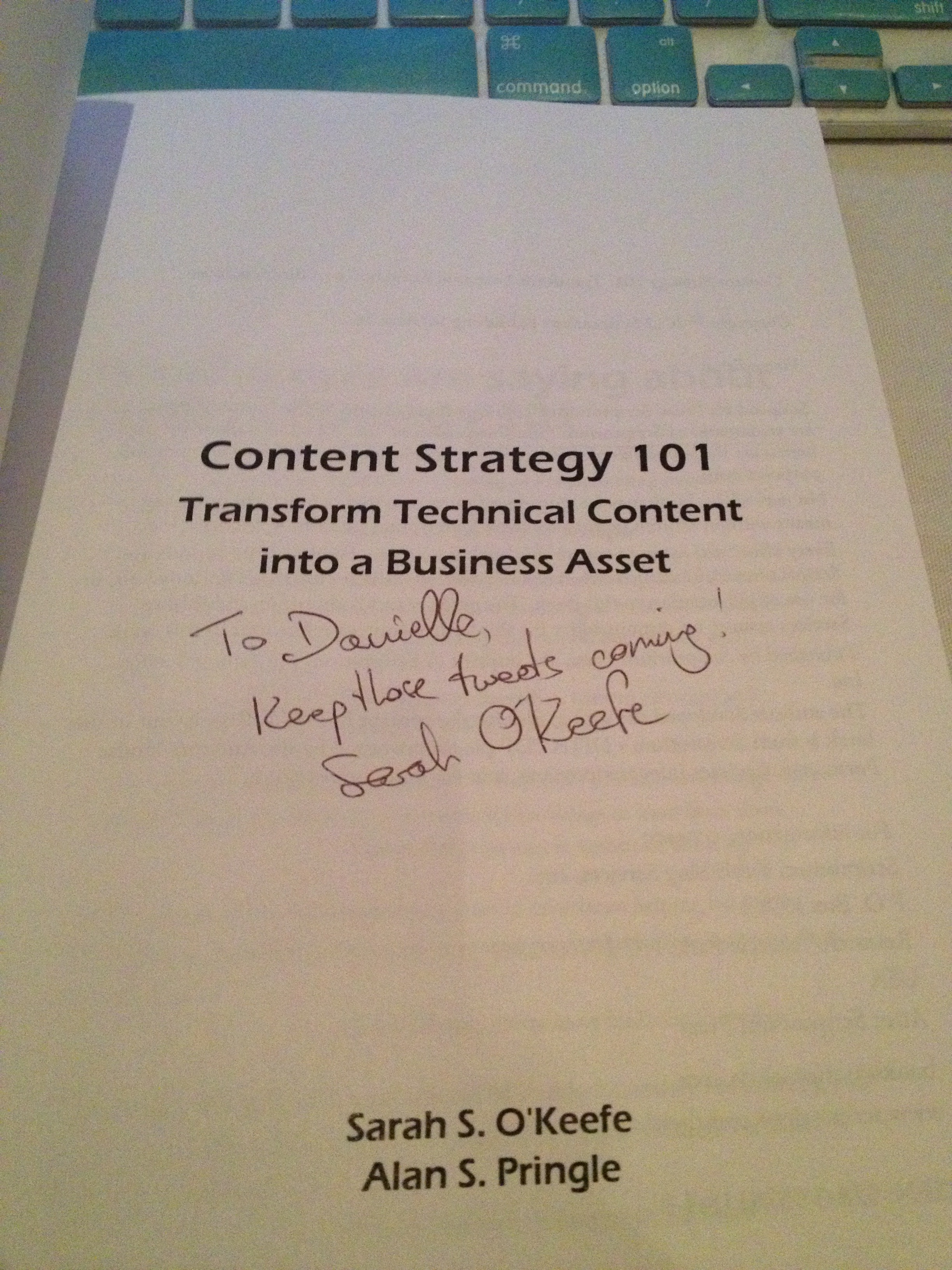
The autograph from my copy of
Sarah O’Keefe’s book,
Content Strategy 101.
Awesome!
Posted in Uncategorized

Adobe Day Presentations: Part IV – Val Swisher asks, “Are You Global Ready?”

Val Swisher
of Content Rules, Inc.

Following a short break after Joe Welinske’s talk about Multi-screen Help Authoring, Val Swisher took to the stage.

Val is the founder of Content Rules, Inc., and she spoke about eight simple rules for technical communicators to follow to make content global-ready–now! Her specialty is doing translation work, so she knows a thing or two about making content ready for a global market. As she went through each rule, she would explain the impact of the rules and why the rules were in place, although some were self-explanatory.

The rule she listed were as follows:

Rule 1: Not all errors are created equal. Some can cost you thousands of dollars!
This is one of those obvious rules. Taking the time to write content carefully as well as making sure proper editing is done is a necessity. Even one small typo can make a difference.

Rule 2: Creative Writing is a myth. Standardize.
Val’s point with this rule is that superfluous writing is not necessary. Keeping content clear, concise, cogent and correct is especially important in translation, and allows for better reuse of content.

Rule 3: Real copy editors don’t do it without a terminology manager. 
It is vital to use the same terms for certain words, especially for translation purposes. For example, the words “puppy”, “dog”, and “canine” all refer to the same animal, but are clearly different words, even though they essentially mean the same thing. In translation, there are times that this much word variation for a single item isn’t available in a different language, so choosing one word as the referential term is recommended. It keeps terminology within the content–especially if reusing content–consistent.  Style guides are, unfortunately, not followed as often as they can be. A system is needed to manage terminology and help prevent problems like this example from occurring.

Rule 4: Have you got translation memory (a translation database)? Your vendors do. Use it. It keeps content standardized and saves money.
This is another fairly self-explanatory rule. I was not aware, since I’m not in the translation business, that there are such things as translation databases. From what I could understand how it works (and someone please correct me if I’m wrong), a translation database has features that when a specific turn-of-phrase is used on one language, there is a specific translation for that combination of words into another language. When a translation is done, the database looks for that word combination and translates it accordingly. This, again, allows for consistency in translations between the different language editions of content.  As a technical communicator who does translations, Val is saying that if you don’t have such a database in place, you should have one because in the long run, it will standardized content and save money.

Rule 5: Don’t complain about quality of your tech writers. You agreed to outsource docs to ___ in the 1st place.
Val pointed out that while there are good outsource resources for writing and translation out there, sometimes the quality is not as good as keeping it in house or closer to home, especially if the content is written by someone whose first language is not English. Good quality source material is key! Having good quality source material helps control costs, especially with translation!

Rule 6: If you write flabby copy, even the nicest vendors will email you a bill for localization that will astound you.
Again, this comes back to having quality content in place. Val’s point was that if you do write weak content that is difficult to translate because it is not quality content, even one’s best clients will send you a bill for the translation for localization purposes, and the bill will be VERY HIGH. Again, having quality content saves money!

Rule 7: Get rid of extra adjectives and superlative words! Delay this product launch, and there’s no next product launch.
This rule is a strong recommendation related again to how content should be written. The use of extra adjectives, adverbs and other superlative words do not enhance the content. Using such words that have to be rewritten or translated can delay a product going out, and for a client, that can be a deal-breaking move. By delaying the product due to not meeting a deadline due to overdue time for translation, and there will be no next time being able to help with a product launch. Obviously, that would be bad business.

Rule 8: Translation is a team sport. You want to work alone? Become an accountant.
While this rule elicited a laugh from the audience, it was a point well taken. Teamwork is KEY! A better source of English content will result between source writers and translators if they work together.

Val was asked the question at the end of her presentation, “What alternative tools for style guides are on the market?” She responded that there are lots of software tools out there, but to be careful about push technology within those software items.

More information can be found at Val’s website, http://www.contentrules.com  and her free e-book is available by e-mailing her at vals@contentrules.com.

I found this presentation rather fascinating, especially since Val presented it with a sense of humor. But her point was clear. Content needs to be as precise as possible when it will be reused and especially when used in translation for consistency. By following her basic rules, costs can be controlled, and the quality of the content can only get better.

I thought about what it takes to do translation, searching my own memory banks from when I almost minored in French during my undergrad years and had to do translations, to the present day watching my husband translate literature written in German to Spanish for a group he’s been involved with for years, to my own struggles to translate what I want to say to my in-laws into my broken Spanish. Translation is not an easy task, but when thinking about translating my English thoughts into another language, it can get tricky because of the turn of phrase or colloquialisms used from area to area. Even in talking to my husband about the topic, he will say that there are different idioms used between Spanish speaking countries, although Spanish will still be relatively “standard.” Being from Ecuador, he can still understand someone from Spain, Mexico or Argentina as much as an American can understand someone from the UK, Canada, or the Australia. But I’ve even found in my own teaching of a business and technical writing course to a corporate group in Asia is that English taught globally is not consistent due to the source English being from different countries, so I have to go and set the record straight.  I can certainly appreciate where consistency and choice of words can lead to better quality content and communication in the long term.

The next presentation, and the last in this series: Adobe Day Presentations: Part V – Mark Lewis and DITA Metrics.

Posted in Uncategorized

Digital Tablets for Kids–Child’s Play, or should we take it seriously?

Just within the last month or so, I’ve been made aware of two tablet computers made for especially kids–and ones that weren’t something like a glorified LeapFrog or VTech toy. There is a place for LeapFrog and VTech-type tablets for the preschool/early elementary school set, but the ones I list below were recent ones that I became aware of targeting the grammar school demographic.

The first one I saw was the Tabeo tablet. I read about it in the following CNET article:

Toys ‘R’ Us unwraps $150 Tabeo tablet for Kids

The Tabeo, according to the article, is an Android-based tablet that includes drop-safe bumpers, wi-fi, and parental controls, and will only be available through this toy selling-enterprise.

The other kids’ tablet that I came across (and I don’t remember how–perhaps watching TV with TechCommGeekSon?) is called the Meep Tablet, which is being released by Oregon Scientific.

You can find the product website here:

Meep Tablet

It, too, is a tablet that runs on an Android OS, has drop-safe bumpers, wi-fi, and parental controls, and it appears that it is sold only through Oregon Scientific.

What would be appealing about these tablets, which are targeted for the ages 6 and up crowd? Part of the appeal would be the price– about $150 for either tablet. Yes, the parental controls and such are nice features–no denying that, but what else? Neither item has much memory, and if kids are going to use these tablets for games, then they need a lot more memory than what a first generation iPhone had. While memory cards can be added, why go to those lengths? Why not just put decent memory chips in the devices in the first place?

Being that I’m an m-learning TechCommGeekMom, I also tried to think about how such devices would be good at a school setting. Could they be used in a school setting? I suppose they could be on some level, and it’d be a decent investment for a school at just $150 a pop. Schools could control the content, using the parental controls. The bumpers used to protect the devices would allow for some longevity for the devices as well. The devices still have video and web cameras, and are still wi-fi enabled. Since they run on a version of Android, they could download Android apps.

But is buying either of these devices worthwhile? Since only the Meep in available now, and the Tabeo is coming out in a few weeks, we’ll have to see what the big reviews say. I wouldn’t mind reviewing them myself if I could get a hold of each of these, so in the meantime, I can only go by what each manufacturer has promoted.

But in thinking about the age group of “6 and up”, and thinking about my own son and how I would want to invest money in a tablet for him (if he wasn’t usually borrowing my iPad), why would I bother to get a kiddie version that’s barely expandable or that could be updated with later software, and had more memory?

My first thoughts turn to the idea of the rumored iPad mini. Oh, if that was out there (and I had the cash), I’d buy that in an instant for my son. Why? Well, first of all, it’s no secret that I LOVE my iPad. I love the variety of apps available–both educational and for games for him. Since he has to use my iTunes account to download apps (and I don’t give him my password), I can supervise what  goes on the device and what doesn’t. That seems like parental control to me. I would be able to use the “Find iPhone” app to track him as well, as needed. It also would much more internal memory, I should think, than what the Meep or Tabeo is offering. Even if it only had a 8GB or 16 GB memory, that’s better than the base memory offering of Meep or Tabeo. Additionally, there are already school programs out there using iPads, so adapting to iPad minis would be an easy transition for many schools, and be easy for kids to use due to its smaller size for smaller hands.

This leads my thought stream into thinking about Nexus 7 tablets, Nook HD tablets, Samsung Galaxy or Kindle Fire HD tablets. Why not get those for a child? They are smaller Android-based tablets as well, right?  Well, the prices tags are a little higher, that’s for sure. In most situations, however, several of these tablets are not THAT much more money, and yet there would be more flexibility in these devices.  I was just even reading a rumor that Microsoft’s Surface tablet may come in a variety that’s in the $200 range. Talk about flexibility compared to some other tablets, even if it’s still more of a PC than a tablet! Why wouldn’t a parent invest in that type of tablet instead, knowing that there are more apps, more downloadable programs, and more memory with these machines?

Business Insider recently posted this article comparing tablets, and it’s worth a read:

The Only 7 Tablets Worth Buying Right Now

Of course, my money is on the hopefully impending iPad mini. But even if that never comes to fruition, these other tablets provide some good bang for your bucks.  I think cheap childproofing bumpers and kid-friendly can be found on eBay and other retailers, if that’s a concern. But I see these other mainstream tablets being a better investment, as they can grow and upgrade with your child better than one “made for children”.

My child is part of the demographic that the child tablets are targeting. He’s now 11, and is a very different child than when he was 7, 8 or 9 years old. His tastes and needs have changed in just a few short years. Heck, he’s even upgraded his Nintendo DS two times in the last three years, because he wanted better memory and flexibility with the DS apps offered, as well as more powerful hardware. He might not put it in those terms, but even he knows the game. (No pun intended there!)  Looking at tablets for growing kids should be looked at the same way–a tablet, for the investment, should be able to grow with the child, and a regular tablet would better suit those needs. With a regular tablet, not only would there be personal flexibility with games and apps, but more opportunities to use it for educational purposes–for homework, classwork, etc.

And that’s TechCommGeekMom’s take on that. If some manufacturer wants to send me one to be put through the TechCommGeekSon wringer, or if someone has had a different experience with a made-for-kids tablet, let me know. I’d be glad to share your experiences in a post here.

Posted in Uncategorized

Welcome to TechCommGeekMom’s First Advertiser!

Just a quick note to have you notice something new on the right-hand column of my blog. It’s an ad for our first advertiser, Adobe!

I’m very excited to have this relationship with Adobe, who have been just huge supporters of TechCommGeekMom.com since the blog first started. Please be sure to click on the ad and check out the Technical Communications Suite 4! I did a review of TCS4 back in July which has been received very well, so here’s your chance to check the product itself out!

Hopefully this is the first ad support of many more to come.

If you, someone you know, or your business is into technical communications, education or e-learning, and are interested in advertising on my blog, let me know!

I am an equal opportunity blog here, and I would like to be able to help present the best products on the market when I can, and I’m off to a great start.

Thank you, Adobe!

Posted in Uncategorized

Remote and Mobile are not the same thing…but could or should be.

TechCommGeekMom is back! I’m sure you didn’t notice that much, but I was away for a week at the beach (or as we Jersey gals say, at the shore) in South Carolina, and while I wasn’t totally away from technology the whole week, I didn’t stay in touch with it as much as I usually do either. Hopefully, I can make up for some of that this week!

Just because I was away, it didn’t mean that I wasn’t thinking about tech comm, e-learning or m-learning while sitting on the beach. Quite the contrary. I had things going on related to all those topics that I still needed to keep up. And sitting by the ocean, listening to the waves, as well as traveling in lots of places far from home and working somewhat remotely got me thinking about the topic of working remotely and mobility, or rather mobile working.

I was actually put to the test in some respects during the trip. There was some important business correspondence that was going on during the week, and I had only my iPhone and trusty iPad, and spotty wifi to enable me to communicate with the “outside” world. I didn’t have the comforts of working from home with my laptop and reliable wifi connectivity that I have at home. (I do live in “Einstein Alley”, after all, so reliable wifi is almost a requirement where I live!) If I went to one of the Starbucks near where I was staying, then there was good wifi, and I could catch up with some of that correspondence. But if I was in my hotel room, it depended on the time of day and which room I was in, which was not exactly convenient.

As we travelled down some country roads before hitting the main highways on our way home, I started to think about mobile learning in these areas. How, in many respects, is this area that I was traveling through any different from any other remote area of the world, where education isn’t always cutting edge, and computers are difficult to access? The mom in me thought deeply about the educational part of this. If I lived in an area that was distant from a lot of technological access, but wanted the best education possible for my child, how would that be achieved?

My imagination first made me think about remote education. What is that? It could be online learning, or even just something static, like the equivalent of a correspondence course. How would that work in a classroom or standard educational system that is not near any major towns? Connectivity is the key for that. Having that connectivity would be greatly needed for the students to learn. Learning about what is happening in the “outside world” will open the minds of students not only to new ideas, but also how to bring those new ideas to their community. For example, would learning a new technology help with growing crops or improving productivity in some sort of service or manufacturing process prevalent in that community? I’m sure it would.

In my opinion, the Internet has always been an educational wonderland, much like how television and radio opened up possibilities and expanded our knowledge of the world. To deny that to the students of today would be a disservice, especially since so much more information is available through the Internet than radio or television alone. How does something work? A student can watch a YouTube video about it.  Who was Salvador Dali? A student can find Wikipedia and other sites that talk about the artist and see photos or video of his works.  Confusion about how to do algebra? Students can watch a video on Khan Academy. Newspapers from all over the world are online, and students can learn difference perspectives on world events as a result. There are so many possibilities!

But is mobile the solution to having a remote education? Yes and no. I think with the examples I showed above, a standard desktop or laptop can help achieve those activities quite easily. In many remote districts, I imagine that there isn’t the money in the school budget to provide that many desktops or laptops, but gaining that exposure would be worth the expense if it could be done.

To add mobile functionality to the mix would definitely enhance this process. Having a tablet computer such as an iPad or Kindle, or even using a smartphone would increase the learning capabilities. It would allow for more interactive learning. It would allow students to take their own video and photos to share with others. Learning could be done in the classroom, or even on a field trip or outside the confines of a classroom–including at home. All the benefits of mobile versus desktop would come to the forefront of reasons to use mobile for learning. Additionally, as smartphones are often more readily available and purchased, even in remote areas, mobile is possible and accessible in those hard-to-reach locales.

So, one has to understand that remote learning is not the same as mobile learning. Simply because one is out of reach from centers of society doesn’t mean that education about the outside world can’t be accessed, but with Internet connectivity, that experience is enhanced greatly. Correspondence courses of yesteryear (and modern day as well) show that you can be away from a learning source, and still gain knowledge needed. Online courses have been proving that in the last two or three decades as well. However, mobile enhances the e-learning experience greatly, providing greater flexibility for how a student can learn and when he or she can access information to learn. With the proliferation of smartphones and tablets exponentially growing every year, even in remote areas, mobile will enhance and promote changes in that the remote learning process, and in turn, the m-learning industry will change and grow.

So, my question to you, dear reader, as a tech comm or e-learning/m-learning professional, how are YOU going to help those learners who are far away from conventional resources? It’s something to think about when writing or creating courses or documentation that will help the end-user.  Mobile documentation is different because it can reach even more remote areas than ever before, but how it’s created and used is key in how successful it can be in helping those end-users, whether they be students or various professionals. Look at the photo that is at the top of this blog posting. How will you provide information to the inhabitants of that small island? Think about it….