Posted in Uncategorized

TechCommGeekMom’s 2013 Year in Review

IMG_2423
TechCommGeekMom visits Multnomah Falls during her Lavacon/Adobe Day 2013 visit to the Portland, OR area.

Okay, I’ll admit this is going to be a slightly self-indulgent (and slightly long) blog post. I read something recently that said that there shouldn’t be so much “self-promotion” in promoting your blog. This has always been a blog that not only encourages community, but it also tracks my own journey through technical communications, for better or worse. Taking the time to do the year-end review of what’s gone on in the past year is a good exercise for anyone.

At first, I thought my year wasn’t all that great, meaning that it wasn’t exciting. I hadn’t achieved some things that I wanted to do; I did not fulfill all my tech comm resolutions for the year. But as I looked through photos of the past year on my mobile devices to come up with something to put in this blog post, I realized that a LOT of good things still happened this year.

The year started off with a bang, as I was finally working full-time after a year of unemployment.  The new job ended up being a good opportunity. I get to work from home, I’m being paid well (a lot better than I ever had before), and it’s doing something that comes naturally to me–content management. I have had the chance to use my UX and web design abilities during this position, too. Things have gone well enough that my contract has been extended for another year.  I know that there’s a good chance that later in 2014, the company I’m contracted to will be switching CMS software, so it’ll be an opportunity to learn a new system and flex those content management muscles. I’m looking forward to it! It’s been a long time since I had a job that I truly enjoyed and feel appreciated for what I do. In past positions, I would offer my suggestions and advice based on what I had learned from my social media connections, graduate school courses, conferences, and personal experience, and I’d be ignored. I don’t mind if someone doesn’t take my suggestion if there’s something valid that will discount it, but using the excuse of “that’s the way we’ve always done it” or “that’s what the end user is used to, so why change it?” doesn’t cut it for me. There’s always a better way. This was the first position that actually gave me a chance to use my voice and makes some executive decisions that would benefit the end user. My manager supports my decisions 99% of the time, so that’s been a huge load off my shoulders. Stress has not been a major issue with this job, and I know I’m fortunate to have made this employment connection.

Having a job, and a good job at that, would make for a good year. But there’s been more.

2013 was the year that I started to go out on the public speaking circuit. It started with my first conference presentation at the STC-PMC Conference in March, followed by two webinars this past fall. Three presentations might not sound like a lot, but considering that I have only presented to my tech comm peers twice beforehand (my capstone presentation at grad school and an Adobe Webinar that Maxwell Hoffmann helped me with immensely in 2012), and all these presentations were STC-related, I figure that’s a pretty good feather to add to my cap.  I’ve been told that the presentations were well-received, and I have gotten some good feedback, so I consider that a big success.

I also added an additional writing credential to my repetoire.  I started writing a by-line for the STC Notebook blog that started out as a column as a newcomer for the 2013 STC Summit. That column has now turned into a regular monthly column for the STC Notebook called Villegas Views. Again, I feel like I’ve received some good feedback on my writing there, so that’s another success.

I attended three conferences this year, namely the STC-PMC Mid-Atlantic Technical Conference, the STC Summit, and Lavacon (although I was only at Lavacon for a day–hey, I still need to write about that! I’ll try to get to that soon!).  The biggest one, of course, was the Summit, which was mindblowing for me. I loved being able to travel, considering I work from home day in and day out. (I’m not complaining, but it was a welcome change of scenery.) Actually, all the conferences were wonderful and overwhelming at the same time, and that sense of feeling somewhere that I belonged was never more evident than when I attended these events. I’m SO glad I did, and that leads me to the last thing that I found to be the greatest part of this year.

While I had started to develop some professional connections in 2012 through social media and through my first visit to Adobe Day at Lavacon in 2012, both social media and these conferences enabled me to expand my professional connections exponentially. However, it became more than just professional connections.  I’ve ended up making some fantastic friends along the way.  I know most people don’t think of me as being shy or introverted, but I actually am. I’m horribly awkward socially , and I know it.  Social media helped with the introductions, for sure. A few in-person introductions have helped as well. I’ve said this before, and I’m sure I’ll say it many times again, but I have found that technical communicators to be one of the most friendly and inviting groups of people I’ve ever met. I have appreciated every person who introduced himself or herself to me in person when knowing me from my blog or a social media connection. I’ve appreciated the friendships that have developed over time from these connections. I’ve loved having some of these friendships with those who are industry leaders develop into mentorships as well. When one of those supportive mentors encourage me or tell me how proud they are of my accomplishments, I want to cry tears of joy. (Heck, I’m crying tears of joy just writing this!) For so long, I’ve felt like an outsider, so to have my professional peers look to me as an equal and show me constant support and encouragment is a huge boost that I’ve needed for years.

This blog has grown, too. The numbers aren’t done for the year yet as I write this, but I’ve added a lot more readers and had more response to TechCommGeekMom in 2013 than in 2012. I’m sure I’ll be doing more celebrating when the blog hits its second “birthday” in March, but for the calendar year, it’s been great. I know I haven’t always been able to keep up with this blog as much as I liked during this year, but I feel like the efforts that were made to grow and expand have been supported by the tech comm community.

So, thanks to all of you for reading my posts either here, on the STC Notebook, or in social media. Thank you for taking the time to talk to me and share ideas with me. Thanks for continually teaching me more about technical communication, and helping me to expand my mind and my understanding of this profession, and teaching me how I can continue to grow in this profession.

2014 is already shaping up to be an exciting year as well. I will be attending three conferences before the year is halfway done, of which I’ll be presenting at two of them, I believe. I know, for sure, that one of the conferences I’ll be presenting at is the STC Summit 2014! That’s a big deal to me. I mean, think about it–only out of grad school two years, and already presenting at the annual Summit? Not too shabby, I would think.  I’ll be continuing to write here at TechCommGeekMom, and I’ll still be writing my by-line for STC Notebook, and I’m hoping that there will be some more opportunities to do presentations either in-person or in webinars.

2013 has been quite the year for me…time will tell how 2014 will be!

Posted in Uncategorized

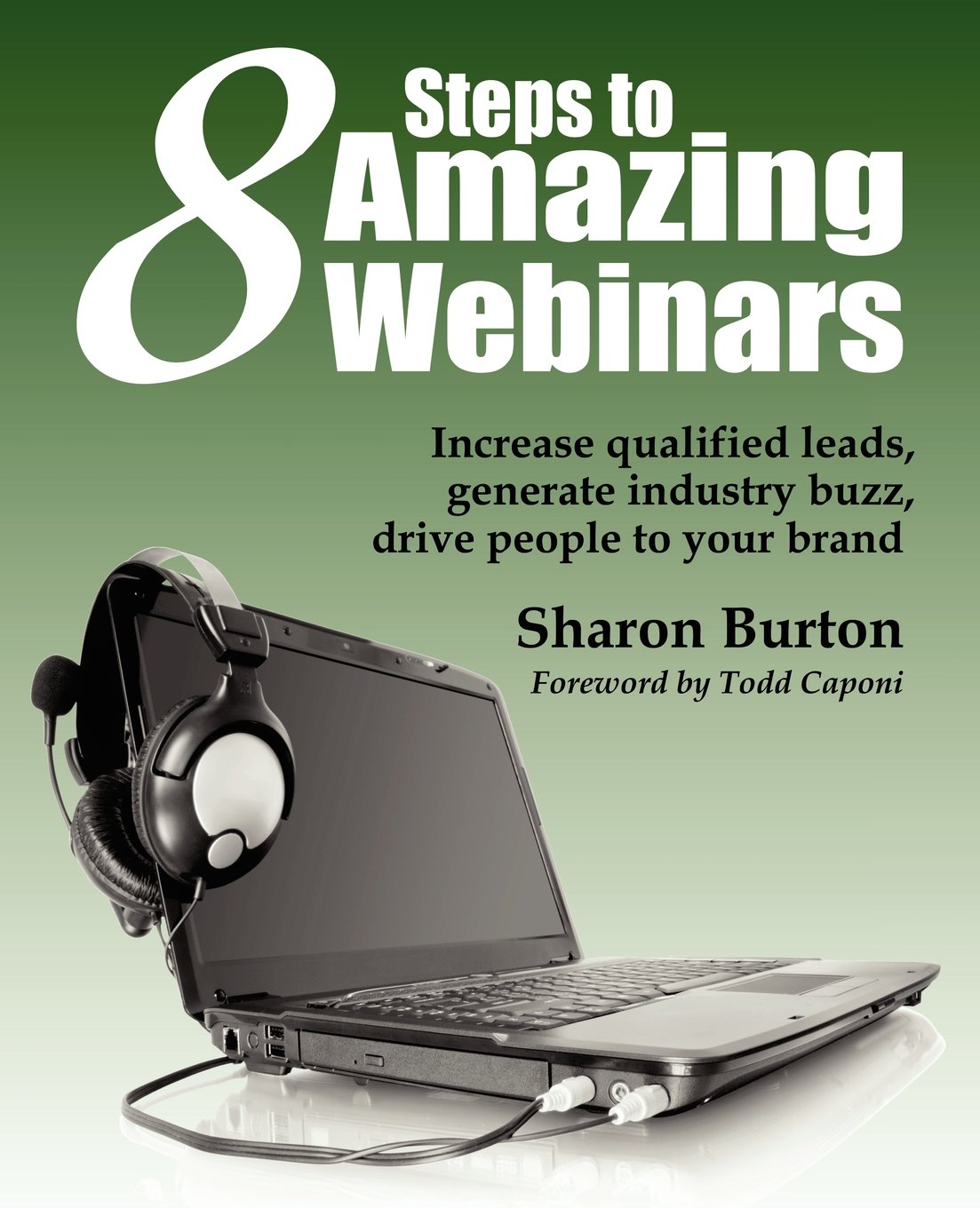
Book Review: 8 Steps to Amazing Webinars by Sharon Burton

8StepsToAmazingWebinarsIn less than a week from this writing, I will be doing a new webinar that I was asked to do by one of the STC Special Interest Groups (SIGs). I was really honored to have been asked, and it’s about a topic that I think I know a little something about–blogging. After all, this little webspot has been going strong for about 21 months now.

But in putting this latest webinar together, I realized that while I felt that I could whip something decent together, it’s been a while since I had to craft a webinar presentation. This, in turn, reminded me that I had a promise to fulfull, as I sought out a reference in my personal library written by one of my tech comm knitting buddies. Pulling this reference out reminded me that I’ve been meaning to write this review since last spring, but had been side-tracked several times until now–when I really needed it most.

Sharon Burton’s book, 8 Steps to Amazing Webinars, is a slim volume of only 81 pages (and that’s the end of Appendix B), but it’s loaded with very concise information. 81 pages is all you need! Considering that this is a short and concise how-to book, it shouldn’t have taken me this long to write this! I truly try to read any books that I’m asked to review cover to cover, and this was a quick but highly informative read!

There are several things I like about Sharon’s book. It’s short and to the point, as already mentioned. For busy presenters who have many things to do other than solely doing webinars, this is great resource because she gets straight to the heart of what needs to be done. Additionally, one of the things that I’ve found that Sharon and I have in common with our tech comm perspective is that our views are highly customer service-oriented. Before my life in an IT/tech comm world, I came from a customer service/client services background, so much of her advice on the how and why webinars can be great marketing tools geared towards customers made a lot of sense to me.

Sharon’s eight steps take the reader from the point of understanding what a webinar is, through every step of the process of creating and following-up with the webinar, including choosing presenters, topics, technology needed, advertisting the webinar, and all the other preparation steps to creating the webinar. She even includes pointers on how to set up the presentation slides that are most likely going to be used in the presentation.

As I read the book, I was quickly reminded of the first webinar that I did back in 2012 for Adobe’s Technical Communications group (you can find the link on the right-hand column of this blog). I remember not knowing the first thing about how to put together a webinar. At the time, Maxwell Hoffman, who is one of the evangelists for Adobe TCS, guided and coached me through the process, and it ended up being a great success. Looking back, I would not be surprised if Maxwell was already well-versed in the steps that Sharon outlines in her book, because I’m fairly sure that we followed every single step. When I also look back to the first in-person presentation I did, which lead to a recent webinar on the same topic, I realized that I had followed much of the same steps again, and got a great response as a result. These steps are practically foolproof, so I can assure you that if you follow Sharon’s advice in the book–and much of it is really common sense, you should have success in presenting a webinar.

Sharon’s viewpoint in this book is from a marketing perspective, in that webinars are used to drive people to a brand, increase leads, and provide resources to your customers. And for 99.9% of time, this is a main focus for most people who would read this book. But even for people who are academics, for example, who are not necessarily trying to create a brand, but rather disseminate valuable information, this book is still helpful because it put the reader in the right mind-set to create a virtual presentation that is meaningful for his or her audience. For example, while I am promoting my “brand” of TechCommGeekMom, I’m not really selling a product or service the same way that a software company or communications service consultancy would be. (At least I’m not at that stage yet!) Even so, I know that when I present the webinars that I’ve done, there is some sort of value based on the type of information that I’m providing. By referring back to 8 Steps to Amazing Webinars as I prepared for this upcoming webinar, I knew that I was on the right track to maximize the information that I will be delivering. It also made me reflect, based on these steps, what made for a bad webinar, and I’m sad to say that I’ve attended a few of those in my time. I think I even remember one that Sharon and I attended at the same time, and I remember us talking about how disappointed we were with that one webinar, and we had the same sticking points about it.

I highly endorse this book for its strong content and its easy-to-read, straightforward language. Anyone who is doing a webinar–or even an in-person presentation–can gain some great pointers and advice following Sharon’s advice. Hey, it’s such good advice that the book is endorsed by the STC itself, and I know that many of their best webinars follow Sharon’s methods. So that says something right there!

You can find the book on Amazon.com, Barnes & Noble, and XML Press websites. And be sure to follow Sharon on Twitter too– she’s @sharonburton, or on her blog found at sharonburton.com. She always has good information to pass along that goes beyond just how to do webinars!

Posted in Uncategorized

Adobe Day @Lavacon 2013 – Val Swisher Says It Starts With The Source

Ladds_1
Ladd’s Addition Rose Garden
Photo from http://www.rosegardenstore.org

Val Swisher was the next to last individual to speak at the Adobe Day at Lavacon 2013 event. For those who are regular readers of this blog, you know that my love for all things Val Swisher has no bounds. I’ve always been able to take her easy-to-digest information, and absorb it quickly into my brain, as well as relay her knowledge to others.  When I looked at Portland Gardens to compare her to, I chose Ladd’s Addition Rose Garden.  While it’s not as well-known (unlike Val, who is very well-known), this particular park, according to The Rose Garden Store,  was one of four rose gardens especially built from the Ladd estate, in which the design included these gardens coming together to form the points of a compass. I often think of Val as my compass, as she has never steered me wrong with her information or with the wisdom and fun that she’s shared with me one-on-one.

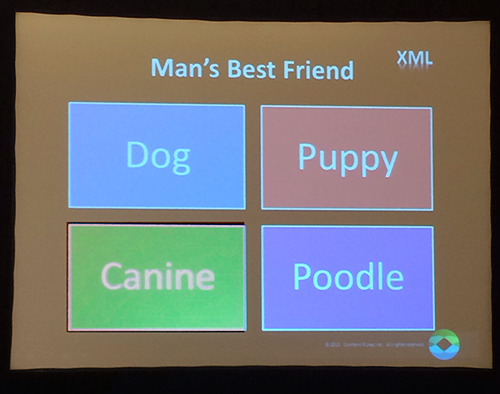
Val’s Adobe Day presentation centered on talking about source English terminology in a multi-channelled, global world, and how terminology affects structured authoring, translation and global mobile content. She started the talk by reminding us that historically, we’ve always created content, whether it’s been on cave walls, through stenography, through typewriters or eventually on word processors. In every instance, consistent terminology has been essential for structured authoring and content. Managing terminology is also essential for translation and for reuse.  She stated that prior attitudes used to be that the more complicated the writing was, the more “fancy” the product was. Today, that’s definitely not true.  She used the example that I’ve heard her use before, but it’s so simple itself that it’s a classic. Her example involves writing for a pet website. If multiple words meaning dog are used, there can be problem with reuse, because you can’t reuse content if you use different words.

Val_example_dog
Here’s the example Val showed.

Val pointed out that it would be an even worse situation if technological or medical terminology was used instead.

Val continued by saying that when it comes to  XML, reuse , and terminology, you cannot realize the gains of structured authoring if you’re not efficient with your words. Terminology is critically important to gain more opportunities.

ValSwisher
Val Swisher explaining how to approach content from a translation perspective.

Translation comes down to three elements– we’re trying to get better, cheaper, and faster translation output. We MUST use technology to push terminology and style/usage rules to content developers. In order to make it cheaper, we need fewer words, reused words, and reused sentences. It’s impossible for writers to know or even know to look up all term and usage rules. We MUST automate with technology. For example, “Hitting the button” is not translatable, but “Select OK” is fine!  She said, “Say the same thing the same way every time you say it.”

For better translation, translation quality needs to improve and meanings need to match in order for better machine translation to be a possibility. Bad translation comes from the source itself.  If the source information is problematic, then the translation will be problematic.  The best way to save money and time is to say the same thing, every time, using the same words, and use shorter sentences. For machine translation, don’t go over 24 words in a sentence.

Faster translation is seen as content that takes less time to translate, needs fewer in-country reviews, and gets to market more quickly. The key to delivering global mobile content is responsive design, global mobile apps, text selection is key, and terminology is the most important element. Val showed this example of how translation in responsive design isn’t working, where the Bosch websites are not exactly in synchronization:

The mobile website on the left looks nothing like the English language version on the right.

The simpler the design is for the website–especially in mobile, the less you have to tweak it. This is especially true where consistent terminology is important, because consistency is needed for structured authoring. Creating truly faster, cheaper, and better translation enables a true global responsive design. This is not a simple task, as there is no such thing as simple, even when writing about complex concepts. Even if you think you’re not translating, your customers are, so the content needs to be very clear. The scary part of this is that some companies use Google Translate as their translation strategy, which is risky at best. To use something like Google Translate as the translation software, the content had better be tight, clear, and consistent.

One of the things I enjoy with Val Swisher’s presentations is that it all comes down to common sense, and she breaks it down into easy manageable parts for those of us–like me–who might not have thought about the context of language for structured authoring, and the consequences for not strategizing content to include translation considerations.

I highly recommend checking out Val’s blog for other great insights.

(As always, Val–if you’d like to add or correct anything here, please do in the comments below!)

Posted in Uncategorized

Adobe Day @ Lavacon 2013 – Rich Media in Framemaker with Matt Sullivan

photo from www.portlandoregon.gov/parks
Crystal Springs Rhododendron Garden
photo from http://www.portlandoregon.gov/parks

Matt Sullivan presented the last individual presentation for Adobe Day at Lavacon 2013, and it was a little different than what I had seen before. To me, it was like Portland’s Crystal Spring Rhododendron Gardens, because while Portland is known for its rose gardens, here’s something that’s different, but not out of place either.

MattSullivan
Matt Sullivan doing his presentation.

Matt recently co-authored the book, Unstructured Framemaker 11 with Sarah O’Keefe, and took the time to show us some of the more special features of Framemaker 11, specifically in reference to the use of rich media and XML. What made this a different presentation from what I had seen before was two-fold. First, Adobe prides itself in presenting these Adobe Day Thought Leadership events as the antithesis of a long commercial for the Adobe Technical Communications Suite applications, so having this presentation about Framemaker specifically seemed to go against that. But the deeper the presentation went, it was obvious that it wasn’t as much about how to include rich media in Framemaker (although that was certainly presented), it was about opening up minds to the idea of using rich media in digital documentation, and Framemaker happened to be the tool used to demonstrate this. Matt Sullivan is one of the foremost experts out there on the use of Framemaker (he did co-author a book, after all, and I’ve seen the book–it’s a hefty tome), so this made a lot of sense. The second part that seemed different was that it was a demonstration at all. As mentioned before, I was a little confused that an aspect of Framemaker was being demonstrated.  For those who were familiar with the product, it was easier to follow along. For those who weren’t as familiar with the product, they could keep up, but it didn’t necessarily have the same impact, but opened eyes to possibilities.

All that aside, Matt gave a lively demonstration of how one can produce rich media output from DITA/XML. Because this was a live demo, it was hard to track all the nuances of the presentation, so there weren’t a lot of notes taken as it would be difficult to describe the processes step-by-step as he was doing them. The audience went along for the journey through these processes, and we could see how Matt used Framemaker to include of rich media. Matt showed us how one can place videos, flash components, and other multimedia into Framemaker docs. He also showed us how to integrate these into the DITA map, and how a PDF document can be produced for both print and interactive versions. One of the best examples Matt showed us was  how 3D models can be used in Framemaker documents in addition to control tables. Matt explained that the beauty of the ability to add rich media to documentation is that it’s all about the single-sourcing features to be able to integrate the rich media.  The other part of what makes it optimal is that rich media can be saved to online formats. He stressed that rich media can be used in unstructured Framemaker as well as structured Framemaker.

Matt has also done several Adobe webinars covering much of the information presented in this presentation and more. As a refresher, he offered a 45-minute demo with the details found at http://wp.me/p1KX8V-4P, which is also available on his blog at http://mattrsullivan.com.

While it was a little difficult to cover and summarize this presentation (no fault of Matt’s–he did an excellent job), as I said before, this was something new for me to experience at an Adobe Day.  I learned not only about how to include multimedia objects in Framemaker specifically, but Matt was also showing how valuable rich media can be when used correctly and methodically in almost any kind of documentation and content out there, which is really the more important part of the bigger picture. As technical communicators, we need to remember that we don’t have to be limited by text and stand-alone images.

(Matt, if you need to correct anything I’ve said here or would like to add anything, please feel free to add in the Comments section!)

Next in the Adobe Day -Lavacon 2013 coverage: Val Swisher’s presentation.

(Yes, I’m going backwards with how everything was presented. Why? Because I can. 🙂 )

Posted in Uncategorized

Everything’s Coming Up Roses! : Why I’ll be going to Adobe Day at Lavacon 2013

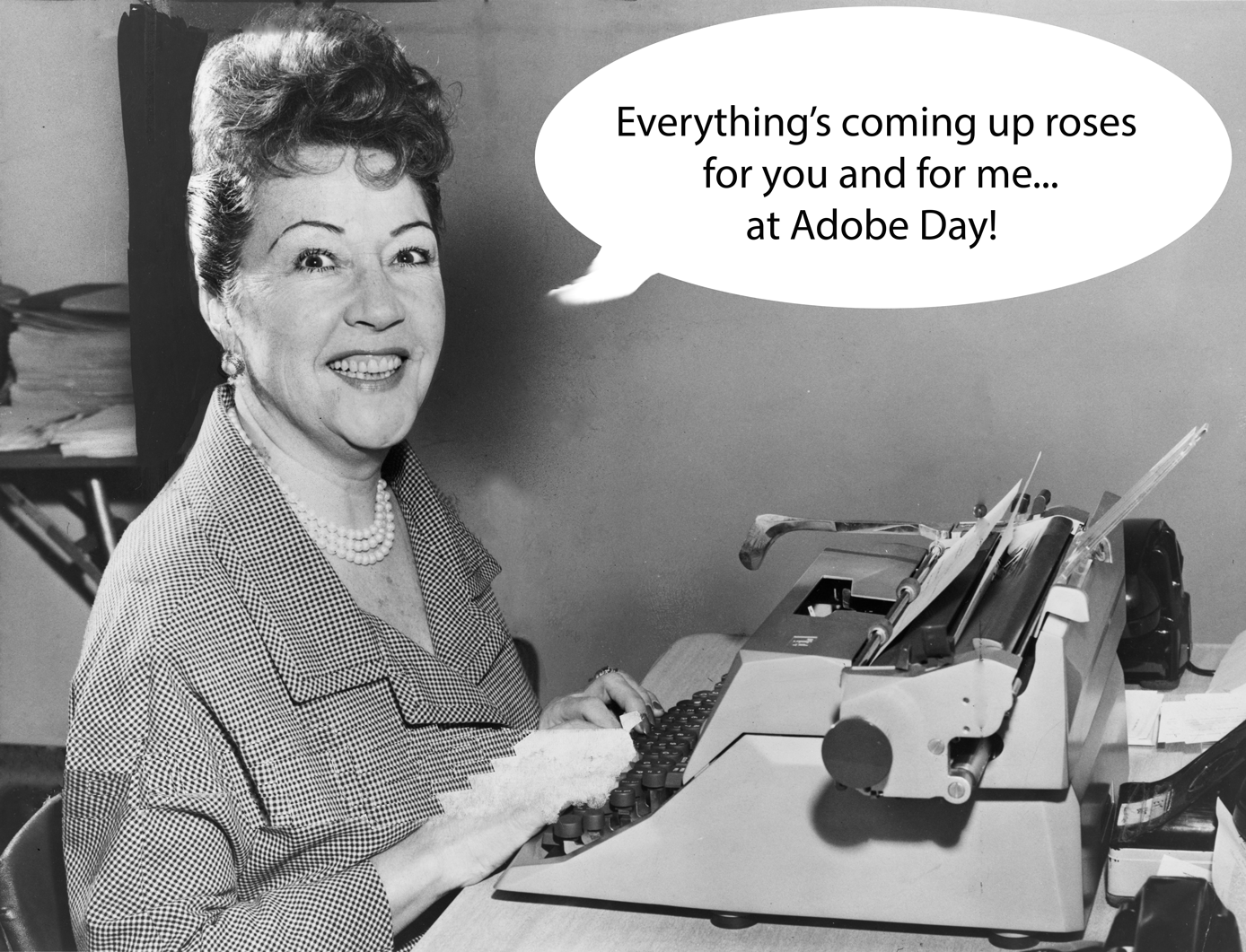
Ethel Merman can't wait to go to Adobe Day at Lavacon 2013--and she's been gone almost 30 years!
Ethel Merman can’t wait to go to Adobe Day at Lavacon 2013–and she’s been gone almost 30 years!

A little more than a month from this writing, Adobe will be hosting an Adobe Day event at the 2013 LavaCon Conference on Social Media and Content Strategies. It will feel a little sentimental for me, because I felt like I had come into my own when attending the same event last year. I remember my excitement at hearing all the speakers and learning so much information from them as a newly-minted technical communicator. All the information that I soaked in during last year’s Lavacon Adobe Day was put to good use, as I was able to use the information when speaking at interviews when I was job searching. I’m confident that the information I learned at the event helped me get the job I have right now.

Now, I’m excited that Adobe is bringing the event back to Lavacon this year.  I think I’m just as excited as last year, to be honest! Having now attended two Adobe Day events (the other being the one at the 2013 STC Summit), I know I’m in for a great time.

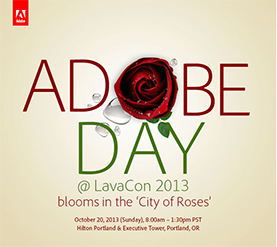
AdobeDayLavacon2013AdAdobe has adopted a theme around the location of the Lavacon Adobe Day, namely around Portland, Oregon’s nickname of “The City of Roses.”  I got to thinking about this, and it seems totally appropriate.  If you think about it, technical communicators are the gardeners and landscapers of content and technical communication. We need to sow and care for our documentation as if they are our gardens and plants.  I know that I grow with each event with my own knowledge, and that’s why I like attending them.

And how is it that we describe growing roses? I believe the expression is that roses are “cultivated”, which implies to me that they aren’t just grown, but they are carefully tended to, bad stuff weeded out, and they are pruned until they are just right, much like technical communication should be.  If these steps are done correctly, diligently, and thoughtfully, rose plants should bloom in full.  The same applies to our documentation–our gardens! The speakers at Adobe Day will be helping us learn the tools and methods we need to make our “gardens” grow!

I’ve seen many of the speakers listed for the event before, speaking about different topics. They always have fantastic insights. I’m also looking forward to seeing some other presenters that I haven’t heard from before.  The great thing about Adobe Day events is that isn’t never the same thing twice.  Topics change and shift with the times, and the talks reflect of that reality.  World-class experts helping us all learn how to make our “gardens” grow on a global scale? Priceless.  The fact that the event is FREE and that it’s not a big info-mercial for Adobe is an added bonus. Adobe makes a very concerted effort to make sure that the event is topic-centric, not software endorsement-centric.  Their goal is to help technical communicators grow in knowledge, and the thought leadership they gather for each of these events are top notch.  Who wouldn’t want to go to something like that?

As I said earlier, I feel that I grow each time that I attend an Adobe Day event.  I’ve already seen how it has helped open my mind, and that knowledge has given me a boost both in job interviews and in the workplace.  I bring back the best ideas to help me not only grow my own career, but to also help the company I work for grow with the times as well.  The last thing any company needs is to be in the weeds, and these talks definitely help with the weeding process of what best practices are to be used. The best ideas are cultivated and presented to us!

So, if you are going to Lavacon this year, or if you are going to be in the Portland, Oregon area on the morning of October 20th, I strongly encourage you to attend this great event. I’ll definitely be there in full force, and I’ll be covering the event live through my Twitter feed as well.

If you do decide to go, be sure to register at the link below, so they know you are coming. They say there’s no such thing as a free lunch, but that’s included in the event, too, so sign up here:
http://adobedayatlavacon2013.campaignsandevents.com/

See you there!