It became very apparent to me in the last week that I could not live without mobile technology. You would’ve thought that I would’ve learned it during the aftermath of Hurricane Sandy. But it hit home much more for me this past week, and I’ll tell you why.
My husband went off on a trip to visit his family in South America. He hadn’t been there since 1997–a time where we had been merely dating. He was away for nine days. Now, for those who are separated from loved ones often enough, nine days might not seem like a lot. My husband and I have been apart for two to three days at a time, but we have never been apart for as long as nine days since that last trip he made in 1997 below the equator. We also didn’t have a child to consider at the time he last went on such a long trip–a sign of times changing. I hate the idea that we were going to be separated for so long.
The other sign of the times changing was that as much as I missed him terribly, I was able to communicate with him while he was down there. Now, the last time he went down there, he and I would sometimes talk by email or by Windows Messenger, but it wasn’t frequently, just because internet connectivity was limited down south, and it was expensive even back then. I wasn’t on a cable coaxial connection back then, but rather a dial-up modem, so time was money.
Internet infrastructure and technology has improved over the last 16 years, fortunately for us. This time, while we did use email, we also texted and used Facetime. We could send photos and video to each other in real time. How? I made sure that my husband brought his smartphone and my extra iPad on the trip, not only to help keep him entertained on the plane with digital movies, books, magazines and games, but so that we had a way to communicate easily too. My father-in-law had installed wifi at his house (it helps that my younger brother-in-law, who still lives with his father, is a computer geek), and so my husband and I could share live conversations on Facetime (he’d call up my iPhone). We’d also be texting each other when needed for quick bits of information during the day, emailing and instant messaging as well. It helped ease how much I was missing him during the trip.
What definitely convinced me that I could never live without mobile devices was the night that my husband was returning from his trip. He was at the airport which had wifi (although it was not strong and somewhat spotty), and to kill some time late at night before his flight, my husband called me on FaceTime to have a video conversation. We could talk more freely than we had during his last trip away. He was amazed at the clarity of the video communication, and there was a moment while we talked when I could see in his eyes that he missed me as much as I missed him. It happened faster than fast, but it was something that could never be communicated with words in a text, email or instant message. It might not even be communicated the same way in a digital photo or video. It was talking in real time that captured it, and it was captured in my brain forever. That’s something that can’t be done that easily with a desktop or laptop. I don’t think that moment would’ve even been possible with a laptop–it would’ve had to have been done with a smartphone or tablet to have happened.
I talk about how mobile technology is the wave of the future–or really, the wave of NOW–in e-learning. I still believe that. But the other night, hours before my husband began his journey home, I learned an important part of mobile technology. Mobile technology is not only to be able to capture video, audio, photos or have a conversation of an event going on anyplace, anytime, but the actual impact of being present for learning in real-time during such an event is everything. It’s the next best thing to being there in person. A conversation between a person in a South American airport and another sitting on a couch in Central New Jersey using streaming video and audio wouldn’t have been possible years ago. It is now.
Criticisms of m-learning often relate to the use of social media, implying that there is a lack of real communication between people because of the presence of social media. I disagree. If anything, it’s helping to bridge the gap, so that moments like my video conversations with my husband can be possible. They don’t have to be between family members, but they can be with colleagues on a project just as easily. Yes, video conversations have been around for a long time too, but not like this. If my husband had wifi in other places he travelled while visiting his family, he could show me in real-time what was happening around him. Now, the wifi infrastructure down there isn’t even close to what we have up in the States, and even here in the States, as I have mentioned before, we could have better support and availability of wifi around the country for better communication. Just think about that for a moment. If wifi infrastructure was strengthened globally, we truly could have a better “anytime, anywhere” experience not only to talk to each other but to learn from each other.
You will never be able to take a mobile device away from me, that’s one thing I’ve learned for sure!
How one indie studio is killing crunch and sharing profits…
Thanks to @cfidurauk for pointing me to this article.
One of the tough things about being a mother in any industry is how to balance responsibilities of being the primary caregiving parent and giving full attention to a job/career. Ann-Marie Slaughter, formerly of the US State Department and now back at Princeton University, wrote a controversial article for The Atlantic magazine (I think it was the Atlantic) which gave her case of while she had it all, she felt she really didn’t.
In this day and age, we need to rethink and rework what the work process is. I’m sure the hours of “9 to 5” were based on daylight hours during the 19th century or something. I’ve always tried to work different hours than that–usually earlier hours so that I could be home at a reasonable hour for my child. Additionally, I have found that there are very, VERY few things in this world that depend on work being done RIGHT NOW or needed to be done YESTERDAY. (Immediate emergency medical care is the only thing I can think of that is THAT urgent.) I applaud Lady Shotgun for their endevour, and hope that more and more people–not just moms, but dads too–start thinking in the terms that this outfit set up shop. If I could find a place like that which could use the skills that I can offer and paid decently, and had the flexible hours that are presented here, I would jump on that bandwagon in a heartbeat.
As technical communicators and e-learning/m-learning specialists, this seems like it should be a viable work solution for so many of us–all parents alike. There are rare instances that documentation has to be out THAT quickly because someone’s life is in jeopardy. Lady Shotgun should be a model for us going forward.
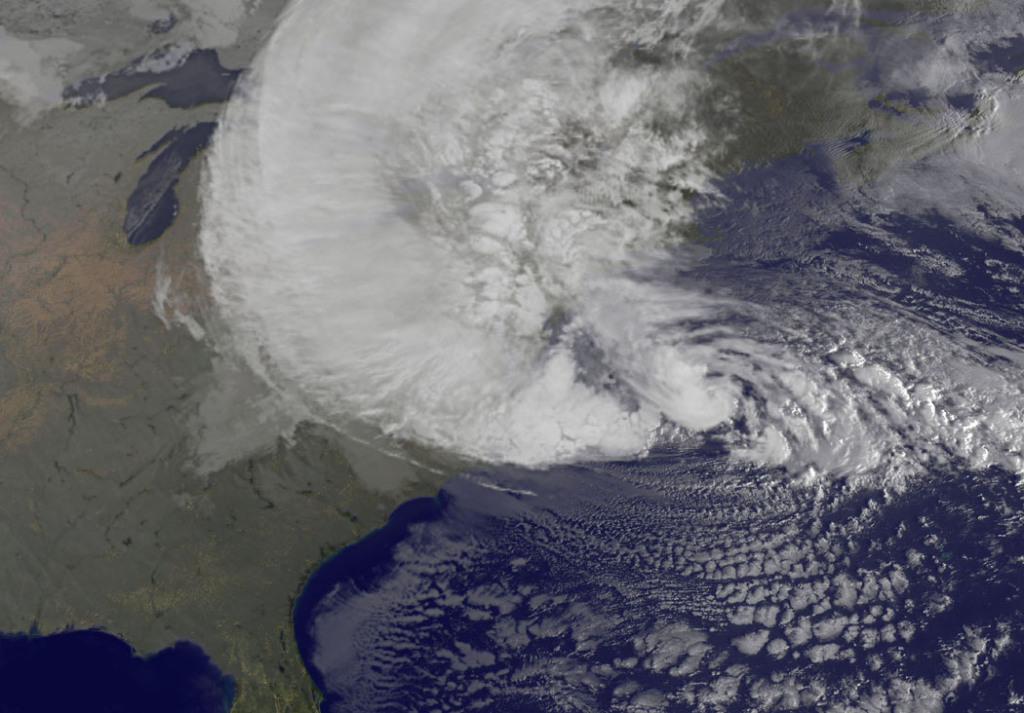
Hurricane Sandy satellite photo as it hit New Jersey
Hello all, and excuse my absence of late! If you hadn’t heard (ha!), Hurricane/ Superstorm Sandy hit the eastern coast of the United States, and headed straight for the state of New Jersey in particular. That means it hit where I live.
I initially started to write this while I was sitting in my car, writing on my iPad while my iPhone was getting recharged using the car battery, but I’m finishing it up on my laptop almost a week later. Hurricane Sandy hit my home, and we were without power for almost four days. A tree fell on our house, but fortunately not through the roof. There was a state of emergency in my town for a couple of days whereby no one was allowed in or out of town. Unless you were emergency personnel, you were not allowed to drive the streets. While we were lucky to get power within a few days (especially with very cold weather setting in), there are still thousands without power where I live, and even those who have lost their homes entirely. I was actually one of the lucky ones. So, you can understand why I might have had other things going on this week. 😉
My house the day before the storm.
Originally, I really struggled with an idea of what to write about this week, but this hurricane made some things very clear, and they are things that needs to be strengthened as a global necessity, not just as a local necessity. This storm made the following very evident to me: mobile technology and social media are critical in this day and age.
I only knew what was happening in the “outside world” and was able to make connections with my cell phone–a smartphone. Granted, the 4G network was incredibly slow, especially in the beginning, because everyone locally was doing the same thing. Something was better than nothing. Since I didn’t have power for my TV or radios, my phone was everything. It made me wish I had a MySpot mobile wifi connection created from my cell phone so that I could transmit the wifi signal to my other devices, but having at least the 4G did the job.
My house after the storm.
In the end, everyone who knows us had a way of knowing that we were okay. Between my husband and I, we texted my brother-in-law, my father-in-law in Ecuador was able to call my husband, and I had sent notes on Twitter and Facebook to let people know we were okay. There wasn’t much more that I could do. Until we had full power and Internet capabilities, I could only recharge my phone on a car recharger and send out the occasional note to update our status on social media. Saving battery life was essential to make sure that we could always be able to communicate. So writing up a blog entry was less important than making sure that our loved ones knew what was going on around us.
We were without electrical power for almost four days, and they were four of the longest days and nights I can remember. You have to remember that I live in a first-world country, where having constant supplies of electricity not only for powering things is commonplace, but it also runs things needed for basic survival, such as keeping perishable foods cold, and providing heat on cold nights (and we had some very cold nights). At my house, having had some Scouting training (I was a den leader for my son’s Cub Scout group for almost 5 years), and just even having a fireplace, we had some advantage. We had done some preparation so it wasn’t so terrible–just terribly inconvenient. There are others, such as my sister, who didn’t have power for more than a week. (She stayed with my parents who had power restored quickly.) There are still work crews from all over the Eastern Seaboard and the MidWest who have come in and have worked around the clock, and continue to do so to still get the rest of New Jersey power again. It is still not done. We’ve become a society that is dependent on its electricity, for sure. But we also have become a society that mostly depends on the power of internet connectivity and having means of communication powered by electricity.
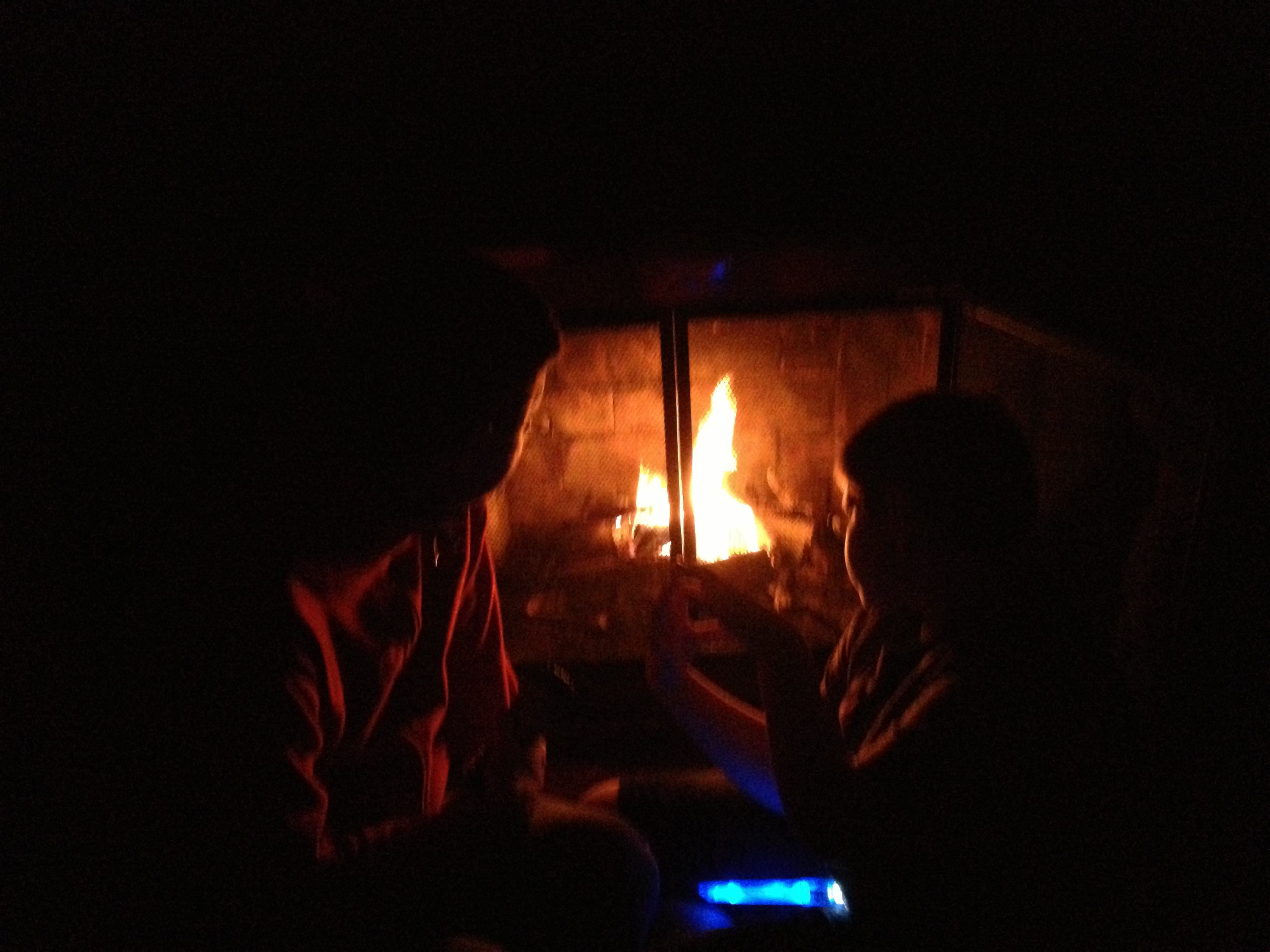
My husband and son keeping warm by our fireplace while we had no power.
Every day that we’ve had with power since it’s been restored, I’ve tried to remind myself about the many people in my state who have lost their homes and/or still don’t have power. I was greatly inconvenienced, but in the end, even with the tree falling on my house, I was still blessed and one of the lucky ones. My town, overall, didn’t sustain the kind of damage that other towns did. The big pond/lake and our town was drained before the storm in order to prevent flooding, and that worked. We didn’t have the water damage or flooding that other places did. Most of the damage we had was due to wind damage, so there were a lot of downed trees that took down power lines. Once trees began to be removed, and crews fixed the wires, then things started to get back in order. As I write this, there is still gas rationing in part of the state, which people need for their cars or even for generators to power their houses until regular service is restored. We’re not quite back to “normal,” but we are fairly close. Schools are starting to open back up for classes tomorrow after a week’s absence, many are returning to work, and shops are opening up again. New Jerseyans may have never been through something like this, but we are a resilient group of people. There is an expression that was often said well before the storm of “Jersey Strong.” That, we are.
But during this storm and its aftermath, I’ve had a lot of time to think about the importance of mobile technology and social media. Through SO much of the storm, my mobile phone was my lifeline to the outside world. Not only could we tell people that we were okay, but if we had been in serious trouble, it was our lifeline out. We would get messages and updates from friends and other resources through our phones. Was the storm over? I could track the storm either through the Hurricane Red Cross app or the Weather Channel app. Was it safe to go out? I’d receive text messages and emails from my town government to let us know what roads were blocked due to downed trees or wires. Where were there shelters if we needed heat, a warm shower and a solid meal? I could find that out as well. What markets had reopened after the storm for food, which gas stations were open with shorter lines, and where could we recharge our devices so we could continue to stay in touch and know what the news was? Different friends who had ventured out told me through social media. Having mobile devices and connectivity made knowing all that information possible. When we needed to have the tree removed from where it was leaning on our house, my husband called up our local tree guy, and his crew was out the very next day. And in a totally 21st century way, having mobile devices kept us entertained at night, as I had loaded up some old episodes of our favorite television programs on my old iPad for my son, and on the new iPad for me. (During the day, we’d be cleaning up our yard and doing other things that would take advantage of the daylight.) Without these modern technological conveniences, it would have been a lot more difficult to get through those days.
But it also got me to thinking about how that technology could have been even better, and where greater improvements could be made. Two things from the technological side were apparent to me. First, connectivity could be improved on a global level, not just at a local level. More communications infrastructure and stronger communications infrastructure are needed to create reliable wireless hotspots. While 4G connectivity was available, it was spotty, and not always reliable during the storm. My husband does not have 4G on his phone, although I have it, so we were solely dependent on my phone for information. A secondary but equally important problem was, however, that using 4G exclusively drained the battery of my phone quickly, especially when the 4G service was very slow. In a stressful and possibly dangerous situation like this storm, that’s a bad thing. I know there are several cities that have wifi service throughout the town, such as Philadelphia. We have many wifi hotspots, but they are not well connected between them, and they don’t reach to households around here. I found, once we had power and connectivity restored, that wifi connectivity on my phone or other mobile devices did not devour battery power on my mobile devices as much as the 4G did.
I started to think of places far, far away from me–and realized this is a global need. How are children in remote places supposed to get electrical power, more specifically battery power for a smart device? And even if there are miraculous power sources for these devices (which there are not at this time, especially in certain regions of the world), how would these children connect to the rest of the world? Both improving battery life/power sources for mobile devices and improving the infrastructure for internet communication are key. It all needs to be set up in such a way that it doesn’t cost a fortune, is readily accessible, and can literally weather anything. It should be similar to using a radio–we can still get AM and FM signals, but we need a wifi version of this. I know that the network services in our area, especially AT & T and Verizon, said they were doing their best to provide and repair the 4G and LTE services damaged from the storm. Okay, I understand that. But in the US, as well as everywhere else globally, we need to start thinking about how to step up the technology so that getting wifi signals are as common as getting an FM signal on a radio. I’m sure that this is technology that is being worked on, but I feel like this storm proved that point very much. Perhaps the internet access providers needed to get ready for the storm by temporarily increasing the network bandwidth and boosting those wifi signals already present. I’m sure that I will be charged an arm and a leg for the amount of data I did use during this time, and the provider companies won’t be giving any storm discounts of any kind under the circumstances.
The other thing that became highly apparent was the importance of social media during this time. It was one thing to receive text messages and emails from my local government (I signed up for emergency messages), loved ones and friends, and to have access to a tiny web browser on my phone, but social media, especially Facebook and Twitter were essential! It was an easy way for me to check in with everyone who needed to know how my family was doing, but also for me to know how all my friends and family were faring as well. Even now, those family members and friends who are still without power are posting status updates letting us know that they are safe, with family or friends with power, or if they are toughing out another cold night. As I mentioned earlier, it was through social media venues that I could see the scale of the storm, through various messages posted on a continual basis. We found out that our local supermarkets were open through Facebook with fresh food, warm place to stop, and outlets to recharge our devices. It allowed communities to come together–multiple communities–to help each other. As I write this, it continues to be working. Posts on Twitter and Facebook are still working to gather supplies for those who are in more trouble than us, provide information for those who seek a safe shelter until their home is habitable again, and moral support, too, for each other. The power of social media is incredible.
When I took my social media class last spring, there were several purpose categories in which social media communications fell, namely broadcasting the self, the netizen, participatory culture, or how social media related to work/labor. To me, there were instances were all these purposes were used during this storm. Social media users broadcast about themselves, providing status updates on their well-being. The netizens were the local governments and other information providers such as internet news agencies, or even Twitter feeds of local government leaders (like Newark mayor Cory Booker) who kept apprised of his city’s situation by staying in constant contact through Twitter to help citizens who had extra needs. All social media users who got through the storm were part of a participatory culture, namely, they were part of the group of “storm survivors” that grouped together. It related to work because we could see how the power companies and other service companies were keeping their customers informed about the progress they were making with restoring power, and would ask customers for feedback on which areas needed more help. Even if one barely posted anywhere on any social media outlet, one could easily understand the breadth and width of this storm’s impact merely by reading the feeds coming from these outlets. I had more information that my husband at any given time because I was looking at all of this and absorbing it, whether it was for personal safety or just for information. It was invaluable, and truly emphasized the importance of social media not only now, but going forward.
Mobile technology and social media were essential in helping my family get through this storm, and it benefitted millions of others through this storm as well. Both of these things continue to be vital as the job is not done in recovering from the storm.
As technical communicators, I think you can see my point, but there is yet another point in which technical communicators are vital in pushing our agendas in our field. That is, helping to provide concise, cogent, correct, and clear information for our end users. One of the problems that I encountered with various apps and communications was that they were so poorly written and explained that sometimes it was difficult to understand the information being provided. This is part of why social media was so vital–there was more of a conversation among users to clarify what a website said, or what a communication said. So many who were providing the information were clearly not writers or natural communicators, and this in itself could be dangerous in certain situations. I’m hoping as we recover from Hurricane/Superstorm Sandy, as a technical communicator, I can try to push the agenda that experienced social media writers and technical writers are needed so that information is provided in a clear way that all people can access it easily, whether there’s an emergency or not.
I hope that technologists are working to make the means of communication stronger with stronger internet connectivity that doesn’t require much power, and that smart devices available can have stronger battery power so that recharging as often isn’t necessary, especially when needing to rely on those communication networks for information. I think social media has proven itself as a strong communication tool during this storm, and it has reinforced the notion to me that I need to continue to stay tied to it, because it’s not only connected to my career livelihood, but my livelihood at large.
Right now, I just have to try to recover and try to get life back to “normal.” Appreciating mobile technology and the power of social media make me glad to live during a time when we have these available to us. Now, I need to get back into the swing of being more technologically immersed after being mostly “off the grid” for almost a week.
As the end of October approaches, so does Halloween. And with Halloween, most people would think of ghosts, witches, vampires and other monsters along with other spooky stuff. As for me, I think of trick-or-treating and the all important CANDY. Mind you, the candy usually given out is not full-sized candy bars, but rather “fun-size” candy–usually miniature versions of the tastes we know and love.
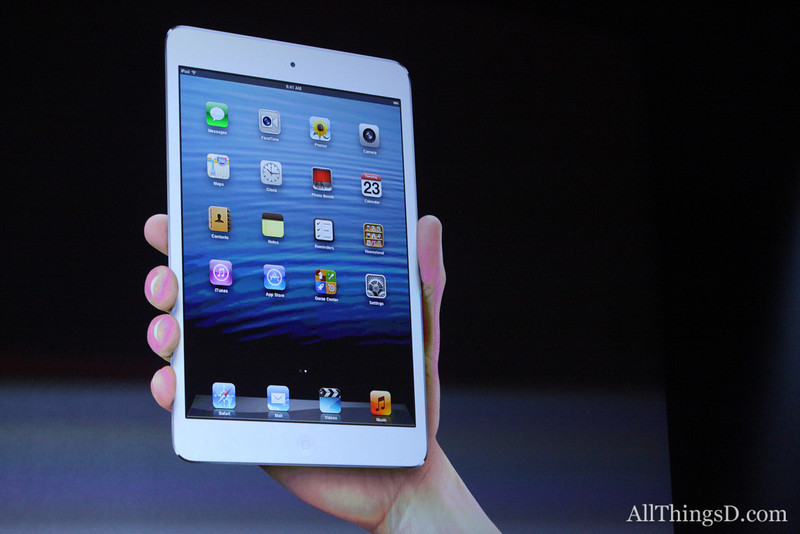
Apple decided to provide us with a new fun-sized item just in time for Halloween–the iPad Mini. It was highly anticipated, and naturally, I sat and watched the announcement. The iPad Mini appears to be about the same size as the most popular e-reader/non-iPad Mini devices, such as a Kindle Fire HD or a Nook. It is small enough to fit in one’s hand, and Apple claims that it’s a new design–and stressed that it’s not a shrunken iPad, but rather a concentrated one. It has all the same features of the iPad 4th generation (which was also introduced during this event), but it’s as thin as a pencil and as heavy as a pad of paper. The screen size is significantly larger than its competitors even though the device is of comparable size. I’ll leave out most of the other details, but needless to say, it performs the same as the new 4th generation iPad also introduced today, and runs all the same iPad only apps. The nice thing that Apple stressed about development for iPad Mini is that it doesn’t change from what is done for iPad–what works on iPad works on iPad Mini. NICE. Everything is faster and more powerful than before, and that makes for a great experience. Its flash storage is the same as a full-sized iPad as well, coming in 16GB, 32 GB and 64 GB. That’s great in itself too.
Photo from AllThingsD.com
So, is it fun-sized? It sure looks like it. Am I getting one anytime soon? No, I don’t have a need for one, considering I just got my cool new iPad 3rd generation not too long ago, and am very happy with that. But I can see a lot of benefits for the iPad Mini, especially for m-learning and use in schools. Sure, having all those cool new features alone make it great, but knowing that it has the same functionality as its full-sized counterpart, there are two features that will make it really great for education and schools.
First, it’s the smaller size. The smaller size will make the device even more portable than a standard sized iPad for students. It’ll be easier to fit in a backpack, or even to use in a classroom or on a field trip. For the elementary school students, the size will make it easier to use for smaller hands. I’m sure that typing with littler hands will be facilitated more easily on a smaller devices. It’s almost as if iPad Minis were MADE for the elementary school crowd! The size also makes reading e-books more like reading from a competitor’s device, in that it’s not much bigger than a paperback novel. The device itself allows for even more mobility than its larger counterpart. It seems to me like this will be a winner in these respects.
The second feature is the price. At a starting price of $329 for the 16GB Wi-Fi version of the iPad Mini, that’s a savings of $150 over the 16GB Wi-Fi version of the full-size iPad. Multiple that $150 many times for all the students that would be given iPads at schools… incredible savings, and maybe more iPad Minis to be bought!
Now, I’m not knocking the full-size iPad. It’s been revolutionary since its introduction two years ago. Tim Cook of Apple spouted off a lot of incredible statistics about iOS downloads and upgrades that were staggering, like 200 million devices upgraded to iOS6 in the past month, and the 100 millionth iPad was sold two weeks ago! (I wonder if it was mine? Ha ha!) Apple stressed their role in education not only with the introduction of iPads and their impact on schools, but also the impact of iBooks as well. (There is a new upgrade of both iBooks and iBooks Author available today as well). iPad full-size will always have a place, just like full-size writing pads have not gone away just because smaller writing pads can be made. There are advantages to full-size iPads, especially when doing larger scale work. Having more screen to view is easier on the eyes in that respect. Like I said, I personally wouldn’t give up my full-size iPad even if given the opportunity to trade it for a smaller one. That’s just me.
But then I think about my middle-school aged son. Having his own iPad Mini would be perfect for him. Not too big, not too small, and at a relatively affordable price, and he’s still get all the features found in the full-sized one. Or for someone who isn’t an avid computer geek, but wants something that’s more beefed up than the Android tablets and e-readers, this is an excellent choice. Or, someone who’s been wanting an iPad but couldn’t afford one, now they can in a “concentrated” size.
I think this means that the iPad Mini is both fun-sized, AND means business!
Now, will the next one be available in chocolate with nuts, caramel and rice crispies?
This post is just a quick summary of the Adobe Day at LavaCon 2012 series from this past week. As you see, there was so much information that it took six posts to try to summarize the event!
Being in Portland, Oregon was great. It was my first trip there, and being a native Easterner, my thoughts pushed me to that pioneer spirit of moving westward in this country. Once there, I saw a hip, young, modern city, continuing to look towards the future. The information I gathered at Adobe Day was general information that was endorsement-free, and practical information that I can use going forward as a technical communicator, and that by sharing it, I hope that others in the field will equally take on that pioneering spirit to advance what technical communications is all about, and bring the field to the next level.
To roundup the series, please go to these posts to get the full story of this great event. I hope to go to more events like this in the future!
As I said, I really enjoyed the event, and learned so much, and enjoyed not only listening to all the speakers, but also enjoyed so many people who are renowned enthusiasts and specialists in the technical communications field and talking “shop”. I rarely get to do that at home (although it does help to have an e-learning developer in the house who understands me), so this was a chance for me to learn from those who have been doing this for a while and not only have seen the changes, but are part of the movement to make changes going forward.
I hope you’ve enjoyed this series of blog posts. I still have many more to come–at least one more that is inspired by my trip out to Portland, and I look forward to bringing more curated content and commentary to you!
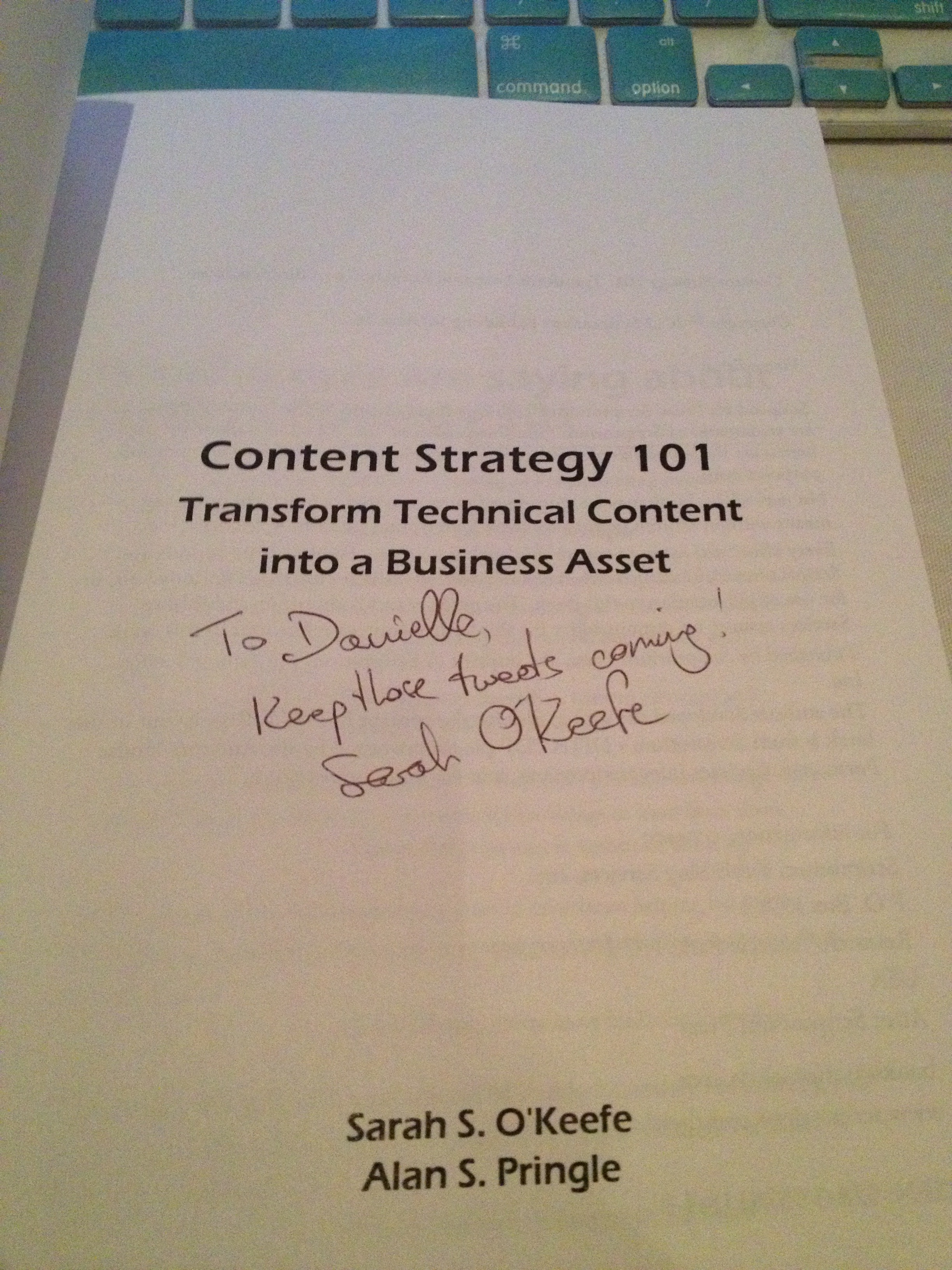
The autograph from my copy of Sarah O’Keefe’s book, Content Strategy 101. Awesome!

 It became very apparent to me in the last week that I could not live without mobile technology. You would’ve thought that I would’ve learned it during the aftermath of Hurricane Sandy. But it hit home much more for me this past week, and I’ll tell you why.









 TechCommGeekMom
You must be logged in to post a comment.