Posted in Uncategorized

A New Year–A New Adobe Technical Communication Suite – PREVIEW

TCS5-Ball-Drop
The Times Square New Year’s ball drop has landed…it’s a new Adobe Technical Communication Suite!

As of TODAY, Adobe is releasing five new tools for technical communication professionals everywhere! Technical Communication Suite 5.0 (TCS5), FrameMaker 12 (FM12), FrameMaker XML Author 12 (FMXA 12) and RoboHelp 11 (RH11), and FrameMaker Publishing Server 12 (FMPS12) are now available. It’s been about eighteen months or so since the last big Adobe tech comm release, so you can imagine there are some new and enhanced features included.

I was privileged to be among a group of tech comm professionals who were invited to get a preview of the products before their release, and I have to say, there were so many new and improved features that it was difficult to squeeze all the information into one press conference! But I’m going to give you the highlights, and I’m sure you’re going to find that there’s something new for you.

In the last release of TCS, namely TCS4, there were several big overhauls of the product, namely that the Technical Communications Suite concentrated on providing tools that supported structured authoring, integrated interactive content, and could support the creation of content for mobile devices while providing searchable, personalized, socially enabled content in a way that would yield bigger results with less resources. It was a major step to enhance these tools, especially in regards to adding mobile and interactive abilities to content. Adobe has continued to build on those major changes with the new features in version 5.0.

The foundation of the Tech Comm Suite has always been FrameMaker and RoboHelp. With the release of TCS5, FrameMaker 12 and RoboHelp 11 have been released with big enhancements that appear to concentrate on making these tools more user-friendly and efficient for the technical writers using them.

FM12_boxshot_2014
Image courtesy of Adobe.

For FM12, the first obvious enhancement is the interface. Adobe has improved the user interface to include colored icons and larger icons that look cleaner and sharper in HD. If you like things “old school” in the original smaller, monochromatic colors, that choice is still available as well. There is also more flexibility in customizing your interface. A new “pod” allows the user to access all the currently opened files in one place, from which you can save and close multiple files at one time, while still viewing the unsaved files. There are also enhanced abilities to drag-and-drop to empty areas of the interface, close pods or panels more easily, double-click on empty areas to minimize or expand pods, and searching capabilities have been expanded. These seem like minor details, but when using a product as often as many technical writers use FrameMaker, these finer details can make a big difference! FM12 includes three samples of unstructured content and one DITA-based content sample with the product.

FM12 is not all about a new façade. Adobe has enriched the authoring process with new capabilities. The first thing that caught my attention is that FM12 can generate QR codes now! They can be created for URLs, SMS texts, emails, or to initiate phone calls. QR codes are taking over these days, so it’s great that these can be both created and integrated into FM documentation. Background color enhancements allow uniform height background color and options to specify paragraph boxes. The addition of a new customer-requested feature is the support regular expression coding.

Single-sourcing has been a hot topic in the last few years, and this has been addressed with new enhancements. FM12 gives users a new way to work with conditional text, by using a new conditional tag pod which provides check-box mechanisms with multiple conditions to allow the user to do more complex filtering with conditional text enhancements. It truly simplifies the entire process, that even a newbie should be able to figure it out easily.

Productivity enhancements have also been included in FM12. A searchable smart catalog function allows the user to filter choices based on the valid choices available and phrase typed by the user, while the user can continue to use the keyboard shortcuts as before. There is also a new capability to open all files from the user’s last session in one click, including the last documents and pages in focus, workspaces such as pods, panels and palettes, among others.

Adobe has also taken care to add great collaboration enhancements in FrameMaker. Native connections to any webdev content management system (CMS), such as Documentum, SharePoint, and Adobe CQ are available. Users can now view entire CMS tree layouts, and can access several key CMS functions, such as checking out documents, editing documents, and searching within document, all from FM12.  PDF review commenting has been made more flexible. The most proactive steps towards subject matter expert (SME) reviews is that reviews can be done on PDF reader apps on mobile devices, and can also be used on those same devices using cloud technology such as Dropbox for both internal and external reviewers. As mobile devices become more commonplace replacing desktops and laptops, this is a great step forward!

Image courtesy of Adobe

Publishing abilities have gotten a boost on FrameMaker as well. It used to be that if you wanted to create certain types of digital output, such a ePUBs, for FrameMaker content, you would have to export it to RoboHelp, and have RoboHelp publish the document.  Now, that step is no longer needed for PDFs, Webhelp, ePUBs, Kindle docs, Microsoft HTML Help, responsive HTML5, or Web help! That’s a big deal, as it allows FM12 to be more efficient by skipping that step of exporting and publishing in RoboHelp. Publishing can also be done through the Web now, too, for multiple users using a FrameMaker server, allowing multiple users to publish simultaneously and automatically to multiple channels and devices. That’s a practical efficiency improvement right there!

FMXA12_boxshot_2014
Image courtesy of Adobe

With this release, Adobe is introducing a new FrameMaker product for those who don’t need the full version of FM12, but are mostly concerned in having a tool to do structured XML authoring. FrameMaker XML Author is a tool that has been created especially for the structured XML market.  Those wanting to use unstructured content will still need to use the full FM12 version.  The XML Author is fully standards-compliant for content creation, and supports the most popular XML technology for single-sourcing. It is not FM12 “lite”, but it is a streamlined, easy-to-use version that supports structured authoring without the bulk of the FM12 features that aren’t needed for structured content, yet still integrate-able with the full version of FM12 and available at a lower price. I’m sure that having this tool will be highly beneficial to many companies who are looking for a way to cut costs (it is priced at 40% the price of FM12 “full”) while still reaping the benefits of having a powerful XML authoring tool.

Another customer request that has been granted by Adobe is the integration of MathML, to allow MathML equations to be imported, created, edited, and published with FrameMaker. Adobe is even including 30-day trials of MathFlow (MathML editor from Design Science) with the shipment of FM12 for those who are interested in trying it out. There are several other features that are also included, along with 55 bug fixes, improved performance and launch time for FrameMaker, but I’d end up writing a book at this point!

Of course, with all these big changes to FrameMaker, we can’t forget RoboHelp 11, which also has had a big overhaul.

Image courtesy of Adobe

RH11, like FM12, has a new UI look as well. Based on customer feedback, RH11 has a new color scheme and a more modern interface that looks more pleasing to the eye. It’s a step in the right direction. Adobe has said that further UI improvements are in the works, but this current new UI is the first step in a long overdue makeover for the interface.

The more important feature enhancements with this new release of RoboHelp include advances with HTML5 publishing, printed document enhancements, and collaboration and single-sourcing enhancements.

The HTML5 publishing enhancements are from the perspective that mobile publishing is central, so new single responsive layouts for all devices are available “right out of the box” when downloading RH11. This new single layout feature will work seamlessly across all devices, can be easily customized, will allow for real-time previewing based on the browser size, and can be published with one click.  There is a new wizard-based layout editor available to help with this process that shows the added responsive HTML5 output options. You can also preview layouts, and the customization is great because no coding in CSS needs to be done, as you can use the editor instead.  To me, this is true single-sourcing creation at its best while simplifying the process! This is a big deal!

Printed documents have not been ignored. Users can now customize headers and footers of printed documents by defining them in the master pages. Headers and footers can also be imported from Word. There is also the ability to specify different headers and footers for the cover, and even and odd pages for different sections of a document. This is great for consistency within branded documentation.

In terms of collaboration and single-source improvements, cloud integration and topic sharing for SMEs has now been included.  RH11 now includes a Resource Manager tool that synchronizes folders using Dropbox, Google Drive, or Microsoft SkyDrive as shared locations, and includes filtering for specific folders. This allows the user to manage linked resources within files used in real time across projects and geography.

Image courtesy of Adobe

The Technical Communication Suite 5.0 includes FrameMaker 12 and RoboHelp 11, but it also includes the updated products of Acrobat Pro XI, Captivate 7, and Presenter 9 to complete the Suite. You will notice that Illustrator, which was included in the TCS4 version, is not included. This was a step, Adobe said, to help lower the price. Additionally, from the way I see it, it makes sense, because both Illustrator and Photoshop–another product that used to be included in prior TCS versions–are now affordably available as part of the Adobe Creative Cloud subscription. I know that I personally have a CC subscription, and I’m guessing that many active technical communicators do too, so this saves us from spending twice for the same product, which makes a lot of sense. TCS5, FM12, RH11, FM XML Author, and the FMPS12 will also be available both as a subscription and through perpetual license as well. There is separate pricing for the FM XML Author and FM Publishing Server software.

The updates made to FrameMaker and RoboHelp are extensive, as there are many more features, but I think you get the idea. Adobe is taking steps to try to stay on top of technological changes that have taken root in the past couple of years, such as mobile and cloud technology, and is working to continue to make a more robust and user-friendly products for technical communicators.

My recommendation is that if you are looking to try TCS5 or any of the TC products out, or are interested in upgrading your current TCS package or individual products, click on the Adobe advertisement in the upper right corner of this page, or visit Adobe’s TCS product page for more information.

I hope you find this helpful!

Posted in Uncategorized

Book Review: 8 Steps to Amazing Webinars by Sharon Burton

8StepsToAmazingWebinarsIn less than a week from this writing, I will be doing a new webinar that I was asked to do by one of the STC Special Interest Groups (SIGs). I was really honored to have been asked, and it’s about a topic that I think I know a little something about–blogging. After all, this little webspot has been going strong for about 21 months now.

But in putting this latest webinar together, I realized that while I felt that I could whip something decent together, it’s been a while since I had to craft a webinar presentation. This, in turn, reminded me that I had a promise to fulfull, as I sought out a reference in my personal library written by one of my tech comm knitting buddies. Pulling this reference out reminded me that I’ve been meaning to write this review since last spring, but had been side-tracked several times until now–when I really needed it most.

Sharon Burton’s book, 8 Steps to Amazing Webinars, is a slim volume of only 81 pages (and that’s the end of Appendix B), but it’s loaded with very concise information. 81 pages is all you need! Considering that this is a short and concise how-to book, it shouldn’t have taken me this long to write this! I truly try to read any books that I’m asked to review cover to cover, and this was a quick but highly informative read!

There are several things I like about Sharon’s book. It’s short and to the point, as already mentioned. For busy presenters who have many things to do other than solely doing webinars, this is great resource because she gets straight to the heart of what needs to be done. Additionally, one of the things that I’ve found that Sharon and I have in common with our tech comm perspective is that our views are highly customer service-oriented. Before my life in an IT/tech comm world, I came from a customer service/client services background, so much of her advice on the how and why webinars can be great marketing tools geared towards customers made a lot of sense to me.

Sharon’s eight steps take the reader from the point of understanding what a webinar is, through every step of the process of creating and following-up with the webinar, including choosing presenters, topics, technology needed, advertisting the webinar, and all the other preparation steps to creating the webinar. She even includes pointers on how to set up the presentation slides that are most likely going to be used in the presentation.

As I read the book, I was quickly reminded of the first webinar that I did back in 2012 for Adobe’s Technical Communications group (you can find the link on the right-hand column of this blog). I remember not knowing the first thing about how to put together a webinar. At the time, Maxwell Hoffman, who is one of the evangelists for Adobe TCS, guided and coached me through the process, and it ended up being a great success. Looking back, I would not be surprised if Maxwell was already well-versed in the steps that Sharon outlines in her book, because I’m fairly sure that we followed every single step. When I also look back to the first in-person presentation I did, which lead to a recent webinar on the same topic, I realized that I had followed much of the same steps again, and got a great response as a result. These steps are practically foolproof, so I can assure you that if you follow Sharon’s advice in the book–and much of it is really common sense, you should have success in presenting a webinar.

Sharon’s viewpoint in this book is from a marketing perspective, in that webinars are used to drive people to a brand, increase leads, and provide resources to your customers. And for 99.9% of time, this is a main focus for most people who would read this book. But even for people who are academics, for example, who are not necessarily trying to create a brand, but rather disseminate valuable information, this book is still helpful because it put the reader in the right mind-set to create a virtual presentation that is meaningful for his or her audience. For example, while I am promoting my “brand” of TechCommGeekMom, I’m not really selling a product or service the same way that a software company or communications service consultancy would be. (At least I’m not at that stage yet!) Even so, I know that when I present the webinars that I’ve done, there is some sort of value based on the type of information that I’m providing. By referring back to 8 Steps to Amazing Webinars as I prepared for this upcoming webinar, I knew that I was on the right track to maximize the information that I will be delivering. It also made me reflect, based on these steps, what made for a bad webinar, and I’m sad to say that I’ve attended a few of those in my time. I think I even remember one that Sharon and I attended at the same time, and I remember us talking about how disappointed we were with that one webinar, and we had the same sticking points about it.

I highly endorse this book for its strong content and its easy-to-read, straightforward language. Anyone who is doing a webinar–or even an in-person presentation–can gain some great pointers and advice following Sharon’s advice. Hey, it’s such good advice that the book is endorsed by the STC itself, and I know that many of their best webinars follow Sharon’s methods. So that says something right there!

You can find the book on Amazon.com, Barnes & Noble, and XML Press websites. And be sure to follow Sharon on Twitter too– she’s @sharonburton, or on her blog found at sharonburton.com. She always has good information to pass along that goes beyond just how to do webinars!

Posted in Uncategorized

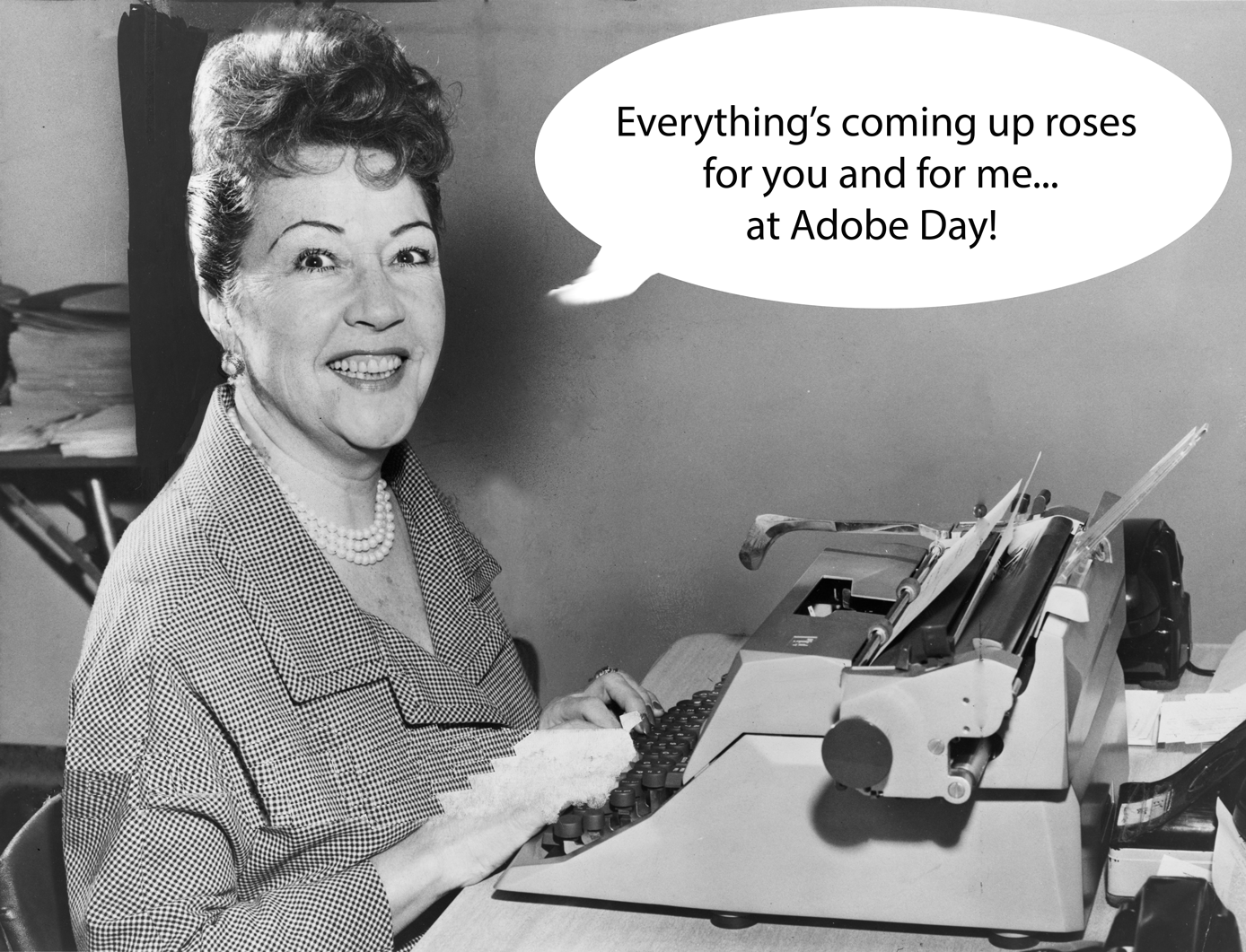
Everything’s Coming Up Roses! : Why I’ll be going to Adobe Day at Lavacon 2013

Ethel Merman can't wait to go to Adobe Day at Lavacon 2013--and she's been gone almost 30 years!
Ethel Merman can’t wait to go to Adobe Day at Lavacon 2013–and she’s been gone almost 30 years!

A little more than a month from this writing, Adobe will be hosting an Adobe Day event at the 2013 LavaCon Conference on Social Media and Content Strategies. It will feel a little sentimental for me, because I felt like I had come into my own when attending the same event last year. I remember my excitement at hearing all the speakers and learning so much information from them as a newly-minted technical communicator. All the information that I soaked in during last year’s Lavacon Adobe Day was put to good use, as I was able to use the information when speaking at interviews when I was job searching. I’m confident that the information I learned at the event helped me get the job I have right now.

Now, I’m excited that Adobe is bringing the event back to Lavacon this year.  I think I’m just as excited as last year, to be honest! Having now attended two Adobe Day events (the other being the one at the 2013 STC Summit), I know I’m in for a great time.

AdobeDayLavacon2013AdAdobe has adopted a theme around the location of the Lavacon Adobe Day, namely around Portland, Oregon’s nickname of “The City of Roses.”  I got to thinking about this, and it seems totally appropriate.  If you think about it, technical communicators are the gardeners and landscapers of content and technical communication. We need to sow and care for our documentation as if they are our gardens and plants.  I know that I grow with each event with my own knowledge, and that’s why I like attending them.

And how is it that we describe growing roses? I believe the expression is that roses are “cultivated”, which implies to me that they aren’t just grown, but they are carefully tended to, bad stuff weeded out, and they are pruned until they are just right, much like technical communication should be.  If these steps are done correctly, diligently, and thoughtfully, rose plants should bloom in full.  The same applies to our documentation–our gardens! The speakers at Adobe Day will be helping us learn the tools and methods we need to make our “gardens” grow!

I’ve seen many of the speakers listed for the event before, speaking about different topics. They always have fantastic insights. I’m also looking forward to seeing some other presenters that I haven’t heard from before.  The great thing about Adobe Day events is that isn’t never the same thing twice.  Topics change and shift with the times, and the talks reflect of that reality.  World-class experts helping us all learn how to make our “gardens” grow on a global scale? Priceless.  The fact that the event is FREE and that it’s not a big info-mercial for Adobe is an added bonus. Adobe makes a very concerted effort to make sure that the event is topic-centric, not software endorsement-centric.  Their goal is to help technical communicators grow in knowledge, and the thought leadership they gather for each of these events are top notch.  Who wouldn’t want to go to something like that?

As I said earlier, I feel that I grow each time that I attend an Adobe Day event.  I’ve already seen how it has helped open my mind, and that knowledge has given me a boost both in job interviews and in the workplace.  I bring back the best ideas to help me not only grow my own career, but to also help the company I work for grow with the times as well.  The last thing any company needs is to be in the weeds, and these talks definitely help with the weeding process of what best practices are to be used. The best ideas are cultivated and presented to us!

So, if you are going to Lavacon this year, or if you are going to be in the Portland, Oregon area on the morning of October 20th, I strongly encourage you to attend this great event. I’ll definitely be there in full force, and I’ll be covering the event live through my Twitter feed as well.

If you do decide to go, be sure to register at the link below, so they know you are coming. They say there’s no such thing as a free lunch, but that’s included in the event, too, so sign up here:
http://adobedayatlavacon2013.campaignsandevents.com/

See you there!

Posted in Uncategorized

Death of the Desktop and Gaming as We Know It

deathofthedesktopIn the past week, I’ve made two observations about how technology is going through an advancement surge. What I mean by that is that there are big changes happening, and it seems like it’s happening incredibly quickly–at least in my eyes.

The first occurrence was last week. My dad called  us because he knew my husband and I had something he didn’t have–more computer knowledge than him. I found it a little ironic, my dad was my first computer teacher in the early 80s when Apple II first came out. My dad, being an educator, was progressive enough to know that these were going to be the wave of the future, and in some respects, he was an e-teacher–an early computer teacher. But here was my first computer teacher asking for help. He admitted that he had let his skills lag, and he was now “a dinosaur”, and didn’t have a clue what he was doing anymore. His desktop had died, but he wanted to retain a lot of information that was still on his old hard drive. My husband declared the desktop was indeed dead,  and suggested that if my dad bought a new desktop, we could probably install the old hard drive as a secondary hard drive in the new computer, and that way he could still access the information.

I took my dad to the local Best Buy and Staples to do some comparison shopping. What struck us both is that there were next to no choices at either store for desktop models. Almost everything was either a laptop, a tablet, or one of those sleek all-in-one units. Considering that my dad wanted and needed one of those BIG desktops–not one of the compact ones, the choices were even more limited.

The irony was that once we brought the desktop back to my house to see if we could install the old hard drive into it, we discovered that it didn’t have a bay inside the casing to accomodate it, but it also essentially only had a motherboard, a power source, a fan, a Blu-ray disk drive, and the hard drive inside. That was it. It was a LOT of wasted space for something that was fairly powerful. The machine also came with the “blessed” Windows 8. I’ve had my hesitations about upgrading to it myself, but my dad had no choice, and the poor chap has been using only Windows XP and Windows 2000 up until now, so he was REALLY behind. Our solution to the hard drive issue was that my husband bought a contraption that you can enclose the old hard drive in a special case, and it turns it into a USB-connected external hard drive. So, that part of the problem is solved.

The Windows 8 solution is not. Dad is struggling to figure it all out, and is perplexed at how Windows 8 works in general. He’s not up to speed with the idea of using cloud-based apps for anything, or even using cloud-based storage.  Since my husband and I are still using Windows 7 (and we’re safe for now), we can’t advise him on how to use it, even though we can give him some advice on apps and cloud-based apps in general. What’s frustrating for my dad is that my mother is even less computer literate than him (she’s been condeming computers for thirty years now), so she’s REALLY thrown by how to use Windows 8. I sent Dad some online resources including an e-book on how to use Windows 8, and he bought another book, so hopefully he’ll be the expert soon enough.

The second indicator to me that things were changing technologically was the closing of our local GameStop store. Now, to be fair, I live in a very small town–one that’s small enough that I questioned why we even had a GameStop in our town to begin with. We liked that store better than the one at the local mall because we got more personalized service, and we liked the staff there. I was only surprised to see that it had disappeared almost overnight the other day when I passed by the shopping center where it was located. I’m sure the store didn’t get enough traffic to warrant it to stay open, so that wasn’t a surprise. I was just surprised that it was done without a lot of fanfare. Related to that, since the store wasn’t there, my son was itching to get a new game for his Nintendo 3DS, and we ended up looking online for choices. Granted, my son is fussy about what games he likes and doesn’t like, so choices seemed slim. But even from my own tastes, it seemed like there weren’t a lot of choices. Here was a portable gaming system that didn’t have many games, even though it’s the most current Nintendo portable gaming system on the market. That didn’t make sense to me. As I later found out, Nintendo is working more and more on putting out games that can be accessed through the 3DS’s wi-fi connection–in other words, accessed through cloud services, and saved on the device’s flash drive or on the SD card that you can install. THAT’S where all the new games were!

As I thought about my dad’s predicament in catching up to the 21st century and my son’s need for more games, it occured to me that more and more access to media of any kind is becoming dependent on mobile services and cloud services.  Really–think about it. As I was finding out from my dad, he could only install or update his Microsoft Office if he subscribed to Office 365–the cloud service. Microsoft has adopted cloud services to deliver its services, as has Adobe. Subscription services are pretty much the main way–and soon the only way–one can get access to this software and applications. It’s rare that anyone gets DVDs to install software anymore–it’s downloaded off the Web now. The same thing was happening with my son. He had better access to games for his device through Nintendo’s cloud services than if he paid for a micro-disk.

These are only two of several observations I’ve made lately that we’re going through a technology surge of sorts that are making what we’ve known and loved for years are quickly becoming obsolete.  Tablets, smartphones, and laptops are pretty much the standard now, pushing mobile to the forefront even more. Touch technology is becoming more prolific, even for the all-in-one desktop computers that are out there, putting it on the same level as its mobile counterparts.  Even the gaming world is getting the clue, with more games downloaded to smartphones and other mobile devices rather than buying the software.  Who buys DVDs or Blu-ray disks anymore when we can download movies and other videos from Netflix or iTunes?

Cloud-based and flash-memory based technology seem to be taking over! Soon enough, DVDs, CDs, and SD cards are going to obsolete like the 5 1/2 inch floppy disks, VHS tapes, tape reels or punch cards! Seriously–think about it–in a year or two (okay, maybe a little more than that), all those things might be GONE.

It’s great that technology is advancing in leaps and bounds like it is. No one is more excited about these advances than I am, in most cases. But I wish I could keep up sometimes! It makes me feel bad for my dear dad, who is getting left in the dust by these advances.  I’m sure he’s not the only one.