Posted in Uncategorized

Happy Thanksgiving 2012!

Today, in the United States, it’s a holiday. Thanksgiving is a day that we Americans celebrate to remember the sacrifices that the first English pilgrims made after their first year of survival in the New World. The celebratory tradition started with those pilgrims sharing the bounty of the harvest they reaped with the Native Americans who lived in the area and taught them some of the survival skills, and gave thanks for everything that came their way. Many generations later, we Americans, use this day to remember and give thanks for what we have as Americans. We celebrate with family, friends, and a huge feast.

OK, so that’s the general idea of the holiday–or at least that’s what it’s supposed to be. The legend or fairytale has been marred over the years with the realities of those who were cast out due to religious oppression in their own country coming to this one and taking horrible advantage of the native people, eventually driving them out over time and making the Native American nation into a minority that is still, to this day, trying to culturally and literally survive. America, for all the pretty stories of pioneering, didn’t always get there in a nice and clean way with hard work. There are some ugly stories too. I just wanted to put that out there, just in case anyone thought that I was unaware of any atrocities in our nation’s history and had notions of any overly lofty American ideals.

But for a moment, let’s just run with those lofty ideals for a moment, and get back to the core idea of how Americans celebrate it now–Americans of all races, religions, cultures, ethnicities and creeds celebrate. Thanksgiving is a nice concept of a holiday, no matter how one celebrates it. I’m sure there are other holidays in other cultures that have something like it, where it’s just a day to celebrate family, friends and whatever good fortune has come by in the past year. There’s been a lot of bad things that have happened over the centuries, and even more recently. Heightened wars in the Middle East, poverty and starvation in different parts of the world, and even closer to home, the devastation of what Hurricane Sandy did to my home state and area. This is a day that I’m thankful that the worst thing that happened during Hurricane Sandy was that a tree fell on our house and ruined part of the roof, and that I didn’t lose my home or more importantly, my family.

It’s a time to realize that while no life is perfect, and all people have their own issues, that some good things can come out of life, and to be grateful for those good things, whether they are big or small.

For me, it’s been a very interesting year. While I’m sure I’ll say more as the year draws to a close, I’ll just summarize the good things I’m thankful for this year, as much of it does deal with my entry into the technical communications world. I’m thankful that there was a program at NJIT in technical communications, and that I could graduate with my Master’s degree in the topic this year. I’m thankful for the professors and students in my program who helped me get out more into the social media world to make my voice heard, and continue to support my endeavors post-graduation. I’m thankful to have met so many people through social media–Twitter, this blog, Facebook, etc.–who are professionals in the technical communications world who have mentored me as well as become my friends. I’m thankful for the opportunities I’ve had through these associations, such as the chance to go to Adobe Day, have my webinar, do the NJIT promotional video, get my teaching job or meet other professionals in person. I have learned so much, and continue to learn so much from all of them. But most of all, I’m grateful for my husband and son, for without them, none of this would be possible. Allowing me to be me, allowing me to continue to learn and grow, and supporting me every step of the way is so important to me. Without those two wacky guys of mine, I would not be in the technical communications field, and would not be continuing to pursue a technical communications career.

So, whether you are in the United States partaking in a big holiday, or it’s just another Thursday or Friday (other places, it’s Friday already from the time I’m writing this!), take a moment and remember what it is that you are thankful for, even if it’s just being glad the be able to pursue a technical communications career that is growing and expanding each day, and that you are part of the great changes that are happening in this world–one little bit at a time.

Posted in Uncategorized

Blast From The Past – Volume 3: Interior Design Influence on…Tech Comm and Social Media?

For this week, I decided that I would post another one of my “Blast from the Past” entries from my graduate school blog. When I go back to review these, many of which were written when I was just starting to understand what technical communications were all about, I see some pretty decent reflections.

I’ve lost direct contact with the person in this entry, as life moves on, and Twitter exploded, but I still learned a lot from the experience. Perhaps I still need to follow-up on the blog entry I proposed at the end based on his books! He’s still out there and making the most of social media and media at large, and has always been ahead of the curve in this regard, continuing to make the most of both marketing communications as well as instructional design with his television shows and now instructional videos on his website.

Enjoy this entry that was originally from March 20, 2010, originally titled, “Interior Design Influence on…Web Design?”:


Recently, I’ve struck up a Twitter friendship with renowned interior designer, Christopher Lowell. He is a very thoughtful, sweet guy. He also posts these great dishes he’s having for dinner that make me hungry! But I digress…

Christopher has always been a little bit ahead of the curve when it comes to media and the wave of the future in communications. He was revolutionary in breaking down the basics of interior design in a user-friendly way, and bringing it to the public on the then-new media outlet of cable television. Between his shows and his books, which eventually branched out into his own product lines of furniture, fabrics and other home accessories, his goal has always been to make interior design about making a home, and making it with your own special stamp. All these years later, he still has that goal of bringing things that seem so lofty down to earth for all of us to enjoy.

One of the things I like about corresponding with him through Twitter is that he really seems to be exactly who you see on TV and read in his books. He’s down to earth, he can be silly, but he really does care about important issues and cares a lot about other people and really using social media as a means of communications. I know that I’ve certainly enjoyed getting to know him little bit by little bit.

So, today he posted on Twitter that he had a new blog post, in which he talked about how he likes how reality TV is starting to be used more constructively, and used Jamie Oliver‘s show about how Jamie is trying to change the diets of school lunches to more wholesome foods for kids as a good example.  He segueways into how he feels that the internet is what the next big wave of information and entertainment will be– more so than it is now, much like cable TV was in its infancy. He alluded to the fact that part of the reason we don’t see him on TV (cable or otherwise) much these days is that he’s exploring these new media. He wrote, “As we continue to open new portals and refine new media platforms, you can bet, I’ll be there, doing what I do best.” That seems appropriate for a guy who has always been on the cutting edge of things.

So what does this have to do with technical writing? Well, a lot. You see, I feel inspired by what Christopher has been talking about, because it’s not only about what he’s doing, but where the future in technology is going, and technical writing is part of that.  I’ve thought of two projects that he’s inspired me to do, but I don’t have the reason to do it other than “just because I feel like it” at the moment, so since I’m busy enough, I’ll have to wait until I have a little more time to work on them, or can work it into a school project for my e-Portfolio. The first idea was just to interview him, and get more details of where he thinks internet media is headed, and the sorts of projects he wants to do, or sees happening. You know, get inside the head of one of the big “movers and shakers” to understand future trends. The other idea is to write a piece called, “The Seven Layers of Technical Writing” or “The Seven Layers of Web Design,” or some similar theme, as Christopher was the one who revolutionized the idea of the “seven layers” of interior design. (Heck, I wouldn’t be surprised if he invented the Seven-Layer Dip!) In my mind, it would be an article that would show, especially for the newbie technical writer, that by sticking to some basic rules of thumb, like the Seven Layer of Design, that you too can master what it takes to be a technical writer.  I’d really have to think it through, because I’m sure it’s not that easy to whittle anything down that has so many variables, like tech writing, like web design, or interior design.

Kudos to you, Mr. Lowell, for giving me some inspiration outside the (technical) box, and getting a new dialogue started in my head…

Posted in Uncategorized

Being a specialist or a generalist? Which is better for a technical communicator?

I feel like I’ve stepped into quite the conundrum by entering the technical communications field. As I continue to search for full-time work, a problem that I seem to find almost everywhere I go is that technical writing jobs in my area seem to require that one be a specialist in their field, or do very, VERY specific types of work. Both before and after my technical communications studies, I had always been taught that with few career exceptions, being a generalist was more often a desired skill set, simply because I couldn’t get stuck in one specific direction and find little to no work. Having a broad range of skills and abilities made one more marketable, flexible, and thus desirable as an employee. I know the last place that I consulted for full-time appreciated that generalist ability of mine, because I ended up being the go-to person for web editing, web design, and general graphics design. There were those who had the title of “web publisher” but didn’t even know basic HTML, and I actually did.

However, I’m finding that as much as I did my best in both my career and my graduate studies to study a broad range of subjects, including social media, e-learning design, content management strategy, UI strategy, and technical writing and editing, to name a few, I end up as a Jack of all trades, but master of none. However, it seems that because I don’t have specifically five years of medical or proposal writing background in XYZ software, I’m useless. I was recently criticized for having an “unfocused” resume because it was so broad. When asked what specialization I wanted to follow, I listed all the subjects I mentioned above and then some others. I feel I have the skills to start out in any of those fields if someone gave me a break to go in any of those specific directions.

One of the things that stuck out in my mind from Adobe Day at Lavacon last month was commentary by the panel at the end of the morning, in which the group said that one of the issues right now in tech comm is that there are too many tech comm specialists instead of tech comm generalists. When I heard that, it was music to my ears, and I felt vindicated for taking the approach I had with my career! I’ve already taken steps–specifically getting a Master’s degree in Professional and Technical Communication–to provide myself with an education on understanding all the available possibilities in the technical communications field, and be able to adapt to it. However, one of the other challenges listed in the panel talk was the general resistance to progressive change. I fear that the resistance to change is far more widespread than anticipated, based on my own experiences. Every job listing and every recruiter I talk to seems to want to pigeonhole me into one specialty, and I don’t want to do that. The reason I went to graduate school was to allow me to gain opportunities beyond my knowledge of content management alone, and allow me to flex my editing, writing, design and e-learning muscles some more.

Perhaps because I’m a “newbie,” I don’t understand this strict adherence to being a specialist in only one kind of tech comm. Becoming a specialist is a double-edged sword. On one side, being able to work in a niche field makes your skills more desirable for that niche. However, on the other side, it limits the kind of work one can do if there are layoffs or one finds him/herself out of work.

Since I’ve been looking for full-time work for almost a year now, I talked to my husband recently about this idea, and questioned whether I should commit more to one particular area of technical communication than another. While I’ve done a lot of content management work, I find it constraining when I want to be able to edit what I see as just plain BAD writing, and I feel limited to not flex my brain muscles on all the things I’ve learned in grad school in the last two years. I’ve tried to immerse myself in the tech comm world and the e-learning world to varying degrees, but again, I find myself as a generalist since I don’t have any job to help me hone my professional focus as of yet. Even so, I wondered if I should just resign myself, and just try to figure out what specialty I should focus on, perhaps in the hopes of increasing my job prospects. After voicing this concern, my husband vehemently disagreed, feeling that it was better just to continue to be able to look at a little bit of everything and do a little bit of everything, as it broadened prospects by giving me multiple directions to follow.

It makes me wonder how other graduates–whether they are from undergraduate or graduate school–find a job at all. How is someone supposed to be able to do a technical communications job with little to no experience? How the heck can they become specialists without first being generalists given a direction from their first jobs? I know I have the flexibility and know-how to go into many jobs, but it’s autobots that read my resume instead of people more often than not, and autobots don’t understand the value of what I can do and my ability to learn on the spot. I’m sure I’m not the only one in this rut, and yet there doesn’t seem to be any flexibility on the part of employers. There are plenty of us who are more than willing to be dedicated employees with a strong skill set foundation, and we aren’t given a chance.

So, what is better? Being a specialist or a generalist? Write your opinion in the comments below.

For me, I’m still torn, and my problem is that if I do need to be a specialist, I don’t know what direction to follow, because I like so many aspects of tech comm. Should I find work as a full-time blogger, pursue my desire to be an instructional designer, go back to content publishing and management, become a technical evangelist, become a teacher or trainer…or what?

(If you know of any telecommuting/remote jobs or jobs in the Central NJ area along these lines, let me know!)

Posted in Uncategorized

Lady Shotgun: taking on childcare and capitalism

See on Scoop.itM-learning, E-Learning, and Technical Communications

How one indie studio is killing crunch and sharing profits…

Thanks to @cfidurauk for pointing me to this article.

One of the tough things about being a mother in any industry is how to balance responsibilities of being the primary caregiving parent and giving full attention to a job/career. Ann-Marie Slaughter, formerly of the US State Department and now back at Princeton University, wrote a controversial article for The Atlantic magazine (I think it was the Atlantic) which gave her case of while she had it all, she felt she really didn’t.

In this day and age, we need to rethink and rework what the work process is. I’m sure the hours of “9 to 5” were based on daylight hours during the 19th century or something. I’ve always tried to work different hours than that–usually earlier hours so that I could be home at a reasonable hour for my child. Additionally, I have found that there are very, VERY few things in this world that depend on work being done RIGHT NOW or needed to be done YESTERDAY. (Immediate emergency medical care is the only thing I can think of that is THAT urgent.) I applaud Lady Shotgun for their endevour, and hope that more and more people–not just moms, but dads too–start thinking in the terms that this outfit set up shop.  If I could find a place like that which could use the skills that I can offer and paid decently, and had the flexible hours that are presented here, I would jump on that bandwagon in a heartbeat.

As technical communicators and e-learning/m-learning specialists, this seems like it should be a viable work solution for so many of us–all parents alike. There are rare instances that documentation has to be out THAT quickly because someone’s life is in jeopardy. Lady Shotgun should be a model for us going forward.

See on www.gamesindustry.biz

Posted in Uncategorized

Is iPad Mini the “Fun-Size” tablet, or does it mean business?

As the end of October approaches, so does Halloween. And with Halloween, most people would think of ghosts, witches, vampires and other monsters along with other spooky stuff. As for me, I think of trick-or-treating and the all important CANDY. Mind you, the candy usually given out is not full-sized candy bars, but rather “fun-size” candy–usually miniature versions of the tastes we know and love.

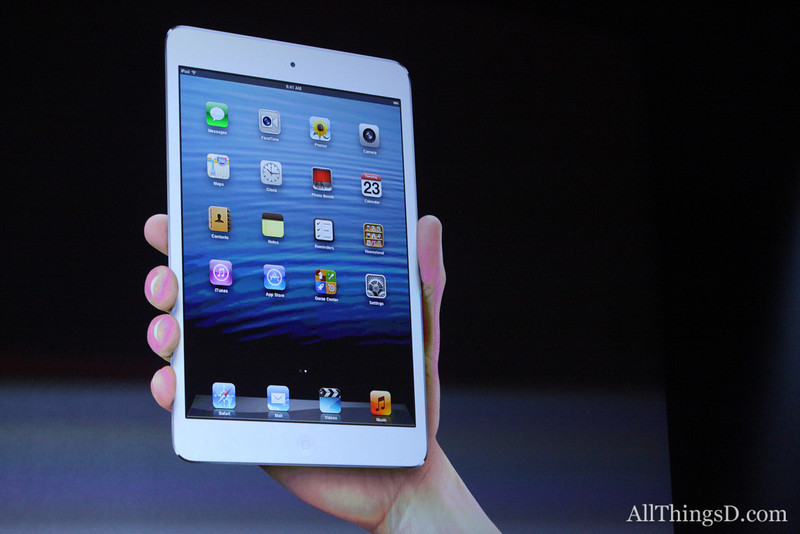
Apple decided to provide us with a new fun-sized item just in time for Halloween–the iPad Mini. It was highly anticipated, and naturally, I sat and watched the announcement. The iPad Mini appears to be about the same size as the most popular e-reader/non-iPad Mini devices, such as a Kindle Fire HD or a Nook. It is small enough to fit in one’s hand, and Apple claims that it’s a new design–and stressed that it’s not a shrunken iPad, but rather a concentrated one. It has all the same features of the iPad 4th generation (which was also introduced during this event), but it’s as thin as a pencil and as heavy as a pad of paper. The screen size is significantly larger than its competitors even though the device is of comparable size. I’ll leave out most of the other details, but needless to say, it performs the same as the new 4th generation iPad also introduced today, and runs all the same iPad only apps. The nice thing that Apple stressed about development for iPad Mini is that it doesn’t change from what is done for iPad–what works on iPad works on iPad Mini. NICE. Everything is faster and more powerful than before, and that makes for a great experience.  Its flash storage is the same as a full-sized iPad as well, coming in 16GB, 32 GB and 64 GB. That’s great in itself too.

Photo from AllThingsD.com

So, is it fun-sized? It sure looks like it. Am I getting one anytime soon? No, I don’t have a need for one, considering I just got my cool new iPad 3rd generation not too long ago, and am very happy with that.  But I can see a lot of benefits for the iPad Mini, especially for m-learning and use in schools. Sure, having all those cool new features alone make it great, but knowing that it has the same functionality as its full-sized counterpart, there are two features that will make it really great for education and schools.

First, it’s the smaller size. The smaller size will make the device even more portable than a standard sized iPad for students. It’ll be easier to fit in a backpack, or even to use in a classroom or on a field trip. For the elementary school students, the size will make it easier to use for smaller hands. I’m sure that typing with littler hands will be facilitated more easily on a smaller devices. It’s almost as if iPad Minis were MADE for the elementary school crowd! The size also makes reading e-books more like reading from a competitor’s device, in that it’s not much bigger than a paperback novel. The device itself allows for even more mobility than its larger counterpart. It seems to me like this will be a winner in these respects.

The second feature is the price. At a starting price of $329 for the 16GB Wi-Fi version of the iPad Mini, that’s a savings of $150 over the 16GB Wi-Fi version of the full-size iPad. Multiple that $150 many times for all the students that would be given iPads at schools… incredible savings, and maybe more iPad Minis to be bought!

Now, I’m not knocking the full-size iPad. It’s been revolutionary since its introduction two years ago. Tim Cook of Apple spouted off a lot of incredible statistics about iOS downloads and upgrades that were staggering, like 200 million devices upgraded to iOS6 in the past month, and the 100 millionth iPad was sold two weeks ago! (I wonder if it was mine? Ha ha!) Apple stressed their role in education not only with the introduction of iPads and their impact on schools, but also the impact of iBooks as well. (There is a new upgrade of both iBooks and iBooks Author available today as well). iPad full-size will always have a place, just like full-size writing pads have not gone away just because smaller writing pads can be made. There are advantages to full-size iPads, especially when doing larger scale work. Having more screen to view is easier on the eyes in that respect.  Like I said, I personally wouldn’t give up my full-size iPad even if given the opportunity to trade it for a smaller one. That’s just me.

But then I think about my middle-school aged son. Having his own iPad Mini would be perfect for him. Not too big, not too small, and at a relatively affordable price, and he’s still get all the features found in the full-sized one. Or for someone who isn’t an avid computer geek, but wants something that’s more beefed up than the Android tablets and e-readers, this is an excellent choice.  Or, someone who’s been wanting an iPad but couldn’t afford one, now they can in a “concentrated” size.

I think this means that the iPad Mini is both fun-sized, AND means business!

Now, will the next one be available in chocolate with nuts, caramel and rice crispies?