What? You say this Adobe Workshop is free? Then I reckon I oughta sign up now….
While I was unable to go to the STC Summit last year, I am looking forward to going to Anaheim this year to not only being a presenter at the STC Summit, but also to learn and connect with other technical communicators again!
I realized that one of the events I’ve always liked attending is the Adobe pre-conference event. They always have great information to share. However–what’s this? No Adobe Day this year? Nope. But wait…there’s something better.
(Click on the wanted poster for more information)
That’s right! Saddle up, and gain some skills through this FREE Adobe Tech Comm Tools Workshop! This looks like a great event, cowboys and cowgirls! There are industry leaders leading the workshop, you earn a certificate for participating (which you can include on your resume, it’s that good), and lunch and snacks are included in the afternoon. And did I mention it’s free? Who says you can’t get a free lunch AND a free certificate? Evidently not Adobe!
Oh, did I also mention that even if you can’t attend to earn the certificate, you can still follow along on my Twitter feed found at @techcommgeekmom that day, as I’ll be tweeting highlights of the event for all who come to the Twitter corral!
If you don’t comply, you can’t register. But these are easy terms to deal with, Sheriff.
Now, there are some caveats in registering, namely that you have to bring your laptop, and download the Adobe Tech Comm Suite Release 2015 Trial Version (if you don’t already have the full version). Other than that, it should be like riding into the sunset.
This is a great opportunity for those who would like to either get to know the Tech Comm Suite better, or brush up on some skills. Space is limited so you should register as soon as possible to get your seat on this great event!
(My apologies to those who are more sci-fi savvy for mixing my space westerns together. Firefly and Cowboys and Aliens were the first things I thought of!)
Taking on new contracting positions is always an adventure. Indiana Jones knows all about that!
It’s been a quiet start to 2016 for me, even though there have been some things going on for me “behind the curtain”. I wasn’t ready to share just yet, but I think I am now, since things have settled down for the moment.
My contract as a knowledge management specialist ended early. The projects that they kept saying to me, “They are coming…we’re waiting for approval…” fell through. Two of them. They also didn’t have any other work for me to do, so understandably, they cut the contract short. Unlike some other jobs, I was greatly relieved to be released. I did not feel that this particular position and company was a great fit. Even though I truly tried to give it a chance, I remember not having good feeling about the place from my first day of work there, and my gut instincts were right. It wasn’t a good match in the end, and the fact that they didn’t plan well for my presence there proved that.
In the meantime, I had two events that changed the picture rather quickly.
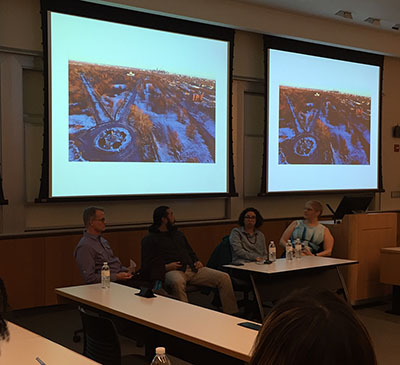
TechCommGeekMom speaking at the PANMA/STC-PMC February 2016 meeting (Photo courtesy of Timothy Esposito for STC-PMC)
First, I was invited to be a panelist/presenter for a meeting that combined the Philadelphia Area New Media Association (PANMA) and the STC-Philadelphia Metro Chapter memberships. The meeting was about freelancing and contracting. Each group contributed two speakers, and I was one of the two representing the STC (the other was my friend, David Calloway). I was the last one to present or speak, and to be honest, I came completely unprepared. I thought it’d be a quick introduction thing, and then moderators would ask questions based on our experiences and background. (I guess I’ve been watching too many American political debates lately.) I was glad that I went last of the four presenters. Although the other three presenters covered much of what I would’ve said, I still had a few things to contribute. David and I took the stance of being contractors rather than freelancers. And as you might remember, several months ago I started my own freelancing company, but it hasn’t quite taken off yet.
But I will admit, listening to the others, I had a big realization of my own that night. I’ve been a contractor for several years, but not of my own choosing. I’ve tried finding full-time employee jobs, and it hasn’t happened in years. I think the last time I was not a part-time person or a non-contract person, it was still the 20th century! Yet perhaps, without my knowledge, I’ve already been a freelancer by default of being a long-term contractor.
That was my “A-HA!” moment, as Mitchell Levy likes to call it. I realized that yes, perhaps I have been a freelancer all along, and perhaps it really isn’t so bad to constantly be getting contract jobs. After the meeting, I told my husband about the discussion, and he pointed out that there was great opportunity in being a contractor. The biggest thing he pointed out was that each contracting job was an opportunity to learn new things. I would learn more about different industries, and often I’d learn more about new software, new procedures, and generally pick up a few new skills. I would also learn more about myself, namely what I’m good at, what I’m not as good at, and what I actually like doing. The more I thought about it, I realized that he was right. These are all opportunities to hone different parts of myself, both in improving what I do well, learning new things, and gaining insight about what is best about my capabilities and how to use them.
Group of PANMA and STC panelists, February 2016 (Photo courtesy of Timothy Esposito for STC-PMC).
Now, not everyone can be a contractor. It’s not easy because of complications of being a non-employee, thus you don’t get the same rights and benefits, like affordable health insurance, as a contractor. Some agencies that contract out do offer these benefits, but they are usually at a higher rate than at a large company. But, at the same time, there are certain flexibilities that a contractor has. If a contractor is careful with personal finances, he/she can take time off, or work more than one position over time. Granted, in 99.99% of cases, if you don’t work, you don’t get paid. So, for example, when I go to the STC Summit in May for about a week, I won’t be paid for “paid vacation”. In fact, a contractor doesn’t get any paid vacation. You get paid for the hours that you work. So, that can be good, and can be bad. If you are a good contractor, you communicate these occasions with your manager, and you ensure that you are caught up with your work to be able to do this, it provides a little flexibility that an employee doesn’t have.
I’ve lamented the woes of being a consultant recently, and it was especially because I was in a bad situation. It was not a good fit, and the worse parts of being a contractor were at their absolute worse. But now that I’ve been away from that, with the help of this PANMA/STC-PMC panel last week, I’m starting to change my attitude a little bit.
With that in mind, I took a new job that started this week…as a contractor. I will be working for a global insurance company as a content writer/copywriter for their global self-service websites. This is a big change for me, because while you’ve known me as a social media writer, I really haven’t done any writing for a company this way before. I originally was reluctant to take the job, as it’s a far commute than what I’m used to and I’m taking a significant pay cut to do this job. But, I saw it as an opportunity to actually put my technical writing, editing, and UI/UX experiences to work in a different way, so it’s worth a try. After all, the contract is only for six months with a possibility for extention. Unlike the last position I took in which I had a sinking feeling about it (and my instincts were right about it), I have a better feeling about this position. After completing my first day, I think it’ll be a challenge to do things from a different perspective, but I liked the group of people I’ll be working with, the environment was more inviting, and I could tell that the work we’d be doing is much more in line with my experiences. While I’ll be learning to do copywriting the way they want, I’ll still be using skills I’ve acquired from all the conferences, webinars, grad school, and social media experiences I’ve had. In other words, I think this is a much better fit, and I think I can learn something positive from this position, which makes me feel much better about taking the position. Everyone was speaking tech language that I understood, and I was deep in the mix with information architects and visual designers as well as spending a lot of time with the other copywriter on my first day. I think it’s going to be a good thing!
I’ve also been continuing to work on a part-time basis with my old content strategist/management job at BASF. It’s my “moonlighting” job, as I call it, but it helps keep those skills fresh at the same time while working with another company that I truly like.
See? Even the old Templar Knight agrees with this attitude change.
These next months are going to be obviously very busy, but I think they’ll provide some good insights into something new for me. I’ll be able to truly write blog posts from a technical writing and UI/UX perspective based on new experiences. Hopefully, future contracting positions will also be providing great learning experiences along the way. Perhaps embracing being a contractor means that I will be more of an adventurer than I thought.
Paul McCartney and Mick Jagger are rock legends and working in their 70s. Why can’t the rest of us do that, if we want to?
Okay, I know there are far greater civil rights that need to be achieved first, like the global equality of all regardless of gender, color, race, religion, or sexual orientation. Those definitely come first. Ageism, however, is one of those things that people forget about. It’s certainly an issue, as society is constantly pushed into thinking that youth and beauty count for everything. While representing and producing more variety in age imagery in marketing and entertainment output is improving, it’s not really improving in the business world.
There was a time, many years ago, where a young graduate could find a job in a company, find a mentor–either in a manager or more experienced worker–to help guide that person’s career and help that person rise within the company. The young graduate would stay with that company for many years, perhaps even until retirement. When I entered the work field, I already knew those days were over. As a young graduate, I already knew it was a world where it was everyone for themselves, nobody was going to guide you and help lift you up. There were few to no mentors for people available. If you were to move up, it was by sheer luck, or hard work, and nothing else. Nobody was going to recognize you for a promotion unless your job was your life and you produced insane sales number or stats in your support (or there was some sort of favoritism/nepotism at play).
Now, this might sound like the usual angst of a Generation-X person like myself. And unfortunately, that has almost always been the case with just about everyone of my generation that I know. But now we are facing a different battle altogether, and it’s not just affecting us, but those who might have gotten a little bit of an extra leg up being a few years older than us. It seems that the millenials are taking over. Are they any smarter than those of us with a few more years’ experience? Nope. But they are cheap, and businesses–for better or worse–are gambling their businesses on the shoulders of this younger generation and leaving those of us who aren’t even close to retirement age out in the dust. I’m not saying that millenials shouldn’t have a chance to find work, but they are easily being favored due to their youth and supposed “digital literacy”.
I can think of several examples where this ageism issue has come to the forefront for me. The first one that comes to mind is a friend from graduate school. She is super smart, has a strong background in marketing and public relations, and worked for many years in both the profit and non-profit sectors. She is highly creative, incredibly well-spoken, and a consummate professional. Add to all of that, she is a delightful person to be around. This makes her a great candidate with loads of experience that would benefit any company. However, beyond sporadic consulting and contract jobs in the last few years, she has had a very difficult time finding a permanent position, as she needs the stability and the benefits package to help support her family. She even lives in the New York City market, where you would think there are a plethora of positions that would be open to her. Heck, she’s worked on a non-profit company wage for many years, so you’d think she’d even be open to taking a lower wage with a corporate entity, and knowing her, she is. But even when she fulfills everything they ask for in a job opening, employers won’t hire her. She’s trying to figure out what’s not adding up, and ageism is the only thing she can conclude.
I also talked to another friend recently who worked for a large company. She said that there was rumor-like talk that the unofficial company policy was that when employees reached a particular age that was before retirement eligibility, they would start working on pushing those employees out, and bring in significantly younger, less experienced workers to do the same job, simply and soley to save on costs.
Seriously?
I’ve also wondered about this for myself. I’m not exactly a young woman, but in many respects, I’m still a young graduate, as I only graduated from grad school slightly less than four years ago. I’ve had some good positions, but when looking for something new, the pay rate is always just a little too low. Why? Because they are hoping for someone who has lots of experience, but is cheap. I don’t ask for less than what I’ve already made in terms of hourly rates. I’ve been told that the rate I was receiving in the past was fair for experience. I’ve even checked against the STC Salary Database for my area to be sure, and I know this to be true. And yet, recruiters call with opportunities for positions that in some cases, I’m over-qualified for yet offer the equivalent of US$12,000-$25,000 LESS per year than I’d be making at my current rate. Of course I’d like a raise, even a cost-of-living/inflation raise, but at this point, I’m just trying to make the same amount of money. Those lower pay rates would be acceptable for a single person 20 years younger than me, but not someone like me who has more experience. From what I can tell, this is a move by companies not only to save money by getting cheaper, younger employees, but also a move to edge out older, experienced, reliable workers who are still willing to learn and adapt to new practices at work, but can’t take the pay cut. This is why my friend and I went back to school–to keep up and learn to make ourselves more attractive prospective employees. That hasn’t exactly worked out the way we planned.
It’s a silent issue, but it’s evidently not just in my head. After doing a simple Google search on the topic, it’s a prevalent problem. An article put out by Reuters called, “Ageism in U.S. workplace: a persistent problem unlikely to go away” was published just a few months ago, and it reinforces this issue. To reinforce that this has been an ongoing problem, here are two articles that were published in the last two years that also reinforce this notion:
Solutions provided in these two articles are not necessarily solutions. Liz Ryan’s go-to solution is to prove to prospective employers that you can fulfill a “pain point” for them, and you are worth the money and experience for it. But how do you know what the pain points are for different companies? They aren’t always so obvious from the outside. The AARP article’s “coping skills” were going back to school, starting a new career, suing an employer, or living off 401K/retirement savings early. Those are not necessarily great solutions. Suing an employer for age discrimination would be hard to do without proof (which is difficult to provide), and going back to school requires money, too. Living off of retirement funds early isn’t a great way to go, either. In the case of my friend and I, we both went back to school and tried to revitalize our careers–or in my case, reboot my career to break into a second career. My career, in my eyes, has barely taken off. I’m still a “new” graduate in many respects. I know it was recommended that I leave the year of my undergraduate graduation off my resume to help against this ageism, but I can tell you that because of my work history, that hasn’t helped (and I already left off the first ten years or so off my resume, since they don’t apply to my current career). What the heck?
In the AARP article, there’s an infographic that says that as of 2014, 58% of American adults believe that ageism starts when employees are in their fifties. I’m starting to question if that number is getting younger, more like at the age of 45. I’m currently 47 at this writing, and I have felt the pinch already. I know people who are in their early fifties who are incredibly capable people in the tech comm world–not just the friend I mentioned here–who are feeling this pinch as well. They attend conferences and local events to stay on top of the latest and greatest information so they can not only network, but also keep their skills and knowledge fresh. Is it an effort done in vain? I’m starting to wonder…
This is a problem that’s universal, not just in technical communications, but in all fields. But I sometimes wonder if more seasoned technical writers and strategists are falling out of favor simply because it’s thought that millenials are not only more digitally savvy, but cheaper labor? Without substansive proof that this is going on, it seems to me that anyone over the age of 40 is going to be having an uphill battle fighting for relevancy in the workplace for several years to come. Anyone over the age of 40 who starts a second career has a disadvantage, as they don’t have many years of experience doing something, yet they are “too old” for the job at the same time.
Do you agree with this observation? Have you experienced age discrimination–for either being “too mature”, or even for being too young for the job? What do you think the solution is for this? What advice do you have for those who are battling this silent fight as they look for employment? Include your comments below.
Rey and BB-8 are trying to find their way, too, in 2016.
While I’ve reviewed what’s happened in 2015 in my recent posts, it’s time for me to look ahead, and see what I need to plan for this year.
I admit that last year, I had big plans. I knew that I wanted to sample some new conferences so that I could have some new experiences and meet new people. I also knew that I wanted to try to launch my own consulting company. Additionally, I knew I needed to learn something new to enhance my skills. I achieved all these goals on some level, so that’s good. However, it’s more difficult this year. If last year was a transitional year, this seems to be more of a transitional year than before. Last year, I had some direction on what I wanted–and needed–to do. This year, I really don’t know where to go, and that’s problematic.
While I earned a mini-MBA in digital marketing last year, I don’t feel strong enough to take on a content marketing job. I could certainly try, but most of the job listings need someone with a stronger marketing background than a digital background. While I understand marketing concepts, my experience fails me on that front. I’m open to taking more coursework in something to enhance my job seeking opportunities, but…in what? Two avenues that I’ve considered is learning more about Agile/Scrum, and the other is looking at getting a certificate in localization practices. I think both would be beneficial, and are things that I’m interested in, but I don’t know how much they would actually help me in the job market where I’m at. I’ve thought about getting some coursework in project management–which is what originally brought me into the IT world almost 20 years ago. Project Management has morphed quite a bit since that time. I’ve also thought about learning more about either WordPress or AEM development, which I think would be good, but I’m not sure where to find the right education for that, or know if I’m up to it, since I’m not really a developer. I’m not sure if any of these are the right direction, either.
I launched my company, but I’ve hardly gotten it off the ground. Part of the problem is that I know I need to focus on what I’m best at, and figure out what I can offer that other consultants can’t. I’m not sure what that is quite yet. I think I have a lot to offer, but honing into what makes me special, unique, and valuable to a client is much harder to define, especially when you are trying to figure it out about yourself. I also need to figure out how to find clients–that’s important, too! If I can get that off the ground more, I’d love that. I’m open to any part-time or full-time projects–even being the sub-contractor for someone else. I’m very open to remote possibilities. I don’t know where the opportunities lie. I know they are out there, but I don’t know how to tap into it.
I’d like to continue trying out new conferences, and perhaps go back to some that I’ve already attended in the past. I’m already set to attend the STC Summit this year, as I’ll be a workshop speaker. I’ll also be attending the STC-PMC Conduit conference–for the first time strictly as an attendee, and not a speaker! But other conferences? A lot of it has to do with time and money. Money is something I don’t have a lot of, and time–well, I don’t know what my time is going to look like a few months from now, let alone later this year. Perhaps I’ll go to the IEEE ProComm which will be in Austin, Texas in the Fall. I’m not sure yet. I thought about going to the Big Design conference in Quito, Ecuador (I heard it’s going to be great, and an opportunity for me to visit cousins-in-law at the same time), but it’s very close to the STC Summit, so I don’t know if I can swing two conferences so close to each other time-wise or financially.
I think the biggest issue, as you can sense here, is that I feel direction-less. It’s almost a dilemma between having too many choices and not enough choices. It’s one of those times that I wish I was a kid again, and someone could see through the clouds better than I could, and help point me in the right direction. But alas, I don’t have such a luxury. I have to figure this out for myself.
You can see that I have ideas, and I’m open to suggestions, but there are too many unknown factors this year that prevent me from committing to anything right now. I don’t know what direction my career is going in right now. Last year was the year that I thought I would turn things around and start in a new direction, and it would be a clear path. I think I had some good ideas last year–and they were, and I could try to continue with them, but I’m not sure how to do that.
So where do I go from this point? As I said, I’m certainly open to suggestions or leads. I have a concept in my head of where I want to go, what I want to do, but I don’t know how to get there. There are no Google Maps to take me there. If you have felt like you didn’t have any direction in your career before proceeding towards next steps, what did you to break out of that rut?
Include your comments below, as I’d really like to hear about some ideas that might benefit me, but could also help others who are facing the same dilemma as I am.
General Leia says, “Don’t worry, kid. You’ll figure it out. The Force is strong with you, Padawan.”
This is not to say I’m not optimistic about this year. I will say that over the past several years, I’m glad that I’ve built a great support network professionally around me who can certainly lift me when I’m down, and I’m grateful for that. Also, who’s to say that I have to set out any goals right now? When I decided to lose weight and get healthy, I didn’t make the plan in January, but rather in May or June of that year. Who’s to say that I won’t have this figured out a little better in a few months? Time will tell, but for now, I’m hoping the Force will provide me with some direction….
Even Sherlock Holmes has a hard time as a consultant in his field. (image from tomandbensbitch.tumblr.com)
I was recently reminded of how challenging it can actually be to be a consultant in this world. As a result, it was suggested to me (thanks, Marc Gravez!) that perhaps it would be a good idea to write and share what it really means to be a consultant.
We need to start with the general perception of what a consultant is. Most people think that consultants are mega-experts in their field that focus only on specific skills. Consultants advise others on how to do certain tasks, and only stay for a short amount of time at a job. Consultants are paid the big bucks, and are independent workers, so they don’t need benefits because they can buy their own–they are independent entrepreneurs of sorts. These individuals want to be consultants, and aren’t looking for permanent work. Because they are at a project for a short amount of time, they do not make any personal connections with clients, and don’t need to be integrated into the company team working on a project. Likewise, when it comes to team or company activities, they don’t care about being included, because their own company does things with them outside of the company.
While I can understand why people would think this way, over many years, I’ve discovered that very rarely are these perceptions are true. In fact, this view is a little bit skewed, and this became very clear once I became consultant myself.
To clarify, there are some independent consultants who are mini-entrepreneurs who do like working on short-term projects, moving around, and making a good salary in the process. However, in my experience, there aren’t many of those out there necessarily, or only a few of those factors are in play. I would venture to guess that many–if not most– consultants are not voluntarily consultants. For example, I’ve been looking for a full-time position for about 8 years now, and have yet to find one. I take consulting jobs to keep my income going, because even temporary work pays more than unemployment or unemployment benefits. I’ve met many people like myself who are in the same situation.
From what I’ve discovered, a “consultant” is a fancy term for a temporary worker with more than administrative assistant level skills (which justifies the higher than admin assistant level salaries). With the economy as it is, many companies are afraid to hire skilled workers full-time because they are more expensive to hold onto long-term due to benefits, insurance, etc. I understand that. Very often, that’s what companies think that they need. However, the disruption of getting temporary workers changing every few months to every few years is not helpful to a company who is looking for consistency. As I said, some people like to be able to change jobs every few months or every other year, but most would prefer to have some employment stability–or at least as much as a regular employee would have. The longest assignment I’ve had to date, since entering the tech comm field, is two and a half years–which is fairly long. The longest assignment I’ve heard of is three years, unless some consultant works more as a vendor than a consultant. Sometimes consultants are converted into full-time employees, but those instances are very rare. There have been SO many times when I was hoping for such a conversion for myself, and it didn’t materialize to my frustration, even when I was told that I was a valuable member of the team and my manager was pleased with my output. I had one “client” even tell me that they just had to hand a project over, and then “let go of the reins”–they didn’t have to worry about me messing anything up, and they knew the project was in good hands. How do you not hire someone like that after more than 2 years? It’s not just me, but many aren’t.
It’s also thought that they are super specialized–and some are. But I’m willing to bet there are a lot of consultants out there that are like me, that have multiple talents and skills waiting to be used. I do content strategist and management tasks mostly, but I can also write and edit, do intermediate level graphics work, interact and write on social media and blog, help build e-learning modules– there’s more than one facet to me. Often, consultants are not allowed to grow and develop their skills as much because they are limited to the task they are hired for, and their client isn’t about to help with professional development. Professional development becomes the responsibility of the consultant if they want to keep up with their field, and be able to either keep the assignment they have, or be able to find something else in the future. The cost of that professional development comes out of the consultant’s pocket, and it’s not cheap by any means. This is not only detrimental for the consultant, but it can also be detrimental for a company, because if they have a long-term consultant, they aren’t investing much in helping their company grow, just in the same way that they claim that investing in professional development for employees helps their employees grow, thus the company grows. It’s a double-edged sword. Even a discounted investment, if not full investment, in a consultant’s professional development, would be helpful for all parties involved.
Consultants are thought to be well paid. And generally, they are. But, as far as being super rich as a result? HA! Consulting can be lucrative if you are representing yourself and you are not working from an agency. Agencies try to get you a fair hourly pay rate, but because they are the “middle man”, they get a huge cut of what the company/client is paying. So, if you got all the funds from the company directly, then yes, you’d be making big money! But as it is, you hope for a fair rate. The only advantage of working through an agency, as I see it, is that they will figure out how much taxes and fees to take out of your paycheck. You are actually an employee of the agency, not the client/company you are working at. If you are an independent consultant without an agency, sure, the extra money that would be the agency fee would be yours, but then you’d be needing to ensure that YOU are taking out the taxes from your incoming paychecks. Additionally, while some agencies offer some benefits, they are often overpriced benefits that aren’t worth the money. I get my medical benefits through my husband’s job, because I’ve yet to have an agency offer a package that would benefit me (or my family) at a reasonable cost. Additionally, independent consultants have to pay for the benefits 100% out of their own pockets, and at least with American medical insurance, that’s a huge sum of money. So in the end, they don’t make as much as an employee does, or probably makes less or the same as an employee does, with less benefits. Additionally, consultants aren’t paid a salary, but rather an hourly rate. No paid sick leave or paid vacations. You don’t work–you don’t get paid. That’s less money right there, alone.
Lastly, consultants are PEOPLE, not robots. We like to interact with other people, and we often enjoy being part of a team. Most of the time, we are treated the same as employees in the workplace when it comes to our daily responsibilities and output, with the same expectations. But when it comes time for rewards, recognition, and simple company inclusion, consultants are left out in the cold. We are the “red-headed stepchildren” of the workforce. We aren’t allowed to participate in the company picnic, get any praise for a job or project that’s done well, or get the bonus or “holiday gift” at the end of the year for all our hard work unless our personal manager decides to give a holiday token gift as a small thank you. I understand that companies can’t pay for everyone because some consultants would start to say they deserve all the rights and privileges of being an employee–even try to pass themselves off as employees– when they are not, but some companies are outright draconian with it. And often, this grand divide between employees and consultants is further widened because consultants are left in the cold.
For example, a company I know gave their employees both a bonus AND and expensive wearable device as an employee gift. Some of the employees complained that they didn’t want it because it wasn’t compatible with their Android phone (okay, valid point), but they whined about it in front of the consultants. What did the consultants get? Nothing. Just an earful of complaints about the gift from the employees. My experience is that consultants do know their place and function in the company. Consultants are usually happy to get whatever they can, because they’re just happy that they are EMPLOYED AT ALL! There was another occasion where I had worked on a very large team project, and everyone on the team except me got an extra bonus and reward because of the company’s reward and recognition program. It was the first time I had actually been recognized for my work, and I couldn’t even benefit from it because I was a consultant. (I admit, I cried about it, because it was the first time in my entire career I had been recognized for my work in any way, and here I was left out again only because I was a consultant and not an employee.) I was fortunate that the client wanted to do something about that so I wouldn’t feel left out, and they were kind enough to make sure that the agency forwarded a token “bonus” of sorts to me. It was an exception, but it meant so much to me because I worked so hard on that project–as much as any employee if not more than some of those employees, and I had never been recognized for my professional work before. It was a kind gesture, but ultimately, it still wasn’t the same as being an employee. Being a consultant often means being left out in the cold, the persona non gratis, at the workplace, and it can be a lonely, un-fulfilling feeling.
Being a consultant is not glamorous or Ab Fab.
Being a consultant is not all that glamorous. We work as hard–sometimes harder–than your average employee so that we can try to keep up or move ahead. Some consultants can turn their independence into a thriving business–they are the lucky ones. Most of us are merely those who struggle to find some stability and security in their career, working for agencies, taking what assignments we can get so that we still use the skills that we have and pay our bills. We are team players, and we can fill in gaps as needed, but even when we are the star players, we are treated like bench warmers. Sure, life isn’t fair, but in that respect, consultants need to be treated with more respect in the workplace as a result. They are doing jobs that perhaps no one else can do–or wants to do, and they are trying to do their best to help your company pull ahead, and they don’t get to reap any of the benefits of doing so, other than knowing they do a good job.
So, support your local consultants. They often contribute to your company as much as any employee does. They invest themselves into what’s best for your company as much as any employee. Like I said, most would love a full-time job, but there are few to be had. They are resourceful people who keep going on many short-term positions with no guarantee of a next assignment right away. I wouldn’t mind being a full-time independent consultant either, but again, figuring out where each next assignment is going to come from is not a guarantee, either. It’s time that consultants are given more credit and compassion than they get now.
If you are a consultant, do you agree with my assessment? Do you like being a consultant, or would you prefer more stable employment? Do you have anything to add to the discussion? Add your comments below. I would like to hear about other people’s experiences and perspectives.










 TechCommGeekMom
You must be logged in to post a comment.