Posted in Uncategorized

Tech Comm and The State of Urbanization

This is how I view many cities.
Is this really where all the tech comm work is?
Photo by Lee Aik Soon on Unsplash

Being that I’m a person whose career is always seemingly in flux, I was listening to a past webinar that featured a few people I knew who were giving advice on how to stay current within the tech comm profession.  While I found there were a few tips in there that were useful, I found that many of them were things that were things I had already tried, but hadn’t found true.  Or, I’ve been doing them all along, and I’m not as far into my career as I want to be.

I’m sure after reading a lot of my posts about remote work, people obviously know what a big proponent I am of remote work–especially in the tech comm field.  But I started thinking about additional aspects of it, and why it’s important that we try to keep working towards remote opportunities being available in this day and age: urbanization.

Now, just so you know, I’m currently contracted at a company–remotely–that has a vested interest in urbanization. One hundred and fifty years ago, people swarmed to the cities to find jobs–industrial jobs in factories, mostly–to support themselves and their families. Once the industrialization craze calmed down, as housing and cost-of-living costs went up in the cities, the move towards more suburban areas started.  People could live outside the cities and still have really good jobs, or they lived in close enough proximity to get to a city without the hassles of city life. It was a winning situation.  I’m finding that now, that is changing back to the industrial revolution thinking again, except there are differences this time.

This time, we are driven by the digital revolution–not the dot-com industry, exactly, but all the digital companies that run throughout the internet that provide information, development, and other resources in our lives.  This sounds like it’d be a tech comm paradise–and it could be–if it wasn’t for one thing. Many of the opportunities are in the cities. Millennial are willingly flocking to the cities to hopefully provide manpower needed, but even they can have issues with living in the cities simply because of one thing: cost.  I know I’ve read where you can’t even afford to live in the San Francisco Bay Area/Silicon Valley, even on the generous paychecks they dole out there, even if you live hours away.  I think I just heard or read the other day that millennials are the first generation that won’t be able to buy cars or homes easily after a couple of years of working out of college.  Baby boomers could because the cost of college, housing, and other “normal” living arrangements were still easily attainable. With each generation, it gets harder, and even if you are a Gen-Xer like myself, it doesn’t mean it’s easier necessarily.

I can’t speak for everyone, but as for myself, I find it very difficult to think that the only way for technical communicators to get jobs is to uproot themselves–and in some cases, entire families–for jobs in the cities, and that includes contract jobs.  It’s bad enough that tech comm struggles to prove to industries that it has permanent value, and that technical communicators are not engineers, scientists, pharmacologists, executive MBAs, or computer programmers/developers who can write. The industry expectation is that you are one of those things, and you can write, instead of the other way around–a writer who can learn terminology and research, and can turn techno-babble into clear language for everyone else. That’s already a battle. But to say that those who do value tech comm are only found in the cities? That’s horrible.

Photo by Annie Spratt on Unsplash

Why is being in the city so important in the digital age? Is it because that’s where the financing is found? Is it because of corporate offices being in a city? I’m sure it’s yes, on both accounts.  But when you really stop and think about it–why, in this digital age, are we having another flocking to urban areas? This doesn’t make sense to me.  I think about where I live in Central New Jersey.  When I was getting out of college, this area was the hot spot if you wanted to find a job. I moved from my parents’ house to the town I live in now to be closer to Princeton. Now…unless you are in finance, pharmaceuticals, or are an ace web programmer/developer (none of which are me), there’s nothing. All the appropriate jobs in are either in New York City or Philadelphia, both of which are at least an hour and a half commute in each direction. That would be three to four hours out of my day. Now, not to sound old, but that’s WAY too much of my time that could be my own. Taking public transportation doesn’t make it any better, really. It makes it more of a hassle, and still doesn’t allow me to own my time.  I know people who do it, and I think they are crazy.

There are a LOT of talented people around the world. A lot of smart people around the world.  I know technical communicators who, like myself, are at a loss as to what to do, because either they already live in a city and struggle to afford it, or like me, struggle to find something that’s either remote, or nearby so they can have a good quality of living for themselves and/or their family.  Why should we sacrifice so much? It’s bad enough that the jobs are in the cities, but if the cost of living in those cities is making working at those jobs unattainable, isn’t the solution for companies to start either moving to the suburbs OR figuring out ways to encourage remote working? Perhaps that’s too logical.

The re-urbanization of society is not necessarily a good thing, especially considering this is the digital age, where we can put up hotspots and satellites and wi-fi towers anywhere we want within reason.  Why aren’t companies taking advantage of this technology? If they like to think of themselves as global and inclusive, why are they limiting that global access and inclusivity only to their urban work sites?

As technical communicators, it should be a big part of our initiative to promote ourselves not only as people who add value to a company’s bottom line through documentation, UX, content strategy, and other skills we have, but that we are also able to work just about anywhere–including in our home offices–and still be effective at what we do. We can help our local economies by staying put and not contribute to the overcrowded cities and the rising costs there.  Why would I want to try to get a studio apartment in San Francisco or Silicon Valley or New York City for USD$1-2 million when I can get a three-to-four bedroom house in a nice neighborhood, have some green space/a garden, a good school district for my child, for a fraction of that? Why should I have to sacrifice my time with my family and other obligations I have to my community by commuting four hours round trip everyday, and sacrificing my physical and mental well-being at the same time?  Urbanization is not a solution, it’s more of a problem. Digitization should be allowing for more widespread resources, not confining them to one area that everyone must flock to.

If companies truly embrace global digitization and global opportunity, they shouldn’t focus solely on cities. They need to look EVERYWHERE, and provide opportunities everywhere.

What do you think? Include your comments below.


Posted in Uncategorized

Music is the ultimate single-sourcing resource

A few years ago, I wrote an article for someone else about how music was used in remixes and mashups, but it never got published. Even so, I was reminded of how music has a lot of reuse due to two events that happened to me over this past weekend.

First, I went to a concert given by the Princeton Symphony Orchestra. The pieces that were played were Tchaikovsky’s 1812 Overture and Beethoven’s Ninth “Choral” Symphony. About an hour before the concert, the maestro/conductor held a little talk about the pieces, giving some history and other notes about the pieces. He mentioned that both pieces were reflections of the times, in that the music reflected the turmoil that was going on in Europe during the early 19th century. But what also struck me–and what I listened for–was the reuse of music to reflect some of the action or feelings of the time. In the 1812 Overture, for example, they played the original Russian version, which begins with a Russian Orthodox chant. Later, you hear the French National Anthem several times repeated over and over to reflect Russian and French forces at odds. Beethoven also used bits of well-known (at the time) country songs that were reflected in each movement.

Second, I started to watch an excellent program on television about the Beatles. It was on very late, and my husband and I–who are big Beatles fans–got drawn in, but had to turn it off as we needed to get to sleep. But when we did see was fascinating, and it put an interesting spin on their music. The episode was concentrating on how revolutionary the Sgt. Pepper’s Lonely Hearts Club Band album was. It was the first time any musicians purposely made a studio album that wasn’t meant to be played for touring. This allowed the Beatles a lot of freedom to experiment with sounds that were either repurposes or found a new place. Sometimes it was the instrumentation that was new; sometimes it was the hybridization of two or more different styles. The one piece that they broke apart that captured my attention was “Penny Lane”. “Penny Lane” is about observations around the area where Paul McCartney and John Lennon grew up. Musically, it captured the old vaudeville sound yet at the same time had a pop/rock sound to it, with overtones of baroque as well. The final track included 4 separate tracks of piano, and a host of other instruments like a special piccolo trumpet (I think that’s what it was called, but correct me if I’m wrong), which wasn’t an instrument used often in modern pop music! Another example, although not part of the album but part of the recording period, is “Strawberry Fields Forever”. Did you ever think that the vocal track sounded a little weird, even though it worked? That’s because the main music background track was made on one day at one speed, and the voice was recorded at a different speed on a different day. John Lennon wanted to use both tracks, but they didn’t synchronize well. Because the technology wasn’t there electronically like it is now, sound engineers had to figure out how to change the variable speed on both recordings so that they could get them to synch. That sort of thing didn’t exist until then! Fascinating stuff.

So what does this have to do with content strategy? Everything. Here’s why.

A big part of content strategy is knowing what to keep and what not to keep. Content strategists are always promoting reuse of content to be used in new ways. By mixing and matching content appropriately, you can get a hybrid that is something new and unique to itself. Nowadays, copyright laws can get in the ways, but if they are heeded appropriately, something new and wonderful can be produced. The music world really started to notice when rap and hip-hop started sampling and reusing music, a practice that’s still used today for new music, remixes, and mashups.

What do you think? Did musicians have this figured out well before writers by almost 200 years? Include your comments below.

Posted in Uncategorized

TechCommGeekMom, where have you been? The Delta Quadrant?

I know you haven’t been in the Delta Quadrant. So where have you been?

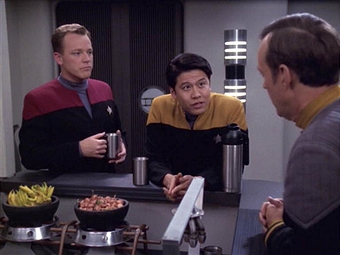
OK, so it’s been a while. I know. While I wish I could say that I’ve been on an Intrepid-class Federation starship named the U.S.S. Voyager, sadly that is not the case.

It’s a little hard to be writing blog posts when a) you don’t know exactly what to say after having written hundreds of posts before, and b) you’re just REALLY busy.

2016 was a rough year, but 2017 has also had its challenges so far.  You know that I’m always in some sort of work search mode, and that’s already had its ups and downs for the past few months.  I was excited to get my first independent contract. It was an opportunity to finally flex my e-learning muscles, and do it on my terms.  I started to create a curriculum matrix,  to make storyboards, to write transcripts, test questions, and study guides, and created video training–21 completed videos in about a month. But the contract ended before the full project was completed, and I don’t know what will be happening going forward. There was a big learning curve involved, and after the fact, I’ve realized where I made some wrong moves, but I also learned where I made many right moves as well.  I’ve been mastering TechSmith’s Camtasia during this time, and feel pretty comfortable with it now. I sometimes feel I missed out on one of my many callings as a video editor (although you never know–that might change going forward).  I know that I was producing good content, if I say so myself, so I have to be satisfied with that for now.

I also was the co-chair of the STC-Philadelphia Metro Chapter (STC-PMC)’s annual CONDUIT conference.  Thankfully, that came off with few hitches, and it was well received by everyone I heard from. Some people hadn’t been to the conference in years, and it was a great opportunity for them to see how our conference has grown!  Next year, at this point, it looks like I’ll be the main chair for the event, so it’s going to feel a little overwhelming, I’m sure. Just being co-chair felt overwhelming at times, while trying to work with client deadlines. It stressed me out enough that I even got physically sick for a while. For CONDUIT, the payoff is worth it, and I hope that everyone who is reading this considers coming as a presenter or attendee for next year.

Oh, and I can’t forget that I’ve been studying my DITA by helping someone who is writing a book about it, and I was asked to contribute edits as a beginner who wanted to ensure that they understood the author’s instructions.  That was cool, and helpful.

Kim: Is she kidding us? Overwhelming?
Paris: That’s what she claims. Who am I to argue?

All through this time, as I said, it’s been a bit overwhelming. I realized some missteps with all of it the hard way, as I usually do, but thankfully I have a lot of good people who help me get back up and fight another day. (Photon torpedos are loaded, Captain.)

I spoke to veteran tech comm consultants at CONDUIT and through Single-Sourcing Solutions’ TC Conclave, as well as just talking to other technical communicators when I had the opportunity offline.  All have provided me with advice about how to move forward in the future as an independent consultant, and massaged my ego just enough, knowing how battered and bruised I felt at times.  For that, thanks to all of you. You know who you are.  This is why I get involved with the STC and with other technical communicators.  Five years of networking is finally paying off–you know me, I know you, and I can learn more about things that they don’t teach you in grad school. I benefit from your experiences and I’m grateful.

Kim: I think we should take a ship-wide survey or start a betting pool on what she’ll do next. Who’s in?

So now the question is…what do I do going forward? I’m in limbo once again with timing, figuring out what to do next. At this writing, I’ve decided to lay low for a couple of weeks. I’m concentrating on my VP duties for the STC-PMC for the rest of this program year (two more main events to go right now!), reworking my consultancy’s website (a project temporarily postponed when I started my contract in February), and doing a little bit of project hunting, but nothing too deep just yet.  I have a few leads on things, but I’ve always been hesitant to “count my chickens before they are hatched,” as the saying goes. I’m looking forward to attending the STC Summit in a few weeks in Washington, DC.  I’m getting excited about going, because I realize that it’ll be nonstop tech comm for me almost from the moment I get there! I’ll be with my tribe! I plan to take advantage of seeing all my STC friends–and making new ones as well–in the hopes that my continued networking will help me build my business. I’m looking at things through a slightly different perspective now.

In some ways, I’m still scared to death being “on my own”.  Having survived through my first experience without an agency, though, was exhilarating, and I liked being my own boss and calling most of the shots, and determining how things should be done.  I was able to validate that in many ways, I’m still on the right track, even if things are slow-going right now.

Kim: Captain, there’s something out there!
Janeway: I need a better description than that, Mr. Kim!

I still have a very long way to go, but I’ll find my way eventually. Sometimes I feel like the very green Ensign Kim, who has some knowledge, but still finding my place while trying to make a difference. Sometimes I feel like Captain Janeway, where I feel like I can lead and figure out what needs to be done. There will be Borg, Kazon, Vidiians, and Hirogen to battle along the way, I’m sure. Hopefully my persistence moving forward will get me where I need to go, even if it takes a while.

Posted in Uncategorized

Adobe Tech Comm Suite 2017 is better than ever!

technical_communication_suite_2017Recently, Adobe held a virtual press conference for the 2017 Release of the Adobe Technical Communications Suite, which launched on 31 January 2017. While the Suite continues to include the latest versions of Captivate, Acrobat, and Presenter, it’s RoboHelp (RH), the XML documentation add-on for Adobe Experience Manager (AEM), and its flagship product in the suite, FrameMaker (FM) and its related FrameMaker Server that have all received updates with this newest release.

FrameMaker itself has been around for thirty years now, but it’s been especially in the last few years that significant changes has been made to accommodate DITA support,  multi-channel and mobile publishing, and support from right-to-left (RTL) languages.

With the 2017 Release, Adobe’s main objective was to provide new features while simplifying current features that would help with productivity and keep the end users in mind.

I found that now that I have a better understanding of the structured authoring views from my recent DITA course, I could see these products with a fresher perspective while I attended this virtual press conference, and better appreciate the upgrades.

The main attraction for the virtual press conference was FrameMaker, as the product has had some major overhauls, including new features centered around the authoring experience.  I won’t go into all of the features, as there’s too much to review, but several of them made a big impression on me. FM has been a complicated tool to use for many years, but it seems to me that with each new release, the tool becomes more user-friendly for those who aren’t as deeply entrenched with all the bells and whistles. The new interface is more modern and usable, and there’s easier access to recent items through the Browse Computer or repository feature.  This gives you access to all resources like tutorials, guides, and online help. It also allows you to access structured and unstructured items in one page. Even within the Search function, there is better auto-complete functionality which shows predictive results based on user typing through responsive HTML5 output.

An important upgrade in this 2017 release is that menus have been optimized and reorganized, with more commands to improve discover-ability.  My favorite new feature within these new menu changes is that the “Special” menu is gone, and the much more logical “Insert” menu has been added. This is something that has sorely been needed for a long time to be more user-friendly interface! Why, just today I was in a different Adobe tool, and I looked to insert an image, and that particular app (a Creative Cloud app) didn’t have an “Insert” menu at all! Insert menus are commonly used in apps almost universally now, that this was a long time coming. It makes inserting objects more intuitive for an app that’s not always that intuitive. It’s one of those “DUH!” things that I’m glad Adobe has fixed for FrameMaker. The Insert menu provides one stop for inserting images, files, variables, elements, equations…you name it! For example, all that needs to be done to insert an image into a document is to go to Insert-> Image and it’s done! You don’t need DPI settings change, as the DPI settings are retained, but they can be changed. You can also do a “drag and drop” of an image into a document easily. All you do is add to your project, then drag the image into the page, and it adapts to the page. You can still adjust the size in object properties if needed. The object properties dialog is improved, as there is an option to maintain aspect ration, DPI can be set inline, and apply a check inline. The “Element” menu is also enhanced. New options have been added to insert, wrap, and change. The Insert drop down is great! It has everything you need, and will likely be heavily used.

Shortcuts for productivity got a boost, as there is a new Command Search feature that is accessed through the <F7> button and very easy to use. All shortcuts are also now listed next to menu commands so that power users can learn them more easily. <CTRL-1> provides a list of where you are within the structure of your structured authoring, which is rather convenient.  Commands that are applicable globally,  such as borders, text symbols, rulers, grid lines, and hotspot indicators that impact all open docs both structured and unstructured are viewable now, although there are some limitations with structured views.

PODS have also has some upgrades as well. A new paragraph designer table allows you to create new styles easily in the pod. Styling icons in table and paragraph designers have been replaced with labeled buttons, configurable options have been reorganized and relabeled, and redundant command operations have been removed. Additionally, adding or editing a conditional tag now happens thru a dialog. The former “Select” drop down list has been replaced by Filter icon. Color and background columns have been removed. Conditional takes are listed with their close to final formatting, with tooltips displayed for conditional tags listed in the pod.  Several catalog PODS are also redesigned, with old buttons replaced with icons. Deletion has been made intuitive by removing extra options.

These changes have allowed the project management of a given project much easier, as now it’s easier to organize content such as a DITA map, book, topic, image, TOC, or index files related to a project in a single place whereby you can drag and drop files from Windows Explorer.

Structured Authoring gets some boosts as well. The Status bar now provides information about the exact path of the current element in your structured document. You can show or hide content from the structure view for a cleaner view as you work. Some of the new Insert menu options have been added for structured authoring, such as the Insert>Cross-Reference function, which should be very handy. There is also an improved DITA Keyspace Manager, whereby  if any DITA map is opened,  it gets populated automatically in drop down. The ability to search for a keyspace by entering the 1st few characters.

To keep up with the rapid changes in technology, high resolutions displays are supported now! Support for 4K resolution is now available, and allows the application to scale automatically. No separate setting is required to adjust resolution, so icons are now more sharp and size will scale automatically with the screen resolution.

Publishing features have not been forgotten, as they include brand new responsive HTML5 layouts that are modern, frameless layouts with a redefined browsing experience, are fully customizable, and can easily match the look and feel of your corporate website template. The navigation is search driven, and you also have the ability to add favorites while still being fully accessible (508 compliant).

New publishing features include the introduction of basic HTML5 formatting without any JavaScript or layout, with the look and feel controlled by CSS. This makes publishing lightweight and easy to share.  Text searches within searchable vector graphics (SVG) can now be done, and supported in HTML5, as the information in the SVG files can be read and displayed as part of search results. Multimedia files are managed in assets folder in published output. Inline styles have been cleaned up, including the introduction of a setting for Excel inline styles from published output. You can publish topics to a single folder–an important organization feature. Content personalization has been improved with DITA attribute support in dynamic content filters in the indexes, and a new dialog has been introduced to select conditional attributes.

Wow, that’s a lot right there!

All these changes are great for the FrameMaker app, but what about the FrameMaker Publishing Server? No worries! The 2017 release of the FrameMaker manage remote publishing, and can publish bi-directional content across formats and devices, so it can integrate with any CMS.

RoboHelp has brand-new, responsive HTML5 layouts as well, also incorporating modern, frame-less layouts with a redefined browsing experience that’s fully customizable. The Search autocomplete is also functional here in RoboHelp as well, allowing for search in responsive HTML5 output that shows predictive results based on user typing by segment first–which is a unique feature, gives contextual results, can indicate the number of occurrences of an entered word or phrase which helps in narrowing down the matching results, and can even correct spelling mistakes as you type in the search. The new authoring features include thumbnail support for images, folder imports for baggage files, and variable view toggling.

The Adobe Technical Communications Suite 2017 Release (TCS 2017) includes these latest versions of FrameMaker and RoboHelp, as well as the latest versions of Acrobat Pro, Captivate, and Presenter, which went bought together in the Suite, provide a 58% savings over buying the tools separately.

While not formally part of the Technical Communications Suite, it’s also important to mention that the Adobe Experience Manager (AEM) XML Documentation Add-On 2.0 version has been released.  If you are using AEM as your CMS or CCMS, you can host your tech and marketing content that’s written up in FrameMaker more easily through the integration of this add-on.  This add-on allows for content sharing and reuse which lends itself to consistent user experience and reduced total cost of ownership. Higher content velocity helps to drive enterprise publishing features, such as batch publishing, baseline publishing, and post-publishing workflows. Enhanced review and collaboration capabilities include web-based inline review, web editor enhancements that help with content management capabilities and document life-cycle management.

If you want more information about TCS 2017, you can click on the Adobe advertisement in the right column, or email the Adobe TCS team directly at techcomm@adobe.com.

Additionally, there is a 2017 Release Launch Webinar on 15 February 2017. It’s free! Learn more and register for the event on the Adobe Event website.


Posted in Uncategorized

4 Lessons Learned (About Learning) From Blogging

Blogs provide great insight and are a helpful educational tool. But did you know the act of blogging can teach us something, too? Danielle Villegas explains.

Source: 4 Lessons Learned (About Learning) From Blogging

Thanks to Phylise Banner, Jennifer Hofmann, and InSync Training for the opportunity to write this article for InSync Training’s blog, Body Language in the Bandwidth. 

I based this article on the many years I’ve been writing here on TechCommGeekMom and other blogs I’ve written over time. I hope there’s helpful information for you here! It’s a quick read, and I enjoyed writing it.

–TechCommGeekMom