Posted in Uncategorized

Adobe Day @ Lavacon 2013: Scott Abel’s 5 Technologies Tech Comm Can’t Ignore

voodoodonutsignI realized as I was writing this post that this would be my 500th post on TechCommGeekMom. Who knew that so much information and thought could accumulate through original posts and curated content?  I’m also very close to my all-time 15,000 hits mark (only a few hits away at this writing). I wouldn’t have believed you if you told me that I’d hit these benchmarks when I started this blog, but of course, I’m going to keep going! I debated about what I should write for my 500th post–whether to finish my Adobe Day coverage or do something else, and in the end, it seems fitting to finish my Adobe Day coverage, because in many respects, knowing and writing about the presentation of Scott Abel, aka “The Content Wrangler”, shows how far I’ve come already in my tech comm journey from beginner to covering internationally known presenters.

Scott is one of the most prolific and vocal speakers out there on the conference circuit speaking about content–whether it be content management or other technical communication topics.  It also seems like he has written the forewords of many of the best tech comm books out there. He’s everywhere! To boot, he’s an accomplished DJ, and I found myself “bonding” with him over dance remixes and mash-ups while at Lavacon, because I always enjoy when he posts either his mash-ups or his favorite mash-ups on Facebook. (I’ll be writing a post about the relationship between tech comm and dance mash-ups in the near future.)  He is a person who is full of so much kinetic energy that you wonder when he’s going to explode, but he doesn’t. Even the time I saw him at the STC Summit last spring with a bad cold, he was still more on top of his game than a lot of people would be on a good day.  Much like Val Swisher, my love for all things Scott Abel also knows no bounds.  He knows how to stir things up at times, but there is no denying that in his frenetic pace of delivering a presentation, you learn SO much. I’m lucky that he’s so kind to be one of my cheerleaders!

ScottAbel
Scott Abel checking his files before his presentation

So when it came to thinking of a garden in Portland to use as an analogy to Scott, I had to deviate. In my mind, he’s the Voodoo Doughnuts shop located about four or five blocks away from the Chinese Garden. Scott’s talks always have lines going out the door, and like many of the Voodoo Doughnuts themselves, the unique flavors dispensed open your mind up to new and delicious possibilities and ideas, and you come back wanting more (hence, more long lines!).  They are both crazy and sweet at the same time. You can’t beat that combination.

Scott was the keynote speaker for Adobe Day as well as the moderator of the discussion panel later in the event. Scott’s topic for his talk was called, “Five Revolutionary Technologies Technical Communicators Can’t Afford To Ignore.”  If Joe Gollner went fast during his presentation, then Scott went at lightning speed, so my notes below are the highlights.

Scott started by telling us that translation is going to be an important part of automated content going forward. It’s important to understand that for the web, the World Wide Web (WWW) is equal to the “land of opportunity.” The WWW can reach a global market reaching new consumers. As American users, we forget that 96% of web users are not in the US. We don’t all speak English globally. In fact, less than 6% of the global population speaks English well, but don’t necessarily read or write it well.

Scott’s list of the five technologies the Tech Comm can’t ignore were as follows:

1) Automated Translation
Why would be need automated translation? We write for the *worldwide* web.  There are over 6000 languages in the world, so translation is a big deal for a global reach and global connection. We need to recognize that content is written for both machines and humans. Even though we write for both machines and humans, we need to write for machines first, as they are the “gatekeepers” of content, such as for searches. Everything goes through the machine first. We need to recognize that writing rules learned in elementary school are no longer sufficient for a world in which language science is needed.  We need to examine our content from the vantage point of a rules-processing engine and ensure it’s optimized for machine translation.

2) Automated Transcription
Automated transcription involves software that translates speech to text for machine use. Without transcription, content is locked and hidden from view. Transcription allows for better searchability of content.  Scott recommended Koemei as a good transcription software tool for video and general transcription, as it can help transform editable content into other languages.

3) Terminology Management
Terminology management controls words in a central place, namely the words used the most and used consistently for branding, products, etc. Terminology management is important for consistency as well as for regulatory reasons. This is an instance where seeking a global content strategist is needed to help standardize processes.  It’s best to adopt a terminology management system, such as Adobe partner and Scott’s suggestion, Acrolinx.

4) Adaptive content
Adaptive content is content that is structured and designed to adapt to the needs of your customer; it’s about substance of the content. Adaptive content adapts to the devices, e.g. laptops, GPS, and smartphones.  Customers are demanding exceptional experiences, so we need to meet their expectations, so it’s up to responsive designers to meet that challenge. Adaptive content makes it possible to publish to multiple platforms and devices.  It is content separated from formatting information. By allowing authors to focus on what they do best, adaptive content makes content findable and reuseable by others who need it. We need to rethink content, as the move to adaptive content involves work, but the ROI (return on investment) can be realized in months instead of years.

5) Component Content Management
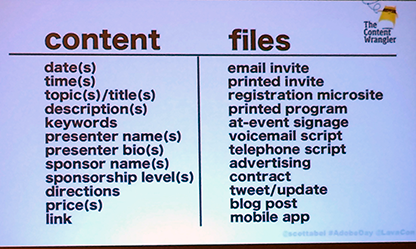
Component content management systems are needed. They focus on the storing of content components that are used to assemble documents. Components can be in all sizes, and can be photos, video, and text. It’s about managing CONTENT not FILES.

Scott provided these slides as his example to show this:
ScottAbel_ExampleA ScottAbel_ExampleB

Structured content, combined with a component content management system, supports personalized content and  targeted marketing, which in turn increases response rates. In this end, this process can save money! The key is to remember that all customers are not the same! Reusing content without the “copy and paste” methods produce the best results. You can ensure that content is consistent by seeking a content strategist who understands content and is a technologist. Implement a component management system. Scott suggested checking out Astoria Software for a good component content management system. 

At this point, Scott’s talk had pretty much finished, but in answering audience questions, he pointed out that there’s a lot more than just these five technologies to watch. He suggested that we should look out for wireless electricity, flexible surfaces, more wireless devices, wearable computing, and augmented reality as well. He also said that in order to mature as a discipline, we need to be content craftspeople, content designers and content engineers. We need to leverage using content and code. We need to think more like engineers, and less like writers and editors. Even websites that are very localized still need to be written for global purposes to improve the English used for the native speakers as well. Controlled vocabulary helps all end users!

Scott covered a LOT of information in a short amount of time, and he set the tone for the rest of the session, as the presentations that followed repeated much of the same information. (This is a good thing, because then we know that the information is valid, coming from several experienced technical communicators!)

Scott posted on Twitter than his presentation was available on SlideShare, but I have it below.

And as always–Scott, if I misinterpreted or misquoted any of the information I summarized above, please let us know in the comments!


Posted in Uncategorized

Recap of the Adobe Day “Coachella” – Tech Comm Rock Stars abound!

KSM ROTHBURY packing up 5Adobe Day at the 2013 STC Summit was really great. It took me a while to digest all my own notes and relive the moments promoting the rock stars of tech comm. But like all good music festivals, the “Coachella” of tech comm had to end, but with great memories of fantastic information that will stay with me for a long time. Hopefully you enjoyed this “magical mystery tour” as well!

There were several people from Adobe that were truly instrumental in making this event a success, but I have to “give it up” for the two Masters of Ceremony of the event, Saibal Bhatacharjee and Maxwell Hoffmann.

Saibal
Saibal Bhattacharjee

MaxwellHoffmann
Maxwell Hoffmann

So many people know them from the Adobe TCS webinars, blogs, and other social media outlets. I know they’ve been two of my greatest supporters, so I want to thank them for inviting me to the event, and as always, making me feel welcome both during Adobe Day, as well as during the STC Summit.

If you missed my series for this Adobe Day event, here’s a recap, so you can relive the day yourself:

 macca

Maybe I’m Amazed I met this Tech Comm legend…

 Jagged+Little+Pill

How does that jagged little pill of content strategy go down?

 Peter-Fonda-and-Dennis-Hopper-in-Easy-Rider

Get your motor runnin’…Head out on the [mobile] highway…

 Coldplay2

XML Metrics are the Coldplay of the Tech Comm World

 coachella

If Tech Comm had its own Coachella, how would it be done?

I hope you’ve enjoyed all the articles. If you have any questions or comments, please feel free to comment below!

The next time there is an Adobe Day near you, or if you have the opportunity to go to one, I strongly encourage you to go! I’ve now been to two of them, and both were different.  It’s amazing to see how perspectives change on the “hot” issues of tech comm in a mere few months! I was glad to hear from leading experts on the pressing topics of the day. And I have to say, I’ve learned so much from both visits. I can honestly say, as well, that both provided information that were applicable to my job, even as a new technical communicator.  Keeping up with current trends in technical communication is important, because technology is changing fast, and technical communicators need to keep up with not only the technology itself, but the needs that new technology presents. Adobe does a nice job of bringing the best thought leadership from around the globe to talk about these issues  for free. How can you pass that up?

Thanks again, Adobe, for an amazing opportunity to attend this free event!

Posted in Uncategorized

Maybe I’m Amazed I met this Tech Comm legend…

macca“Excuse me, Dr. Corfield, I’m tweeting this event for Adobe today. Would you happen to have a Twitter handle?”

With the apology that he hadn’t one, but that he did have a Facebook page, I had started a too-short yet lovely pre-event chat with Dr. Charles Corfield, the keynote speaker for the 2013 STC Summit’s Adobe Day. In my mind, being the inventor of Adobe Framemaker would easily qualify the tech comm pioneer for the Tech Comm Hall of Fame (if there was such a thing). For me, talking to Dr. Corfield was like talking to the Paul McCartney of tech comm (and that’s super high praise coming from a Macca fan like me!). Just as McCartney is unequivocally deemed as one of the early pioneers who revolutionized how we listen to rock music today, Corfield helped to revolutionize tech comm with his creation of Framemaker, and in the process, created what we know as a software standard for technical communication that still holds up today. I loved listening to Dr. Corfield’s soft-spoken, British accent as he chatted with me briefly about social media and about some of the things he was going to be talking about in his presentation. I was truly having a fangirl moment, and hopefully I kept my cool during the conversation. Awesome!

CharlesCorfield
Dr. Charles Corfield
The “Father” of Framemaker

Dr. Corfield started his talk by presenting us with a history of how Framemaker came about. He explained that before Framemaker, computing was still fairly archaic, but workstation computers were starting to become more powerful. As a graduate student at Columbia, he was looking to create software that could take things a step beyond word processing, namely make software that could also create unified pagination and page layouts. Framemaker allowed page layouts and paginatable text to work in a symmetrical flow. The software targeted long documents and other paper output done by humans.

Dr. Corfield pointed out that the first content management problems started to occur as a result, and those issues included the need for internal references, such as footnotes, indexes, cross references,  and markers. The power of Framemaker’s ability to create indices to update long documentation was–and still is–more powerful than Microsoft Word even today. He also added the ability to refer to external factors like external references and hypertext.

Framemaker created the ability to manage variants of a single document, leading to what we now think of as single source publishing. Variants would be such objects as variables, conditional text, frozen pagination and change-pages. This yielded a new dilemma. As Corfield posed it, do you send out fully changed documentation or only the pages that were changed, especially with super large documents? The problem would be that with big documents, people would say, “Well, what changed?” Corfield pointed out the Boeing 777 project in 1990s needed IMMENSE documentation, so they needed to use retrievable databases. The Boeing 777 project solution was to use SGML (the predecessor of HTML and XML). This project made it the first “web” delivery of documentation. The Boeing 777 project used Framemaker with SGML, using HTML, XML, DITA as well as “structure.” Framemaker provided a server-based generation of documentation.

Shifting his talk a bit, Dr. Corfield started to talk about Framemaker’s impact today.  He pointed out that the original retina display was actually paper! Sophisticated layouts had to be used to maximize the user-experience. The computer came along later to expand on that concept. Displays started out with 72 dpi (dots per inch) displays, which led to crude layouts. Now, retina display is available at 300 dpi, but we need to re-learn what we did on paper yet also include dynamic content from high resolution video and images.  Corfield pointed out that there has been a proliferation of platforms. We have desktop, laptops, smartphones, and tablets that use different platforms such as Unix, DOS, and MacOS (for PC and Mac products respectively) that need different outputs. Technical writing, therefore, is directly impacted by all the different displays and platforms in relation to  document authoring. It is a requirement to produce structure and rich layouts for the output. Documentation needs to be able to support dynamic content (video, animation, etc.) and it needs to manage content for consumption on multiple platforms. The good news is that Framemaker can do all that! While there are other tools out there that can also deliver different kinds of output, many still struggle to manage and deliver to these needs the same way that Framemaker can now. Dr. Corfield is not part of Adobe anymore, nor is he part of today’s Framemaker product, but he seems happy with where the product has gone since he left it in Adobe’s hands.

(I should note, that while this was a talk sponsored by Adobe, this really wasn’t intended to be a big info-mercial for Framemaker, but rather something that puts the concept of tech comm software into perspective, and it happens to be the product of the sponsor.)

So, where does this tech comm legend think technology is going next? Corfield thinks that going forward, voice is going to have the biggest impact. He felt that screen real estate is full, and that much of the visual is about adding a new widget, then removing a widget. Voice, he continued, eliminates how keyboard shortcuts are remembered. How many keyboard shortcuts does the average user know? Touch screens are a slow way to perform data entry. The impact of voice will be the ability to use visual tips, and have voice act as a virtual keyboard. Voice will be impacting product documentation, allowing it to understand how existing workflows can be modified. Corfield’s prediction is that Framemaker, along with other software out on the market, will “assimilate” voice, just like everything else.

Since leaving Framemaker, Corfield has been working with a product called SayIt, using voice as part of workflow optimization, and emphasized that voice truly is the next big thing (you heard it here, folks!). When asked about the use of voice technology in practical office use, Corfield responded that push-to-talk technology helps prevent cross-talk in an office environment. He also pointed out that with voice, there are no ergonomic issues as there are with carpel tunnel syndrome using a mouse and keyboard. If anything, voice will be more helpful!

On that note, the presentation was over. The long and winding road had ended, but has lead to new doors to be opened. 😉

I really enjoyed listening to the history and the thought process behind Framemaker that Dr. Corfield presented. Everything he mentioned made total sense, and it’s to his credit that he had the foresight to think about the next steps in word processing to create a useful tool like Framemaker to help technical writers meet the needs of documentation in the digital age.

There is a certain aura around creative, imaginative and smart people who make huge differences in our lives, whether it’s in music like McCartney, or tech comm software like Corfield. You can’t help but be awed in their presence, and yet understand that they are generally humble people.  When you have a chance to meet an individual like that, you want the opportunity to capture the moment–like have a picture of yourself and that person to prove that it happened. I was much too shy to ask Dr. Corfield for a photo with me to be honest. I felt awkward asking, so I didn’t. Heck, I felt awkward asking about his potential Twitter name! Even so, I’m glad I had the opportunity to meet him and hear him speak.  He’s got my vote as a candidate for the Tech Comm Hall of Fame someday.

(And, Dr. Corfield, if you do ever read this, please feel free to correct anything written here or add any clarification or other commentary below!)

Posted in Uncategorized

How does that jagged little pill of content strategy go down?

Jagged+Little+PillTo continue with the tech comm rock star theme set forth by Adobe for Adobe Day, I thought carefully about who might represent Rahel Anne Bailie, whose talk was titled, “Content Strategy in a Content Economy– Is Your Content Prepared?”  It took me a little while, but it finally came to me. Rahel is the Alanis Morrisette of tech comm.  Both ladies are Canadian, and they both have a no-nonsense approach to their craft. Alanis Morrisette became famous with her breakout album, “Jagged Little Pill” not only because the music was good, but she broke her ideas down simply and didn’t mince words. Morrisette looked at the good, the bad, and the ugly, and worked on making sense of what was going on around her.

RahelBailie
Rahel Anne Bailie
The Alanis Morrisette of Tech Comm

Rahel does the same thing for content strategy. She breaks it down to a level to ensure that anyone who even begins to think about content understands what content is, and how it should be utilized at the most basic level. She tells it like it is, and why we need to employ it.

Rahel began her Adobe Day talk by talking about economic evolution. She started by pointing out that our economies have progressed from an agricultural economy, to an industrial economy, which in turn progressed to a service economy, then evolved to a knowledge-based economy, to an information economy, then to an attention economy, which has resulted in what we have today–a content economy.

Content includes the sub-sets of content that are location-based content and verified content. Location-based content includes geo-locational and geo-fenced information like Yelp, or information that is blocked from outside countries. Verified content deals with endorsed and social relevance; it has the user questioning, “How do I know that the content is true?” Facebook or TripAdvisor “likes” are an example of this. Cultural relevance applies to this as well. Topics such as Canadian versus American, demographics, and interests act as  filters.

Rahel stressed that content has value! It’s recognized as a business asset and it deserves to be managed with as much care as other assets. The problem is that we don’t inventory content in most cases–it’s not like managing our finances or physical inventory at a plant. This means that this is a big necessity! In order for this to happen, content has to work well. Like design, it’s only noticed when there’s a problem with it.

Rahel shifted the conversation to explaining how sub-sets relate to content. She explained that new user experiences these days include smaller screens as the first entry point to content, such as m-commerce and m-banking. Tablets are also being used as entertainment devices. We also have to content with multi-screen and multi-dimensional content, which are viewed as

  • ancillary, such as television plus social media,
  • sequential, where users use a desktop and mobile device interchangeably, or
  • simultaneous, in which there is a collaboration requiring instant synchronization between devices.

One also has to think about market maturity, and must look at market differences, social network penetration, the mobile market and growth opportunities. Cross market content involves a single language for many markets. By offering native languages in other markets, cross-border commerce incurs content needs as well.

Using language to meet adaptive needs makes a difference! How do we meet this head-on? Rahel suggests a repeatable system that governs the management of content throughout the entire life cycle creates content strategy. The life cycle consists of continually analyzing content, collecting content, publishing content, and managing content. Rahel reminded us that a tactic is not a strategy, but rather a strategy is the analysis and the prescription. Content touch points occur throughout a customer’s journey, and can include multiple variables and outputs, but also need to include localization.

In a content economy, we need ALL the right factors at the right time using right media. We need to work towards an integrated content strategy.

As this is a topic that can go even deeper, Rahel recommended her book, http://TheContentStrategyBook.com , which talks more at length about content strategy.

As most of my own current work revolves around content strategy these days, I was really happy to listen to Rahel talk about the benefits and necessity of content strategy. It’s something that I try to explain and promote at my own job, because so much of it really involves analyzing and pre-planning the usefulness and necessity of content. Rahel’s talk brought that concept home to me even more, and helped me validate what I’ve been telling others. She reminded me that it doesn’t matter what the medium is–print, web, or some other digital means–but content needs to be clear, concise, and cogent, as my favorite professor used to tell me (who was also, coincidentally, Canadian).  Rahel’s talk definitely set a positive tone on content strategy and its place in technical communications. I was glad that Adobe made sure to include her in Adobe Day, because content strategy isn’t going anywhere right now–it’s more important than ever! 

Rahel, if I’ve misquoted you, or something that I wrote needs further clarification, or if you’d like to add anything to these notes, please feel free to let me (and the readers) know in the comments below!

Posted in Uncategorized

But what shall I pack?

Bookmark and Share

luggage stuffingThe event is still about three and a half months away, but I decided that this year, I’m going to go to another big tech comm conference. I really feel that going to a professional conference truly benefits me, because I learn SO much from people who have more experience and know-how than I do. Just attending the Adobe Day at Lavacon last fall boosted my IQ enormously, and I have to credit information that I learned there in helping me get the content strategy/web publishing job that I have now. All the forward-looking thinkers attend these sort of events, and I don’t want to miss out.

I’m going to a really big one this time too. I’m going to my first STC (Society of Technical Communication) Summit. I’ve been a member of the STC for the past year, and just re-upped my membership for a second year. It’s not a cheap membership, especially for someone who’s just getting started. I started at the affordable student rate when I was still a student, and fortunately I can still take advantage of their “new professional rate” being that I’m still rather new out of school. It’s been worth it, as I’ve met several people who are members, and I think there needs to be some sort of organization that helps to bind the profession together and provide resources for all tech comm professionals, both new and experienced. This year’s Summit is in Atlanta, Georgia. I haven’t been to Atlanta for slightly more than twenty years, and again, it was for computer training, I think. Atlanta has changed a bit since that time, so it should be interesting to see it now.

I’m looking forward to not only going to the various talks and events from the STC Summit, but I’m also looking forward to seeing people I know from online and those whom I met at Adobe Day at Lavacon, but also meeting new people. Conferences are a great way to connect with people who have similar professional experiences as you do, and that you can share information in person. Ha, I was just thinking this is almost like the biggest gathering of “Technical Communicators Anonymous” addicts! But seriously, It’s an incredible opportunity to meet with the movers and shakers in the tech comm world, as well as meet those rising stars and foot soldiers who brave through content every day like you do. It’s a great time when the academic side of tech comm meets the corporate side of tech comm. So, just from a social networking perspective, it’s going to be big.

I also heard from a little bird that there might even be another Adobe Day event especially for the STC Summit, but that hasn’t been confirmed. And if there is, you know that I’ll be there to check that out. I loved my Adobe pre-conference experience from Lavacon a lot, as you know, so I can’t even imagine how great this one could be….If there is another one, you can be sure that I’ll be passing the word along and letting all of y’all know. (Yes, practicing my Southern accent in writing already. ;-))

I think the difference, this time, will also be that I am truly a tech comm professional now. Yes, I’ve been talking the talk for a long time, blogging, doing the social media thing, doing some odd jobs here and there, but only in the past month have I gotten a real tech comm job working on content management. I will not be an unemployed wannabe this time around. For the STC Summit, I will be a fully-fledged technical communicator.

And for these reasons, I can’t wait to go! I know I’ll be packing my iPad and iPhone…but what else will I need (other than clothes, of course)? STC Summit alumni–let me know! Let me know if you’ll be going too!