Posted in Uncategorized

What Can Technical Communication Do After The U.S. Election?

bill-teds-excellent-adventure-confused
DUDE! What just happened?

In the past week, the United States had an important election for its next President. The election results, to say the least, have been controversial. While I’m not one to usually talk politics on this website, I’ll simply say that this past week has been devastating to me, and has hit me hard. It wasn’t because my candidate lost, but because her opposition, who promoted MANY values which I do not endorse in the least, was elected. There has been a segment of people in my country, that as a result of this new leader’s position, that think that they, too, can engage and promote these inappropriate behaviors, while others are trying to find ways to express and take action against those inappropriate behaviors.

I’ve been thinking long and deeply about how this election affects the technical communications community. I know people involved in technical communications that voted for candidates from both parties. Most of the technical communications community that I know had the same reaction that I did–one of deep disappointment. There were some who were happy for the outcome, but the overwhelming majority of the technical communicators I know were not–including some who aren’t even American citizens and are living outside of the U.S.!

A big part of my disappointment is that the President-Elect, who is not known to choose his words well or speak eloquently, promoted animosity towards people of different colors, people of different faiths, people of different sexual orientation or identification, and women in general. That’s problematic. These are all people who contribute to our society in positive ways, and don’t have any reason to be maligned at all. AT ALL.  I’ve always talked about the technical communications community being my “clan”. During the years I’ve become more involved with the tech comm community, I’ve found that each time I get together with my tech comm bretheren, the diversity among American technical communicators is what makes us an example of how American diversity is supposed to work.  This diversity carries over into our relationships with technical communicators around the world.

A big part of tech comm, especially in the last five to ten years (if not longer) has been embracing the knowledge that globalization and localization is an important key to effective technical communication. Whether it’s for business purposes or otherwise, a large part of what technical communicators do is write with the ability to reach out to the world. Not just their own hometowns, their own states, their own regions, or their own country–they write for a global audience.  With recent events, we are reminded that we need to continue to keep our hearts and minds open to different languages, different cultures, different religions, and different traditions here at home before it even goes abroad.

The other thing that has me very concerned is the economy. The U.S. was in a deep recession before the current President took his office. The economy has recovered, with the unemployment rate easily half of what it was during the recession. I’m definitely one of those people who felt that pinch, but worked hard to end up ahead. During these recession years, I went back to school–and some of it was paid for by my state’s training programs for re-employment–to reinvent myself as a technical communicator. I realized what my skills were, where I had gaps, and I filled the gaps as best as I could. Even now, I still do that. I constantly am trying to pick up new skills to keep myself flexible and employable.

When the world starts getting topsy-turvy, companies react for self-preservation, and that can result in job losses, often for people like technical communicators. It’s the old thing of doing more with less, so hiring stops or slows down until the company can figure out how the election will impact the economy. We’re in that position now, which is not good for those of us who are currently looking for new projects or jobs right now. So as we’ve had to do before, we’ll need to learn to adapt again.

Related to the economy, I’ve been listening to the pundits on television talk about how both political parties ignored a specific segment of disengaged voters from rural America that made their needs known through their votes. We’re feeling the impact of those votes now, but it has opened up a discussion about how to address bridging the gap. The focus of the political parties, according to the pundits, concentrated more on those who were living in the big cities and the suburbs instead of addressing the needs of rural America, or not addressing rural America as much as it should be.

This issue provoked a lot of deep thinking for me. One of my biggest issues related to rural America that I can relate to as a technical communicator has been finding work outside of a large city. While I live in between New York City and Philadelphia–two of the biggest cities in the United States where there are plenty of technical communication opportunities–they are too far a commute for me to go on a daily basis. Now, imagine someone who has a great set of technical communications skills, but then lives somewhere that isn’t anywhere near a big city. What do they do? Additionally, thinking even outside the box of technical communications, why isn’t there more industry spreading out around the country, to bridge those gaps? For example, why doesn’t Apple have offices in the middle of Nebraska that can start to help devise tech tools that can help various types of farmers in the rural areas of the U.S.? That’s not their focus, I know, but perhaps they should start thinking outside of their own box. How could someone in rural America use their products, provided that they could afford them? How would those products help agricultural services grow and prosper? The biggest question of all this is, how can we ensure that rural America is part of the globalization and localization movements? I was remembering that for many years–I don’t know if it’s still in place–that the U.S. Goverment used to pay farmers to NOT produce surpluses of crops. What if we could help them, by allowing farmers to produce whatever they produce, and help them learn how to globalize their businesses with shipping their crops or products made with those crops? When those government subsidies were created, there was no internet commerce, no globalization on the scale there is now. How can we, as technical communicators, help change that view and help that person globalize their business? (Perhaps I’m over-simplifying things here and don’t have a full grasp of economics, but hopefully you understand where I’m going with this thought process.)

Part of that, in my opinion, goes back to two things I’ve talked about many times in this blog. First, we need to make mobile learning a priority, because it’s not just second- or third-world countries that need opportunities to advance. There are already segments within the U.S. that have yelled loudly through their votes during this election that they need it, too. Education is progress, even in rural areas. If someone has a problem with land producing crops, and they only know the old solutions that aren’t working, then technology is going to be the solution in educating them on how to create or learn new solutions.

Second, companies have to start being more flexible towards remote work. Not everyone can get up and move to a big city or large suburban area to find appropriate work. They need to stay in their community for whatever reason. A great solution in figuring out how to extend globalization and localization within our own borders is allowing remote work. That way, that person from rural America can work doing what he/she does best, while still being an active and vital member to their community, and perhaps with the good pay they have, can help to revitalize their local economy, bringing that knowledge to their community instead of having to move elsewhere and not making a direct impact.

The proclivity of technical communicators, from my observations, is that they have big hearts. They have strong ideas, they are organized, and they know how to take action. They are generally open-minded, they think “outside the box” for solutions, and they understand the importance of reaching out and embracing the world because the proliferation of the internet has warranted it.  We can make a difference in how we approach our work, both domestically and internationally, to set an example of best practices of being decent human beings trying to help each other progress and survive in this world.

This isn’t just something that Americans need to do right now, but it’s everyone globally who supports the basic values of every human being being treated with respect and dignity, and providing moral support whenever possible that needs to be part of this. We all have the same human rights and needs. We all need to be able to live together, work together, and survive together. Technical communicators have the ability to shape ideas and processes. We are strategists at heart, whether as wordsmiths, content strategists, or instructional designers, or any other title that falls under the umbrella that describes technical communication.

In the coming weeks, months, and years ahead, we need to figure out how each of us can contribute to this human goal, starting at home. Let’s start with the words from the Wyld Stallions of “Bill & Ted’s Excellent Adventure”:

bill-teds-excellent-adventure-photo
“Be excellent to each other!”
Posted in Uncategorized

So You Want to Be an Instructional Designer? | EdSurge News

Good listener. People person. Lifelong learner. Sound like you? No, we’re not trying to arrange a first date. These are some common traits of people with successful careers in a booming job market: instructional design. Colleges, K-12 schools and companies increasingly turn to  instructio

Source: So You Want to Be an Instructional Designer? | EdSurge News

I wish I had seen this article several years ago.  Getting into Instructional Design isn’t easy if you don’t have a degree in it, but you still have a lot of the foundational background to break into the field. Some just “fall” into the field, but I have yet to see a job listing for an entry-level instructional designer in the last five years.  Even so, this article will let you know some basics about what it takes to be an instructional designer.

Do you agree with the article’s assessment? Include your comments below.

–TechCommGeekMom

Posted in Uncategorized

How Statistics Solved a 175 Year Old Mystery About Alexander Hamilton

What do Alexander Hamilton, Harry Potter, and Bayesian Statistics Have in Common?

Source: How Statistics Solved a 175 Year Old Mystery About Alexander Hamilton

Oh, when I read this, I knew this would appeal to the history geek in me, while also satisfying the tech comm geek in me as well.  When the click bait of this article says, “What do Alexander Hamilton, Harry Potter, and Bayesian Statistics Have in Common?”, you know I went for the bait. And knowing that Alexander Hamilton’s reputation is becoming more relevant thanks to the Broadway musical, “Hamilton”, I thought this would be relevant to share.

hamiltonNot only did I come away with a cool story about The Federalist Papers and statistics, but the thing that kept coming back to me was how tech comm has become advanced enough that we use many of the same techniques in content strategy now.  To be more specific, Mark Lewis and his talks and book about XML metrics instantly popped into my head, and how we use similar statistics to figure out how to economize our content, and provide the best ROI for the content that is created.

Read this article, then go back and read my articles about Mark’s talks about XML Metrics here and here. You’ll see where I was making a connection.

What do you think about this? Do you think that The Federalist Papers project laid the groundwork for XML metrics and other metrics we use today in tech comm? Why or why not? Include your comments below.


Posted in Uncategorized

BBC – Capital – Native English speakers are the world’s worst communicators

In a room full of non-native speakers, ‘there isn’t any chance of understanding’. It might be their language, but the message is often lost

Source: BBC – Capital – Native English speakers are the world’s worst communicators

The BBC has done it again with another excellent article about English language. I have to admit, even though I am a native English speaker, there are times that I don’t understand some of the abbreviations used, and I prefer to spell things out (I think that abbreviations can be a little bit lazy sometimes). But this article makes a fantastic point that native speakers don’t always think about the larger audience of those who speak English as a second or third language. I have no problem asking what something means even in my own language, but that shouldn’t be necessary. One of the things I didn’t like about a job I had was that I was expected to write content in native English, and not try to make it closer to some sort of standard English. “Leave that to the translators to figure out,” I was told. That response irritated me, but I had to comply with what they wanted, even though that’s the wrong way to approach it.

With the advent of the Internet, global communications are much more frequent and common now than even 10-15 years ago. While other countries are making an effort to use the lingua fraca of the Internet, native English speakers should make more of an effort to meet the non-native English speakers part way in being more clear in our communications as well. If someone says they don’t understand me, I’d rather they tell me, because then that’s MY fault, not theirs.

What do you think? Include your thoughts in the comments below.

–TechCommGeekMom

Posted in Uncategorized

Will Tablets Replace PCs? Part 2

"Nope. Even I can't see much improvement over the last few years," says Geordi LaForge.
“Nope. Even I can’t see much improvement over the last few years,” says Geordi LaForge.

Four years ago, I wrote a post that was in response to RJ Jacquez’s post on his blog about the advent of the Microsoft Surface’s release.

My response to RJ Jacquez’s question: Will Tablets replace PCs?

RJ’s argument was that while mobile was the wave of the future, he felt that the Surface was not a mobile product. Since the Surface still ran full programs rather than streamlined apps, it really didn’t qualify as a mobile device, despite its tablet-like form. His argument was that the industry needs to learn to streamline code to make lighter programs for heavy duty use so that mobile can become more prolific.

My argument at the time, more or less, was that while I agreed with his thinking and supported more use of mobile, I didn’t think it was going to happen anytime soon because PCs enabled people to use more powerful programs that tablets just couldn’t handle. I supported the idea of cloud technology, which was just barely emerging at the time, but I knew it wasn’t there yet. Only when cloud technology could catch up, I contended, then we could start making a bigger move to mobile devices as our primary work tools.

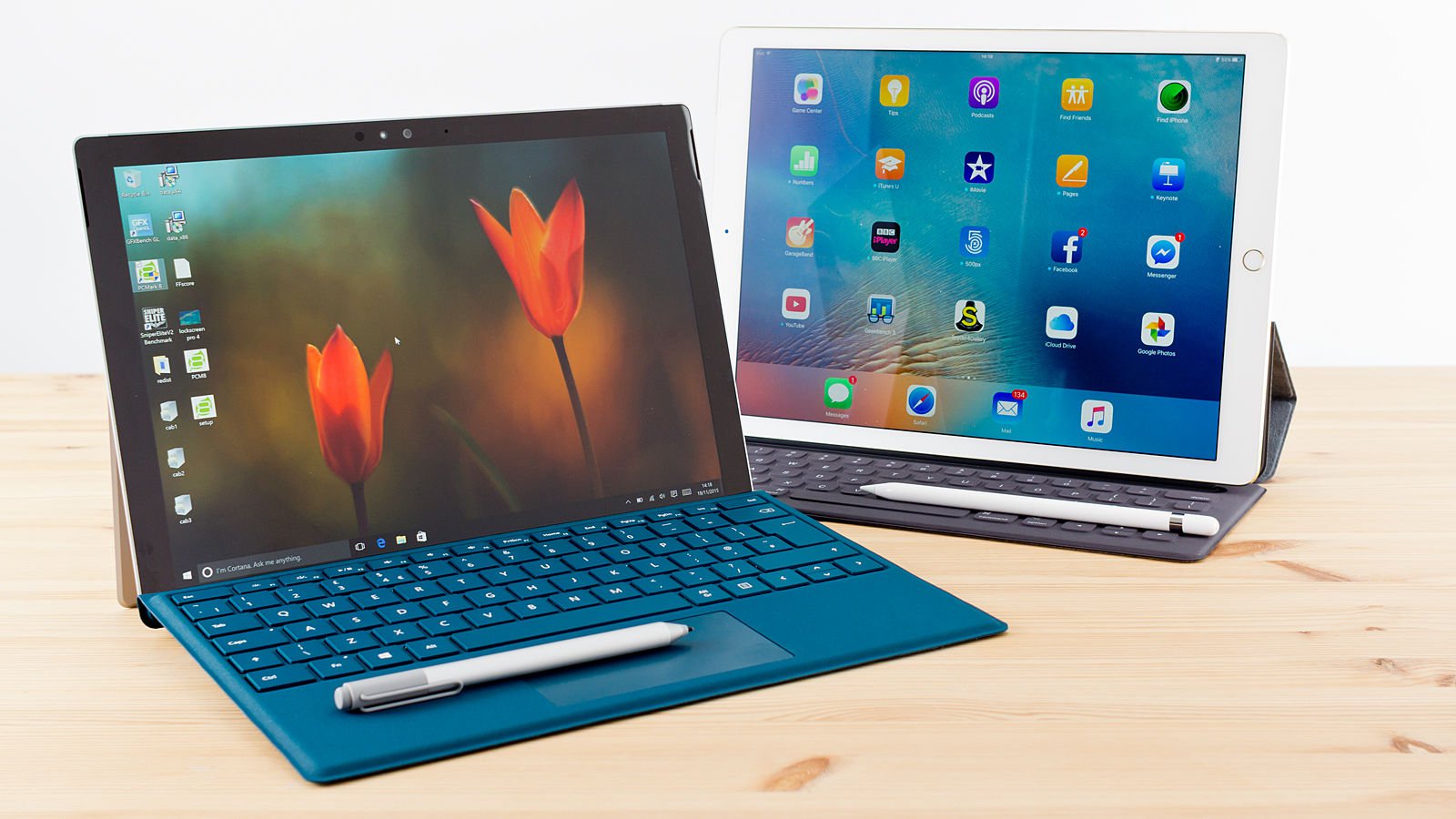
surface_pro_4_vs_ipad_pro_5Well, here we are, four years later. Have we made huge strides in moving more to mobile? Yes and no.

More tablet-like devices have been created in these four years, and the main leaders in this arena, Surface and iPad, have made improvements over the years. Surface has its standard version of the device, as well as a “Surface Pro” and “Surface Book”. iPad has developed its competition creating iPad Pro, but the various MacBooks continue to be the competition for the Surface Book.

Surface’s OS is still the same thing that runs on laptops, namely full versions of Windows 10. Windows 10 runs regular, full version programs, but it also runs on apps that can be bought through the Microsoft Store, including many cloud-based apps such as Microsoft Office 365. But, it’s still a really flat PC in a tablet format. People still use it like their PC, running more powerful programs in it, and use it as a laptop, just smaller. It’s certainly more portable than a standard laptop, but as laptop design gets thinner and thinner, it doesn’t make much of a difference. Additionally, the price tag on the Surface is still pretty high. To get a powerful enough machine that can create and edit video, you’d pay somewhere around US$3000.00+ for a Surface, when you could get something just as powerful in another brand of laptop for less than half that price (like I did for my current laptop).

iPads, in the meantime, have become more robust, and while still more dependent on cloud-based apps such as its own Work suite and it does run the cloud-based Office 365, other apps like Adobe’s Creative Cloud aren’t the same. There are Creative Cloud apps available for iPad, but they are still the watered down versions of them, and not the full versions that can be used on a laptop. Even though Adobe claims that Creative Cloud is cloud-based, it’s only cloud based insofar as it will save your work in iPad to your storage within Creative Cloud, but that’s about it.  iPads have definitely been a frontrunner in promoting  cloud-based storage, but running robust apps that are memory-intensive isn’t part of its anatomy.

Still, with these minimal advances, they are still steps forward in the right direction. For example, I do used Office 365 or iWork on my iPad when I help my son write up his homework assignments, and I can store them on my OneDrive or my iCloud. If he’s working on a bigger project, he can use PowerPoint or Keynote on my iPad, save it to OneDrive or iCloud, and then continue working on the project using my laptop or his desktop.  Cloud-based storage, and some other cloud-based apps have definitely gotten better, for sure. I like this ability to switch from my laptop to my iPad to work on low-impact project, like doing my son’s homework.

There are some apps that won’t ever happen on iPad. For example, I’ve been working heavily in Dreamweaver this past week or two. This is not to say there aren’t other HTML/JavaScript editing tools that are probably iPad apps out there, but this is the most popular one and a standard one to use. Is there an iPad version to access? No. I need to use my laptop for this.  This might be where Surface would be the better choice, but again, it’s still really a laptop in a different device shell, as mentioned before.  I doubt that Flare or Adobe TechComm Suite tools are ready for the iPad treatment either. They can probably run on a Surface, but would you really want that?

Even a StarFleet Captain like Benjamin Sisko can find this sort of thing daunting, and needs to seek Kira's help in straightening this out!
Even a StarFleet Captain like Benjamin Sisko can find this sort of thing daunting, and needs to seek Kira’s help in straightening this out!

It looks like the PC versus tablet/mobile wars will continue to rage on for a while. I don’t think they’ve gotten that far in four years, but the few improvements made have certainly been in the right direction. We’re not quite there yet. I think RJ’s original thought that all apps need to be streamlined for mobile use was a great observation then, and it’s still one that needs to apply now.  If we are truly going to move towards the mobile age, bigger steps have to be made. These are steps forward, for sure. I think more has been concentrated on mobile phones, to be honest, since more people own them. And that seems appropriate. I don’t bring my iPad or my laptop with me everywhere, but I bring my phone everywhere. Then again, I’m not working on HTML code on my phone, so there has to be some sort of balance at some point.

Mobile devices are becoming more powerful all the time, but it looks like we’ll have to be a little more patient before we see another big leap with technology. I know there are some “big” announcements from Microsoft and Apple about these tablet products sometime this week, but I’m not holding out for any big advances, even though they are certainly overdue.

What do you think? How will this lack of technology development–or the future of mobile technology–help or hurt tech comm? Include your comments below.