Musings and learning about technical communications issues from your TechCommGeekMom–a geeky mom who is into tech comm…since 2012.
Author: TechCommGeekMom
Danielle M. Villegas is a technical communicator who currently employed at Cox Automotive, Inc., and freelances as her own technical communications consultancy, Dair Communications. She has worked at the International Refugee Committee, MetLife, Novo Nordisk, BASF North America, Merck, and Deloitte, with a background in content strategy, web content management, social media, project management, e-learning, and client services. Danielle is best known in the technical communications world for her blog, TechCommGeekMom.com, which has continued to flourish since it was launched during her graduate studies at NJIT in 2012. She has presented webinars and seminars for Adobe, the Society for Technical Communication (STC), the IEEE ProComm, TCUK (ISTC) and at Drexel University’s eLearning Conference. She has written articles for the STC Intercom, STC Notebook, the Content Rules blog, and The Content Wrangler as well. She was very active in the STC, as a former chapter president for the STC-Philadelphia Metro Chapter, serving and chairing on several STC Board committees, and most recently was the STC Board Vice-President before the organization closed.. You can learn more about Danielle on LinkedIn at www.linkedin.com/in/daniellemvillegas, on Twitter @techcommgeekmom, or through her blog.
All content is the owner's opinions, and does not reflect those of her employers past or present.
Blogging is becoming increasingly important for individuals and brands.While there are dozens of articles and resources discussing the importance of blogging, many people find themselves overwhelmed with where and how to start writing a blog post.Many people sit down to write and then find themselves riddled with questions such as:What is the ideal length of a post?Should I use photos? How do I optimize it for search?Below, I will tackle all of those questions and provide some insight into the f
This article, which I found on LinkedIn, provides a good set of basic rules to follow when creating blog posts. So much is lost, but it’s really not that hard. It’s often over-thought. This article shows how to bring things back down to earth.
Great article written by Marcia Riefer Johnston at CMI regarding content types according to Noz Urbina. You might know Noz from the book he co-wrote with Rahel Bailie, "Content Strategy: Connecting the dots between business, brand, and benefits." Noz provides three common examples of different content types, and how they are structured. This is definitely worth a read.
Great article that came to me by way of Scott Abel, The Content Wrangler, on Facebook. The article makes a great point that seems like it would be obvious, but it’s not always as apparent as to how to achieve this goal. The article outlines several great steps to accomplish this.
TechCommGeekMom in front of the main building at the National University of Ireland (NUI) at Galway.
I’m now back from my 10-day trip to Ireland, and it was certainly an adventure. While there are parts of the US that have bilingual signs around due to the large Hispanic populations in areas, I think I had gotten used to hearing Spanish enough that I don’t think much about it. (I do live in a bilingual household, thanks to my Ecuadorian husband, after all.)
So it was interesting to be in a European country for the first time in about 15 years and making adjustments to both a different version of English, as well as listening to another language I had never really listened to before!
Since Ireland is a former British colony and it’s so close to Great Britain, I had to turn the “British English” switch on in my head. Using that tactic certainly helped to bridge the gap of my understanding of people and things around me. While it’s practically a sin to compare British English to Irish English, since the two islands are so close together, the language similarities are enough that you can’t deny the connection. It’s little things like asking where the “loo” is, or seeing a sign at a store saying they are “stockists” (versus Americans saying “dealers”), or that instead of “Help Wanted” signs, you see “Required”. It’s these little nuances that you find to be important to know what people are talking about.
A sign on one of the lawns at NUI-Galway. Notice that the Gaeilge is before the English, and that this seems to be a universal rule at many college greens!
I spent half of my time in Dublin and half my time in County Galway. The famous Irish brogue isn’t that strong in Dublin, but it’s certainly stronger as you move westward. What makes much of it stand out is the pronunciation of English words with the “-th” in it. For example, the number after “one, two…” is “tree”, not “three”. It takes a little getting used to hearing, and I’ve had to stifle a giggle now and then, but you get used to it. There are a few slightly rolling “R” sounds as well, but they aren’t as clear as those “tr-” sounds. Otherwise, at least in Dublin, the accent is not that strong. You could easily mistake someone (until you hear some of those slight nuances) for being American, as compared to a London/British accent.
In Galway or the Aran Islands in western Ireland, which I spent the other half of my visit, the Gaeilge (Irish language) brogue was much stronger, and my listening skills were truly put to the test. I made sure that my flat American accent was as crisp and clear as possible as well, to make sure that I was understood and didn’t slur my words as much as I would if I was back at home, although it was easy for me to slip into a slight brogue myself.
Gaeilge is an interesting language, because for the first time in my life, I couldn’t figure out the phonetics or understand bits and pieces of it. I suppose that since it’s not a Latin-based or Slavic-based language like those I’ve studied (but never quite mastered) over my lifetime, I had nothing to compare it to. One thing I’ve always tried to do is pronounce another language decently enough not to be laughed at, and usually I can do this with Spanish, French, Polish, Russian, or some other common European languages. But Gaeilge–forget it! I couldn’t figure it out at all. My favorite example is from travelling on Irish Rail. As we approached each stop, the speakers would announce the arrival in Gaeilge first, then in English. I swear that “Iarnród Éireann” (which means “Irish Rail”) sounded like, “Here nor there” every time I heard it, which I thought was ironically kind of amusing.
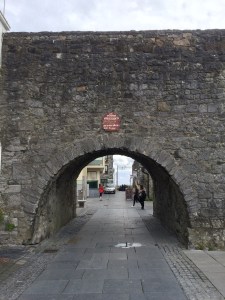
The Spanish Arch in Galway. The sign above the arch reads: AN PÓIRSE SPÁINNEACH The Spanish Arch ONE OF FOUR ARCHES BUILT IN 1584.
Through the combination of trying to employ my British English and attempting to understand some Gaeilge, I was able to navigate around Ireland without any significant issues. But I also found that culturally, Ireland is trying to still find its identity. I know there has been a very big movement nationally to bring Gaeilge and Irish culture back into predominance, especially with the 100th anniversary of the 1916 revolution just a year away. But at the same time, as a former British colony that played a huge part in British history and has a very long love-hate relationship with the country, the British influence was still rather clear. So, I think Ireland is still trying to figure out if it likes being a former British colony, especially since it still imports many of its goods, stores, and media from Britain, or if there is still a huge grudge against them. It was hard to tell sometimes.
This was a great opportunity to put my views about localization and globalization into practice as a content strategist. I know that the lack of good navigational signage was another thing that was lacking–I couldn’t find my way around if it weren’t for my handy-dandy iPhone with me helping me with maps and directions! Even so, when there were signs, most of the time they were rather clear, which was refreshing to see. I was glad for that.
I will be returning to Ireland in July to attend the 2015 IEEE ProComm in Limerick. Having been through Ireland now, I know the “drill” and have a better idea of what to expect when I arrive in this new town. I know what to ask and look for to satisfy my needs. It makes me want to visit more countries, and see how they handle localization and globalization issues with signage and other media. I think it’d expand my knowledge to be something that I’ll better understand going forward, especially with English-language countries. After all, this was a trip that definitely proved that all dialects of English are not alike!
What do you think? Should English-language speakers try to homogenize the language more for better understanding? Put your comments below.
Should we aim our content at personas or at persons? Scott Abel and Robert Rose tackle the question. Their answers might surprise you. – Intelligent Content
Marcia Riefer Johnston has written a great article here. Personas are something that I learned about both in content strategy and digital marketing classes, so it was interesting to see both perspectives presented here on the pros and cons of creating them. It can be confusing, but I think both Robert and Scott have made some compelling arguments here.









 TechCommGeekMom
You must be logged in to post a comment.