Posted in Uncategorized

To e (learn), or not to e(learn), mobile learning is the question.

[Updated 3/15/12 to include link to the webinar video.–TCGM]

Alas, poor Yorrick, I thought I knew m-learning well…

I attended a great webinar today hosted by Float Learning in which the subject of the webinar was, “Rapid Development Tools for Mobile Learning.” One of my favorite champions in the m-learning cause, RJ Jacquez, was one of the featured speakers, so I was anxious to listen and learn. During the webinar, while the hosts and featured speakers had their discussion–which I did listen to–there was also a very active chat session going on simultaneously. It was a challenge to keep up with it, but it was just as exciting, nonetheless!

Much of what the chat discussion talked about, as did the webinar, is how those who are developing m-learning materials really need to change the game, that going mobile doesn’t mean just converting regular e-learning courses for a mobile audience. As was said, who is going to look at a smartphone for hours on end watching PowerPoint slideshows go by? Nope, in this transition from e-learning to m-learning, it’s a real opportunity to rethink how e-learning is done for m-learning. iPad or the use of other tablets is not the same as using smartphones, just as mobile learning isn’t the same as learning from a desktop or laptop. As someone from the chat mentioned, with all the different phone and tablet formats, it’s almost like the height of the browser wars again. There are some great software publishers who get this, and some who don’t, understanding that there are so many formats to have to try to deal with, and again the idea of Flash dying a very painful death, this is really at the forefront of many whose job is to make these courseware conversions.

But it’s not just about converting things from Flash to HTML 5 friendly content. It’s actually about the content itself as well. A big point that was made was instructional design and content design are of equal importance right now. As I said before, no one really wants to watch a two hour lecture on their iPhone, do they? Not that it can’t be done, but it’s not very practical now, is it? Content design has to be rethought and redone–in some cases, from scratch–to convey the same information in bit size pieces that are more conducive to mobile formats for mobile devices.

The main thought was that as much as the world hasn’t completely caught onto this idea, e-learning professionals need to get on the bandwagon and truly promote what m-learning really is and “join the revolution”. Software tools are not there, and m-learning thinking isn’t quite there yet. Or at least, it’s not up to par as it should be in various learning arenas (traditional education as well as corporate education).

Or is it?

Shortly after attending this webinar, iTunes sent its weekly email of new and leading education apps. I usually just glance at it, but I noticed something that might have potential. When I opened the description, I couldn’t believe it. There was something there that could act as a model for exactly what those who were chatting in the webinar were talking about.

It was an app to learn Shakespeare’s Hamlet. (Click on the image below, and you’ll be taken to an iTunes webpage about it.)

Evidently, the company that published this app, Mindconnex Learning Ltd., is already on this, and understands what this is about. In this Hamlet app, the original text of the play is broken down into smaller, easier to manage pieces. There are sections that provide analysis and notes, character analysis…the works! It provides the unabriged text along with the learning guides needed to help understand such a complicated work in English literature. Mindconnex also has other apps for other works by Shakespeare, and not only has them created for iPad use, but also for iPhone use. How great is that? Mindconnex Learning has the right idea, and I wish them good luck as they continue to help set a standard for m-learning.

So, the next step seems to be that e-learning professionals have to get on board with m-learning formatting, which is just as much about formatting for the devices as it is formatting the instructional design to make it more usable on those devices.

Will this happen in the near future? Let’s hope so.

Posted in Uncategorized

The Wrath of Khan (Academy)

Khan Noonian Singh from Star Trek

KHAAAAAAANNNN!!!!

←No, not that one.

I first heard about the Khan Academy from my husband. My son, who is a high-functioning autistic, had fallen behind in his math skills because of problems with his classroom teacher (that’s a long story, I won’t get into it). Needless to say, a kid who had been doing fine in standard third grade math was still doing third grade math, and we were trying to find solutions to figure out how we could get him to catch up in a way that might interest him. My husband, in his quest to find something online, had found the Khan Academy, and had explained to me the history of the site. It sounded like a great idea, so I took a look at a couple videos on some of the simpler math concepts. It was great! I mean, what’s not to like, and why didn’t I come up with this idea myself? I liked the concept of what Salman Khan was doing, and it was easy to follow, and interesting to watch. While we didn’t introduce it to my son as we got sidetracked with other things (again, long story), I never forgot what the Khan Academy was about, and hoped that it would do very well in years to come.

Well, much to my happy surprise, it’s caught on like wildfire. It’s actually built up to a little business, and is now a leading standard in reverse classroom or “flipping the classroom” techniques. What’s the reverse classroom, or how do you flip a classroom, you may ask? (It’s okay– I didn’t know until about a week ago or so myself.) This concept is where at night, student would study and learn the new concept, and then do the homework at school. The idea is that kids would learn a new concept on their own, and then use class time for putting what they learned on their own the night before into practice with exercises, and the teacher would spend the time helping reinforce the ideas and helping to clarify what wasn’t clear. When I read what the idea of the reverse classroom was, I thought, “Brilliant! Why didn’t they do that when I was a kid in school?” I can see a lot of subjects where that would come in handy, and to hear that Khan Academy was one of the leading online resources for such learning, my main thought was how cool that had to be, and how much more fun learning would be. (Yes, even for those subjects you hated.) The CBS program, “60 Minutes” even just did a piece on Salman Khan and Khan Academy, which you can see here.

Now, like the “genius” character from Star Trek who appeared and then reappeared for a movie of epic proportions, Sal is back with a new way to distribute Khan Academy information, namely with a newly minted iPad app. It seems only natural that something like this had to be next, especially in light of the mobile learning movement that’s starting to take hold. I downloaded the app, and figured that I would review it here for you.

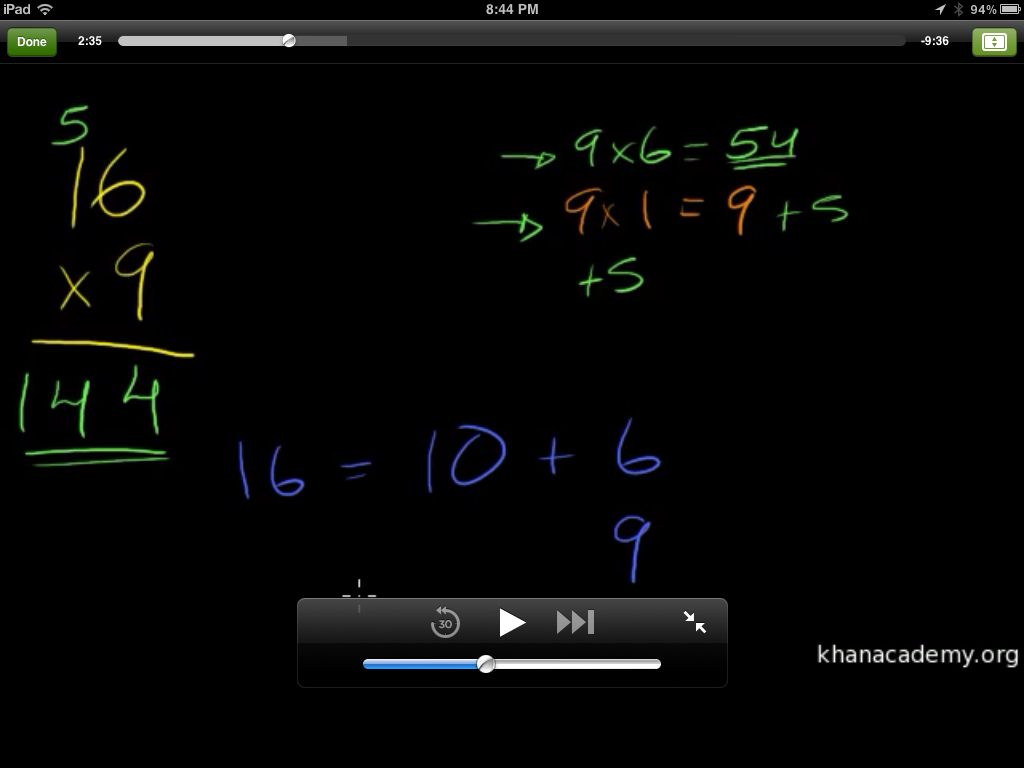
I looked at two courses within the program. It appears that all the content– and then some, that’s currently available on the Khan Academy website is available through the app. Now, I started tonight to keep track of what I looked at, and logged into the site. Login is either through Google (which makes sense, since Google is one of Khan Academy’s benefactors) or through Facebook. I chose to sign in through my Facebook account, and it only took basic information, nothing more, which is good. (I wish more apps that you sign into from a social media site only did that!) Anyway, the design was slick and simple. In landscape mode on my iPad, videos were listed on the left from a menu, and the video was found at the right. One feature on the iPad, you will notice in the screenshot image I have below, is that there is also a transcript of what Sal is saying in the video. I suppose this is good if you speak English but are not a native speaker, and you want to understand what he’s saying. (He speaks clearly for native English speaker, just so you know.) It also helps as a table of contents of sorts, so you can always say, “Oh, at this timestamp…” or “When he said….”, a person can find it within the video.  I found that at first, the scrolling of the transcript wasn’t working too great, but the longer I left it going through the lesson, it eventually synched up.

One of the neat features that I didn’t realize right off the bat, was that the video is not limited to the small screen seen above in the main interface– although what’s there is still clear. With the swish of multiple fingers, the video can expand to full screen like below:

I was glad of this feature, not only because that way, the learner can see things better, but with the full-size, larger interface, it gives the experience a homier feeling, like someone sitting down next to you with a set of colored markers and paper (albeit black paper, but hey, I’m fine with that.)

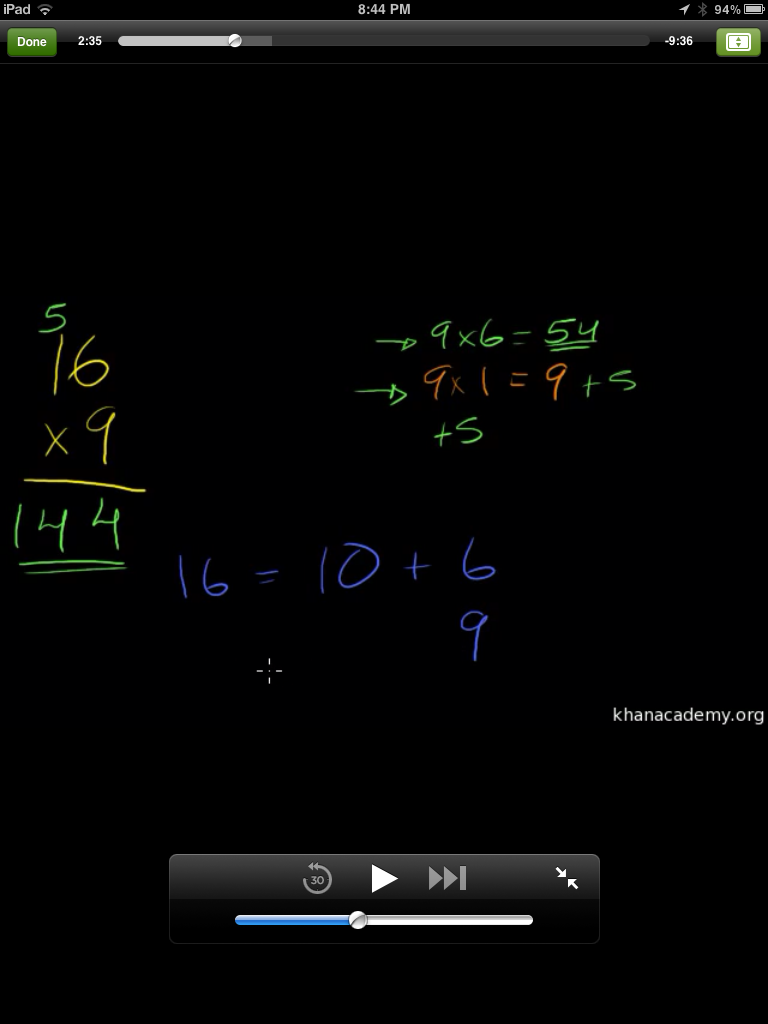
I looked at the display through a portrait view, and it looked like this:

(Sorry it’s a little smaller– the larger size image was TOO big.) You can see that the menu list is gone, but the video screen and transcript are still in place. When expanding the video in portrait format, it looks like this:

It’s still legible, and clear, and has that same comfort level as when it was in landscape mode. The screens adjust quickly between the landscape and portrait modes, which is good.

I won’t review the videos, as that’s been done before. I took this multiplication course, as it’s information that I’ve been reviewing with my son, but I also took a history lesson on Allende and Pinochet in Chile, and I thought it was well done. Sal does not show any bias towards one or the other, but does a pretty good job of presenting the facts, and actually invites the learners to draw their own conclusions, ask their own questions about the historical information. That is real teaching, my friend. A true authority will never admit to knowing it all, but will admit to being incredibly well informed, and always willing to invite curiosity, which is what Sal is doing here. He really does an excellent job.

Now, you may ask, what does this have to do with mobile learning? LOTS. Khan Academy is a rising star in e-learning right now, and by creating an app for iPad makes the courses even more accessible than ever. And just to play devil’s advocate, I accessed the Khan Academy through my iPhone’s Safari browser, just to see if everything would be teeny weeny and a waste of my time, but since all the videos are saved on YouTube, it’s very accessible. In fact, on the Safari browser, the site switched to a mobile browser version of the site, provided the same main menu of topics and videos, and upon choosing the video I wanted, I could still view the same videos pretty clearly. So even if a student didn’t have an  iPad or computer at home, if they or one of their parents had a smartphone, they could still access the information fairly easily.

So, is there a wrath of Khan? Not really. The only wrath that Salman Khan might have is what motivated him to start his non-profit academy in the first place– a passion to be able to provide basic (and not so basic) educational information to masses of learners all over the world by an easy means of communication at an affordable rate. (Who can’t afford free? Only cost is the computing device used, and many have access or have one.)

And isn’t that what mobile learning is supposed to be about? Easy access to easy to understand education information? I encourage anyone reading this to look into the Khan Academy. The firm is full of movers and shakers in the e-learning world that are dedicated to a higher purpose. It’s the kind of firm I would LOVE to work for, if given the opportunity. (Sal, call me!)

Posted in Uncategorized

Study, or not to study. That is the question.

I’ve often wondered what it truly takes to be able to call oneself an instructional designer or an e-learning specialist. I suppose there could be lots of criteria for it.  Some people have been traditional teachers, and from there moved into technology positions, bringing their wealth of information to the IT world. Some have gone to school to specifically become instructional designers, learning everything there is to know about how to present information and assess what students know.  Some are IT people who fell into the field by working for a company or department that was in charge of learning and development at a corporation.  Whatever the case is, there are plenty of ways that e-learning specialists have come to where they are. The question is…do I consider myself an e-learning specialist?

I’d like to think so. My first IT job was actually that of being the customer service manager of a new e-learning dot-com during the dot-com boom of the late nineties. I was the second employee the owners had hired, and like all small companies getting off the ground, employees often had to wear multiple hats, not just do the job for which they were hired.  While I did do the customer service work, I also ended up learning how to be the content manager for the LMS system that we used, and eventually, after the company grew, I was promoted out of customer service (that part was actually outsourced) to be the senior (okay, only) content project manager of the company. It was a long while ago, and very stressful and busy, but the nostalgic part of me remembers them as heady days. I learned the basics of how LMS and CMS systems worked, and I could see how content and assessments were created and rewritten so that the assessments would evoke learners to answer correctly. Heaven knows how many assessments I had to put into the system from third-party content writers. But that’s how I got my start, and I loved being in that company and that business.

The business was sold to a bigger company that said it was a merger, but it really was a takeover, and eventually everyone–even the owners–were pushed out. It was a disappointment, because I thought we really had something good going, and I really wanted to stay and continue the work I was doing.

Flash forward to several years later, after some stay-at-home years with my little son, my first full-time job was with a philanthropy that was automating the grant application system they had from applicants sending in faxes to answering questions and uploading documents online. While it wasn’t an e-learning job exactly, it was explained to me in my training that instructional design methods were being used to ensure that questions were asked in a way that would be clearly understood by the applicants, and would also elicit the kinds of responses the philanthropy needed to make a decision as to who would earn grants and who wouldn’t. I spent my days doing a lot of technical editing and applying those instructional design techniques, which seemed to come very naturally to me (I was even told that I picked up the concepts more quickly than many had), and again, I enjoyed what I did.

Shortly after that position came to an end due to layoffs, I found myself looking for some sort of unemployment training. I figured out, somehow, that the technical editing and instructional design skills I had were referred to as “technical communications”, and so I looked for programs that might help me get a leg up on learning more, so that perhaps I could find another job. Well, I did, and I started with a graduate certificate in technical communications essentials, and since I liked it so much, I transferred all my credits into the Master’s program, which I am in the middle of finishing up right now. This is my last semester, and I’m taking two classes and a capstone seminar, and as of May, I will have my Masters of Science in Professional and Technical Communications.

During all this studying, I’ve been doing a lot of focusing on e-learning and m-learning, and in the past year, really starting to concentrate more on this with the advent of the iPad (and getting my iPad, and seeing its potential in education!). There was only one class offered that had anything to do with instructional web design, and I took that course during my certifcate courses…but that was it. Almost every course since, I’ve tried to bring in some sort of element that had to do with e-learning or mobile technology whenever possible. I’m continuing to do that now, even, in my last semester. I’ve even made a greater effort to get involved in the e-learning and m-learning community in the last few weeks, and have made huge leaps and bounds during these weeks meeting new people in the field or share the same interest in education and technology especially through Twitter. In fact, if you are reading this now, you are most likely one of those people. HI!!! Glad you are here.

Oh, and one more thing…I think I’ve had a special understanding of instructional design that’s not the norm (I don’t know that it’s unique, as I’ve met a few others who are in a similar situation), which is that I have a special needs child, and with him, I’ve had to learn even more about how people learn and how people acquire knowledge. In the process, I’ve learned how to think outside the box to enable effective learning. Technology is part of it, and it could play an even bigger part, but there has been some creative thinking in the process as well.

So…does this experience make me an e-learning specialist? I’m not sure. Part of my problem is that because I haven’t stayed in one industry for years or have a PhD in some scientific field to make me an SME, and that I’ve trained myself to have as broad a technical communications foundation as possible (to enhance my chances of finding employment) despite my special interest in e-learning, I’m not thought as one, I don’t think. Oh, and the fact that I haven’t used a specific up-to-date LMS or LMS building system, or have used e-learning software like Captivate, Lectora or Articulate (although I’ve been told that I would probably pick it up very, very quickly) in a long time, I’m ineligible to speak as an e-learning specialist.  So, what DOES it take to be an e-learning specialist?

I’m sure some of it is that I still need to get some further education. I was fortunate that the Master’s degree that I’m earning is through an accredited institution– that is, it’s a place that is already a well-established bricks-and-mortar school, and it so happens that this is an online degree taught by the same staff at the bricks-and-mortar school. I’m not knocking other legitimate online learning places, but for me personally, there has been a certain comfort in knowing that my degree is from a place that people have heard of and gone to well before online degrees were invented. (My husband graduated from my soon-to-be alma mater more than twenty years ago, and his late stepfather taught there well before either of us were born!)

So, what do I do next? Do I just do my best to wiggle my way into some position somewhere, and hope that there is a manager out there that understands that I’m experienced and yet a newbie at the same time? Or, like I said, do I further my education? It’s a tough decision. For now, part of the issue is money. Education isn’t cheap. Sure, I could look up some YouTube or software manufacturer videos to learn these software programs…and in time, that may be the solution or part of the solution…but will it be enough?

One of the big questions and hot topics in e-learning and especially with the advent of m-learning is the DIY Education.  Anya Kamenetz has written two books on the subject, namely, “DIY U” and “The Edupunks’ Guide to a DIY Credential“, and she mostly talks about the idea of people creating their own education in a cost effective way, whereby a learner can learn through, for example, TED videos and online person-to-person learning instead of just through the conventional means (even a conventional course that’s done online), and that the mentality of what education is has to change. She says that as student debts are rising, and not everyone can afford a conventional education, there is lots of good information available through the Internet that can allow a person to learn what’s needed to effectively participate in a particular field or the workforce at large. Brilliant stuff. Someone she writes about who is a mover and a shaker in education and technology, and someone  who actually works at my undergrad school (wish he was there when I was there!), is Jim Groom. Jim is the one who is credited for creating the term, “edupunk”, and has been a strong advocate of open source education and the use of technology in higher education. He came a decade after I graduated, and it looks like he’s made a big splash at my alma mater!  Are these two individuals among those who are leading a bigger movement into something that should be, well, obvious, and one I should be taking advantage of?

I’m not sure what path to take. I’ve thought of going for a PhD in Instructional Design and Technology, but between the time and money factors, but I don’t know that I’m up to it just now. Should I get another Master’s degree? Same issue as the PhD. I’ve also thought about perhaps going for another graduate certificate in Instructional Design and Technology. That might be a more viable option…but again, time and money are factors.  Do I just take a few essential courses, just to get myself up-to-speed, or at least give me a little more credibility and knowledge? Perhaps…it wouldn’t take as much time and money as the other options. But in the end, will it give me the credibility I need to be considered an e-learning specialist?

I don’t know. And therein lies the problem.  So, I need to ask again…what constitutes an e-learning specialist? I would really like to know, because I feel this is my “calling”.  Do I just do my own thing educationally going forward? Am I fine where I am with the education and experience I already have? Do I need to do more, and if so, what? I wish someone could give me some direction.


Posted in Uncategorized

Um, that’s nice but…

Apple made it known to users of iWork.com that their documents would no longer be saved there in favor of iCloud.  You can read more about it here.

Okay, I have no problem with that. It makes sense that Apple is pushing iCloud hard, and has been since the release of the iPad two and the iOS5 that came out. Fine.

But there’s a problem.

If you are using the iWork apps in iPad or iPhone (I can’t speak for Macs, since I don’t have one), if you try to utilize the “Share and Print” feature, you can’t save it to the iCloud. Oh no, you can’t.  Well, I speak only for the “Pages” app, which is the only one I’ve downloaded for my iPad. I’ve updated it as far as it can be updated, but that little feature hasn’t changed. It can share to iWork.com, or to iDisk, but there is no feature to go to the iCloud. Now, you’d think that perhaps the iWork.com option would reroute to the iCloud, but noooOOOOOOOooooo. It doesn’t.  Now, I’ve set up an iWork/iCloud account, and so, naturally, I would think that I could try to save my docs there. They do save when I sync my iPad with the iCloud, but I don’t think they save to my iCloud/iWork account at all. It’s frustrating.

One of the big things that is important and a hot issue with mobile technology right now is the ability to be able to have a singular experience between your mobile apps and your…non-mobile apps (like your desktop/laptop). This was a big issue for RJ Jacquez on his blog very recently in the post named, “The Importance of Having a Singular Computing Experience for Mobile Learning,” noting Amazon’s Whispersync and Dropbox as examples of those who have it right.  So obviously, this has been on my radar recently,  and often is since I try to be the mobile grad student, working off both my laptop and my iPad, depending on where I am at the moment.

Since Apple tends to be a leader in mobile technology these days, wouldn’t you think that they would’ve added another option to the iCloud in the Pages app if they are trying to push users in that direction? It seems so obvious, yet they haven’t done it. They can always take out the “Share with iWork.com” option out in an update release once the site is completely blocked.  It just doesn’t make sense to me.

Am I missing something?

Posted in Uncategorized

Here we go!

Here it is! I have my own blog here on WordPress! While I’ve written other blogs over time, this is the first one that I’ve actually decided to write to talk about professional stuff, namely technical communications, especially e-learning, m-learning, and education and technology in general.

I still can’t believe I’m doing this, but here I am. Over the next few weeks, I’ll try to clean up this site, and start pulling in some of the tech comm content that I wrote on my grad student blog, and also talk about new things or concerns as well.

I hope you enjoy this new site as it develops!

Techcommgeekmom