Posted in Uncategorized

The Pros and Cons of Gamification in the Classroom

See on Scoop.itM-learning, E-Learning, and Technical Communications

As the gamification trend continues unabated, experts weigh in on students’ and instructors’ motivations.

Danielle M. Villegas‘s insight:

Thanks to @kevin_corbett for finding this article. I do think gamification helps in the learning process, but as the article points out, we’re still in our infancy stages of truly deploying this effectively. Good article. 

–techcommgeekmom

See on www.edtechmagazine.com

Posted in Uncategorized

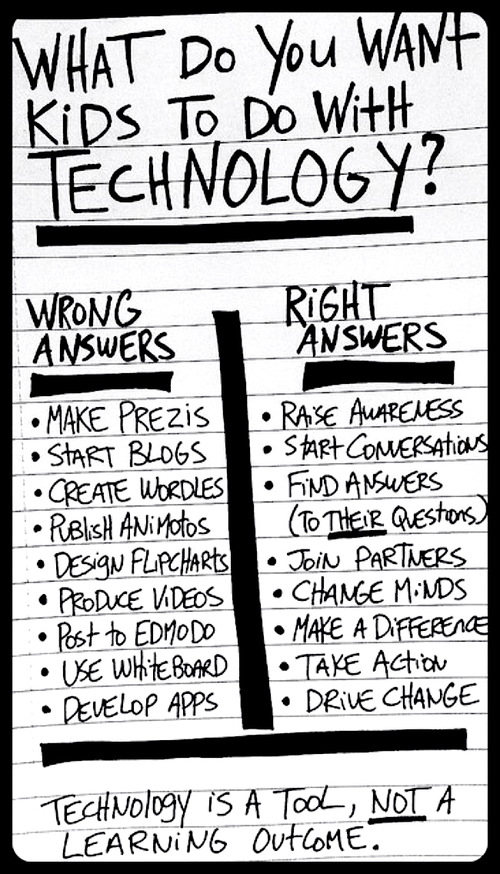
What Do You Want Kids to Do with Technology?

See on Scoop.itM-learning, E-Learning, and Technical Communications

Wrong Answers: make Prezis, start blogs, create Wordles, publish Animotos, design flipcharts, produce videos, post to Edmodo, use whiteboard, develop apps


Right Answers: raise awareness, start conversations, find answers (to THEIR questions), join partners, change minds, make a difference, take action, drive change


Technology is a TOOL, NOT an outcome

Danielle M. Villegas‘s insight:

I love this! I think it’s something that’s easily overlooked, not only for students, but adults too. Adults get too obsessed about the tools as well, if you ask me! And as is the case with both the student and adult populations, we can always learn and adapt to new tools.

–techcommgeekmom 

Posted in Uncategorized

English as a Talent Magnet

See on Scoop.itM-learning, E-Learning, and Technical Communications

I get a lot of questions about my program of Englishnization – the goal I have set to make English the unified language of our business. Many ask me why I bother. If they could see my in-box,

Danielle M. Villegas‘s insight:

Found this thanks to Adriane Hunt on LinkedIn. 


Is English becoming the "business language," much like French used to be (perhaps still is) the diplomat’s language? Is this a good thing or bad thing, or "it is what it is"? 


Discuss. 

–techcommgeekmom

See on www.linkedin.com

Posted in Uncategorized

What’s wrong with being a lurker?

watson on laptopIt occurred to me that while I haven’t been writing or curating as much as I usually do, I still make sure that I’m reading my various social media feeds, so I can see what the latest trends and conversations are about these days.

The thought popped into my mind–what’s wrong with being a lurker, who is someone who reads but doesn’t comment online? After all, not everyone likes or wants to be writing all the time. I personally have a big mouth that translates here into writing, but that doesn’t mean that everyone likes to talk as much as I do. There is no requirement in social media that one needs to be posting or re-posting tweets or other information that they read every five minutes, after all.  Even so, what’s the advantage of being a lurker online?

The way I see it, being a lurker is similar to being the person in the room who obviously isn’t saying a word, but is absorbing all the information that’s going on in the room. The lurker can read, observe and learn a lot just by staying still and not saying anything, and in the process, acquires a vast amount of information being given through comments made and by reading articles posted.  This is not a bad way to learn a lot about any given topic, while learning about the people who shape those thoughts or trends.

In the end, however, the lurker loses out. Social media is not only about communicating information, but it’s also about the connections made through this kind of communications. Communication with each other is the key to why we can have discussions or debates on issues.  The person who writes those posts or tweets those tweets appreciates it when you retweet, or even make a brief comment of, “I agree!” or “That was a great article.” It validates the position of the author, but it also shows your competence in the subject matter too–that you understand the concept being presented.  By respectfully responding with your own commentary, it allows others to see YOUR perspective as well. You automatically become part of the conversation and the process.

Don’t be a lurker and sit back for too long. Feel free to participate! You might be surprised to find that your original perspective might be enjoyed and respected by others.

Posted in Uncategorized

PC sales in ‘longest’ historical drop

See on Scoop.itM-learning, E-Learning, and Technical Communications

Global personal computer (PC) sales fall for the fifth quarter in a row, making it the “longest duration of decline” in history.

Danielle M. Villegas‘s insight:

This has been long predicted, and if you think about it, it’s not really all that surprising. Tablets have made everyday computing affordable and accessible. PCs, in my mind, are for the "heavy lifting" tasks beyond simple media, e-messaging and web browsing. Most people don’t do the heavy lifting on a daily basis, especially in their personal lives, so naturally tablets are an affordable way to stay connected. 

Those in technically-related jobs, like tech comm, e-learning, web development, etc. need those heavy-lifting machines, but we’re also buying machines in a way that we don’t upgrade as quickly anymore. For example, I bought my laptop in 2010. I’ve upgraded the RAM, replaced the battery, but I also bought a machine that wasn’t the cheapest or slowest processor at the time. It’s a 1st generation Intel iCore 5. That’s a minimum now, but wasn’t then. I usually upgraded my machine every 2.5-3 years, but I think I can hold out on my laptop for another year–maybe two. PC manufacturers have to rethink their sales to be like cars. You could perhaps lease a laptop or desktop for 2-3 years (some actually do that), or think long-term where a person could have the machine for more time than the average leasing term, like 5-7 years–or more. If PCs were built and upgradable much like a person can maintain a car, I think laptops wouldn’t decline so much.


Even so, like I said, the average person on the street uses a tablet or smartphone to connect in ways that a PC isn’t needed. Perhaps sales expectations and dynamics need to shift.

–techcommgeekmom 

See on www.bbc.co.uk