Posted in Uncategorized

So, what’s ahead in Tech Comm for 2013?

Mathematician working on calculus equationShortly after the obligatory reviews of 2012 come the obligatory predictions about 2013. Sometimes such predictions are on target, and sometimes the predictions are rather ludicrous. One has to admit, though, some of the ludicrous ones do become true, and some can be purely entertaining.

So what are my predictions for 2013? Good question. I don’t really have any idea.

The past year has been a total whirlwind for me. As I mentioned in my last post, so many things happened to me that were unexpected, and there was so much more information learned than was expected that I wouldn’t know where to begin to make such predictions.

It’s also the time of year that one makes resolutions. As we know, most people have a difficult time sticking to New Year’s resolutions. I am no different. If I could keep a resolution, I would look like a supermodel. 😉 Instead, I try to set goals instead of resolutions. Goals are more realistic, because like resolutions, they are usually for some sort of better condition in one’s life, but there aren’t always time limitations as to when this goal will be achieved. I was determined to get my Master’s degree in two years. It took two and a half years, but I still attained my goal. You get the idea.

Most of my goals this year related to doing things around my house that have been waiting for years, such as remodeling my 30 year old kitchen, or putting new carpeting on the stairs. I’m also trying to see if I can try to travel more this year, because that one whirlwind trip to Portland, Oregon for Adobe Day was exciting for me, and it gave me a break from the humdrum of regular life while infusing my brain with new, uselful information.  I am hoping that I can get to the STC Summit this year, but I have to see about that–it’s not cheap if you haven’t been working for a while, and you don’t have a company to pay for it. It’s on the U.S. East Coast this year, which makes the travel itself easier and more affordable, but the conference–even the early bird rates–are a lot for a newbie technical communicator. But, I’m hoping with the new job, I’ll be able to afford it. Time will tell. I’ve also set a goal that I want to go back to the UK for a visit. I love that country, and haven’t been in twenty-one years. I found out that I have a cousin that lives in London who is an educational technologist, so catching up with her in person rather than through Facebook should be fun.

But what about professionally? I start my new job as a Web Publisher on January 3rd. I’m excited, nervous and anxious all at the same time. I’m always like this when I start a new job. It’s that, “What did I get myself into?” feeling that just about everyone gets. Don’t get me wrong–I think this is going to be a great opportunity for me, but after being out of full-time work for so long, it’s going to take some adjustment to get back into the swing of things. I’m sure I can do the job and do it well. It’s just the “newness” of it all that gets me. Some find that feeling exciting, but it’s nerve-wracking for me until I truly understand my role. I want to do well, after all. So since my job is supposed to involve a lot with content management, some writing, some web design, and even a little bit of videography and audio manipulation, it should be good. They are all things I can do well, and look forward to doing. I’ve been told that if I do well, there are other potential projects beyond this one I’ve been hired for, so I want to do well. I am excited to be a full-fledged technical communicator now after waiting in the wings for a while.

So, as far as predictions, I can’t make any, but perhaps I can make suggestions–specifically suggest some technical communication goals for consideration for the next year, based on what I’ve learned in the past year.

First, THINK MOBILE. This is foremost. It doesn’t matter whether it’s for e-learning/m-learning or just for simple websites, mobile is essential going forward. I think a lot of companies are in denial of this, thinking that tablets and smartphones are a fad, but they really aren’t. I don’t have specific stats anywhere (and feel free to contribute them in the comments if you have them), but I feel like I’ve read that smartphones outnumber landlines worldwide now, and mobile devices are used much more than desktop-style devices as well.  On the road, more people are likely to bring a tablet and/or smartphone than a laptop for basic information that they need to obtain. But, as we all know as technical communicators, mobile devices are not laptop replacements necessarily, so we need to write accordingly for this different devices. A huge portion of 2012 seemed to show me that tools like Adobe’s Technical Communication Suite 4 (see more information in the top right column) and other software tools are keeping up with the times, and providing HTML5 support as well as providing single-source solutions for both desktop and mobile content. As technical communicators, we need to push the agenda that these kinds of tools are essential to more efficient workflows for us, but also are an investment in content management as well.

Related to that, as technical communicators, there’s a real need to push the use of better content. There is always some crossover between marketing communications and technical communications, but in the end, from my own experience, technical communicators have a better edge in managing and writing content. No offense, mar comm writers, but there’s a point–in my view–that marketing communications gets a little too fluffy. It’s too much about the sales and gimmicky verbiage instead of really giving customers the information they need to make informed choices about products and services. Advertising is one thing, but if a customer is going to a website or app to get more information, it’s because they want INFORMATION, not a sales pitch. I’m a consumer, and I’ve also been a consumer advocate in my career, so I’ve been on both sides of this, and I have to side with the consumer on this one. A sales pitch can initially draw a content consumer into your website or app, but once that is done, you want that consumer to be either able to come back, or provide such excellent information that they don’t come back. If there’s good support provided on a site with pertinent information, then there’s customer satisfaction. It’s that simple. And yet, so many companies don’t completely realize this. I don’t know how many companies I’ve seen where the writing is…well…not up to par (to be polite), and I didn’t have the permission to fix it to be more succinct and to the point to help the consumer or audience of the content. It frustrated me to no end. And yet, when I’d try to explain to authority figures that the writing going on wasn’t working well because it was too long winded and needed to be pared down for easier reading while still getting the main points across, I was ignored.  There was a Beastie Boys song called, “You’ve Got to Fight For Your Right to Party!”, and it relates to this, as it makes me think that technical communicators need to fight for their right to, well, do their jobs! We have the skills and know-how, and we can help to elevate companies that should be cutting edge to that level. I can think of so many companies that think they are cutting edge and are actually way behind instead,  very much in denial. Or, for whatever reason, companies would not invest in the technical communications of the company when that’s where the money would be well spent.

I get very excited about technical communications because while it’s been a field that’s been around for about 100 years (give or take a few years), it still is working to earn the full respect that it needs. With technological advances, technical communicators have huge opportunities to really show what they can do. Right now, with the huge and quick advances made in mobile technology especially in the last few years, this is definitely a time when technical communicators can shine. We have to exert and advocate for ourselves to carve out our place more definitively. We need to adapt to the changing environments to make sure that we are not expendible, but rather necessities. We need to be multi-specialists rather than specialists.

I’m sure you get the idea by now. These concepts are what have been driven into me by the best of the best in the tech comm business in the last year, and I know this is what need to move technical communications forward.  When I entered my MSPTC program at NJIT three years ago, one of the motivating factors for entering the program and continuing with the program was not only the subject matter, but predictions that the technical communications field was going to have a big surge. I want to be part of that wave, and be one of the movers and shakers of the movement. I’m hoping that all technical communicators reading this will look at the new year as an opportunity to help shake things up in the world using the skills that we have. Whether we promote m-learning, single-source content management, or just emphasize clearer, better writing, our mission is clear. Make content better for ALL consumers of information. Make this your New Year’s goal– no matter how big or small your contribution is, make your content BETTER.

If goals like that can be achieved, THAT will be what’s ahead for Tech Comm in 2013.

Posted in Uncategorized

What did you do to get that Tech Comm job?

MH900431660As the news continues to spread that I finally got a full-time job after a year of searching, one of my friends from Adobe suggested that I should write a post about how I got the job, with the purpose of encouraging others that they, too, can find a tech comm job.

Well, I won’t lie. It wasn’t easy. And my path may not be the right path for everyone, but I think there are some universal elements that can be recommended here. As this blog has often been a testament of my job searching woes and questioning what seemed to work and what didn’t, all I can do is recall what seemed to work for this particular interview that got me the job, and what lead me to that moment. In a nutshell, it was a lot of hard work.

Let me first start by bringing this recent article to your attention:

Employers may be aggravating the ‘skills gap’

The article explains that in the US, while there isn’t a lack of unemployed workers, there is a lack of skilled workers in specific professions, and that employer demands of finding such workers instead of making a small investment in training otherwise competent workers is contributing to the problem. Gone are the days when, if you had half a brain and could learn how to do things, your employer would hire you and train you on that specialty. Most of my career was done this way. After college, I had a degree in hand, and could show that I could speak, write well, and think on my feet, so I was trained as a consumer affairs rep for a national manufacturing company. I would pick up different skills as I went from job to job, learning and gaining skills as I went along, eventually even shifting from a client services career to an IT career. But when I returned to the workforce after a brief stint away to be a stay-at-home mom, I found that wasn’t always the case anymore. In the last year or two, I can tell you that I KNOW this isn’t true anymore, or it’s a rarity. The article above mentions the loss of the time honored tradition of apprenticeships, something that may need to have a comeback. I supposed that internships are similar to apprenticeships, but they are far and few between as it is, especially for a mom like myself trying to get back into the workforce to help the family finances. Most are for school credit, instead of a small wage to learn a skill or craft. Possibly good for some students, but not that good for the rest of us who have to support ourselves or family.

In a sense, I had to create my own apprenticeship. In economic hard times, necessity is the mother of invention, and this mother needed to invent a new career out of necessity. My first full-time job after the onset of motherhood gave me the direction–technical communications. From there, I had to figure out how to better establish myself as a technical communicator, and eventually become one in the field.

So as not to bore you with my long story of how I finally arrived at this moment of getting a job, I’ll cut to the chase of what I think helped me in the end.

1) Don’t be afraid of being a multi-specialist or generalist. I know that several weeks ago, I questioned this, because this seemed to be a huge roadblock for me. In the end, it was the fact that I was a multi-specialist, I think, that picqued the employer’s interest. Yes, I could work on a CMS system, but I also know a lot about m-learning, social media, web design and yes, I can write. I think that the more I discussed what I knew about each topic, the more I could see eyes of the interviewers light up.

2) Create an e-portfolio of your work. This was really helpful for me. As much as I could say that I could write, create audio and video files, understood web design, and understand social media, I had PROOF. My e-portfolio could provide samples of most of my skills so that employers could see for themselves. While my e-portfolio originally started as my capstone project for graduate school, it has been enhanced and appended several times after graduation to appeal to prospective employers as well as those who just want to understand my work.

3) Get an education. You don’t necessarily need to go out and get a Masters degree like I did, but if you feel deficient in any field and there is any course available that will allow you to gain some new skills, take advantage of it. Even if I had only taken that first introductory course in grad school, I feel like I would have gotten ahead more than if I didn’t take that class. I knew when I was first unemployed that I had a lot to catch up with when it came to technology, so I took advantage of my state’s re-employment program that allowed workers to enhance their skills.  It paid for the first three courses of my graduate certificate that eventually was transferred into my degree. But there are lots of great courses too, at local community colleges, continuing education programs, and oh yeah–online! Learning more always gives you more to provide a prospective employer.

If you are looking for a technical communications position specifically, there are several accredited schools who offer online programs for certificates, undergraduate degrees, and graduate degrees. Look at the ID/TC Education Resources in the menu bar above for some suggestions. Being a product of one of these online degree programs, I do recommend NJIT’s MSPTC program, as it did help me get to where I am and prepared me for this.

Or, educate yourself, and teach yourself a new skill. Take advantage of trial offers to use software you haven’t used before, but see what is prevalent in the field. For me, it was Adobe’s Technical Communications Suite. (As a technical communicator, you can try it out too if you click on the ad on the right column at the top!)

4) Get involved in social media. While I had always been someone keeping up with friends and family through social media, I also made a conscious decision during my job search to use social media to gain an advantage in the workforce. How? If I could keep up with trends going on in the field, then I could speak more competently about changes going on in the field than if I just stayed stagnant where I left off. In the past year, I’ve learned so much about technical communications and e-learning/m-learning issues that were never discussed in the classroom. Also, don’t be afraid to start a blog like this one. It allows others to understand how your mind thinks as well as what is important to you. It’s a great addition to the e-portfolio. It can also be a resource in finding positions as well, as many employers and groups are posting job vacancies through social media channels now.

5) Get a part-time job in the meantime. While I was trying to find that great full-time job, I actually held two short-term part-time jobs. One was as an assistant webmaster to a local academic publisher, and the other was teaching a virtual course in technical and business writing to a corporate office in Asia. While they weren’t exactly traditional tech comm jobs per se, they both helped me keep some of my skills fresh, and let me look at other industries beyond those I already had experienced.

6) Network with other tech comm professionals. You always hear how one should network, and it’s true. Just so you know, networking does NOT come naturally to me at all–not even close. In fact, I really don’t like networking, but I forced myself to do it, and I’m glad I did. I signed up with the STC while still a student, and attended one or two events that were local to me, and I was able to make some valuable connections. Similarly, networking is an extension of social media.  While I did use social media to educate myself on the latest topics of the field, I also used it to get to know other tech comm professionals. When I went to Adobe Day at Lavacon a couple months ago, it allowed me to instantly connect with more people because I had gotten to know them online, and for that, I’m grateful.  I’ve also kept in contact with my professors and several classmates through social media, and that’s helped with networking as well.  While it wasn’t the case for this particular job, my last full-time job came about from networking with a classmate who helped get my resume in front of the right person at her office. Even the teaching job was found because one of my professors posted it on LinkedIn. You never know what connections you can make that will either lead to a job, or provide you with an excellent support system to help get you through.

7) Create a functional resume instead of a chronological one. I had a recruiter tell me that a chronological resume that I was submitting wasn’t telling him anything about my abilities, especially since my career was going in a zig-zag direction between jobs. On top of that, my last two jobs, which were part-time, didn’t really say much about my ability as a technical communicator necessarily. He suggested that I create a functional resume rather than a chronological resume to send out to his clients. I balked at first (which I often do when I think I already have something good), but I did it anyway, and I’m glad I did. This is part of what the recent interviewers liked most. I was able to lay out what skills I had in both a broad sense, and then with specific examples of what I did with those skills. The places where I did them and when I did them didn’t matter as much as me being able to do them. My actual skills were able to shine more than where I was last. I still have a chronological resume for those that insist on that type, but more often, I would sent the functional one instead, and I got a better response for jobs that were more in line with what I was looking for as a result.

I’m sure there are plenty of other factors that contributed to me landing this position, but I think these seven items were key for me, and they can easily apply to someone else.

In the end, it boils down to making an effort to put yourself out there, not only with resumes on various job engine websites, but also making something of yourself that can make you stand out a little more, thus providing you with that slight edge over someone else that can land you the position. If you don’t put yourself out there, then no one will ever know who you are or what you are capable of, and that’s self-defeating. Even after taking a year to get a job, I would still pursue all of these steps to seek a job, as I know they are steps that do give me an edge above the rest.

If you are job searching for a technical communications or instructional design position, try some of these if you haven’t already, and good luck!

Posted in Uncategorized

Big News for TechCommGeekMom!

doctor-who-dance_o_GIFSoup_comWhy is the 11th Doctor (of Doctor Who) on the left dancing? Because I feel like dancing! “Why?” you may ask. Well, I’ll tell you.

I’m very excited to announce that…

I FINALLY GOT A JOB!

Yes, I think that’s a reason to feel like celebrating, don’t you think? I’ve been looking for a new full-time job for about a year now, and it’s taken this long to find something.  I will be working as a consultant doing web publishing work for the internal and external HR websites of the North American headquarters of a global chemical company.  Much of the position will be helping to organize their content management system, but it sounds like this assignment could blossom into something more.

I have to actually thank all the people I’ve connected to in the last nine months through social media, especially through Twitter and this blog. I’ve learned so much from all of you during this time that went beyond my recently earned Masters degree, and I have received such fantastic support in the process. Social media has given me a voice, and I’ve appreciated those who “listened” to my words. My goal in participating in social media was to not only learn, but to keep up with the issues and concerns of those in technical communications and e-learning so that I would have a better understanding of them should I find myself in the position I am now–about to embark on a new job soon. I learned so much in the process, and it lead to opportunities–especially thanks to Adobe’s Technical Communications Suite team–that I wouldn’t have ever dreamed of, and those opportunities empowered me during my interview.  I learned about structured content, the importance of proper translation and XML metrics, and the need to be able to roll out content for mobile devices just from going to the Adobe Day pre-conference event at Lavacon alone.  Articles and conversations on Twitter and Facebook furthered the cause. Even though this new position does not involve m-learning, the topic did come up twice during my interviews, and I think that my knowledge and competency of the subject actually helped boost my credibility immensely. There was not one aspect of what I’ve delved into via social media with all of you involved that didn’t come up during my interview, and that evidently gave me the edge. So many thanks to all of you in helping me grow and learn through your continual support. Oh, and just for the record, being a generalist/multi-specialist did help the cause as well. 😉

But does this mean the end of TechCommGeekMom? Heck no! First of all, this position doesn’t start for another month, so I have some time to still contribute to this blog. If anything, I am hoping that by being a more active participant in the technical communications field, I will be able to write more as time goes on. I might not write as often from time to time, but I think more information will come through as I continue on my path to learn more through this new, upcoming experience.

I hope you share my excitement and will celebrate with me.  It’s been a long road to get here, but it looks like I’m finally on the road going in the right direction. 🙂

Posted in Uncategorized

Blast From The Past – Volume 3: Interior Design Influence on…Tech Comm and Social Media?

For this week, I decided that I would post another one of my “Blast from the Past” entries from my graduate school blog. When I go back to review these, many of which were written when I was just starting to understand what technical communications were all about, I see some pretty decent reflections.

I’ve lost direct contact with the person in this entry, as life moves on, and Twitter exploded, but I still learned a lot from the experience. Perhaps I still need to follow-up on the blog entry I proposed at the end based on his books! He’s still out there and making the most of social media and media at large, and has always been ahead of the curve in this regard, continuing to make the most of both marketing communications as well as instructional design with his television shows and now instructional videos on his website.

Enjoy this entry that was originally from March 20, 2010, originally titled, “Interior Design Influence on…Web Design?”:


Recently, I’ve struck up a Twitter friendship with renowned interior designer, Christopher Lowell. He is a very thoughtful, sweet guy. He also posts these great dishes he’s having for dinner that make me hungry! But I digress…

Christopher has always been a little bit ahead of the curve when it comes to media and the wave of the future in communications. He was revolutionary in breaking down the basics of interior design in a user-friendly way, and bringing it to the public on the then-new media outlet of cable television. Between his shows and his books, which eventually branched out into his own product lines of furniture, fabrics and other home accessories, his goal has always been to make interior design about making a home, and making it with your own special stamp. All these years later, he still has that goal of bringing things that seem so lofty down to earth for all of us to enjoy.

One of the things I like about corresponding with him through Twitter is that he really seems to be exactly who you see on TV and read in his books. He’s down to earth, he can be silly, but he really does care about important issues and cares a lot about other people and really using social media as a means of communications. I know that I’ve certainly enjoyed getting to know him little bit by little bit.

So, today he posted on Twitter that he had a new blog post, in which he talked about how he likes how reality TV is starting to be used more constructively, and used Jamie Oliver‘s show about how Jamie is trying to change the diets of school lunches to more wholesome foods for kids as a good example.  He segueways into how he feels that the internet is what the next big wave of information and entertainment will be– more so than it is now, much like cable TV was in its infancy. He alluded to the fact that part of the reason we don’t see him on TV (cable or otherwise) much these days is that he’s exploring these new media. He wrote, “As we continue to open new portals and refine new media platforms, you can bet, I’ll be there, doing what I do best.” That seems appropriate for a guy who has always been on the cutting edge of things.

So what does this have to do with technical writing? Well, a lot. You see, I feel inspired by what Christopher has been talking about, because it’s not only about what he’s doing, but where the future in technology is going, and technical writing is part of that.  I’ve thought of two projects that he’s inspired me to do, but I don’t have the reason to do it other than “just because I feel like it” at the moment, so since I’m busy enough, I’ll have to wait until I have a little more time to work on them, or can work it into a school project for my e-Portfolio. The first idea was just to interview him, and get more details of where he thinks internet media is headed, and the sorts of projects he wants to do, or sees happening. You know, get inside the head of one of the big “movers and shakers” to understand future trends. The other idea is to write a piece called, “The Seven Layers of Technical Writing” or “The Seven Layers of Web Design,” or some similar theme, as Christopher was the one who revolutionized the idea of the “seven layers” of interior design. (Heck, I wouldn’t be surprised if he invented the Seven-Layer Dip!) In my mind, it would be an article that would show, especially for the newbie technical writer, that by sticking to some basic rules of thumb, like the Seven Layer of Design, that you too can master what it takes to be a technical writer.  I’d really have to think it through, because I’m sure it’s not that easy to whittle anything down that has so many variables, like tech writing, like web design, or interior design.

Kudos to you, Mr. Lowell, for giving me some inspiration outside the (technical) box, and getting a new dialogue started in my head…

Posted in Uncategorized

Adobe Day at LavaCon 2012 Roundup!

This post is just a quick summary of the Adobe Day at LavaCon 2012 series from this past week. As you see, there was so much information that it took six posts to try to summarize the event!

Being in Portland, Oregon was great. It was my first trip there, and being a native Easterner, my thoughts pushed me to that pioneer spirit of moving westward in this country. Once there, I saw a hip, young, modern city, continuing to look towards the future.  The information I gathered at Adobe Day was general information that was endorsement-free, and practical information that I can use going forward as a technical communicator, and that by sharing it, I hope that others in the field will equally take on that pioneering spirit to advance what technical communications is all about, and bring the field to the next level.

To roundup the series, please go to these posts to get the full story of this great event. I hope to go to more events like this in the future!

As I said, I really enjoyed the event, and learned so much, and enjoyed not only listening to all the speakers, but also enjoyed so many people who are renowned enthusiasts and specialists in the technical communications field and talking “shop”. I rarely get to do that at home (although it does help to have an e-learning developer in the house who understands me), so this was a chance for me to learn from those who have been doing this for a while and not only have seen the changes, but are part of the movement to make changes going forward.

I hope you’ve enjoyed this series of blog posts. I still have many more to come–at least one more that is inspired by my trip out to Portland, and I look forward to bringing more curated content and commentary to you!

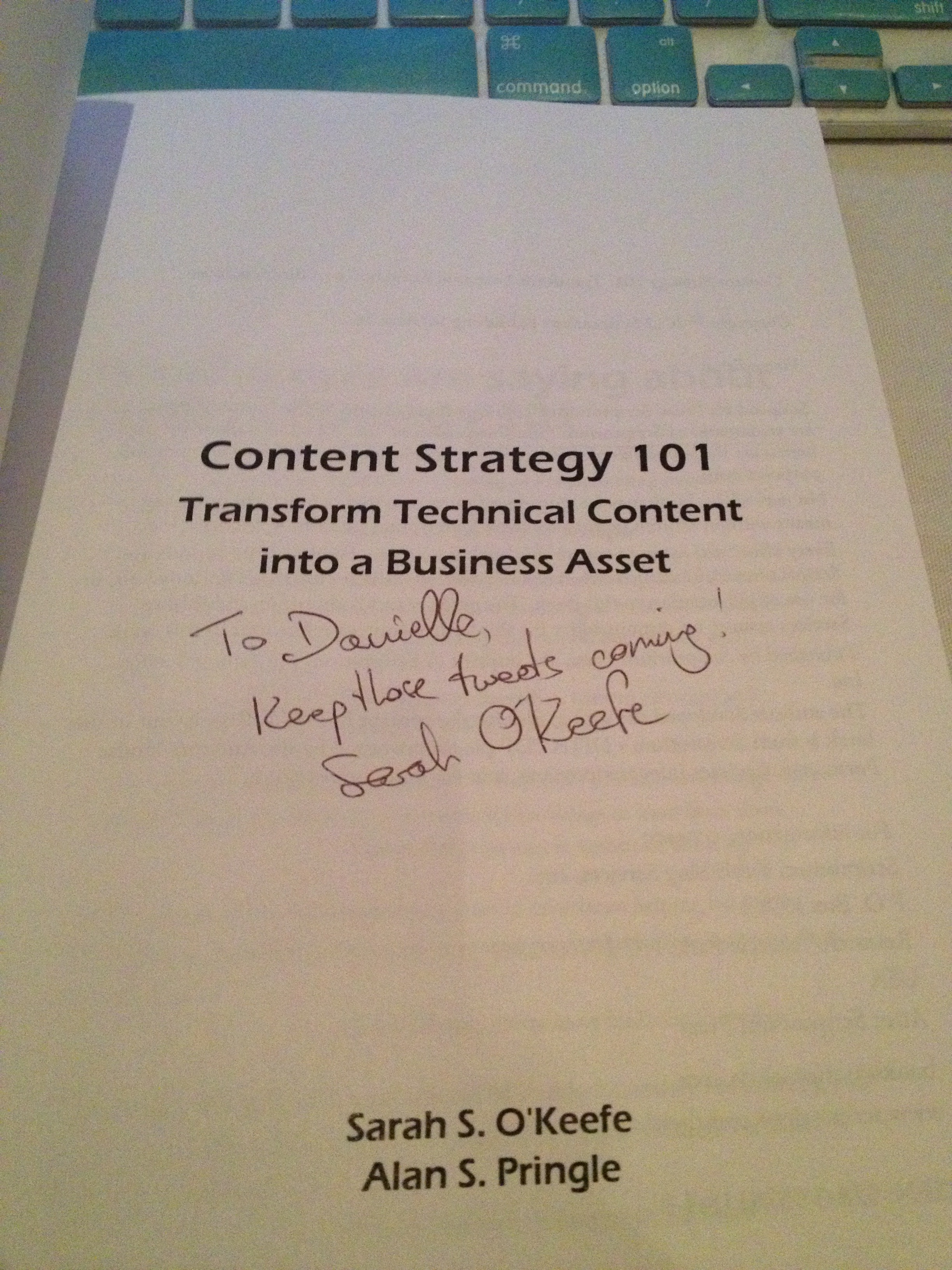
The autograph from my copy of
Sarah O’Keefe’s book,
Content Strategy 101.
Awesome!