Posted in Uncategorized

Adobe Day @Lavacon 2013 – Val Swisher Says It Starts With The Source

Ladds_1
Ladd’s Addition Rose Garden
Photo from http://www.rosegardenstore.org

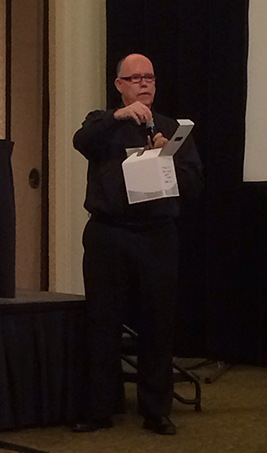
Val Swisher was the next to last individual to speak at the Adobe Day at Lavacon 2013 event. For those who are regular readers of this blog, you know that my love for all things Val Swisher has no bounds. I’ve always been able to take her easy-to-digest information, and absorb it quickly into my brain, as well as relay her knowledge to others.  When I looked at Portland Gardens to compare her to, I chose Ladd’s Addition Rose Garden.  While it’s not as well-known (unlike Val, who is very well-known), this particular park, according to The Rose Garden Store,  was one of four rose gardens especially built from the Ladd estate, in which the design included these gardens coming together to form the points of a compass. I often think of Val as my compass, as she has never steered me wrong with her information or with the wisdom and fun that she’s shared with me one-on-one.

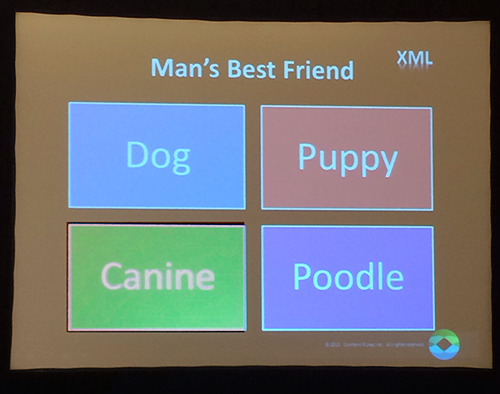
Val’s Adobe Day presentation centered on talking about source English terminology in a multi-channelled, global world, and how terminology affects structured authoring, translation and global mobile content. She started the talk by reminding us that historically, we’ve always created content, whether it’s been on cave walls, through stenography, through typewriters or eventually on word processors. In every instance, consistent terminology has been essential for structured authoring and content. Managing terminology is also essential for translation and for reuse.  She stated that prior attitudes used to be that the more complicated the writing was, the more “fancy” the product was. Today, that’s definitely not true.  She used the example that I’ve heard her use before, but it’s so simple itself that it’s a classic. Her example involves writing for a pet website. If multiple words meaning dog are used, there can be problem with reuse, because you can’t reuse content if you use different words.
Val_example_dog
Here’s the example Val showed.

Val pointed out that it would be an even worse situation if technological or medical terminology was used instead.

Val continued by saying that when it comes to  XML, reuse , and terminology, you cannot realize the gains of structured authoring if you’re not efficient with your words. Terminology is critically important to gain more opportunities.
ValSwisher
Val Swisher explaining how to approach content from a translation perspective.

Translation comes down to three elements– we’re trying to get better, cheaper, and faster translation output. We MUST use technology to push terminology and style/usage rules to content developers. In order to make it cheaper, we need fewer words, reused words, and reused sentences. It’s impossible for writers to know or even know to look up all term and usage rules. We MUST automate with technology. For example, “Hitting the button” is not translatable, but “Select OK” is fine!  She said, “Say the same thing the same way every time you say it.”

For better translation, translation quality needs to improve and meanings need to match in order for better machine translation to be a possibility. Bad translation comes from the source itself.  If the source information is problematic, then the translation will be problematic.  The best way to save money and time is to say the same thing, every time, using the same words, and use shorter sentences. For machine translation, don’t go over 24 words in a sentence.

Faster translation is seen as content that takes less time to translate, needs fewer in-country reviews, and gets to market more quickly. The key to delivering global mobile content is responsive design, global mobile apps, text selection is key, and terminology is the most important element. Val showed this example of how translation in responsive design isn’t working, where the Bosch websites are not exactly in synchronization:

The mobile website on the left looks nothing like the English language version on the right.

The simpler the design is for the website–especially in mobile, the less you have to tweak it. This is especially true where consistent terminology is important, because consistency is needed for structured authoring. Creating truly faster, cheaper, and better translation enables a true global responsive design. This is not a simple task, as there is no such thing as simple, even when writing about complex concepts. Even if you think you’re not translating, your customers are, so the content needs to be very clear. The scary part of this is that some companies use Google Translate as their translation strategy, which is risky at best. To use something like Google Translate as the translation software, the content had better be tight, clear, and consistent.

One of the things I enjoy with Val Swisher’s presentations is that it all comes down to common sense, and she breaks it down into easy manageable parts for those of us–like me–who might not have thought about the context of language for structured authoring, and the consequences for not strategizing content to include translation considerations.

I highly recommend checking out Val’s blog for other great insights.

(As always, Val–if you’d like to add or correct anything here, please do in the comments below!)

Posted in Uncategorized

Uhura and Translation Software–Still not there yet

star-trek-uhura NNMy husband’s first language is Spanish. As a result, naturally, most of his relatives speak Spanish exclusively. I, however, do not speak Spanish.  I took two beginner courses, but I know little Spanish in comparison.  I have had more French in my background, and with the similarities between French and Spanish, I can sometimes understand enough written Spanish to get by.

Recently, my husband’s aunt was celebrating her birthday, and I wanted to send her a brief line or two on Facebook to acknowledge the day. She only speaks Spanish–or at least her English is very outdated, so I knew it’d be better to write in Spanish. I used the Bing Translator to help me write a note to our “Tia”, and I had enough of a Spanish background to know it was correct. I think.

I started thinking about how translation is advancing with technological changes, and how writing for translation in tech comm is becoming increasingly important. It occurred to me that we are certainly not at the stage that we can each have a Lieutenant Uhura, the communications officer from Star Trek, at our disposal.  Even in the 23rd century, she still had to learn several languages and would depend on her software–and even the occasional book–to help her get through a difficult translation. This scene from the film, Star Trek VI, came to mind when I thought about it:

So, things aren’t perfect even when we do have universal translators.

Back in the present,  two people who have spoken about translation in tech comm came to mind. The first person I thought of was one of my favorite content management speakers, Val Swisher. Val and her company, Content Rules, specialize in translation and how it fits into using content management wisely. I always love hearing her presentations about the importance of translation editing, and writing content for reuse that can easily be used for translation.  One of the examples that Val uses often is a scenario involving a pet care website. In curating content, one author may use the word, “pooch,” another might use, “puppy,” and yet another might use the term, “canine.” All are different terms to describe a dog, but that doesn’t mean that translation software–or even a human translator–necessarily understands the differences. The same occurs with expressions. There are several expressions or slang that can be used in English that don’t have an equivalent translation in another language, and vice versa. Heck, sometimes slang used between different dialects of English alone need translation!  Since translation is often lacking for many parts of the world for things as simple as instructions on how to use everyday, life-saving products, I know Val is very involved with a volunteer group called, Translators Without Borders, for this very reason–to help smooth out that process of getting technical communication out to ALL parts of the world, especially in areas that actually might need it more than one would think.

The other person that came to mind was Ray Gallon. On a panel at the Adobe Day during the 2013 STC Summit, Ray stated very clearly that as technical communicators, we should all know at least two languages other than our own, as it lends to our global credibility.  Tying it into what Val has talked about, his statement made sense.  Over the years, I have studied five languages other than English, although I’ve mastered none of them. I got up to an intermediate to advanced level in one language (French), but I don’t remember as much as I should. And as mentioned, my Spanish hasn’t been that good despite two separate years of classroom Spanish and 17 years of hearing it from my husband and his family. Nonetheless, learning another language–or several other languages, for that matter–can help an English-speaking writer understand how other languages are structured. During my freshman year of undergraduate school, my roommate and I were taking 300-level classes in foreign languages; she was taking Spanish while I was taking French. When each of us had essay assignments, we’d consult each other, and we actually would have some fun figuring out how to change our wording in English to fit the language architecture of the respective languages we were studying.  Even now, while some of my in-laws do speak English, it’s not strong, so I find I have to restructure my sentences in such a way that they can translate or understand the English better.  It truly helps to put translation into perspective. 

Uhura can't translate as well as C3-PO and doesn't have the gift of the TARDIS to help her, but she's definitely the epitome of translation and localization to us in the present.
Uhura can’t translate as well as C3-PO and doesn’t have the gift of the TARDIS to help her, but she’s definitely the epitome of translation and localization to us in the present.

So, imagine poor Uhura. She’s no C3-PO who can translate a million languages or so. Nor does she have the gift of the TARDIS to do her translating for her. Uhura probably had to learn not only how to use universal translation hardware and software for all the human languages, but alien languages as well. So, in that respect, I’m sure that Uhura took Ray Gallon’s advice to make her life easier and allow her to stand out.

I recommend that you also read the following post that I discovered while doing a little research myself, as it covers almost the same topic here from another perspective. It’s very good.

Star Trek VI: will computers ever emulate the charm of human language learners?

Having an understanding about localization and globalization in language will help all of us be better technical communicators.  Translation software is getting better, but it’s not flawless. I know enough of the languages I have learned to know when a translation is wrong, which can often be the case as well. We live in a time that we may see something close to a true universal translator available, but in the meantime, we need to be more aware of how we write for a global audience.

How do you approach your audience? Do you write for a single language or for a global audience–or for that matter, a universal audience? I know I’m not perfect when it comes to writing this blog for a global audience, but I do try when I think about it.

(Val and Ray, please feel free to chime in or correct anything here in the comments!)

Feel free to add any insights to the comments below. I’m definitely curious about how technical communicators approach this subject in their work on a daily or frequent basis.

Posted in Uncategorized

Another one of those 2012 Tech Comm Years in Review? But it’s MINE…

MP900309664It’s December 31st, 2012, and the end of another long year has come. This is the time of year when everyone starts to see the year in review posts and articles all over every media source imaginable. I’m no different– I’ve already posted a Top Ten Posts of 2012 for TechCommGeekMom.  But this post is more about my reflection of the year–and what a year it’s been!

This is not to say that everything has been coming up roses for me this year. Upon reflection, there were a lot of good things that happened over the past year that were never expected and were really great. There were also things that were definitely not so great.

The not as great things included problems that my son was having at school that greatly affected his behavior, me getting pneumonia for a month last winter, losing my full-time job, and being laid off my part-time job. Just those things alone could easily make it a bad year, especially if you knew some of the details of the school problems my son was having.

But there were so many things that outweigh those negatives that for once, I can actually say that 2012 was a pretty good year for me. The first big thing was that I graduated from NJIT with my MSPTC. That was the result of two and a half years of blood, sweat and tears–sometimes literally–to get it finished. It was so much a part of what I did for a while that I actually miss it. The fact that I actually graduated, with honors no less, is surreal. I can’t believe that it’s all finished and done, when I feel like I should still be taking a class or doing something more, like writing up another paper.  I was very fortunate to have made several friends in the program, even through this virtual program, and make connections that I think will benefit me for life. The knowledge I gained from the program will also serve me for life as well, I am sure.  I know that NJIT was proud enough of my recent accomplishments enough to feature me as one of its “poster girls” for the Continuing Education program by featuring me in a promotional video for the school. I’m honored and still surprised that they picked me, but appreciate the nod of approval nonetheless.

The other part of what made this year exceptional was this blog. What began as a combination of a class assignment and something to do on a whim has taken on a life of its own. I don’t think anyone, especially me, would have expected anyone to be reading it with the gathering that I’ve collected over the past year. Social media has truly been key to many of the successes I’ve had this year.  I’m glad that I started to become more involved professionally with Twitter and Facebook especially, in order to connect with other technical communicators. Not only did I seek to learn from other technical communicators in the past year, but I used social media as a means of marketing this blog so that my voice could be heard amongst the many great voices out there. The amazing thing to me is that my voice was heard.

Now, I did have some unexpected help along the way. As I’ve explained in the past, it was an early post in which I vented my frustrations about learning tech comm software that someone heard me very loud and clear.  It was someone at Adobe, who not only heard me, but also wanted to help me.  That person was Parth Mukherjee.  It was very early in our contact that he wanted to help, and offered me a webinar. What, me? A webinar for someone just out of grad school? Yes, crazy as it sounded, that what he offered me and I took it. I’m glad I did. Along the way, I got to know Saibal Bhattacharjee, Maxwell Hoffman, Ankur Jain, and Tom Aldous at Adobe as well, and they constantly provided me with more opportunities and support throughout the year–many more than what are listed here. The biggest highlights of this relationship for me were doing the webinar in June that gained me initial greater exposure, and when I was invited to be one of Adobe’s guests at their “Adobe Day” pre-conference event at Lavacon. For a gal who is still new to the field to be invited to “run with the big boys and girls” was a thrill! I learned so much at the Adobe Day conference, and I had a chance to meet and get to know some of the people that I had not only gotten to know through social media, but people I revered and respect in the field.  There have been so many good things that happened to me thanks to Adobe, and I don’t think I can ever thank them enough. As I’ve also said many times before, I was a big fan of Adobe’s before the connection with Adobe’s Tech Comm team, but now they’ve allowed me to become truly loyal to the company with everything they’ve done for me personally that they didn’t have to do. Thank you so much!

I also had an opportunity this year to express my technical communications knowledge in a different way–I was able to teach a virtual class in business and technical writing to Microsoft Korea through the World Learning Company. It was a unique opportunity to present information not only so the students could understand the information, but I truly wanted my students to learn the information so they could use it more often in their everyday business communications. I got great feedback from the end-of-class surveys as well as directly from the students themselves that I made it easier to understand these complicated language nuances, especially since English was a second language for nine of the ten students I had! It was a great opportunity to flex my knowledge muscles to help other people become better writers, and I enjoyed it thoroughly.

A big part of this year was all the people I met who helped me along the way. In addition to those at Adobe and NJIT, I met SO many individuals along the way that helped me through this first year of being an “official” technical communicator. I’m sure I’ll be missing someone from this list of tech comm and e-learning professionals, as there were so many, but off the top of my head, they include RJ Jacquez, Mayra Aixa Villar, Miriam Lottner, Toby Price, Barrie Byron, Jamie Gillenwater, Sharon Burton,  Christie Fidura, Shay Shaked, Marcia Riefer Johnston, Colum McAndrew, Renaldo Lawrence, Joe Ganci, Sarah O’Keefe, Val Swisher, Jackie Gerstein, Anita Horsley, Scott Abel, Chad Udell, Alyssa Fox, and Karen Mahon. Each person here, and many others whom I met through social media or in person, contributed to my knowledge base and growth not only as a technical communicator and e-learning specialist, but also as a person. I thank each and every one of you for your support in taking me under your wing, but also for your friendship.

I also want to thank Gary Woodill, who is one of the m-learning gods in my eyes, for retweeting my tweet promoting my Whitepaper, thus giving it his understated blessing. That was a big deal to me for you to acknowledge it and deem it worthy of retweeting the link.  Also many thanks to TechWhirl, especially Craig Cardimon, for promoting two of my blog posts in recent editions of the “Tech Writer This Week” feature on TechWhirl.com. For me, that was a huge indication that I have “arrived” in tech comm.

So, as you can see, 2012 was actually a very good year for me. Sure, I didn’t have a full-time job, and I had illness and issues that were beyond my control at home, but for me, this has ended up being one of the best years that I’ve had in a long time. My first full year of being a technical communicator hasn’t been without some bumps along the way, but through this blog, my school connections, and all the new social media connections I’ve made in the past year, I wouldn’t change a thing. What a whirlwind for a “newbie”! I can only hope that I will continue to have the support of all these wonderful people, and be able to truly practice what I’ve learned over the past year in my new adventures as a Web Publisher for BASF in 2013.

This was the year of building, and I’ve gained a fantastic foundation. Now is the time to continue to grow and move onwards and upwards! I’m anxious about 2013, but having this strong foundation, I have a feeling that it’s got the potential to be another great year.

What are my resolutions for 2013? Well, I don’t know about resolutions, but I know that some of the things that I hope to achieve, other than a firm establishment in the tech comm field, is to go to the STC Summit in May (I hope), and maybe some other conference as well, if I can afford it. I want to meet so many more people in tech comm, and absorb the  information given by the best and brightest in the field. This year, I was the new kid on the block, and in 2013, I want to be part of the next generation of technical communicators helping to take the field further.

Thank you to everyone reading this, and have an incredibly Happy New Year!

Posted in Uncategorized

Organizing Hard So Information Is Why?

See on Scoop.itM-learning, E-Learning, and Technical Communications

Organization: the final frontier …Continue reading →…

There’s been a great discussion about understanding content strategy that Val Swisher, Mark Baker and Marcia Riefer Johnston have engaged. Check out Marcia’s latest contribution to the conversation–which includes links to Val and Mark’s commentaries–for a great look at how technical communicators should be looking at content strategy, and how we can help others understand this complicated and complex topic in simpler terms.

-techcommgeekmom

See on howtowriteeverything.com