
Posted in Uncategorized

Do you speak the Queen’s English? It’s a Rhetorical Question.

William and Kate,
aka The Duke and Duchess of Cambridge

I’ve been a big royalty follower for 30 years. It started the weekend before the wedding of the Prince of Wales and Lady Diana Spencer, and it hasn’t stopped since that time. Nor has my interest in royals been limited to just the Brits. I’ve always been fascinated by any royals, no matter the nationality, and keep up with the “royal gossip” reading Hello Magazine online.

So, what does this have to do with anything, especially something related to technical communications? A friend of mine found the following article in the Telegraph, which talks about how the received pronunciation of how the Duke of Cambridge’s elders speak is starting to change to a more modern pronunciation, with less crispness and precision than in the past–more like how the Duchess of Cambridge and many average Brits speak.

Prince William’s cut-glass accent is a little less polished than Kate Middleton’s

To me, this fact is of notable significance. English, like any other language, is a constantly evolving language. While the same base language is spoken among those claiming to speak English, there are significant differences not only in pronunciation, but also in how it’s used. Those speaking English in India, Australia, and New Zealand greatly differentiate from their fellow speakers in Canada, the U.S. or South Africa. Heck, just within my own state of New Jersey, there are different pronunciations of certain words! Different vocabularies and different expressions are used often, but the foundation of the language is the same. This also applies to other languages as well that are used globally like Spanish and French.

This is an important thing to note, as rhetoric is a good part of technical communications. How language is presented in spoken word, whether by a recording, audio file or video file, can make a difference as to whether the message being delivered is clear to the audience.  This also has an impact on the translation in technical communications. Recalling Val Swisher’s talk on Adobe Day, the choice of words when writing documentation that needs to be translated into other languages is critical. Using expressions or colloquialisms is frowned upon, as often these expressions cannot be translated directly.

However, I’ve also seen this happen within different English dialects. For the past two months, I’ve been teaching a virtual technical and business writing course to Asian-based employees of a very large global software company. Of all the students I had, only one was a native English speaker. Knowing that typically British English is used outside the Americas to learn English, I did my best to adapt my vocabulary accordingly. (Good thing I’m such an Anglophile and watch a lot of British television these days!) Even with that, I could hear from my students–who usually spoke English well–that certain nuances from their particular locales still came through their speech, and I don’t mean just accents.  Students from India and Singapore were much more formal with their words and phrase choices than their colleagues based in Korea or Kuala Lumpur. There’s nothing wrong with that, but merely an observation.  I also thought about how American English has changed. If one watches an American film made in the 1930s or 1940s, much of the rhetoric used was very different from today, much like the American equivalent of the Queen’s English described in the article above. There are still very good speakers in the U.S, but that crispness of speech is more relaxed and modern.

For me, I think my rhetoric holds up decently enough. I know that I will slide into some bad habits now and then, but not too often. I don’t have a pronounced “Jersey” accent that’s put forth on television shows, but I am a native Jersey Girl through and through. (You can judge for yourself on the home page of my e-portfolio, where I’m featured in a video for NJIT’s MSPTC program.) One of my younger sisters is an actress, and while she has had extensive elocution lessons, she doesn’t necessarily have a particular accent, especially a “Jersey” accent. So when a famous British actor met her years ago and spoke with her at a book signing, he swore she was from Sweden and not from New Jersey!

As we become more globally aware, thanks to Internet connectivity, we need to become more aware of how we communicate to each other rhetorically to make sure that we understand each other as clearly as possible. As technical communicators, we should be setting the standards and leading the way for others.

So as you speak to fellow English speakers that you know locally and globally, how does your rhetoric stand up to the rest?

Posted in Uncategorized

Adobe Day at LavaCon 2012 Roundup!

This post is just a quick summary of the Adobe Day at LavaCon 2012 series from this past week. As you see, there was so much information that it took six posts to try to summarize the event!

Being in Portland, Oregon was great. It was my first trip there, and being a native Easterner, my thoughts pushed me to that pioneer spirit of moving westward in this country. Once there, I saw a hip, young, modern city, continuing to look towards the future.  The information I gathered at Adobe Day was general information that was endorsement-free, and practical information that I can use going forward as a technical communicator, and that by sharing it, I hope that others in the field will equally take on that pioneering spirit to advance what technical communications is all about, and bring the field to the next level.

To roundup the series, please go to these posts to get the full story of this great event. I hope to go to more events like this in the future!

As I said, I really enjoyed the event, and learned so much, and enjoyed not only listening to all the speakers, but also enjoyed so many people who are renowned enthusiasts and specialists in the technical communications field and talking “shop”. I rarely get to do that at home (although it does help to have an e-learning developer in the house who understands me), so this was a chance for me to learn from those who have been doing this for a while and not only have seen the changes, but are part of the movement to make changes going forward.

I hope you’ve enjoyed this series of blog posts. I still have many more to come–at least one more that is inspired by my trip out to Portland, and I look forward to bringing more curated content and commentary to you!

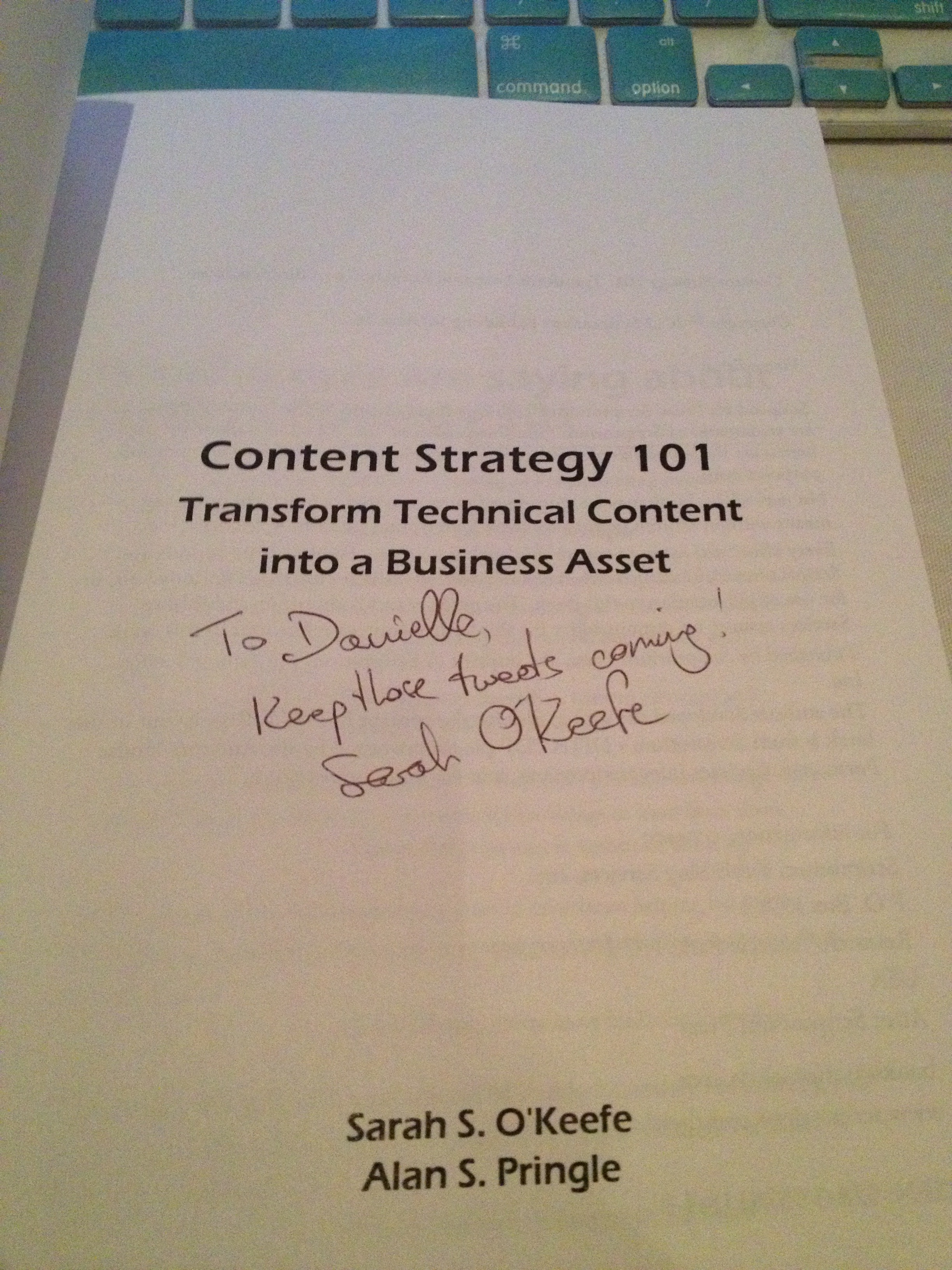
The autograph from my copy of
Sarah O’Keefe’s book,
Content Strategy 101.
Awesome!
Posted in Uncategorized

Adobe Day Presentations: Part IV – Val Swisher asks, “Are You Global Ready?”

Val Swisher
of Content Rules, Inc.

Following a short break after Joe Welinske’s talk about Multi-screen Help Authoring, Val Swisher took to the stage.

Val is the founder of Content Rules, Inc., and she spoke about eight simple rules for technical communicators to follow to make content global-ready–now! Her specialty is doing translation work, so she knows a thing or two about making content ready for a global market. As she went through each rule, she would explain the impact of the rules and why the rules were in place, although some were self-explanatory.

The rule she listed were as follows:

Rule 1: Not all errors are created equal. Some can cost you thousands of dollars!
This is one of those obvious rules. Taking the time to write content carefully as well as making sure proper editing is done is a necessity. Even one small typo can make a difference.

Rule 2: Creative Writing is a myth. Standardize.
Val’s point with this rule is that superfluous writing is not necessary. Keeping content clear, concise, cogent and correct is especially important in translation, and allows for better reuse of content.

Rule 3: Real copy editors don’t do it without a terminology manager. 
It is vital to use the same terms for certain words, especially for translation purposes. For example, the words “puppy”, “dog”, and “canine” all refer to the same animal, but are clearly different words, even though they essentially mean the same thing. In translation, there are times that this much word variation for a single item isn’t available in a different language, so choosing one word as the referential term is recommended. It keeps terminology within the content–especially if reusing content–consistent.  Style guides are, unfortunately, not followed as often as they can be. A system is needed to manage terminology and help prevent problems like this example from occurring.

Rule 4: Have you got translation memory (a translation database)? Your vendors do. Use it. It keeps content standardized and saves money.
This is another fairly self-explanatory rule. I was not aware, since I’m not in the translation business, that there are such things as translation databases. From what I could understand how it works (and someone please correct me if I’m wrong), a translation database has features that when a specific turn-of-phrase is used on one language, there is a specific translation for that combination of words into another language. When a translation is done, the database looks for that word combination and translates it accordingly. This, again, allows for consistency in translations between the different language editions of content.  As a technical communicator who does translations, Val is saying that if you don’t have such a database in place, you should have one because in the long run, it will standardized content and save money.

Rule 5: Don’t complain about quality of your tech writers. You agreed to outsource docs to ___ in the 1st place.
Val pointed out that while there are good outsource resources for writing and translation out there, sometimes the quality is not as good as keeping it in house or closer to home, especially if the content is written by someone whose first language is not English. Good quality source material is key! Having good quality source material helps control costs, especially with translation!

Rule 6: If you write flabby copy, even the nicest vendors will email you a bill for localization that will astound you.
Again, this comes back to having quality content in place. Val’s point was that if you do write weak content that is difficult to translate because it is not quality content, even one’s best clients will send you a bill for the translation for localization purposes, and the bill will be VERY HIGH. Again, having quality content saves money!

Rule 7: Get rid of extra adjectives and superlative words! Delay this product launch, and there’s no next product launch.
This rule is a strong recommendation related again to how content should be written. The use of extra adjectives, adverbs and other superlative words do not enhance the content. Using such words that have to be rewritten or translated can delay a product going out, and for a client, that can be a deal-breaking move. By delaying the product due to not meeting a deadline due to overdue time for translation, and there will be no next time being able to help with a product launch. Obviously, that would be bad business.

Rule 8: Translation is a team sport. You want to work alone? Become an accountant.
While this rule elicited a laugh from the audience, it was a point well taken. Teamwork is KEY! A better source of English content will result between source writers and translators if they work together.

Val was asked the question at the end of her presentation, “What alternative tools for style guides are on the market?” She responded that there are lots of software tools out there, but to be careful about push technology within those software items.

More information can be found at Val’s website, http://www.contentrules.com  and her free e-book is available by e-mailing her at vals@contentrules.com.

I found this presentation rather fascinating, especially since Val presented it with a sense of humor. But her point was clear. Content needs to be as precise as possible when it will be reused and especially when used in translation for consistency. By following her basic rules, costs can be controlled, and the quality of the content can only get better.

I thought about what it takes to do translation, searching my own memory banks from when I almost minored in French during my undergrad years and had to do translations, to the present day watching my husband translate literature written in German to Spanish for a group he’s been involved with for years, to my own struggles to translate what I want to say to my in-laws into my broken Spanish. Translation is not an easy task, but when thinking about translating my English thoughts into another language, it can get tricky because of the turn of phrase or colloquialisms used from area to area. Even in talking to my husband about the topic, he will say that there are different idioms used between Spanish speaking countries, although Spanish will still be relatively “standard.” Being from Ecuador, he can still understand someone from Spain, Mexico or Argentina as much as an American can understand someone from the UK, Canada, or the Australia. But I’ve even found in my own teaching of a business and technical writing course to a corporate group in Asia is that English taught globally is not consistent due to the source English being from different countries, so I have to go and set the record straight.  I can certainly appreciate where consistency and choice of words can lead to better quality content and communication in the long term.

The next presentation, and the last in this series: Adobe Day Presentations: Part V – Mark Lewis and DITA Metrics.

Posted in Uncategorized

Adobe Day Presentations: Part II – Sarah O’Keefe and Content Strategy

Sarah O’Keefe
of Scriptorium Publishing

After an energetic first presentation by Scott Abel, second presenter Sarah O’Keefe, author of Content Strategy 101 and founder of Scriptorium Publishing, talked about “Developing a Technical Communication Content Strategy.”

Sarah started by telling us that many companies don’t understand the value of technical communication, so technical communicators need to justify their approach. When writing up business cases for these justifications, technical communicators need to include what the current situation is, recommendations to improve the situation, costs associated with those recommendations, as well as the benefits and risks of taking the actions recommended.  If there are regulatory and legal requirements, then there is the need to build a case for more efficient compliance in order to avoid legal complications.

Sarah expounded on how technical communication departments should talk to management about how technical communications can control costs. She explained that there is a myth that cheap documentation can be done. She busted that myth by explaining that cheap documentation is actually more expensive, as it can be limited in availability making it useless, it can be hard to understand and out of date, and it may not be translatable into other languages. The cost of bad content is high customer service volume,  lost sales, content duplication, huge global costs, and it can contradict marketing communications.

The solution, she said, is efficient development involving the reuse of content, using single sourcing and cross-departmental reuse of content, only tweaking text that is already available. She stressed that formatting and production are important! Using templates and various structures are helpful. She encouraged using tools for creating the needed output.  Sarah also said that localization is important as well, that translations are needed component of communication documentation. All these can help bring costs down significantly! Sarah gave an example of how a common obstacle to efficient customer service or tech phone support is often a monster-sized PDF that the support representatives need to read before providing service while on the phone! The process of having to read the long document while online with a customer is time consuming and not cost efficient.

Sarah encouraged technical communicators to work on collaborating and creating better working relationships with other business departments such as tech support, training and marketing with technical content, as this will help to support those departments with pertinent information as well as help them to streamline information. Technical communication can be used to support sales–read documentation before you buy! Technical communication content also can help to increase visibility by creating searchable, findable and discoverable documentation,  especially for Google or SEO purposes. Sarah recommended building user communities with technical communication documentation, and making sure that technical communications aligns with business needs.

Sarah has further information which goes into greater detail both in her book, and on the book’s website, which is found at: http://www.contentstrategy101.com .

Sarah’s presentation was really good, in my opinion, because coming from my own experiences, much of what she explained was true, and as she said, the biggest battle is making management understand the value of having solid content strategy. One of my biggest issues at my last consulting job was exactly the scenario that Sarah described; marketing was not taking proper advantage of the technical communication documentation available, nor was it sharing resources and creating reuseable content. As a result, in-house documentation was long and overly customized when much of the information was the same or very similar (needed few tweaks), and the sales advisors that needed the information rarely looked at it because it was too long. When I made the recommendations about reuse or editing from a technical communications standpoint, I was ignored. Of course, I was only a consultant, and I wasn’t privy to understanding the departmental costs, but it did not feel good to know that some of the issues could be fixed with the kind of collaboration that Sarah described. In this respect, I could associate with what she was saying.

An aside note is that Sarah is a self-confessed chocoholic, and a fun part of her presentation was that she incorporated chocolate production into her presentation. To verify her chocoholic status, I was out with Sarah after the event, and caught her in the act of buying more chocolate at one of Portland’s chocolate boutiques:

Sarah O’Keefe buying more chocolate for inspiration!

I do think Sarah’s message is very clear. Technical communications has a lot of value, especially with structured content and reusable content, and as technical communicators, we need to push that agenda to management so that we can provide a bigger service to our clients and companies that they currently realize.

(Sarah–feel free to correct any of my interpretations in the comments below!)

Next post: Adobe Day Presentations: Part III – Joe Welinske and Multi-screen Help Authoring

Posted in Uncategorized

Missed Adobe Day at LavaCon2012? Here’s the scoop…

One of the “Three Sisters” mountains
outside Portland
(don’t know which one–took this from
my airplane seat coming home!)

As I write this, I am still recovering from quite the whirlwind of a weekend! I flew out to the West Coast on Friday night, and returned to the East Coast on Sunday.  I met SO many people who are not only leaders in the technical communications field in one capacity or another, but they are also nice and SMART people in the field. You couldn’t help but be inspired or feel smarter once you walked out!

Now granted, this was the first time I ever attended a conference-type event within the tech comm field, so I was excited to be there and soak everything in as much as I could. This is not to say that I’ve never been to a professional conference or travelled to this type of event; I just never have done it with the tech comm crowd.

Like I said, for me, at least, as the “new kid on the block”, I didn’t know exactly what to expect of the event, the topics, or the people I would encounter, and I’m glad to say that everyone was very welcoming to me, and I felt included as a fellow technical communicator very quickly. It was a little surreal in some instances, because many of the people I met were those whom I had only met online through Twitter or Facebook–Twitter mostly, so to be among such a collection of established tech comm thought leaders could have been a lot more intimidating, but it was not that way at all.

There was so much great information that came out from the morning that I will be splitting up my report over the next few days. Each day going forward will have my summary about each speaker at the event. And I have some photos as well!

So, let me get started into the Adobe Day event itself –with some photos!

Saibal Bhattacharjee (@saibalb79) from Adobe setting up.

The Adobe Day event started with an introduction from LavaCon organizer Jack Molisani welcoming everyone to the event. Jack, thanks for organizing and running LavaCon! Although I’m missing the main conference, I’m hearing awesome stuff about the speakers on Twitter, so I think you deserve some kudos for helping to assemble all of it!

Jack Molisani

Jack was followed by a short introduction and welcome by Maxwell Hoffmann, who is one of the key players of Adobe’s Technical Communications marketing team. If you’ve ever attended any Adobe Tech Comm webinars, more than likely you’ve heard Maxwell moderating the webinars. He is also one of the bloggers for Adobe’s Tech Comm blog. Having worked with him while creating my own webinar for Adobe, I can say that he does a fantastic job at what he does.

Maxwell Hoffmann of Adobe

One thing I’d like to mention, before continuing, is that the nice thing about Adobe Day was that is wasn’t actually about Adobe or promoting Adobe products. I don’t recall during the entire duration that any speaker promoted any Adobe product or the brand other than possibly to thank the company for the opportunity to speak. All the speakers spoke broadly about technical communications as a whole, so whether one supported Adobe products or not, everyone could benefit from the information being provided.  This really was a collective presentation of the best and brightest in thought leadership, and an opportunity to network and learn from those who are considered top in the technical communications field.

Now, for this post, I’m actually going to start this Adobe Day series going backwards in the day’s event, starting with the panel discussion that was at the end of the morning.

The panel topic at the end of the Adobe Day event was titled, “The Decade Ahead: Opportunities and Challenges for Technical Communications Professionals.” Scott Abel, who is also known as “The Content Wrangler,” moderated the panel.  The panel included several of the leading thought leaders in the tech comm industry. The panel consisted of Joe Gollner, Beth GerberBernard Aschwanden, Joe Welinske, Val Swisher,  Sharon Burton and Joe Ganci.

Adobe Day Panel.
L to R: Joe Gollner, Beth Gerber, Bernard Aschwanden, Joe Welinske,
Val Swisher, Sharon Burton, and Joe Ganci

As far as the opportunities in tech comm right now, Sharon Burton said it best when she exclaimed, “We are in the Wild West!” meaning that the field is still so very wide open that anything done right now would be in the pioneering spirit. Another point that Sharon summarized was that 99% of the content consumers are not happy with the tech comm content they are receiving, and so a revolution is brewing. It was agreed by all that so many new ways to deliver content are out, such as using audio, video, shared content, personalized content and mobile content. The choices are limitless and there is so much to explore that there is room so that we can all contribute! Interactivity and structured content will be key to communicating information as well.

That said, the group presented the challenges ahead, which included providing technical communicators with an education on understanding all the available possibilities, combating management’s misperception of cost, the general resistance to progressive change, business models still tied to old metrics, and too many tech comm specialists instead of tech comm generalists. An additional challenge mentioned dealt with the relationship that technical communicators have among themselves as well as to the rest of the world. It was suggested that technical communicators are not creating appropriate relationships with other business departments, and need to be proactive in business affairs to prove the value of tech comm as a whole and how it integrates with other business needs, thus providing a good ROI (return on investment). When the panelists were asked what skills were needed to go forward, they replied that the need to create communities to support each other and learn from each other was key, which could be done through such activities like participation in branding and discussion on the Twitter website with other technical communicators.  Bernard Aschwanden did comment, “People are not lazy enough!” which elicited a laugh. However, his point was that in this day and age, people just want more direct route to complete tasks, and community building was part of that.

Nolwenn Kerzreho, another attendee at Adobe Day, noted on Twitter during the discussion  that “[T]ech writers need to change, have to get an education in structured writing and writing for a global audience…Key is that needs to be promoted…everywhere!” Good point that I missed noting on Twitter myself, Nolwenn!

In other words, the panel felt that while this is a time with a lot of changes due to technological advances with plenty of opportunity to use different kinds of content to deliver information, there are still obstacles in the way that prevent those opportunities from coming to fruition. However, those obstacles aren’t anything that can’t be conquered over time. A big part of making these opportunities happen will be adopting the use of structured content and community building.

Now, if this was the caliber of the discussion just for the panel at the end of the Adobe Day event, then you can only imagine that each of the presentations before this were equally great as well, and why I’ve come back with renewed enthusiasm.

I’ll also just add here that I had the chance to meet SO people that I had only met through social media or featured in various technical communications media. It was like a parade of tech comm stars to me, and I was a little in awe to be among them! I enjoyed meeting so many people who really enjoy what they are doing and trying to make a difference in this field.

Waiting for Adobe Day to start!
Me and Kyle Johnson of Rocket Software
(photo courtesy of @barriebyron, also of Rocket Software)

I also have to say that in addition to Maxwell Hoffmann, I met others from the Adobe team as well, including Saibal Bhattacharjee, Ankur Jain (the Robo(Help) Cop!) and Tom Aldous. They did an excellent job putting this event together, and I appreciated their kindness and support in having me there to attend. I felt so welcomed! I was really happy to meet them in person after so many months of corresponding through Twitter or email.

I’ll be going through each presentation given prior to this panel in the next several posts over the next week, and I know you will find the information as educational as I did.

Next post: Adobe Day Presentations: Part I – Scott Abel and Structured Content.

PS– To anyone featured in this post or who attended this event, please let me know if I need to append or correct anything featured in this summary or in the future posts on the presentations. I am working off my “notes” that I tweeted during the event, so my recollection may need some tweaking. 😉