This is another installment of my “Blast from the Past” entries originally posted in my academic blog. This one comes to us from May 8th, 2010– almost exactly two years ago! It’s interesting to read that some of these issues are still relevant today– what have you done to learn or use HTML 5 and CSS3? I admit, I while I still do have some understanding, I think I need more. Even Adobe has gotten up to speed with their release of their Edge product, so it proves that things are moving fast!
–techcommgeekmom
One of the things that I think is critical to technical communication is the emphasis on the technical. After all, talking one-on-one in person is communication, and there’s been communication since cave people bonked each other on the head with clubs. Technology has always been emerging over the centuries. Just last night, during my son’s Cub Scout meeting, the denner was giving a presentation about electricity, and mentioned the invention of the telegraph. It occurred to me, and I brought it to the attention of the boys, that the telegraph was probably the first form of e-mail, if you think about it.
So, fast forward to today. I came across this article, which talks about the future of web-based coding languages:
It basically talks about the history of HTML and CSS, and the next generation of these web development codes. I already have a general handle on these, since I’ve not only had to work with these codes professionally, but also had to revive my skills and learn CSS in order to create my e-Portfolio for PTC 601. So, does this mean I need to learn a new set of codes? What kind of adjustments need to be made for HTML5 and CSS3? Time will tell if and how I will learn more about these codes. Hopefully I will so I can stay on the cutting edge of things.
How does this relate to technical communication? Well, someone will have to write about it and tell how to use it. Additionally, part of being a technical communicator is not only creating the communication itself, but actually knowing how to put it out in the world, be it by webpage, fax or printed document. HTML5 and CSS3 are part of that, so it’ll be important to start to learn about these new technologies. If it means that being able to post animations and video without specialized players (like Flash) into any browser that supports HTML5 and CSS3, then that’s actually a GOOD thing. Apple has been embracing it since they don’t want to use Flash or other players, for example. This will open up a larger arena for the world, by removing some limitations that make things more readily accessible.
So, you need to allow this geek girl here her excitement into technology geekery. This is part that makes technical communication fun, at least for me.
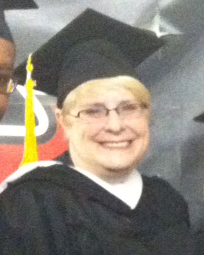
Today was a big milestone day in my life. Today, twenty-two years after I received my Bachelor of Arts in History from the University of Mary Washington (Mary Washington College back then), I received my Masters of Science in Professional and Technical Communication from the New Jersey Institute of Technology (NJIT). Let me tell you, if you had talked to me at the time of my Bachelors degree and told me that a) I’d be getting a Masters degree and b) it would be in a program that involved computer related stuff and technical writing, I would have thought you were insane.
I put two and a half years of my life into this degree. There was blood, sweat and tears that were involved now and then (literally, in some cases!). My husband was a weekend widower for most of that time, and my son understood that Mom had to do her homework too, and it was way more than he had because she was anywhere from in the 17th-20th grades (compared to him being in 5th grade).
I started this program because I was unemployed. I was being laid off from a job that had certain aspects I liked, namely editing and the use of instructional design. I also had some e-learning and some instructional design from a prior job that I liked, so I decided to “work the system” in seeing if I could find some sort of coursework that would help to update my skills as job retraining through the state’s re-employment programs. By a miracle, there was an ad on Facebook–of all places– for NJIT’s MSPTC program and the grad certificates in technical communications essentials. When I looked at the curriculum, it was exactly what I was looking for, and so many of the electives that I wanted to take! I was able to complete all the paperwork and convince the state to pay for my tech comm certificate. I started with that, because I figured that it was a shorter commitment, I would still get some significant training out of it, and if I didn’t like it, I wasn’t stuck in it for the long haul. And if I did like it, I could always transfer the credits straight into the Masters program.
Well, you guessed it– I ended up loving it. The state ended up paying for my first three courses until I got a job that allowed me to pay for the rest of my education myself, which was an incredibly expensive investment. I took as broad a range of subjects as I could, but found myself always gravitating towards e-learning and m-learning just the same. I oriented many papers to cover e-learning and m-learning topics over time, yet kept my options open so that I had more opportunities to not only expand my own knowledge base, but provide opportunities in other areas I liked in case the e-learning direction didn’t work out the way I wanted.
And now…I have a Masters degree. I think there was a point in my career that I knew I wanted a Masters degree, and that perhaps a Masters degree would help with my career– but doing what? The problem was that the kind of degree I wanted to do wasn’t around the way it is now when I first got my undergraduate degree. Creating websites was strictly for computer developers and programmers, and I wasn’t that. I wasn’t an English major who specialized in creative writing or journalistic writing either. Not that there’s anything wrong with those majors–not at all, but they weren’t me, or at least not quite me. Discovering the world of technical communication when I did and finding an educational resource when I did was purely fortuitous timing, if nothing else, but I’m glad it’s become part of my life.
I seem to recall that the advisor for the program said something about me in reference to this program to the effect of it being something where I learned about my own voice. I think this is definitely true. Growing up, and even through my undergrad years, I thought being a good writer had to do with being a “flowery” writer, someone who always included all these incredible details in their works. I couldn’t do that. Part of the reason that a History degree appealed to me was that I just had to collect and re-churn out facts in a cohesive manner. Even with that, I didn’t understand that I could do that well until my senior year of college, when my favorite professor motivated me to write some of my best work of my college career. Some of the papers I did for him that I thought were horrible were ones that he thought were my best. When I re-read them years later, I realized what he was saying– they were good. Maybe I really was someone who could write decently.
I think the understanding that I could write well was developed more as I winged my way through my professional life, but it really didn’t become clear until I joined this program. I did find my voice, and I could express my opinion, and…people listened. People understood my message. And people thought I explained myself well, and liked the work that I did. I sometimes am still surprised that I was able to pull this off. But yes, I found my voice, and I found what makes me excited in the working world, and that’s technical communication with an emphasis on e-learning and m-learning the most. (But get me started on editing “International English“, UX or content strategy as well, and my engines get revved up as well!)
Today is a big day. Today is a day I realized that I can make a big contribution to global society just being myself and truly doing what I love. I know that even with a Masters degree in my hand, I still have SO much more to learn to realize my full potential in the e-learning and m-learning world, and I’m doing my best to take what I’ve learned from my MSPTC program and move forward. And I don’t mean just academically, but what I’ve learned about myself from the experience as well.
In my last post, I talked about how important it is right now in the technical communications world to keep up with skills and teach yourself new things. The world is moving SO fast that it’s hard to keep up, even with a brand-spanking new graduate degree in hand! Even as I write this, while it might seem like I’m done, I’m far from done. I’m trying to take some online tutorials in Adobe Tech Comm Suite 3.5 software, and I’m throwing myself into an instructional design project. I need to get my feet wet in the real world, and I have to keep it moving or else I’ll miss out or fall behind quickly. Even if your goal is not getting a Masters degree, I highly encourage you to challenge yourself with something new. The ID/TC Education Resources link above is a list of programs that I curated to help others to find additional education to help further their careers as well. I found that NJIT’s MSPTC program fit my needs at the time I started, but I’ve since learned of some other great programs that are listed on that page. You might learn some new skills, but you might also learn more about yourself in the process.
Other than teaching myself more software, are there plans to continue with, say, a doctoral degree? While I would love to be known as “Dr. Villegas,” I think I need some time and space to still fully realize this MSPTC degree. It hasn’t sunk in that I have it. It still seems a little surreal. I also need time to figure out, if I do go on with further education, if it only is a matter of getting another graduate certificate, or if a PhD or EdD is what I want to do. And then…in what, and how? Perhaps, like 22 years ago, the program I want or need isn’t out there yet, so biding my time will help.
Tomorrow is a new day, and a step towards a new future as a master of technical communication. It’ll be interesting to see what happens next!
My techcomm, m-learning, and e-learning friends–I need to advise you of a painful truth about the world. It’s rough out there. The world economy has been such a mess for the last five years or so, and it’s been slow to recover from the bad times. At least from my own experiences, I can say that just in the last three and a half years alone, I was laid off, unemployed, working, then laid off again to now where I’m semi-working (working part-time, just finished school) and have a few projects, but nothing that’s long term as of yet. In other words, it’s a jungle out there, and I know from first hand experience that technical communicators need to be survivalists out there, like Bear Grylls or Les Stroud (SurvivalMan). Just like those on that show, “Survivor,” we need to outwit, outplay and outlast others to stay in the game. One has to start thinking out of the box as to how to continue in the world as a technical communicator.
Within the last two days, I encountered two things that addressed this very notion. The first was an article by Miriam Lottner, who writes the Documentation Management and Technical Writing Blog for Tech-Tav Documentation, Ltd. in Israel. She wrote an article called, “Getting to the top and staying there” that addressed the issue of technical communicators looking for jobs where she lives. As someone who contracts technical writers herself, she addressed what she looks for and what she feels are skills that are needed to get ahead today in the technical communications field. She recounted a story of being able to place a person for a very specific project because they had skills that others did not have. The main point of her article was that to stay ahead, one needs to push away the obsolete skills that nobody wants to know anymore, and brush up on or learn new skills, because technology is always changing. She even mentions that she is in the process of writing a book about HTML5 to help other learn and get ahead. (I’m looking forward to getting a copy! I’ve had the pleasure of meeting and talking to Miriam on Skype, and she’s a sharp cookie who loves techcomm, so I’m sure the book is going to be fabulous!)
Fast forward a day, where I was at the home of a fellow member of the Society of Technical Communications (STC-Philly), along with some other local NJ members, and we sat together to listen to a virtually shared meeting presented by the STC-NYC chapter. The NYC chapter was having speakers Ross Squire and Donna Timpone present a talk called, “Technical Communications: Your Annual Career Tune-Up.” It was an interesting presentation, because while there were great tips to remind those who were participating about making networking connections, it was emphasized that with technology moving so quickly these days, it really benefitted technical communicators to get out and learn new skills. Going back to school or taking an online course on something new was encouraged to not only boost one’s skills and provide someone with additional experience that could be brought into a new job, but the use of social media to make networking connections was also important. Being passive doesn’t work anymore if you are looking for employment of any kind, whether it’s to move up or just find something at all. Staying on top of the game is what is key these days. A key point to Ross’ and Donna’s talk was that e-learning and m-learning, both in acquiring information and putting out information was going to be vital. In other words, being on both the receiving and sending sides and understanding those roles will be crucial. Understanding and participating in social learning is highly important. In other words, if you want to play the game, you have to start gaining the survival skills.
In reading Miriam’s article, and listening to Ross and Donna, I felt a certain satisfaction knowing that in many respects, I’m on the right track with getting my own career started. Less than 3 years ago when I got laid off the first time, I started taking matters into my own hands by starting with my online courses for a graduate certificate in technical communications essentials. I’m glad I kept up with my classes, because now I’ve been laid off again for a while, but I’m about to graduate with my Masters degree in technical communication, and after looking at trends and issues in techcomm, e-learning, and m-learning, I feel like I’m ready to get out there. It may be a little rough and bumpy sometimes, and no doubt I’ll be on my own to struggle to survive, but I believe I have what it takes, and I will be a tech comm survivor. Heck, while I’ve finished my classes and have yet to still get my Masters degree in my hands in a few days, I’ve already started boosting my skills set with learning some new software that will be coming in handy as I move forward with my career in the near future. Learning never ends. If I hadn’t taken some courses or taught myself other IT skills years ago, I wouldn’t even be where I am now.
(Addendum: Look above at the ID/TC Educational Resources if you are looking for some ideas of further e-learning, m-learning or tech comm learning!)
The Boy Scouts have among their important mottos the saying, “Be prepared.” This is so vital these days.
So, do you have what it takes to be the Bear Grylls of technical communications? If not, you need to do some boot camp training soon….
Today’s entry from the TCGM grad school archives is from April 2010, when I was still a tech comm fledgling. Note the reference to Walter Issacson towards the end of the entry. His name might be more familiar to us now, as he is the official biographer of the late Steve Jobs, and whose book came out just after Jobs’ death last fall. I have always been a history geek, so it was fun to try to make this connection back then (and I still stand by it!)
So what do you think…would ol’Ben here have been an m-learning advocate? Knowing his love of communication and technology, as well as his avid promotion of literacy and education, methinks he would’ve totally supported it!
On a night when I finally felt mentally and physically exhausted enough to take a break, I found my husband channel surfing on TV. (Now that we have an HD-TV, he’s on it a lot more than he used to be.) Among the channels that he does like to watch– and I do too, is the History Channel in HD. Last night, I think the show was Modern Marvels, and they actually had the whole episode dedicated to the works of Benjamin Franklin. Now, I’ve always had a slight soft spot in my heart for Ben Franklin, ever since I was in about third grade, and read my first biography about him, and knowing that he had strong ties to Philadelphia, which is the city I most associated with when I was growing up (even though I lived halfway between New York and Philly, Philly has family and that was the “culture” I was oriented around.) This was recently revived with a trip to the Franklin Institute with my son.
Anyway, I didn’t catch the whole show, and of course, my husband would be channel surfing during commercials, but from what I was catching of the program, which was towards the end of the episode, they were talking about Franklin being ahead of time on many levels–which he was–and how he was a big player when it came to eighteenth century communication and science. We know that Franklin was the one who was a newspaper printer, a philosopher, a statesman, a politician, and a scientist. But the thing that ties all those other elements of this post-Renaissance man is that he was a writer. He was a prolific writer, in fact, writing everything from the contents of the Pennsylvania Gazette, to books about philosophy, and writing letters and documents that helped to form the United States and its diplomatic ties. He also opened up the first public library in the United States, specifically the Library Company of Philadelphia, whereby patrons could join for a small fee and share the books in the library, for the purpose of learning and being able to exchange ideas.
The author Walter Issacson, who wrote a biography about Ben Franklin, was one of the commentators, and he was saying that if Ben Franklin lived in this day and age, he’d be loving it! With this being the digital age of email, computer communications, cell phones, Twitter, etc., Franklin would’ve been totally in his element, as he was all about the latest in science and communication, and for a guy in his time, he was on the cutting edge of such things. Part of a segment I saw talked about how Franklin was the first one to help devise the concept of watermarks and other security devices to protect the manufacturing of money, some of which are still used today. It was also mentioned that if Franklin had a new way of doing something or a new invention, he always shared his ideas and how he did them, with the exception of this currency security printing method, understandably. So, that makes me think that perhaps with all the cool inventions and discoveries he made, and considering that he was both a scientist AND a writer, that sharing that information made him the first American technical communicator.
What do you think? It’s a pretty good theory, anyway. 😉
Okay– I didn’t get a Webby Award. How could I? I just got started here. However, I’m feeling like a movie star right now, because I’m very excited about an opportunity I’ve been given–and yet never expected.
Do you remember, when I first started this blog, that I wrote a blog post talking about needing to learn about tech comm and e-learning tools of the trade? It was basically a rant about the importance of new technical communicators coming out of schools or learning program needing to know some of the tools of the trade, even if it’s an old one, and it doesn’t matter which one, just so the tech comm student can get a basic foundation? I still feel rather passionate about that. In a good program, you are often given really great skills that you almost don’t need to know the tools, as theoretically, as long as you have the aptitude to do great technical communications, the tools will come later. I agree with that…however, it’s not realistic in today’s job market. Speaking personally, I know that I can learn lots of software applications pretty quickly, but I just need to be shown how they are used first– that’s all. And I know that my technical communications skills are solid. The problem is that right now, job descriptions are very specific in letting applicant know that they want this software package or that software package. If you don’t have any skills for using any of the software package in that genre, you are out of luck. I recently applied for a position, and I was told that they wouldn’t accept my application merely because they were fairly strict on a person having X amount of years on a particular software package. And this was even though I was totally qualified on all other fronts for this position.
Anyway…you get the point…back to our story…
Well, lo and behold–and little did I know–what kind of doors that blog posting would open. Shortly after that posting, I was contacted by Adobe, who surprised me by letting me know that the Adobe TCS team had read the blog post. They liked my writing style and what I had to say here–which for a new e-learning commentator, is definitely encouraging! They also let me know that they do their darndest to get the Technical Communications Suite software out to academic technical communications programs out there, and are working on adding more schools all the time. (Good news for future technical communicators!) .
So after some back and forth conversations through global email, Twitter, Adobe Connect and good ol’ telephone, I am thrilled to announce that on 5 June 2012 at 1:00 PM EDT/10:00 AM PDT, I will be the presenter of an Adobe webinar titled, “Transition from Content Consumer to Content Creator: Dual Viewpoints.” Here’s the webinar description:
The technical communications world is changing quickly with technological advances. It can be a difficult transition from content consumer to becoming a content creator. If you are new to the technical communications field and trying to find some direction, how do you make that transition and learn the tools of the trade? Join technical communicator Danielle Villegas, who blogs and tweets as TechCommGeekMom, as she discusses the challenges of being a content manager, pursuing a professional course in Technical Communication, and moving ahead in a technical communications career. Danielle will concentrate on content for mobile devices while sharing her first hand experiences learning about the most desired skills. She will be discussing how visual and web design, technical writing and editing, and content management skills come together to create good technical content.
I am truly honored and thrilled with this opportunity that Adobe has given me! Many thanks to them, again, for the opportunity!
OK, so it’s my first webinar and all, and I’m sure I won’t win a Webby Award for it, being that it’s my first time out of the gates, so to speak. But it makes me feel like a movie star for this brief shining moment, and I can’t wait to share my experiences and thoughts with the tech comm audience out there!

 This is another installment of my “Blast from the Past” entries originally posted in my academic blog. This one comes to us from May 8th, 2010– almost exactly two years ago! It’s interesting to read that some of these issues are still relevant today– what have you done to learn or use HTML 5 and CSS3? I admit, I while I still do have some understanding, I think I need more. Even Adobe has gotten up to speed with their release of their Edge product, so it proves that things are moving fast!

 My techcomm,

 On a night when I finally felt mentally and physically exhausted enough to take a break, I found my husband channel surfing on TV. (Now that we have an


 TechCommGeekMom
You must be logged in to post a comment.