Posted in Uncategorized

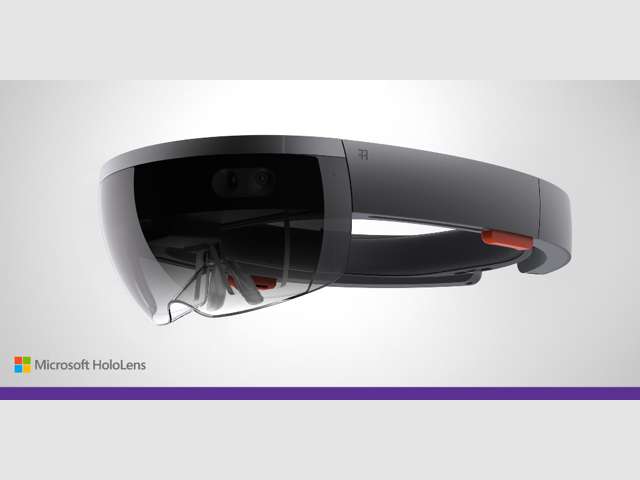
Move over, Google Glass! HoloLens is here!

http://recode.net/2015/01/21/microsofts-hololens-makes-the-leap-to-holographic-computing/
Photo courtesy of Recode.net

Today, I tuned in to listen to the Windows 10 event that was to promote more about the upcoming new OS that many are anticipating will be a big improvement over Windows 8 and 8.1. While I’m a huge fan of iOS products like iPad and iPhone, when it comes to my laptop, I’m a devoted PC gal who would much rather use the Microsoft operating system and tools. I suppose it’s because this is what I’ve been used to for 20-plus years, and it’s easier for me to adapt those changes, and more of the tools I like to use are available for PC use. Yet, while I’m usually a relatively early adopter with many things, I’ve been very hesitant to adopt Windows 8 or 8.1. There are some improvements with Win 8.1, but when I first encountered Win 8, I balked.  So, time will tell what happens once we all get our free upgrades to Win 10 (which is great–it’s going to be free for the first year of availability to Win 7 users like me, and to Win 8/8.1 users). There was a set of business apps called Surface Hub that looked good that combined OneNote with a digital whiteboard and provided new sharing capabilities for workgroups and meetings. I could see the practical uses for that in my own work right now.  The new browser called “Project Spartan” looks incredibly promising as well, based on some of the new functionality that will be forthcoming.

But what REALLY caught my attention in this event was the introduction of a new device that Microsoft introduced. I think it was a bit of a surprise to see this, but it is a sign that Microsoft means business, and to me, it’s a positive sign.  Microsoft has created a new device called the HoloLens. And from what I could tell, HoloLens is everything that Google Glass wishes it could be. While the viewing apparatus used is certainly more…clunky looking…than Google Glass, everything else about it (and why it’s probably still clunky looking) is what it has going for it. There are no wires, no synching it with your phone–it is an autonomous device unto itself. The connection with today’s Win 10 event is that it will run Win 10, but it showed how people can interact with the world around them, and still use the holographic tools around them to merge reality and virtuality. It’s difficult for me to describe, but the 3D imagery used was fantastic, and they showed several applications of how it could be used more practically with other people–including those who don’t have a HoloLens.

I think the biggest difference of all–other than the fact that this is a device that acts on its own, with its own processors among other things, is that unlike Google Glass that was being promoted as a device that could be used as a tool and for everyday use, HoloLens seems to be promoted solely as a tool. Now, it can be used for gaming and such, but the tool applications were what really made it stand out more than anything. My husband and I were using Skype and exchanging comments while watching the live streaming video, and when we were commenting about the differences between HoloLens and Glass, his comment was, “…but this is built as a tool.. you can see the size. It’s not meant as an accessory.. it’s actually a tool.” He’s exactly right. This isn’t a novelty item with potential for greater capability. It has the greater capability, but it’s not an accessory.

I recommend reading this article by The Verge that includes great video and further description of the product. 

I don’t think this is the type of thing that I need right now, even when it comes out. I don’t have any practical application. But I could see how this could be used in several years once the components do become smaller and I can use it as an accessory. (Give it time!)

What do you think? Do you think this is the next step of merging the virtual world with reality? Sure looks like it to me. Post your comments below.

Update: When I mentioned the new HoloLens to my son, he asked me, “Are you sure they aren’t just ripping off Oculus Rift?” Good question. I don’t think so, because HoloLens lets you see through to what’s actually around you, whereas Oculus Rift is contained in its view. Tell me what you think.


Posted in Uncategorized

My response to RJ Jacquez’s question: Will Tablets replace PCs?

Recently, due to the upcoming release of Microsoft’s Surface machine, RJ Jacquez released two blog posts promoting the idea that tablets, in time, will indeed replace the PC as we know it, and that Microsoft is going in the wrong direction with this Surface device. Between his post titled, “For the sake of ‘Mobile’ I hope Microsoft Windows 8 and the Surface Tablet fall short” and Tablets Will Replace PCs, But Not In The Way You Think, he says that he feels that Surface is not taking us forward because it embraces the idea of adapting our devices to old software, instead of moving forward with mobile devices and rethinking how to create new productivity software for these new tablets that can make users more productive.  After paraphrasing several articles that have been out in the press that claim that productivity apps such as Microsoft Office, Photoshop, and Final Cut Pro (to name a few) are items that need to be addressed by the tablet industry, he counter argues,

Personally I think that most of these articles miss the bigger point, namely the fact that most people think that Tablets replacing our PCs will require a 1:1 task-replacement approach. I don’t buy this argument….In other words, we are currently shaping our mobile tools and soon these amazing devices, along with the incredibly creative apps that accompany them, will shape us and redefine every single task we do from here on out, including learning design, image editing, web design and yes every productivity task as well.”

I understand what he’s saying. If I’m interpreting him correctly, his argument is that devices like Surface should not be adapted to run bloated “power” software that needs the extra storage and peripherals to work, thus making the devices less mobile, but rather software should be streamlined to become more efficient so it can run in a tablet like an iPad which doesn’t need extra storage because it relies on the Cloud nor does it need any other peripherals to function. Some of the other “power” apps that RJ mentioned that critics think would need PC power include Photoshop, Microsoft OneNote and Avid Studio.

Well, I do have to agree with RJ insofar as I think that mobile is the future, and it is forcing us to really look at software and its limitations, and it’s making us think about how to streamline processes and our needs. mLearning is in the midst of a huge revolution due to that mindset right now. And actually, there are tablet versions of Photoshop, MS OneNote, and Avid Studio available for tablets that cover most of what users need. So it’s not like these kinds of software can’t be adapted for most people’s uses.  The average user does not use Word or Excel or Photoshop or other apps the same way as a power user, so streamlined apps are fine.

However, I think there may be a need–at least for a little while longer–for PCs to still exist for other kinds of “power” uses. The first thing that comes to mind are apps that are not as mainstream as the ones mentioned so far. Tech comm apps like Framemaker, RoboHelp and Flare are the first ones that come to mind. Now I know that Adobe is working to put just about all of their major software products on the cloud, so that’s a move in the right direction. I have no idea if Flare or the other leading tech comm productivity software packages are moving that way as well. The same thing with e-learning software…again, Captivate is part of Adobe’s cloud-based Technical Communications Suite 4 right now, but what about Lectora or Articulate or other instructional design software packages?  These are all software programs that aren’t quite ready for tablet use yet, but for the sake of mobile productivity, it might not be a bad idea to move in that direction. But for now, staying as desktop apps is probably fine.

There’s an app called Cloud On that has the right idea. It’s an app that’s available for both iOS and Android use, and essentially it provides a means of accessing full versions of Microsoft Office on tablet devices, and then saving documents in a Dropbox, Box or Google Drive account. No short cuts here! Full functionality of the software, on the go!

So, why aren’t the all the big software companies jumping onto the bandwagon with this? Apple already has by creating tablet versions of their iWork and iLife apps, but what others? Some companies have taken baby steps, or are working on it, and others…well, I think they are not keeping up, or are in denial that having a lean version of their software is needed.

I can say, as I mentioned, that I’ve used Cloud On, but I’ve also used my iPad’s Notes app. I used the Microsoft OneNote app on my iPad heavily last year during grad school, as I would start my homework assignment on my iPad during my lunch hour, and then sync it in my SkyDrive account so I could access it from my laptop at home to finish an assignment. I recently used Photoshop Touch on my iPad when I was too lazy to power up my laptop one night to fix a photo for a friend.  When I’ve made movies or did any digital photography projects, they’ve been done more on my iPad than on my laptop due to more affordable choices that meet my basic needs for editing.

So, my answer to RJ’s question is that I feel there will still be some apps that will need a PC to do much bigger jobs. Desktops and laptops are our workhorses right now, and you wouldn’t ask a pony to do the work of a Clydesdale horse. The PC isn’t going away anytime soon, and it will remain the hub of business and other work for some time to come. But, I agree with what RJ said, that in looking forward to the future, we need to continue to think mobile and how we can make it work so that much of these workhorse products can be made more lithe and flexible to our needs.

One last thought to put the mobile/tablet point in perspective–if you are a Star Trek fan like I am, you will have noticed that everyone carries portable devices–the size of a tablet, e-book or smartphone– to access huge databases and information, and to do much of the “heavy” information lifting for anyone aboard a starship. This was depicted on the shows well as much as 25 years ago, before the advent of tablet devices and smartphones. Think about how the various characters on the show used their devices. They would tap into a main computer device on the ship–much like we would access a network or the Cloud–to obtain information and make various calculations as needed.

It would seem to me that we are getting closer to that kind of scenario in reality, but we’re not quite there yet. We’re getting close, though!