For this week, I decided that I would post another one of my “Blast from the Past” entries from my graduate school blog. When I go back to review these, many of which were written when I was just starting to understand what technical communications were all about, I see some pretty decent reflections.
I’ve lost direct contact with the person in this entry, as life moves on, and Twitter exploded, but I still learned a lot from the experience. Perhaps I still need to follow-up on the blog entry I proposed at the end based on his books! He’s still out there and making the most of social media and media at large, and has always been ahead of the curve in this regard, continuing to make the most of both marketing communications as well as instructional design with his television shows and now instructional videos on his website.
Enjoy this entry that was originally from March 20, 2010, originally titled, “Interior Design Influence on…Web Design?”:
Recently, I’ve struck up a Twitter friendship with renowned interior designer, Christopher Lowell. He is a very thoughtful, sweet guy. He also posts these great dishes he’s having for dinner that make me hungry! But I digress…
Christopher has always been a little bit ahead of the curve when it comes to media and the wave of the future in communications. He was revolutionary in breaking down the basics of interior design in a user-friendly way, and bringing it to the public on the then-new media outlet of cable television. Between his shows and his books, which eventually branched out into his own product lines of furniture, fabrics and other home accessories, his goal has always been to make interior design about making a home, and making it with your own special stamp. All these years later, he still has that goal of bringing things that seem so lofty down to earth for all of us to enjoy.
One of the things I like about corresponding with him through Twitter is that he really seems to be exactly who you see on TV and read in his books. He’s down to earth, he can be silly, but he really does care about important issues and cares a lot about other people and really using social media as a means of communications. I know that I’ve certainly enjoyed getting to know him little bit by little bit.
So, today he posted on Twitter that he had a new blog post, in which he talked about how he likes how reality TV is starting to be used more constructively, and used Jamie Oliver‘s show about how Jamie is trying to change the diets of school lunches to more wholesome foods for kids as a good example. He segueways into how he feels that the internet is what the next big wave of information and entertainment will be– more so than it is now, much like cable TV was in its infancy. He alluded to the fact that part of the reason we don’t see him on TV (cable or otherwise) much these days is that he’s exploring these new media. He wrote, “As we continue to open new portals and refine new media platforms, you can bet, I’ll be there, doing what I do best.” That seems appropriate for a guy who has always been on the cutting edge of things.
So what does this have to do with technical writing? Well, a lot. You see, I feel inspired by what Christopher has been talking about, because it’s not only about what he’s doing, but where the future in technology is going, and technical writing is part of that. I’ve thought of two projects that he’s inspired me to do, but I don’t have the reason to do it other than “just because I feel like it” at the moment, so since I’m busy enough, I’ll have to wait until I have a little more time to work on them, or can work it into a school project for my e-Portfolio. The first idea was just to interview him, and get more details of where he thinks internet media is headed, and the sorts of projects he wants to do, or sees happening. You know, get inside the head of one of the big “movers and shakers” to understand future trends. The other idea is to write a piece called, “The Seven Layers of Technical Writing” or “The Seven Layers of Web Design,” or some similar theme, as Christopher was the one who revolutionized the idea of the “seven layers” of interior design. (Heck, I wouldn’t be surprised if he invented the Seven-Layer Dip!) In my mind, it would be an article that would show, especially for the newbie technical writer, that by sticking to some basic rules of thumb, like the Seven Layer of Design, that you too can master what it takes to be a technical writer. I’d really have to think it through, because I’m sure it’s not that easy to whittle anything down that has so many variables, like tech writing, like web design, or interior design.
Kudos to you, Mr. Lowell, for giving me some inspiration outside the (technical) box, and getting a new dialogue started in my head…
Structured content is a lot like a new closet. No amount of organization will work until you put everything in its rightful place.
This is a fantastic article that my new friend, Val Swisher, wrote about understanding structured content management. She is a marvelous speaker that I saw at Adobe Day at Lavacon, and spent some time with her afterwards. She’s a creative and smart person, and knows a lot about this subject! I love her analogy with the closet in this article! I definitely encourage you to read this article, because it’s a great breakdown of how the whole concept works.
I’m so glad that this is now my 200th post on this blog! TechCommGeekMom has come a long way since it started out as a class project in grad school, now hasn’t it? For this particular post, I’d like to share my thoughts on something that I’ve been thinking about for the past two weeks or so. It reveals one of my hobbies to you, but hopefully you’ll like the analogy.
As you’ve seen in the subject line of this post, I’m going to be talking about knitting and how it relates to tech comm and m-learning. Now, I know what you are going to say. Knitting is for grandmothers who make ugly stuff for everyone, and you are obligated to wear it when she comes over and visits. You couldn’t be wrong. Knitting has had a huge upsurge in the last ten or so years, and more and more people are adopting it as a hobby. It goes back to the 9-11 attacks, when people were trying to get back to a sense of security and home. I think with economic times, it’s also a relatively easy and inexpensive hobby to have (unless you are a true diehard like some of us).
Knitters these days make more than clothing items, accessories and toys, but it’s become an artform unto itself. (Ever hear of yarn bombing?) I can’t remember when I started knitting exactly…but I’m guessing it was around 2004 or 2005. I know I was knitting in 2006 when I went to California for a convention for the now defunct Body Shop At Home businesses, and met Anita Roddick, as there’s photographic evidence of knitting in my hands during the event. In any case, it gave me a chance to learn something new that spoke a whole other language of its own, had a different vocabulary, and I got to work with all sorts of colors and textures in the process. For someone with sensory integration issues, it’s a great outlet for sight and touch. Even the rhythm of knitting up something has a calming effect, and following patterns forces my brain to focus.
So what does all this have to do with tech comm and m-learning? Well, as I thought about it, there’s definitely an analogy that could be made about the benefits of knitting and how they lend themselves to these topics. All this first came to me after I had spent the day at Adobe Day, and later took a small soujourn into the city of Portland with four fabulous technical communicators who also happen to be knitters. They had invited me to go on a yarn crawl with them (similar to a pub crawl, but in search of high quality yarn instead of libations), and I readily accepted. We only made it to one store, but we had a great time checking out all the high-end yarns and knitting notions available.
As I reflected on Adobe Day, one of the big themes of the morning was the idea of using structured content. Without structured content, all of one’s content could fall apart and lose strength. An architecture needs to be created to make it work. Well, knitting is like that. If one doesn’t follow a pattern, and just knits in a freestyle, haphazard manner, instead of a nice jumper/sweater, one could end up with a garment with no neck hole and three sleeves. Without the structure of a pattern, and even reusing good content (or stitches, or groupings of stitches describing appropriate methods for structure), the whole thing falls apart. The beauty, too, of reusable content in content management, just as in a knitting pattern, content that is produced well, is solid, and the reader can understand clearly and concisely will produce good results, and can be recombined effectively in different instances without losing its meaning. Take a look at a sweater or knit scarf you might have. You’ll find that each stitch makes sense, even when you look at different pattern of how the cuffs and collar differ from the sleeves and the body. But it all fits together. In my mind, this is how reusable content can be used. Very tight, well written content can be reused in different combinations without losing its context and form if done correctly.
The other way I thought of the analogy of knitting again had to do with how one learns how to knit, and how it relates to m-learning. Knitting fair-isle sweaters, Aran sweaters or lace shawls doesn’t come on the first day of learning how to knit. Heck, I’m even still learning how to do all these techniques! It comes with learning a foundation–namely the knit stitch and the purl stitch–and building upon that foundation. Any piece of knitting you see is all a matter of thousands of knit and purl combinations to make the item. But first, one has to master the simple knit and purl stitches by learning how to understand how to gauge the tension between the needles, the yarn and your fingers. Once that is mastered, then learning how to read the “codes” or the knitting language of K2, P2, S1 (that’s knit two, purl two, slip one), for example, then the real fun begins. Knitters have to pay attention to details in the directions, because knitting can be a long task. Except for tiny baby sweaters or sweaters for dolls or stuffed animals, I don’t know any sweater that could be hand knit in a single day, even if it was done from the time the knitter woke up until the time the knitter went to bed. It just couldn’t happen, even for a fairly experienced knitter. So, each part of the knitted pattern must be learned or read in chunks so the knitter can understand where he or she left off. Talk to me about lace patterns especially, and it’ll make more sense. But each technique takes time to master, and most knitters learn these techniques a little bit at a time. Whether a knitter is self-taught or taught in a conventional learning environment, nobody learns all there is to know about the most advanced knitting techniques on the first day. Just getting knitting and purling down takes a while. It’s an arduous task to learn to knit and knit well, and to be patient enough to see a pattern all the way through.
Just like in m-learning, things need to be learned in small chunks for comprehension. Information has to be short and to the point so that the reader, just like the knitting pattern reader, can take that information, mentally digest it, and then work out how to use the information. There is definitely trial and error in both m-learning and knitting; if one doesn’t succeed, then it’s possible to go back and try to re-learn the information and correct it, and in doing so, retains the information better.
Now, if one happens to be BOTH a technical communicator AND a knitter, then these are easy concepts. Reusing content, breaking down information into smaller portions for better learning retention, structuring the content appropriately and consistency comes both with our words and our stitches.
A variety of tools can be used in either case to create the content. For technical communicators, it’s the use of different software tools that help us achieve our goal. For knitters, different sized needles, different kinds of yarns and other tools can be used in the process. Is there only one way of doing things? Of course not. Is there any single tool that will do the job? Generally, no. This is the beauty of both technical communication and knitting. In the end, the most important tool is the mind, because without the individual mind, creativity and intellect cannot be expressed. When all of these tools and factors work together, it is possible to create a fantastic piece of work. When this combination of factors aren’t followed, it can look pretty disastrous.
So, next time you see someone with a pair of knitting needles in their hands, look carefully at the workflow that person is following. You might learn something from it.
This post is just a quick summary of the Adobe Day at LavaCon 2012 series from this past week. As you see, there was so much information that it took six posts to try to summarize the event!
Being in Portland, Oregon was great. It was my first trip there, and being a native Easterner, my thoughts pushed me to that pioneer spirit of moving westward in this country. Once there, I saw a hip, young, modern city, continuing to look towards the future. The information I gathered at Adobe Day was general information that was endorsement-free, and practical information that I can use going forward as a technical communicator, and that by sharing it, I hope that others in the field will equally take on that pioneering spirit to advance what technical communications is all about, and bring the field to the next level.
To roundup the series, please go to these posts to get the full story of this great event. I hope to go to more events like this in the future!
As I said, I really enjoyed the event, and learned so much, and enjoyed not only listening to all the speakers, but also enjoyed so many people who are renowned enthusiasts and specialists in the technical communications field and talking “shop”. I rarely get to do that at home (although it does help to have an e-learning developer in the house who understands me), so this was a chance for me to learn from those who have been doing this for a while and not only have seen the changes, but are part of the movement to make changes going forward.
I hope you’ve enjoyed this series of blog posts. I still have many more to come–at least one more that is inspired by my trip out to Portland, and I look forward to bringing more curated content and commentary to you!
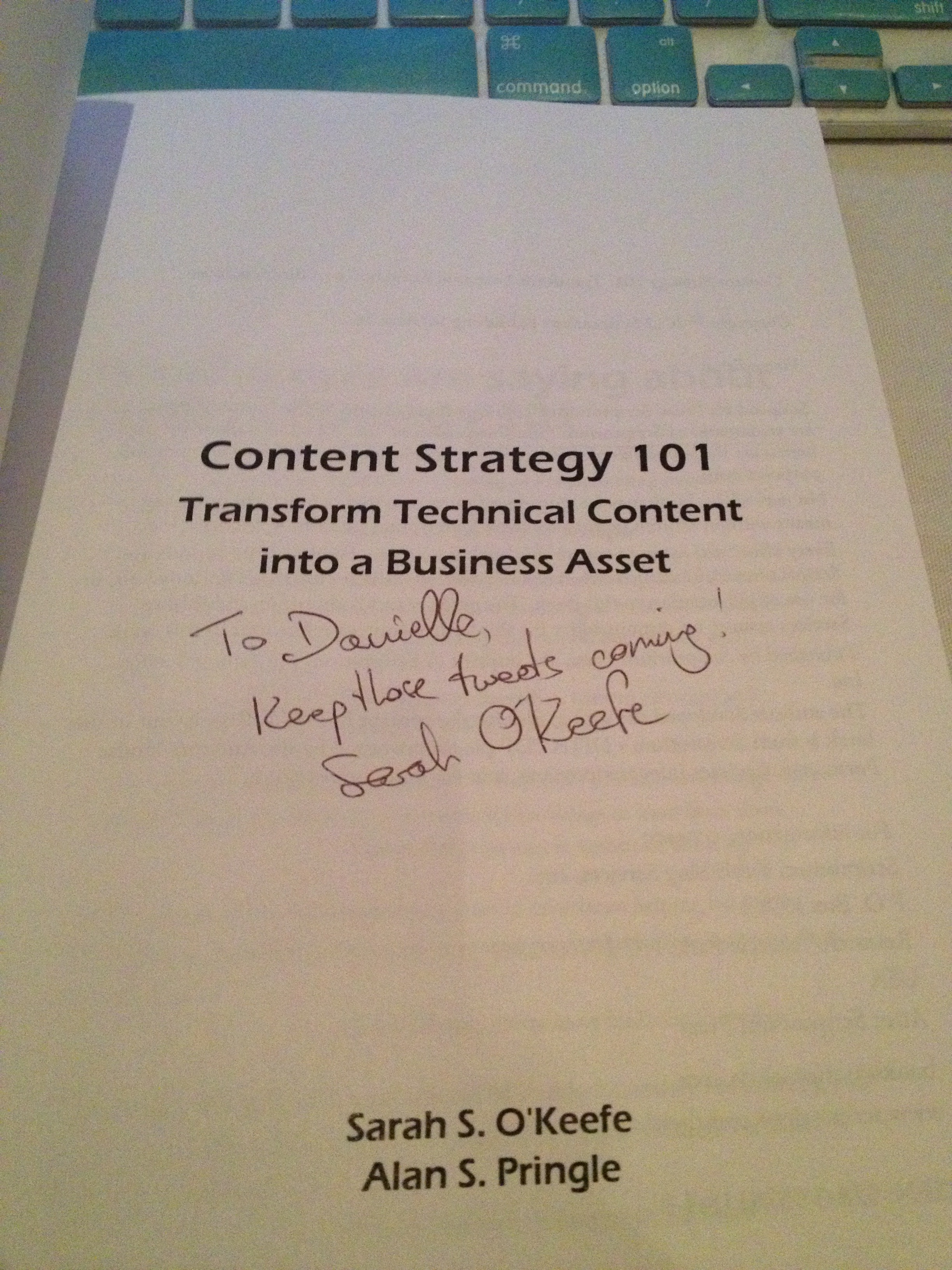
The autograph from my copy of Sarah O’Keefe’s book, Content Strategy 101. Awesome!







 TechCommGeekMom
You must be logged in to post a comment.