I’ve noticed a disturbing trend that seems to be happening in the English language–at least in American English. Every time I heard this mistake, I cringe and wonder why it’s happening.
Evidently, people are not using adverbs correctly anymore. I keep hearing the “-ly” dropped from words in sentences often, and it makes me wonder why this is happening. Is it a lack of proper verbal education–not being taught to speak properly? Is it ignorance? Or is it part of an evolutionary process occurring in American English? (I haven’t noticed it when listening to British English on British television shows, which is why I think it might only be in the United States.)
Let me use some of the sentences that I’ve used above as examples, in which I’ll drop the “-ly” from the descriptor of the verb in the sentence.
“Evidently, people are not using adverbs correct anymore….Is it a lack of proper verbal education–not being taught to speak proper?”
See what I mean? This bothers me to no end, because I’m starting to see it in written English too, and, well…
IT’S NOT CORRECT!!
Perhaps I watch too much reality television that shows under-educated people who aren’t exactly the living examples of academia or professionalism. Even so, while I’ve noticed this trend in the past few years, it seems like it’s getting worse. Is this evidence of the decay of American education? Perhaps. I can tell you that being the “grammar police” of my household, this is always a concern to me. I want to make sure that my son speaks well and properly as he grows up and makes his way into the world.
While I was writing this, it occurred to me that there is another consideration with this phenomenon related to technical communication. This lack of correct adverb use can greatly affect translation and localization efforts. A huge issue that I’ve been hearing in tech comm is the need to write more clearly and in plain language to aid in better translation for localization. If adverbs are not used correctly, how does that translate? In some languages, it might not matter, since some languages don’t use adverbs the same way English does. But most languages that I’ve ever encountered (and I’ve studied four, but far from mastered any of them) always had adverbs. Adverbs are simply proper grammar! So if improper grammar was used in a document, how would that reflect on the writer and the establishment the writer represented?
I implore my fellow technical communicators to please advocate for the adverb! Please make sure that adverbs are used properly, both in written and spoken language. We need to make corrections to preserve this important part of speech. Save the adverb!
Earlier this year, I was asked by the STC-PMC to write a two-part article about the differences and similarities between American and British English. Part 1 was published in February. Today, I happily saw that the second part was published in the STC-PMC bi-monthly newsletter.
David Crystal, author of English as a Global Language, has said that in the pursuit of a World Standard Spoken English (WSSE), American English seems to be the most influential in its development, as American grammar is now starting to influence contemporary British usage. He also discusses at length how different dialects will allow national and international intelligibility to start developing. He said, “If WSSE emerges as the neutral global variety in due course, it will be make redundant the British/American distinction. British and American English will still exist, of course, but as varieties expressing national identity in the UK and the USA.
Edmund H. Weiss, the author of The Elements of International English Style, also points out that there is clash when trying to come up with a standard version of English, namely between “…globalization, producing a one-size-fits-all solution for a diverse world of English speakers, versus localization, adapting and modifying this universal model for particular readers in particular locales.” Where English is a second language, Weiss demonstrates, the idioms and figures of speech end up resembling the language structure of the native language. Because of there are about 400 million native English speakers, and about a billion people who speak it as a second language or as a foreign language (for business or a profession), the importance of clear, unambiguous communication is undeniable.
There are many great resources available about this conundrum that can help put everything in perspective, especially in a world in which the Internet is starting to spread the use of English more and more all the time. Some good ones include:
Books:
· Do’s and Taboos of Using English Around the World by Roger E. Axtell
· Divided by a Common Language: A Guide to British and American English by Christopher Davies
· The Elements of International English Style: A Guide to Writing Correspondence, Reports, Technical Documents, and Internet Pages for a Global Audience by Edmond H. Weiss
· English as a Global Language by David Crystal
· Brit-Think, Ameri-Think by Jane Walmsley
So, what’s a technical writer supposed to do? The best thing to do is to be exceedingly careful of using slang or idioms that relate to one’s native English, and be aware of local usage used on a global scale. This isn’t an easy task at all, yet it’s an important consideration when translating English into another language, let alone trying to write for English speakers globally.
This post is just a quick summary of the Adobe Day at LavaCon 2012 series from this past week. As you see, there was so much information that it took six posts to try to summarize the event!
Being in Portland, Oregon was great. It was my first trip there, and being a native Easterner, my thoughts pushed me to that pioneer spirit of moving westward in this country. Once there, I saw a hip, young, modern city, continuing to look towards the future. The information I gathered at Adobe Day was general information that was endorsement-free, and practical information that I can use going forward as a technical communicator, and that by sharing it, I hope that others in the field will equally take on that pioneering spirit to advance what technical communications is all about, and bring the field to the next level.
To roundup the series, please go to these posts to get the full story of this great event. I hope to go to more events like this in the future!
As I said, I really enjoyed the event, and learned so much, and enjoyed not only listening to all the speakers, but also enjoyed so many people who are renowned enthusiasts and specialists in the technical communications field and talking “shop”. I rarely get to do that at home (although it does help to have an e-learning developer in the house who understands me), so this was a chance for me to learn from those who have been doing this for a while and not only have seen the changes, but are part of the movement to make changes going forward.
I hope you’ve enjoyed this series of blog posts. I still have many more to come–at least one more that is inspired by my trip out to Portland, and I look forward to bringing more curated content and commentary to you!
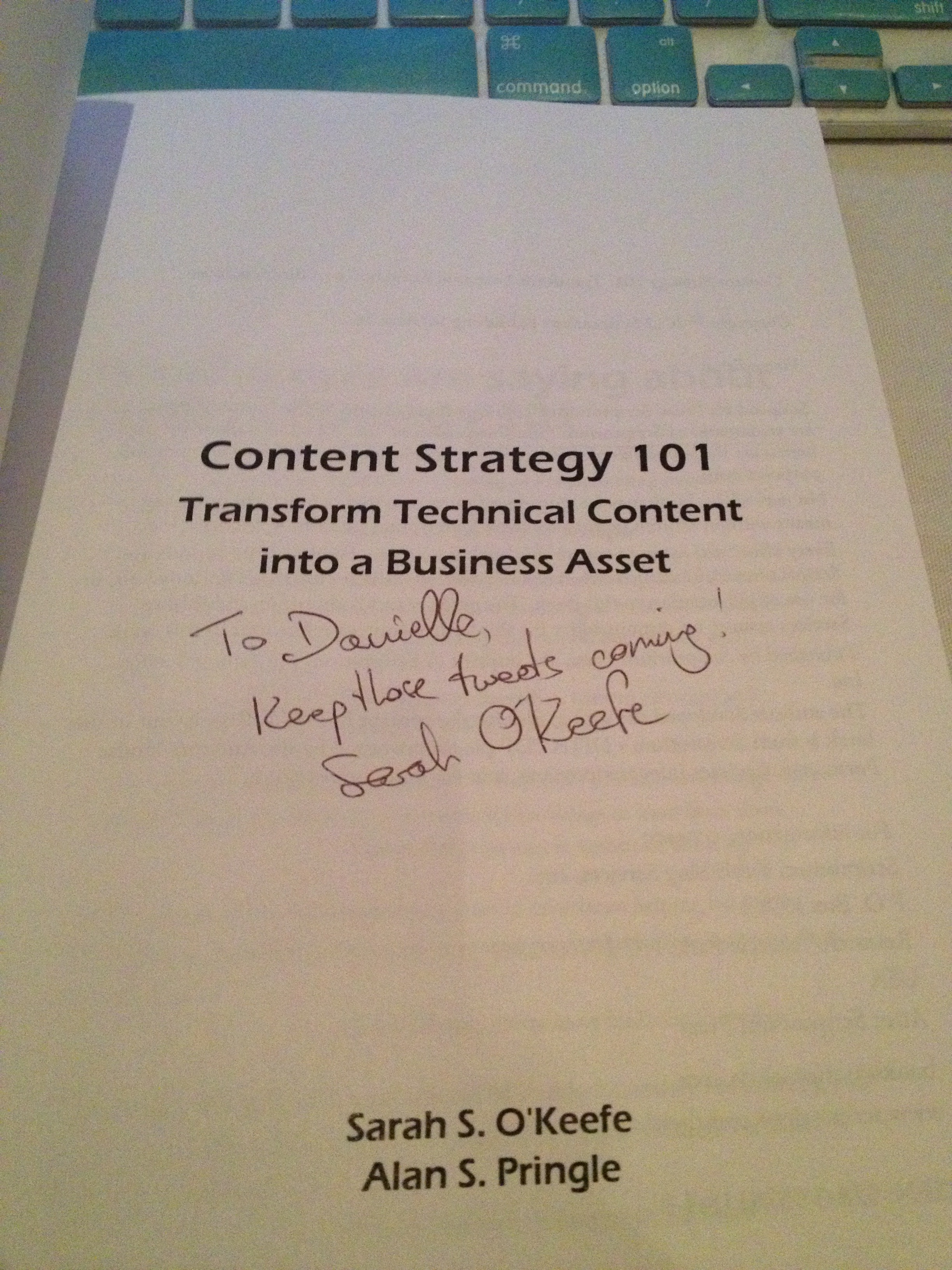
The autograph from my copy of Sarah O’Keefe’s book, Content Strategy 101. Awesome!
Val is the founder of Content Rules, Inc., and she spoke about eight simple rules for technical communicators to follow to make content global-ready–now! Her specialty is doing translation work, so she knows a thing or two about making content ready for a global market. As she went through each rule, she would explain the impact of the rules and why the rules were in place, although some were self-explanatory.
The rule she listed were as follows:
Rule 1:Not all errors are created equal. Some can cost you thousands of dollars! This is one of those obvious rules. Taking the time to write content carefully as well as making sure proper editing is done is a necessity. Even one small typo can make a difference.
Rule 2:Creative Writing is a myth. Standardize. Val’s point with this rule is that superfluous writing is not necessary. Keeping content clear, concise, cogent and correct is especially important in translation, and allows for better reuse of content.
Rule 3:Real copy editors don’t do it without a terminology manager.
It is vital to use the same terms for certain words, especially for translation purposes. For example, the words “puppy”, “dog”, and “canine” all refer to the same animal, but are clearly different words, even though they essentially mean the same thing. In translation, there are times that this much word variation for a single item isn’t available in a different language, so choosing one word as the referential term is recommended. It keeps terminology within the content–especially if reusing content–consistent. Style guides are, unfortunately, not followed as often as they can be. A system is needed to manage terminology and help prevent problems like this example from occurring.
Rule 4:Have you got translation memory (a translation database)? Your vendors do. Use it. It keeps content standardized and saves money. This is another fairly self-explanatory rule. I was not aware, since I’m not in the translation business, that there are such things as translation databases. From what I could understand how it works (and someone please correct me if I’m wrong), a translation database has features that when a specific turn-of-phrase is used on one language, there is a specific translation for that combination of words into another language. When a translation is done, the database looks for that word combination and translates it accordingly. This, again, allows for consistency in translations between the different language editions of content. As a technical communicator who does translations, Val is saying that if you don’t have such a database in place, you should have one because in the long run, it will standardized content and save money.
Rule 5:Don’t complain about quality of your tech writers. You agreed to outsource docs to ___ in the 1st place.
Val pointed out that while there are good outsource resources for writing and translation out there, sometimes the quality is not as good as keeping it in house or closer to home, especially if the content is written by someone whose first language is not English. Good quality source material is key! Having good quality source material helps control costs, especially with translation!
Rule 6:If you write flabby copy, even the nicest vendors will email you a bill for localization that will astound you.
Again, this comes back to having quality content in place. Val’s point was that if you do write weak content that is difficult to translate because it is not quality content, even one’s best clients will send you a bill for the translation for localization purposes, and the bill will be VERY HIGH. Again, having quality content saves money!
Rule 7:Get rid of extra adjectives and superlative words! Delay this product launch, and there’s no next product launch.
This rule is a strong recommendation related again to how content should be written. The use of extra adjectives, adverbs and other superlative words do not enhance the content. Using such words that have to be rewritten or translated can delay a product going out, and for a client, that can be a deal-breaking move. By delaying the product due to not meeting a deadline due to overdue time for translation, and there will be no next time being able to help with a product launch. Obviously, that would be bad business.
Rule 8: Translation is a team sport. You want to work alone? Become an accountant. While this rule elicited a laugh from the audience, it was a point well taken. Teamwork is KEY! A better source of English content will result between source writers and translators if they work together.
Val was asked the question at the end of her presentation, “What alternative tools for style guides are on the market?” She responded that there are lots of software tools out there, but to be careful about push technology within those software items.
I found this presentation rather fascinating, especially since Val presented it with a sense of humor. But her point was clear. Content needs to be as precise as possible when it will be reused and especially when used in translation for consistency. By following her basic rules, costs can be controlled, and the quality of the content can only get better.
I thought about what it takes to do translation, searching my own memory banks from when I almost minored in French during my undergrad years and had to do translations, to the present day watching my husband translate literature written in German to Spanish for a group he’s been involved with for years, to my own struggles to translate what I want to say to my in-laws into my broken Spanish. Translation is not an easy task, but when thinking about translating my English thoughts into another language, it can get tricky because of the turn of phrase or colloquialisms used from area to area. Even in talking to my husband about the topic, he will say that there are different idioms used between Spanish speaking countries, although Spanish will still be relatively “standard.” Being from Ecuador, he can still understand someone from Spain, Mexico or Argentina as much as an American can understand someone from the UK, Canada, or the Australia. But I’ve even found in my own teaching of a business and technical writing course to a corporate group in Asia is that English taught globally is not consistent due to the source English being from different countries, so I have to go and set the record straight. I can certainly appreciate where consistency and choice of words can lead to better quality content and communication in the long term.
Sarah started by telling us that many companies don’t understand the value of technical communication, so technical communicators need to justify their approach. When writing up business cases for these justifications, technical communicators need to include what the current situation is, recommendations to improve the situation, costs associated with those recommendations, as well as the benefits and risks of taking the actions recommended. If there are regulatory and legal requirements, then there is the need to build a case for more efficient compliance in order to avoid legal complications.
Sarah expounded on how technical communication departments should talk to management about how technical communications can control costs. She explained that there is a myth that cheap documentation can be done. She busted that myth by explaining that cheap documentation is actually more expensive, as it can be limited in availability making it useless, it can be hard to understand and out of date, and it may not be translatable into other languages. The cost of bad content is high customer service volume, lost sales, content duplication, huge global costs, and it can contradict marketing communications.
The solution, she said, is efficient development involving the reuse of content, using single sourcing and cross-departmental reuse of content, only tweaking text that is already available. She stressed that formatting and production are important! Using templates and various structures are helpful. She encouraged using tools for creating the needed output. Sarah also said that localization is important as well, that translations are needed component of communication documentation. All these can help bring costs down significantly! Sarah gave an example of how a common obstacle to efficient customer service or tech phone support is often a monster-sized PDF that the support representatives need to read before providing service while on the phone! The process of having to read the long document while online with a customer is time consuming and not cost efficient.
Sarah encouraged technical communicators to work on collaborating and creating better working relationships with other business departments such as tech support, training and marketing with technical content, as this will help to support those departments with pertinent information as well as help them to streamline information. Technical communication can be used to support sales–read documentation before you buy! Technical communication content also can help to increase visibility by creating searchable, findable and discoverable documentation, especially for Google or SEO purposes. Sarah recommended building user communities with technical communication documentation, and making sure that technical communications aligns with business needs.
Sarah has further information which goes into greater detail both in her book, and on the book’s website, which is found at: http://www.contentstrategy101.com .
Sarah’s presentation was really good, in my opinion, because coming from my own experiences, much of what she explained was true, and as she said, the biggest battle is making management understand the value of having solid content strategy. One of my biggest issues at my last consulting job was exactly the scenario that Sarah described; marketing was not taking proper advantage of the technical communication documentation available, nor was it sharing resources and creating reuseable content. As a result, in-house documentation was long and overly customized when much of the information was the same or very similar (needed few tweaks), and the sales advisors that needed the information rarely looked at it because it was too long. When I made the recommendations about reuse or editing from a technical communications standpoint, I was ignored. Of course, I was only a consultant, and I wasn’t privy to understanding the departmental costs, but it did not feel good to know that some of the issues could be fixed with the kind of collaboration that Sarah described. In this respect, I could associate with what she was saying.
An aside note is that Sarah is a self-confessed chocoholic, and a fun part of her presentation was that she incorporated chocolate production into her presentation. To verify her chocoholic status, I was out with Sarah after the event, and caught her in the act of buying more chocolate at one of Portland’s chocolate boutiques:
Sarah O’Keefe buying more chocolate for inspiration!
I do think Sarah’s message is very clear. Technical communications has a lot of value, especially with structured content and reusable content, and as technical communicators, we need to push that agenda to management so that we can provide a bigger service to our clients and companies that they currently realize.
(Sarah–feel free to correct any of my interpretations in the comments below!)

 I’ve noticed a disturbing trend that seems to be happening in the English language–at least in American English. Every time I heard this mistake, I cringe and wonder why it’s happening.




 TechCommGeekMom
You must be logged in to post a comment.