I’ve been seeing a lot of videos about various accents in the English language lately, and it makes me think that I must have missed some sort of calling to be a linguist. I find it all fascinating! But in watching these two videos about how to do an American accent (from a British perspective) and hearing several UK dialects (that all sound like music to this set of American ears), it’s no wonder that between various vocabularies and actual different sounds in pronunciation that things can get confusing when trying to figure out a way to create a “standardized English”. (And this isn’t even including other dialects around the world!)
Take a listen here– Enjoy! (I’ll be working on some of my British accents. I think I have the Northern Irish/Southern Irish one down, kind of, due to mimicking family relations. 😉 )
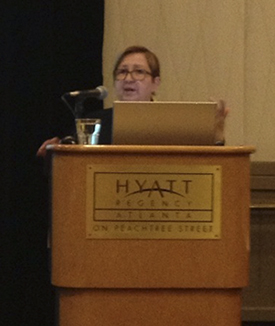
To continue with the tech comm rock star theme set forth by Adobe for Adobe Day, I thought carefully about who might represent Rahel Anne Bailie, whose talk was titled, “Content Strategy in a Content Economy– Is Your Content Prepared?” It took me a little while, but it finally came to me. Rahel is the Alanis Morrisette of tech comm. Both ladies are Canadian, and they both have a no-nonsense approach to their craft. Alanis Morrisette became famous with her breakout album, “Jagged Little Pill” not only because the music was good, but she broke her ideas down simply and didn’t mince words. Morrisette looked at the good, the bad, and the ugly, and worked on making sense of what was going on around her.
Rahel Anne Bailie The Alanis Morrisette of Tech Comm
Rahel does the same thing for content strategy. She breaks it down to a level to ensure that anyone who even begins to think about content understands what content is, and how it should be utilized at the most basic level. She tells it like it is, and why we need to employ it.
Rahel began her Adobe Day talk by talking about economic evolution. She started by pointing out that our economies have progressed from an agricultural economy, to an industrial economy, which in turn progressed to a service economy, then evolved to a knowledge-based economy, to an information economy, then to an attention economy, which has resulted in what we have today–a content economy.
Content includes the sub-sets of content that are location-based content and verified content. Location-based content includes geo-locational and geo-fenced information like Yelp, or information that is blocked from outside countries. Verified content deals with endorsed and social relevance; it has the user questioning, “How do I know that the content is true?” Facebook or TripAdvisor “likes” are an example of this. Cultural relevance applies to this as well. Topics such as Canadian versus American, demographics, and interests act as filters.
Rahel stressed that content has value! It’s recognized as a business asset and it deserves to be managed with as much care as other assets. The problem is that we don’t inventory content in most cases–it’s not like managing our finances or physical inventory at a plant. This means that this is a big necessity! In order for this to happen, content has to work well. Like design, it’s only noticed when there’s a problem with it.
Rahel shifted the conversation to explaining how sub-sets relate to content. She explained that new user experiences these days include smaller screens as the first entry point to content, such as m-commerce and m-banking. Tablets are also being used as entertainment devices. We also have to content with multi-screen and multi-dimensional content, which are viewed as
ancillary, such as television plus social media,
sequential, where users use a desktop and mobile device interchangeably, or
simultaneous, in which there is a collaboration requiring instant synchronization between devices.
One also has to think about market maturity, and must look at market differences, social network penetration, the mobile market and growth opportunities. Cross market content involves a single language for many markets. By offering native languages in other markets, cross-border commerce incurs content needs as well.
Using language to meet adaptive needs makes a difference! How do we meet this head-on? Rahel suggests a repeatable system that governs the management of content throughout the entire life cycle creates content strategy. The life cycle consists of continually analyzing content, collecting content, publishing content, and managing content. Rahel reminded us that a tactic is not a strategy, but rather a strategy is the analysis and the prescription. Content touch points occur throughout a customer’s journey, and can include multiple variables and outputs, but also need to include localization.
In a content economy, we need ALL the right factors at the right time using right media. We need to work towards an integrated content strategy.
As this is a topic that can go even deeper, Rahel recommended her book, http://TheContentStrategyBook.com , which talks more at length about content strategy.
As most of my own current work revolves around content strategy these days, I was really happy to listen to Rahel talk about the benefits and necessity of content strategy. It’s something that I try to explain and promote at my own job, because so much of it really involves analyzing and pre-planning the usefulness and necessity of content. Rahel’s talk brought that concept home to me even more, and helped me validate what I’ve been telling others. She reminded me that it doesn’t matter what the medium is–print, web, or some other digital means–but content needs to be clear, concise, and cogent, as my favorite professor used to tell me (who was also, coincidentally, Canadian). Rahel’s talk definitely set a positive tone on content strategy and its place in technical communications. I was glad that Adobe made sure to include her in Adobe Day, because content strategy isn’t going anywhere right now–it’s more important than ever!
Rahel, if I’ve misquoted you, or something that I wrote needs further clarification, or if you’d like to add anything to these notes, please feel free to let me (and the readers) know in the comments below!
I’ve noticed a disturbing trend that seems to be happening in the English language–at least in American English. Every time I heard this mistake, I cringe and wonder why it’s happening.
Evidently, people are not using adverbs correctly anymore. I keep hearing the “-ly” dropped from words in sentences often, and it makes me wonder why this is happening. Is it a lack of proper verbal education–not being taught to speak properly? Is it ignorance? Or is it part of an evolutionary process occurring in American English? (I haven’t noticed it when listening to British English on British television shows, which is why I think it might only be in the United States.)
Let me use some of the sentences that I’ve used above as examples, in which I’ll drop the “-ly” from the descriptor of the verb in the sentence.
“Evidently, people are not using adverbs correct anymore….Is it a lack of proper verbal education–not being taught to speak proper?”
See what I mean? This bothers me to no end, because I’m starting to see it in written English too, and, well…
IT’S NOT CORRECT!!
Perhaps I watch too much reality television that shows under-educated people who aren’t exactly the living examples of academia or professionalism. Even so, while I’ve noticed this trend in the past few years, it seems like it’s getting worse. Is this evidence of the decay of American education? Perhaps. I can tell you that being the “grammar police” of my household, this is always a concern to me. I want to make sure that my son speaks well and properly as he grows up and makes his way into the world.
While I was writing this, it occurred to me that there is another consideration with this phenomenon related to technical communication. This lack of correct adverb use can greatly affect translation and localization efforts. A huge issue that I’ve been hearing in tech comm is the need to write more clearly and in plain language to aid in better translation for localization. If adverbs are not used correctly, how does that translate? In some languages, it might not matter, since some languages don’t use adverbs the same way English does. But most languages that I’ve ever encountered (and I’ve studied four, but far from mastered any of them) always had adverbs. Adverbs are simply proper grammar! So if improper grammar was used in a document, how would that reflect on the writer and the establishment the writer represented?
I implore my fellow technical communicators to please advocate for the adverb! Please make sure that adverbs are used properly, both in written and spoken language. We need to make corrections to preserve this important part of speech. Save the adverb!
Earlier this year, I was asked by the STC-PMC to write a two-part article about the differences and similarities between American and British English. Part 1 was published in February. Today, I happily saw that the second part was published in the STC-PMC bi-monthly newsletter.
David Crystal, author of English as a Global Language, has said that in the pursuit of a World Standard Spoken English (WSSE), American English seems to be the most influential in its development, as American grammar is now starting to influence contemporary British usage. He also discusses at length how different dialects will allow national and international intelligibility to start developing. He said, “If WSSE emerges as the neutral global variety in due course, it will be make redundant the British/American distinction. British and American English will still exist, of course, but as varieties expressing national identity in the UK and the USA.
Edmund H. Weiss, the author of The Elements of International English Style, also points out that there is clash when trying to come up with a standard version of English, namely between “…globalization, producing a one-size-fits-all solution for a diverse world of English speakers, versus localization, adapting and modifying this universal model for particular readers in particular locales.” Where English is a second language, Weiss demonstrates, the idioms and figures of speech end up resembling the language structure of the native language. Because of there are about 400 million native English speakers, and about a billion people who speak it as a second language or as a foreign language (for business or a profession), the importance of clear, unambiguous communication is undeniable.
There are many great resources available about this conundrum that can help put everything in perspective, especially in a world in which the Internet is starting to spread the use of English more and more all the time. Some good ones include:
Books:
· Do’s and Taboos of Using English Around the World by Roger E. Axtell
· Divided by a Common Language: A Guide to British and American English by Christopher Davies
· The Elements of International English Style: A Guide to Writing Correspondence, Reports, Technical Documents, and Internet Pages for a Global Audience by Edmond H. Weiss
· English as a Global Language by David Crystal
· Brit-Think, Ameri-Think by Jane Walmsley
So, what’s a technical writer supposed to do? The best thing to do is to be exceedingly careful of using slang or idioms that relate to one’s native English, and be aware of local usage used on a global scale. This isn’t an easy task at all, yet it’s an important consideration when translating English into another language, let alone trying to write for English speakers globally.





 TechCommGeekMom
You must be logged in to post a comment.