Posted in Uncategorized

How do we determine the bounds of digital literacy?

Yes, you are seeing this correctly. There’s a blog posting from me. No need to double-blink in disbelief. I am still alive and well. I don’t always get much of a chance to write here because I’m busy! One of these days, I’ll try to catch up with what’s going on with me, but in summary, I’m busy teaching a technical editing class at NJIT, working a part-time gig for BASF, working a “freelance contract” with a pharmaceutical company as a digital content strategist, and working my tail off for the STC-Philadelphia Metro Chapter as president, conference chair, sponsorship chair, and competition chair.  Not a lot of time to come up for air these days!

But as I do have a short moment right now to put these thoughts down, I thought I’d start this conversation, because it is a frequent topic that comes up again and again in all the things I’m working on these days.

Where are the boundary lines what constitutes digital literacy? Just like a person needing to know how to read and write, we live in an age where almost everything is done digitally these days.  You can’t do a lot of what you used to be able to do on paper or manually. You call a toll-free helpline, and you are most likely to get an automated chatbot responding to you before you can even get to a real person. Credit cards use chips increasingly more than the magnetic strips, or even use Apple Pay, Samsung Pay, or the like. To get help for anything, most people go online to find answers through browser searches.  So where’s the line of what’s considered digitally literate and digitally illiterate?

I bring this up because I often get into discussions about what is acceptable and user-friendly UX, and what’s not. I usually follow the tech comm mantra of “know your audience”, so many of the audiences I have to deal with aren’t necessarily the most digitally savvy bunch. I’ll argue to include something to make interactivity with the site more apparent, whereas others will argue that it’s not necessary.

I also wonder about people who still can’t figure things out like social media, or GMail or Google Drive, or things like that. These have been around for a decade–or more! There are other apps and sites that have also been around for a long time, and people still have no clue how to begin to use them (and it’s more disturbing to me when it’s someone who has to either work with digital on a daily basis, write for digital, or is teaching digital).  Now, some may argue that it’s a generational thing, but I don’t agree. I know people who are my parents’ age (into their 70s) who have a better clue than I do about how to use digital, and are very good at it. And then I know people younger than me who have no idea how to use word processing or a simple spreadsheet. It runs the gamut.  Digital has been a part of society for at least the last 30 years, and there isn’t anybody who isn’t touched by it these days. Those who don’t adapt fall behind. Digital is pretty much everywhere, and it’s even easier to use now than it was in the decades before.

Case in point: I recently had to go for my yearly eye exam. My optometrist is still scheduling in a paper book, does her bookkeeping in a paper book (the receptionist writes out receipts rather than prints them out), and most of the records are still done solely on paper. Additionally, they don’t have an up-to-date database or access to one to look up insurance information. I was told that I didn’t have certain kind of coverage, but when the place that I got my glasses (a different place than my doctor) looked the information up, I did have the coverage. Why? They could access the information online more easily.  While it seems old-fashioned, my doctor is actually severely behind the times, and she’s going to have issues keeping up with more modern practices soon enough. She complains that there’s no software that meets her needs, but she doesn’t know that no software will meet ALL of her needs, and she needs to work with a vendor to customize things as much as possible so that it WILL meet her needs.

I also had to deal with someone for whom I had help them sign onto Google Drive and Gmail. I’ve told this person many times how to do it–in writing, no less–and they still can’t figure it out. I don’t think it’s my instructions, as others have used the same instructions without any issues. I think part of it is a conscientious mental block that person puts up, because they don’t want to learn.

So, this is why I ask…

As a society, we put great emphasis on the basics of learning how to read and write. Same thing for understanding the basics of mathematics. So what’s the functional literacy level for using digital? I will grant you that understanding how to use digital has evolved over time. But there’s a point where, even as technical writers, we need to be promoting better ways to be literate. For example, if you are on a webpage, and you see text that’s in a different color or especially if it’s underlined, wouldn’t that tell you that it’s a hyperlink, and it’s going to take you somewhere else or open another window? Then why do we still have text like, “Click here to view the video” instead of “View the video”–or better yet, if the title of the video is mentioned in the sentence, just hyperlink the video title? This is especially true when it comes to writing for mobile, as you can’t “click” on something, just as you can’t “tap” on a desktop/laptop interface unless you have a touch screen.  This is an example of something that’s incredibly basic, yet there are those who still don’t get it.

So how do we define the parameters of being digitally literate versus being digitally illiterate in this day and age? I know I have my own ideas, but I would like to hear yours.  How would you define these parameters? Include your comments below.


Posted in Uncategorized

STC-NEC Interchange 2018’s Keynote Speaker: TechCommGeekMom


Nighttime image of Lowell, MA
Well, this will be a first!  I’ve been invited to be the keynote speaker for the STC-New England Chapter’s conference, Interchange, this coming fall–October 26-27, 2018 in Lowell, Massachusetts.  Interchange is one of those regional conferences that I’ve wanted to attend, and to be invited to speak as the keynote? Wow! I’m truly honored.

They first asked me if I was interested actually when I was in the midst of CONDUIT 2018 this past spring. To say the least, I was surprised. Me? Keynote material? Then I thought, hey, why not? I’m sure I can figure out something to talk about in a half hour (I have until October to figure it out now–possibly sooner).  I know that the STC-New England Chapter is hard at work to ensure that this is going to be a really good conference, and worth the trip north in the fall! I’m looking forward to seeing my STC friends from New England, and meeting some new ones.

If you are interesting in checking out this conference, go to the Interchange 2018 website for more details. I hope that I will see you there, and please don’t jeer or heckle me while I speak (although some people I would expect it from. LOL)

In the meantime, plans are already underway for CONDUIT 2019. We haven’t pinned down an exact date yet, but it will be in the first half of April, for sure.  I’m in the midst of seeing if we can find a new venue for our little conference. I’ve visited one place that’s excellent–and most of our board’s first choice–but I have to do due diligence in visiting the other places as well that we’ve chosen as finalists, and then doing some number-crunching to see which is the most economical. There will be some big changes for next year no matter where we go, but we are confident that it will be worth it.

In the meantime, go register for Interchange 2018, and I’ll see you there!

Posted in Uncategorized

Music is the ultimate single-sourcing resource

A few years ago, I wrote an article for someone else about how music was used in remixes and mashups, but it never got published. Even so, I was reminded of how music has a lot of reuse due to two events that happened to me over this past weekend.

First, I went to a concert given by the Princeton Symphony Orchestra. The pieces that were played were Tchaikovsky’s 1812 Overture and Beethoven’s Ninth “Choral” Symphony. About an hour before the concert, the maestro/conductor held a little talk about the pieces, giving some history and other notes about the pieces. He mentioned that both pieces were reflections of the times, in that the music reflected the turmoil that was going on in Europe during the early 19th century. But what also struck me–and what I listened for–was the reuse of music to reflect some of the action or feelings of the time. In the 1812 Overture, for example, they played the original Russian version, which begins with a Russian Orthodox chant. Later, you hear the French National Anthem several times repeated over and over to reflect Russian and French forces at odds. Beethoven also used bits of well-known (at the time) country songs that were reflected in each movement.

Second, I started to watch an excellent program on television about the Beatles. It was on very late, and my husband and I–who are big Beatles fans–got drawn in, but had to turn it off as we needed to get to sleep. But when we did see was fascinating, and it put an interesting spin on their music. The episode was concentrating on how revolutionary the Sgt. Pepper’s Lonely Hearts Club Band album was. It was the first time any musicians purposely made a studio album that wasn’t meant to be played for touring. This allowed the Beatles a lot of freedom to experiment with sounds that were either repurposes or found a new place. Sometimes it was the instrumentation that was new; sometimes it was the hybridization of two or more different styles. The one piece that they broke apart that captured my attention was “Penny Lane”. “Penny Lane” is about observations around the area where Paul McCartney and John Lennon grew up. Musically, it captured the old vaudeville sound yet at the same time had a pop/rock sound to it, with overtones of baroque as well. The final track included 4 separate tracks of piano, and a host of other instruments like a special piccolo trumpet (I think that’s what it was called, but correct me if I’m wrong), which wasn’t an instrument used often in modern pop music! Another example, although not part of the album but part of the recording period, is “Strawberry Fields Forever”. Did you ever think that the vocal track sounded a little weird, even though it worked? That’s because the main music background track was made on one day at one speed, and the voice was recorded at a different speed on a different day. John Lennon wanted to use both tracks, but they didn’t synchronize well. Because the technology wasn’t there electronically like it is now, sound engineers had to figure out how to change the variable speed on both recordings so that they could get them to synch. That sort of thing didn’t exist until then! Fascinating stuff.

So what does this have to do with content strategy? Everything. Here’s why.

A big part of content strategy is knowing what to keep and what not to keep. Content strategists are always promoting reuse of content to be used in new ways. By mixing and matching content appropriately, you can get a hybrid that is something new and unique to itself. Nowadays, copyright laws can get in the ways, but if they are heeded appropriately, something new and wonderful can be produced. The music world really started to notice when rap and hip-hop started sampling and reusing music, a practice that’s still used today for new music, remixes, and mashups.

What do you think? Did musicians have this figured out well before writers by almost 200 years? Include your comments below.
Posted in Uncategorized

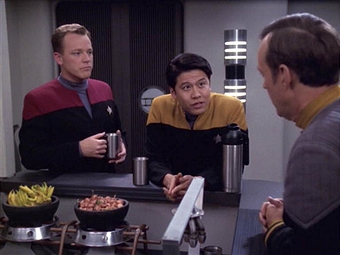
TechCommGeekMom, where have you been? The Delta Quadrant?

I know you haven’t been in the Delta Quadrant. So where have you been?

OK, so it’s been a while. I know. While I wish I could say that I’ve been on an Intrepid-class Federation starship named the U.S.S. Voyager, sadly that is not the case.

It’s a little hard to be writing blog posts when a) you don’t know exactly what to say after having written hundreds of posts before, and b) you’re just REALLY busy.

2016 was a rough year, but 2017 has also had its challenges so far.  You know that I’m always in some sort of work search mode, and that’s already had its ups and downs for the past few months.  I was excited to get my first independent contract. It was an opportunity to finally flex my e-learning muscles, and do it on my terms.  I started to create a curriculum matrix,  to make storyboards, to write transcripts, test questions, and study guides, and created video training–21 completed videos in about a month. But the contract ended before the full project was completed, and I don’t know what will be happening going forward. There was a big learning curve involved, and after the fact, I’ve realized where I made some wrong moves, but I also learned where I made many right moves as well.  I’ve been mastering TechSmith’s Camtasia during this time, and feel pretty comfortable with it now. I sometimes feel I missed out on one of my many callings as a video editor (although you never know–that might change going forward).  I know that I was producing good content, if I say so myself, so I have to be satisfied with that for now.

I also was the co-chair of the STC-Philadelphia Metro Chapter (STC-PMC)’s annual CONDUIT conference.  Thankfully, that came off with few hitches, and it was well received by everyone I heard from. Some people hadn’t been to the conference in years, and it was a great opportunity for them to see how our conference has grown!  Next year, at this point, it looks like I’ll be the main chair for the event, so it’s going to feel a little overwhelming, I’m sure. Just being co-chair felt overwhelming at times, while trying to work with client deadlines. It stressed me out enough that I even got physically sick for a while. For CONDUIT, the payoff is worth it, and I hope that everyone who is reading this considers coming as a presenter or attendee for next year.

Oh, and I can’t forget that I’ve been studying my DITA by helping someone who is writing a book about it, and I was asked to contribute edits as a beginner who wanted to ensure that they understood the author’s instructions.  That was cool, and helpful.

Kim: Is she kidding us? Overwhelming?
Paris: That’s what she claims. Who am I to argue?

All through this time, as I said, it’s been a bit overwhelming. I realized some missteps with all of it the hard way, as I usually do, but thankfully I have a lot of good people who help me get back up and fight another day. (Photon torpedos are loaded, Captain.)

I spoke to veteran tech comm consultants at CONDUIT and through Single-Sourcing Solutions’ TC Conclave, as well as just talking to other technical communicators when I had the opportunity offline.  All have provided me with advice about how to move forward in the future as an independent consultant, and massaged my ego just enough, knowing how battered and bruised I felt at times.  For that, thanks to all of you. You know who you are.  This is why I get involved with the STC and with other technical communicators.  Five years of networking is finally paying off–you know me, I know you, and I can learn more about things that they don’t teach you in grad school. I benefit from your experiences and I’m grateful.

Kim: I think we should take a ship-wide survey or start a betting pool on what she’ll do next. Who’s in?

So now the question is…what do I do going forward? I’m in limbo once again with timing, figuring out what to do next. At this writing, I’ve decided to lay low for a couple of weeks. I’m concentrating on my VP duties for the STC-PMC for the rest of this program year (two more main events to go right now!), reworking my consultancy’s website (a project temporarily postponed when I started my contract in February), and doing a little bit of project hunting, but nothing too deep just yet.  I have a few leads on things, but I’ve always been hesitant to “count my chickens before they are hatched,” as the saying goes. I’m looking forward to attending the STC Summit in a few weeks in Washington, DC.  I’m getting excited about going, because I realize that it’ll be nonstop tech comm for me almost from the moment I get there! I’ll be with my tribe! I plan to take advantage of seeing all my STC friends–and making new ones as well–in the hopes that my continued networking will help me build my business. I’m looking at things through a slightly different perspective now.

In some ways, I’m still scared to death being “on my own”.  Having survived through my first experience without an agency, though, was exhilarating, and I liked being my own boss and calling most of the shots, and determining how things should be done.  I was able to validate that in many ways, I’m still on the right track, even if things are slow-going right now.

Kim: Captain, there’s something out there!
Janeway: I need a better description than that, Mr. Kim!

I still have a very long way to go, but I’ll find my way eventually. Sometimes I feel like the very green Ensign Kim, who has some knowledge, but still finding my place while trying to make a difference. Sometimes I feel like Captain Janeway, where I feel like I can lead and figure out what needs to be done. There will be Borg, Kazon, Vidiians, and Hirogen to battle along the way, I’m sure. Hopefully my persistence moving forward will get me where I need to go, even if it takes a while.

Posted in Uncategorized

4 Lessons Learned (About Learning) From Blogging

Blogs provide great insight and are a helpful educational tool. But did you know the act of blogging can teach us something, too? Danielle Villegas explains.

Source: 4 Lessons Learned (About Learning) From Blogging

Thanks to Phylise Banner, Jennifer Hofmann, and InSync Training for the opportunity to write this article for InSync Training’s blog, Body Language in the Bandwidth. 

I based this article on the many years I’ve been writing here on TechCommGeekMom and other blogs I’ve written over time. I hope there’s helpful information for you here! It’s a quick read, and I enjoyed writing it.

–TechCommGeekMom