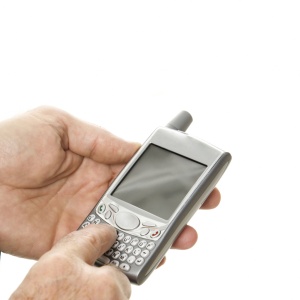
 Last week, I was in contact with one of my former professors at NJIT‘s MSPTC program. We talked about several things going on, and in the process of the email conversation, she mentioned that she is starting another semester of the PTC 601 (Advanced Professional and Technical Communications) classes, and she asked me a question about mobile, because she wanted to add a new component to an assignment.
I remember doing the assignment well just three years ago. Essentially, the student is given a manual for a fictitious coffeehouse franchise’s espresso machine, and the student has to rewrite the manual into a quick reference guide, preferable something that included visual images that could the learner/user can learn from it or refer to it as needed. Conceptually, it’s an easy enough assignment (or at least it was to me), but creating it with the tools I had at the time proved challenging, even if I did pull it off.
Adding a mobile component to this assignment makes a lot of sense to me. This is a perfect example of what m-learning is, what it looks like, and what it can be! Taking a simple how-to manual and creating a mobile app for it is highly logical, especially in this scenario. I mean, think about it…how often do people whip their smartphones out of their pockets to look up any kind of information, let alone have a how-to app on their phones? So having a special app that could be downloaded and instantly used as a reference guide for that newbie coffee barista would be ideal!
I was happy to hear about this addition to the assignment. The professor knows how enthusiastic I am about promoting mobile solutions, and I was thrilled to hear that she is making an effort to include mobile solutions in the MSPTC curriculum. So, she asked me if I knew any software programs that could convert text into some sort of mobile output. The first thing that came to mind was Adobe’s Technical Communications Suite 4, especially with Framemaker and Robohelp. But, the school doesn’t have a copy of that for students yet (they are working on it), and even with the short trial, there’s a big learning curve for an assignment that would be due fairly quickly.
So, I began to do a little research to help the professor out. There were a few things–a few parameters–that I had to keep in mind as I looked for a tool for her to use. It has to be easy to use for someone who didn’t have too much or negligible programming skills. It has to be free or at the barest minimum of cost. And it had to have an easy ramp-up to have a project done on it in a week or so. I knew, from experience, that people from all walks of life come into this program, with a true mix of web expertise. I remember helping some of my fellow classmates by providing a crash course in HTML, and the quest for the free or cheap web editing software or site where an e-portfolio could be created. So, I understood the parameters well.
The sad thing I discovered was that while there are dozens of places to set up and create free or cheap websites with web editing available that anyone could use to set up a good looking site, the same can’t be said yet for creating mobile sites. There are a few sites that do help a person create a mobile app easily, but it’s not cheap. Or, if it’s cheap, it requires some programming know-how. It was tough. the other thing to keep in mind was whether the mobile app being created was for a “native” app, a “web” app or “hybrid” app. The differences between these is that a native app is saved on the mobile device and can be used offline. The web app is one that is essentially a mini website and needs an internet connection to access the app. A hybrid is…well, you can figure that out. If you’ve ever tried to access an app on your phone, but couldn’t get it to function because you didn’t have wifi or 4G, then that’s a web app. If it only partially worked, but you still needed wifi/4G to connect for part of it, it’s a hybrid. You get the idea. In the end, I gave the professor a few suggestions that I found.
The first was something called Viziapps. I think I had heard of Viziapps because I believe (just off the top of my head) that this was the software being used in an STC class on how to build mobile apps. Viziapps allows individuals to create a mobile app without knowing any or little coding, but they would have to have some idea of information architecture (which is part of the project assignment–understanding what’s important, what’s not, what comes first, content structure, etc.). It’s mostly a visual editor that allows the user to build the apps online, then publish on the web for free, provided the creator has created a web app. If it’s a native or hybrid app, then that has a price. It seems like it might be a viable choice as a tool that would allow for a quicker ramp-up for someone seriously trying to create a mobile app.
Other more creative choices would be using their mobile devices to make something. For example, there is an app called SnapGuide, in which an individual can take photos or video to demonstrate how to do something. Mobile by Conduit might be another possibility, as it’s free, and supposedly has an interface style similar to WordPress.
But then I thought about WordPress, and I realized that might be another option. TechCommGeekMom is a WordPress website, after all, and it can be read on mobile devices. Basic WordPress accounts are free and fairly easy to use. You can create a “blog” or website on WordPress, and then there’s a setting to create a mobile interface. Here’s a little bit of info about it: http://en.support.wordpress.com/themes/mobile-themes/ It seemed to fit the criteria needed for a mobile app creator/editor, in that it’s free, it has a mobile output (as well as a regular web output), and it provides a primer for content management in the experience. I thought that if I was still in the class, I’d create several pages on a single WordPress website for different parts of the Guide–similar to the pages and navigation I have here, and then promote the mobile access to the website. It’s not a perfect system, but for quick ramp-up purposes for a fairly small assignment, it seems like it would fit the bill.
I think my former professor appreciated the help, but we both discussed the dilemma that it posed. Why must someone have a programming degree and some cash in order to create a mobile app–whether it be a native, hybrid or web app? Depending on the app, all three formats have their positive and negative aspects to them. But how does one learn how to use any of these mobile app writer/editor products quickly? There are some great tools out there, I’m not denying that, but for the true beginner or student on a budget who is trying to learn how to create mobile solutions skills as a technical communicator, it’s not that easy. I see a huge business opportunity here (not that I have the time, cash, or enough knowledge to start such a business), but creating a highly user-friendly software program that one’s grandma could create a mobile app for a very low cost would be a fantastic business. It would make even more information accessible to share with others.
It occurred to me later that for the average user, another possibility is another Adobe program that I’ve been using to create and maintain my e-portfolio, called Adobe Muse. It’s a cloud-based app that acts as a very easy UI interface to create websites and mobile apps. I’ve used the website editor, but I haven’t tried the mobile conversion yet there. I believe it’s about $14-15 per month, and you can set up an account at Adobe’s Business Catalyst and create your mobile site that way. It allows those who have next to no programming skills create something that looks great, but it also allows more advanced users some nice shortcuts to create great sites without having to do all the coding–Muse does it for you.
Perhaps, as mobile solutions become more mature like editing software for desktop interface websites, this mobile app creator problem will go away, and there will be more affordable options. In the meantime, we have to wait or muddle through it all…
If you know of any easy-to-ramp-up mobile app editors, please mention it in the comments below! Share, everybody!




 TechCommGeekMom
You must be logged in to post a comment.