When the one-day opportunity to order Google Glass came up recently, I jumped on it. I had tried on Marta Rauch‘s pair a couple months ago, and had seen her presentations about it, and fell in love with them. This was wearable technology I could use, as far as I was concerned! I was able to order the Glass I wanted, and was very excited about it…until I told my husband. I didn’t tell him how much it cost, but I did tell him that I bought them. He totally flipped out, but not in a good way. He felt that whatever I did spend on them, it was too much money for a “toy”. I’m earning some good money now, and I felt it was an investment–I’d like to explore how they are used, and how technical communication and m-learning would be part of the wearable technology experience for myself. But no. I cancelled the order, as he had a good point about the cost being too high. Even so, I’m really sad about missing out on this opportunity.
Financial considerations aside, it got me thinking about technological “toys”, and what’s truly a “toy” versus adopting early technology, albeit at a high price initially. I’ve heard Neil Perlin talk about how he had some of the earliest portable computers around–nothing like the laptops of today–that cost a small fortune even by today’s standards. Sure, it’s outdated and obsolete technology now, but so are a lot of other technologies that were around just a few years ago. Children today don’t know what a Walkman is, or that telephones used to actually have a cord and you actually used a dial mechanism to connect your phone to another phone. Heck, pay phones are pretty much obsolete now. What did people think when the first iPhone or the first flip phone came out? Those are obsolete now, too. So, sure, perhaps Google Glass is a very expensive “toy”, but how does anyone know if perhaps I was really an early adopter and I’d be ahead of the curve for knowing how to make it work and use it for practical reasons if I had actually gotten one?
I remember when I got my first iPad–it was an iPad 2. I had saved up, and asked anyone who was going to be getting me a gift for my birthday, holidays, etc. to give me gift cards to Best Buy so I could purchase it. I was so thrilled when I got it, and my husband thought that was a waste of money. He insisted that I already had a laptop, and didn’t need an iPad, that again–it was just a toy. I insisted that yes, there were “toy” elements to it, but I considered it “computing lite”, where I could do many tasks that I normally do, but the ones that didn’t necessarily need my laptop to be powered up. Then, about a year later, I was fortunate enough to win an iPad3 so I could upgrade. My husband had insisted that I sell my old one, but for all his moaning that I should get rid of it, guess who’s been using it for almost two years now? Yep, him. It’s still a little bit of a “toy” to him, but he’s a news junkie, and he loves to read different news sources and some light research on it when he’s not using his desktop (nope, he doesn’t even own a laptop). So, it’s not going anywhere. My iPad has gone with me all over the country–on vacation, to conferences, and has entertained me when I don’t need to be in front of my laptop. I’ve gotten my money’s worth out of mine multi-fold. And yet…I feel like this is the same situation.
Of the emerging techologies that are coming out, whether they are wearables or something else, what do you think is a tech “toy” and what do you think could be the next big thing, or a step towards the next big thing? 3-D printers and Google Glass have my attention–I would love to own both of them. What has your attention? Add your thoughts to the comments below.
I broke out of the tech comm mold a little bit, and actually did an e-learning, or more specifically, an m-learning presentation today at the e-Learning Conference 3.0 at Drexel University in Philadelphia today. I was totally out of my comfort zone, because while I love to talk about and share what I know about m-learning, I’m not an m-learning professional, meaning this is not something I do everyday like the rest of the attendees. I also had never been in front of such a large group (there were 50+ people in the room! New record for me!), and among those who DO use e-Learning everyday. I was grateful that I had people come up to me and tell me they liked my presentation. I was glad that at the end of my presentation, I was able to get a conversation going in the room about m-learning practices.
Not bad for a content strategist, eh? 😉
Due to popular demand (okay, some attendees asked for it), here are the slides that I used. If they don’t make sense for some reason, feel free to ask questions in the comments, or email me directly.
The Times Square New Year’s ball drop has landed…it’s a new Adobe Technical Communication Suite!
As of TODAY, Adobe is releasing five new tools for technical communication professionals everywhere! Technical Communication Suite 5.0 (TCS5), FrameMaker 12 (FM12), FrameMaker XML Author 12 (FMXA 12) and RoboHelp 11 (RH11), and FrameMaker Publishing Server 12 (FMPS12) are now available.It’s been about eighteen months or so since the last big Adobe tech comm release, so you can imagine there are some new and enhanced features included.
I was privileged to be among a group of tech comm professionals who were invited to get a preview of the products before their release, and I have to say, there were so many new and improved features that it was difficult to squeeze all the information into one press conference! But I’m going to give you the highlights, and I’m sure you’re going to find that there’s something new for you.
In the last release of TCS, namely TCS4, there were several big overhauls of the product, namely that the Technical Communications Suite concentrated on providing tools that supported structured authoring, integrated interactive content, and could support the creation of content for mobile devices while providing searchable, personalized, socially enabled content in a way that would yield bigger results with less resources. It was a major step to enhance these tools, especially in regards to adding mobile and interactive abilities to content. Adobe has continued to build on those major changes with the new features in version 5.0.
The foundation of the Tech Comm Suite has always been FrameMaker and RoboHelp. With the release of TCS5, FrameMaker 12 and RoboHelp 11 have been released with big enhancements that appear to concentrate on making these tools more user-friendly and efficient for the technical writers using them.
Image courtesy of Adobe.
For FM12, the first obvious enhancement is the interface. Adobe has improved the user interface to include colored icons and larger icons that look cleaner and sharper in HD. If you like things “old school” in the original smaller, monochromatic colors, that choice is still available as well. There is also more flexibility in customizing your interface. A new “pod” allows the user to access all the currently opened files in one place, from which you can save and close multiple files at one time, while still viewing the unsaved files. There are also enhanced abilities to drag-and-drop to empty areas of the interface, close pods or panels more easily, double-click on empty areas to minimize or expand pods, and searching capabilities have been expanded. These seem like minor details, but when using a product as often as many technical writers use FrameMaker, these finer details can make a big difference! FM12 includes three samples of unstructured content and one DITA-based content sample with the product.
FM12 is not all about a new façade. Adobe has enriched the authoring process with new capabilities. The first thing that caught my attention is that FM12 can generate QR codes now! They can be created for URLs, SMS texts, emails, or to initiate phone calls. QR codes are taking over these days, so it’s great that these can be both created and integrated into FM documentation. Background color enhancements allow uniform height background color and options to specify paragraph boxes. The addition of a new customer-requested feature is the support regular expression coding.
Single-sourcing has been a hot topic in the last few years, and this has been addressed with new enhancements. FM12 gives users a new way to work with conditional text, by using a new conditional tag pod which provides check-box mechanisms with multiple conditions to allow the user to do more complex filtering with conditional text enhancements. It truly simplifies the entire process, that even a newbie should be able to figure it out easily.
Productivity enhancements have also been included in FM12. A searchable smart catalog function allows the user to filter choices based on the valid choices available and phrase typed by the user, while the user can continue to use the keyboard shortcuts as before. There is also a new capability to open all files from the user’s last session in one click, including the last documents and pages in focus, workspaces such as pods, panels and palettes, among others.
Adobe has also taken care to add great collaboration enhancements in FrameMaker. Native connections to any webdev content management system (CMS), such as Documentum, SharePoint, and Adobe CQ are available. Users can now view entire CMS tree layouts, and can access several key CMS functions, such as checking out documents, editing documents, and searching within document, all from FM12. PDF review commenting has been made more flexible. The most proactive steps towards subject matter expert (SME) reviews is that reviews can be done on PDF reader apps on mobile devices, and can also be used on those same devices using cloud technology such as Dropbox for both internal and external reviewers. As mobile devices become more commonplace replacing desktops and laptops, this is a great step forward!
Image courtesy of Adobe
Publishing abilities have gotten a boost on FrameMaker as well. It used to be that if you wanted to create certain types of digital output, such a ePUBs, for FrameMaker content, you would have to export it to RoboHelp, and have RoboHelp publish the document. Now, that step is no longer needed for PDFs, Webhelp, ePUBs, Kindle docs, Microsoft HTML Help, responsive HTML5, or Web help! That’s a big deal, as it allows FM12 to be more efficient by skipping that step of exporting and publishing in RoboHelp. Publishing can also be done through the Web now, too, for multiple users using a FrameMaker server, allowing multiple users to publish simultaneously and automatically to multiple channels and devices. That’s a practical efficiency improvement right there!
Image courtesy of Adobe
With this release, Adobe is introducing a new FrameMaker product for those who don’t need the full version of FM12, but are mostly concerned in having a tool to do structured XML authoring. FrameMaker XML Author is a tool that has been created especially for the structured XML market. Those wanting to use unstructured content will still need to use the full FM12 version. The XML Author is fully standards-compliant for content creation, and supports the most popular XML technology for single-sourcing. It is not FM12 “lite”, but it is a streamlined, easy-to-use version that supports structured authoring without the bulk of the FM12 features that aren’t needed for structured content, yet still integrate-able with the full version of FM12 and available at a lower price. I’m sure that having this tool will be highly beneficial to many companies who are looking for a way to cut costs (it is priced at 40% the price of FM12 “full”) while still reaping the benefits of having a powerful XML authoring tool.
Another customer request that has been granted by Adobe is the integration of MathML, to allow MathML equations to be imported, created, edited, and published with FrameMaker. Adobe is even including 30-day trials of MathFlow (MathML editor from Design Science) with the shipment of FM12 for those who are interested in trying it out. There are several other features that are also included, along with 55 bug fixes, improved performance and launch time for FrameMaker, but I’d end up writing a book at this point!
Of course, with all these big changes to FrameMaker, we can’t forget RoboHelp 11, which also has had a big overhaul.
Image courtesy of Adobe
RH11, like FM12, has a new UI look as well. Based on customer feedback, RH11 has a new color scheme and a more modern interface that looks more pleasing to the eye. It’s a step in the right direction. Adobe has said that further UI improvements are in the works, but this current new UI is the first step in a long overdue makeover for the interface.
The more important feature enhancements with this new release of RoboHelp include advances with HTML5 publishing, printed document enhancements, and collaboration and single-sourcing enhancements.
The HTML5 publishing enhancements are from the perspective that mobile publishing is central, so new single responsive layouts for all devices are available “right out of the box” when downloading RH11. This new single layout feature will work seamlessly across all devices, can be easily customized, will allow for real-time previewing based on the browser size, and can be published with one click. There is a new wizard-based layout editor available to help with this process that shows the added responsive HTML5 output options. You can also preview layouts, and the customization is great because no coding in CSS needs to be done, as you can use the editor instead. To me, this is true single-sourcing creation at its best while simplifying the process! This is a big deal!
Printed documents have not been ignored. Users can now customize headers and footers of printed documents by defining them in the master pages. Headers and footers can also be imported from Word. There is also the ability to specify different headers and footers for the cover, and even and odd pages for different sections of a document. This is great for consistency within branded documentation.
In terms of collaboration and single-source improvements, cloud integration and topic sharing for SMEs has now been included. RH11 now includes a Resource Manager tool that synchronizes folders using Dropbox, Google Drive, or Microsoft SkyDrive as shared locations, and includes filtering for specific folders. This allows the user to manage linked resources within files used in real time across projects and geography.
Image courtesy of Adobe
The Technical Communication Suite 5.0 includes FrameMaker 12 and RoboHelp 11, but it also includes the updated products of Acrobat Pro XI, Captivate 7, and Presenter 9 to complete the Suite. You will notice that Illustrator, which was included in the TCS4 version, is not included. This was a step, Adobe said, to help lower the price. Additionally, from the way I see it, it makes sense, because both Illustrator and Photoshop–another product that used to be included in prior TCS versions–are now affordably available as part of the Adobe Creative Cloud subscription. I know that I personally have a CC subscription, and I’m guessing that many active technical communicators do too, so this saves us from spending twice for the same product, which makes a lot of sense. TCS5, FM12, RH11, FM XML Author, and the FMPS12 will also be available both as a subscription and through perpetual license as well. There is separate pricing for the FM XML Author and FM Publishing Server software.
The updates made to FrameMaker and RoboHelp are extensive, as there are many more features, but I think you get the idea. Adobe is taking steps to try to stay on top of technological changes that have taken root in the past couple of years, such as mobile and cloud technology, and is working to continue to make a more robust and user-friendly products for technical communicators.
My recommendation is that if you are looking to try TCS5 or any of the TC products out, or are interested in upgrading your current TCS package or individual products, click on the Adobe advertisement in the upper right corner of this page, or visit Adobe’s TCS product page for more information.
Sarah Jane Smith of Doctor Who is gazing into her crystal ball, trying to figure out why the 3rd Doctor and the Master aren’t going at it with more mobile tech.Happy New Year! Welcome to 2014!
I had set several goals for 2013, and for the most part, I achieved many of them. Due to finally having a job this past year, I was able to pay for my new kitchen outright (okay, we saved on labor costs because my multi-talented husband installed everything–and I mean everything–except the Silestone countertops), so I have a new kitchen that I love. I definitely travelled more, as I visited Atlanta for the first time in 21 years due to the STC Summit, and I got to visit Portland, Oregon again for Lavacon. I didn’t get to go to the UK, however. And I still don’t look like a supermodel yet.
My 2014 goals are still fairly ambitious, I think. I would like to build upon my web publishing experiences at work, and figure out how to become a content engineer, rather than merely a content manager. I’m hoping that attending the Intelligent Content Conference in San Jose, CA this February and attending this year’s STC Summit in Phoenix, AZ will with help with that. I’m not sure if I’ll be able to make it to Lavacon again until later in the year. I still want to go to the UK, but I think I may have to wait a little longer for that. If there’s a way to combine a vacation and a conference there at the same time, perhaps I can pull it off later in the year instead of going to Lavacon (just to vary things up a bit). I had hoped to become a certified Muse expert last year, and that didn’t happen. Perhaps I can try this year. I also got the “WordPress for Dummies” book this year, which has inspired me to become more expert at using WordPress. I currently use the version hosted by WordPress itself, but I think it might be helpful to understand how the independently managed version works, too. If I can achieve some weight loss in the process during all of this, I will consider 2014 a success. 😉
As for predictions for 2014 in tech comm, I decided that I would be a little more analytical about it. Two years ago, it seemed that the push in tech comm was that we needed to think more carefully about content management reuse of content, and think in terms of mobile content. This past year, that was extended to translation and localization of content, taking it a step further. So with those concepts in mind, what’s the next step? In my mind, it’s implementation of all of these with more vigor. Some companies are on top of this, but it wouldn’t be surprising to me if many companies–even large, global companies–are not on top of any of this yet, or on top of it in an effective way. I think about companies that I’ve worked for in the past, and how, despite their size and availability of resources, these companies wouldn’t be cutting edge in distributing content for desktops or mobile, and regional sites were not as localized nor standardized as they should be. So, in my mind, this is the year of implementation.
Another thing to consider is technology changes. Over the past few years, we’ve been adapting not only to desktop or laptop interfaces, but we’ve also been adapting to more mobile devices like smartphones and tablets. Marta Rauch, a technical communicator friend of mine who is part of the Google Glass beta testing, pointed
out that 2014 is due to be a year in which even more portable, wearable mobile devices will become relevent. These devices would include something like Google Glass or similar products, but it also would include devices like Samsung’s wristband device or devices that are synchronized with car components. She’s got a point. Components are getting smaller, and technological portability is becoming more and more mainstream all the time. How do we decide what content is most user-friendly, reuseable, streamlined, and pertinent for these kinds of mobile devices? It’s something we need to start thinking about now.
“Riker to the Tech Comm community–are you there?”
So there you have it. At least in my mind, if we aren’t all wearing Comm Badges like in Star Trek by the end of the year, I don’t know what this world is coming to. 😉 But it’s hard for someone like me to figure out where the future is going. I’m grateful there are those who are on the cutting edge that can help me figure that sort of thing out, and can educate me on the latest and greatest so that I can bring it to my own workplace, as well as talk about it here on TechCommGeekMom.
I’m sure that there will be plenty of surprises coming up in 2014. As I said, I have three conferences that I’ll be attending in the first half of the year, and I know with the continuation of this great work contract I have, I will probably be learning a lot of new things through that opportunity, too. My philosophy is to never stop learning, and I plan to continue to learn a lot more going forward in the coming year.
What are you predictions for the coming year? Am I on target, or off-base? What did I forget to mention? Let me know in the comments.
I realized as I was writing this post that this would be my 500th post on TechCommGeekMom. Who knew that so much information and thought could accumulate through original posts and curated content? I’m also very close to my all-time 15,000 hits mark (only a few hits away at this writing). I wouldn’t have believed you if you told me that I’d hit these benchmarks when I started this blog, but of course, I’m going to keep going! I debated about what I should write for my 500th post–whether to finish my Adobe Day coverage or do something else, and in the end, it seems fitting to finish my Adobe Day coverage, because in many respects, knowing and writing about the presentation of Scott Abel, aka “The Content Wrangler”, shows how far I’ve come already in my tech comm journey from beginner to covering internationally known presenters.
Scott is one of the most prolific and vocal speakers out there on the conference circuit speaking about content–whether it be content management or other technical communication topics. It also seems like he has written the forewords of many of the best tech comm books out there. He’s everywhere! To boot, he’s an accomplished DJ, and I found myself “bonding” with him over dance remixes and mash-ups while at Lavacon, because I always enjoy when he posts either his mash-ups or his favorite mash-ups on Facebook. (I’ll be writing a post about the relationship between tech comm and dance mash-ups in the near future.) He is a person who is full of so much kinetic energy that you wonder when he’s going to explode, but he doesn’t. Even the time I saw him at the STC Summit last spring with a bad cold, he was still more on top of his game than a lot of people would be on a good day. Much like Val Swisher, my love for all things Scott Abel also knows no bounds. He knows how to stir things up at times, but there is no denying that in his frenetic pace of delivering a presentation, you learn SO much. I’m lucky that he’s so kind to be one of my cheerleaders!
Scott Abel checking his files before his presentation
So when it came to thinking of a garden in Portland to use as an analogy to Scott, I had to deviate. In my mind, he’s the Voodoo Doughnuts shop located about four or five blocks away from the Chinese Garden. Scott’s talks always have lines going out the door, and like many of the Voodoo Doughnuts themselves, the unique flavors dispensed open your mind up to new and delicious possibilities and ideas, and you come back wanting more (hence, more long lines!). They are both crazy and sweet at the same time. You can’t beat that combination.
Scott was the keynote speaker for Adobe Day as well as the moderator of the discussion panel later in the event. Scott’s topic for his talk was called, “Five Revolutionary Technologies Technical Communicators Can’t Afford To Ignore.” If Joe Gollner went fast during his presentation, then Scott went at lightning speed, so my notes below are the highlights.
Scott started by telling us that translation is going to be an important part of automated content going forward. It’s important to understand that for the web, the World Wide Web (WWW) is equal to the “land of opportunity.” The WWW can reach a global market reaching new consumers. As American users, we forget that 96% of web users are not in the US. We don’t all speak English globally. In fact, less than 6% of the global population speaks English well, but don’t necessarily read or write it well.
Scott’s list of the five technologies the Tech Comm can’t ignore were as follows:
1) Automated Translation
Why would be need automated translation? We write for the *worldwide* web. There are over 6000 languages in the world, so translation is a big deal for a global reach and global connection. We need to recognize that content is written for both machines and humans. Even though we write for both machines and humans, we need to write for machines first, as they are the “gatekeepers” of content, such as for searches. Everything goes through the machine first. We need to recognize that writing rules learned in elementary school are no longer sufficient for a world in which language science is needed. We need to examine our content from the vantage point of a rules-processing engine and ensure it’s optimized for machine translation.
2) Automated Transcription
Automated transcription involves software that translates speech to text for machine use. Without transcription, content is locked and hidden from view. Transcription allows for better searchability of content. Scott recommended Koemei as a good transcription software tool for video and general transcription, as it can help transform editable content into other languages.
3) Terminology Management
Terminology management controls words in a central place, namely the words used the most and used consistently for branding, products, etc. Terminology management is important for consistency as well as for regulatory reasons. This is an instance where seeking a global content strategist is needed to help standardize processes. It’s best to adopt a terminology management system, such as Adobe partner and Scott’s suggestion, Acrolinx.
4) Adaptive content
Adaptive content is content that is structured and designed to adapt to the needs of your customer; it’s about substance of the content. Adaptive content adapts to the devices, e.g. laptops, GPS, and smartphones. Customers are demanding exceptional experiences, so we need to meet their expectations, so it’s up to responsive designers to meet that challenge. Adaptive content makes it possible to publish to multiple platforms and devices. It is content separated from formatting information. By allowing authors to focus on what they do best, adaptive content makes content findable and reuseable by others who need it. We need to rethink content, as the move to adaptive content involves work, but the ROI (return on investment) can be realized in months instead of years.
5) Component Content Management
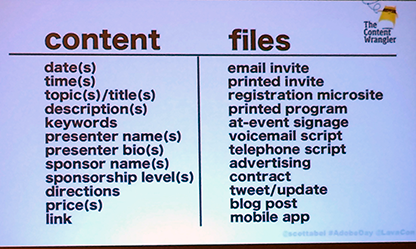
Component content management systems are needed. They focus on the storing of content components that are used to assemble documents. Components can be in all sizes, and can be photos, video, and text. It’s about managing CONTENT not FILES.
Scott provided these slides as his example to show this:
Structured content, combined with a component content management system, supports personalized content and targeted marketing, which in turn increases response rates. In this end, this process can save money! The key is to remember that all customers are not the same! Reusing content without the “copy and paste” methods produce the best results. You can ensure that content is consistent by seeking a content strategist who understands content and is a technologist. Implement a component management system. Scott suggested checking out Astoria Software for a good component content management system.
At this point, Scott’s talk had pretty much finished, but in answering audience questions, he pointed out that there’s a lot more than just these five technologies to watch. He suggested that we should look out for wireless electricity, flexible surfaces, more wireless devices, wearable computing, and augmented reality as well. He also said that in order to mature as a discipline, we need to be content craftspeople, content designers and content engineers. We need to leverage using content and code. We need to think more like engineers, and less like writers and editors. Even websites that are very localized still need to be written for global purposes to improve the English used for the native speakers as well. Controlled vocabulary helps all end users!
Scott covered a LOT of information in a short amount of time, and he set the tone for the rest of the session, as the presentations that followed repeated much of the same information. (This is a good thing, because then we know that the information is valid, coming from several experienced technical communicators!)
Scott posted on Twitter than his presentation was available on SlideShare, but I have it below.
And as always–Scott, if I misinterpreted or misquoted any of the information I summarized above, please let us know in the comments!

 When the one-day opportunity to order Google Glass came up recently, I jumped on it. I had tried on Marta Rauch‘s pair a couple months ago, and had seen her presentations about it, and fell in love with them. This was wearable technology I could use, as far as I was concerned! I was able to order the Glass I wanted, and was very excited about it…until I told my husband. I didn’t tell him how much it cost, but I did tell him that I bought them. He totally flipped out, but not in a good way. He felt that whatever I did spend on them, it was too much money for a “toy”. I’m earning some good money now, and I felt it was an investment–I’d like to explore how they are used, and how technical communication and m-learning would be part of the wearable technology experience for myself. But no. I cancelled the order, as he had a good point about the cost being too high. Even so, I’m really sad about missing out on this opportunity.









 TechCommGeekMom
You must be logged in to post a comment.