Posted in Uncategorized

What Does Knitting Have To Do With TechComm and m-Learning?

I’m so glad that this is now my 200th post on this blog! TechCommGeekMom has come a long way since it started out as a class project in grad school, now hasn’t it? For this particular post, I’d like to share my thoughts on something that I’ve been thinking about for the past two weeks or so.  It reveals one of my hobbies to you, but hopefully you’ll like the analogy.

As you’ve seen in the subject line of this post, I’m going to be talking about knitting and how it relates to tech comm and m-learning. Now, I know what you are going to say. Knitting is for grandmothers who make ugly stuff for everyone, and you are obligated to wear it when she comes over and visits. You couldn’t be wrong. Knitting has had a huge upsurge in the last ten or so years, and more and more people are adopting it as a hobby. It goes back to the 9-11 attacks, when people were trying to get back to a sense of security and home. I think with economic times, it’s also a relatively easy and inexpensive hobby to have (unless you are a true diehard like some of us).

Knitters these days make more than clothing items, accessories and toys, but it’s become an artform unto itself. (Ever hear of yarn bombing?)  I can’t remember when I started knitting exactly…but I’m guessing it was around 2004 or 2005. I know I was knitting in 2006 when I went to California for a convention for the now defunct Body Shop At Home businesses, and met Anita Roddick, as there’s photographic evidence of knitting in my hands during the event. In any case, it gave me a chance to learn something new that spoke a whole other language of its own, had a different vocabulary, and I got to work with all sorts of colors and textures in the process. For someone with sensory integration issues, it’s a great outlet for sight and touch. Even the rhythm of knitting up something has a calming effect, and following patterns forces my brain to focus.

So what does all this have to do with tech comm and m-learning? Well, as I thought about it,  there’s definitely an analogy that could be made about the benefits of knitting and how they lend themselves to these topics.  All this first came to me after I had spent the day at Adobe Day, and later took a small soujourn into the city of Portland with four fabulous technical communicators who also happen to be knitters. They had invited me to go on a yarn crawl with them (similar to a pub crawl, but in search of high quality yarn instead of libations), and I readily accepted. We only made it to one store, but we had a great time checking out all the high-end yarns and knitting notions available.

Pardon us drooling over the yarn!
Five technical communicators who
are also knitters! We know!
At KnitPurl, Portland, OR, during LavaCon
L to R: Sharon Burton, me, Sarah O’Keefe,
Marcia R. Johnston, and Val Swisher

As I reflected on Adobe Day, one of the big themes of the morning was the idea of using structured content. Without structured content, all of one’s content could fall apart and lose strength. An architecture needs to be created to make it work. Well, knitting is like that. If one doesn’t follow a pattern, and just knits in a freestyle, haphazard manner, instead of a nice jumper/sweater, one could end up with a garment with no neck hole and three sleeves. Without the structure of a pattern, and even reusing good content (or stitches, or groupings of stitches describing appropriate methods for structure), the whole thing falls apart. The beauty, too, of reusable content in content management, just as in a knitting pattern, content that is produced well, is solid, and the reader can understand clearly and concisely will produce good results, and can be recombined effectively in different instances without losing its meaning.  Take a look at a sweater or knit scarf you might have. You’ll find that each stitch makes sense, even when you look at different pattern of how the cuffs and collar differ from the sleeves and the body. But it all fits together.  In my mind, this is how reusable content can be used.  Very tight, well written content can be reused in different combinations without losing its context and form if done correctly.

The other way I thought of the analogy of knitting again had to do with how one learns how to knit, and how it relates to m-learning. Knitting fair-isle sweaters, Aran sweaters or lace shawls doesn’t come on the first day of learning how to knit. Heck, I’m even still learning how to do all these techniques! It comes with learning a foundation–namely the knit stitch and the purl stitch–and building upon that foundation. Any piece of knitting you see is all a matter of thousands of knit and purl combinations to make the item. But first, one has to master the simple knit and purl stitches by learning how to understand how to gauge the tension between the needles, the yarn and your fingers. Once that is mastered, then learning how to read the “codes” or the knitting language of K2, P2, S1 (that’s knit two, purl two, slip one), for example, then the real fun begins. Knitters have to pay attention to details in the directions, because knitting can be a long task. Except for tiny baby sweaters or sweaters for dolls or stuffed animals, I don’t know any sweater that could be hand knit in a single day, even if it was done from the time the knitter woke up until the time the knitter went to bed. It just couldn’t happen, even for a fairly experienced knitter.  So, each part of the knitted pattern must be learned or read in chunks so the knitter can understand where he or she left off.  Talk to me about lace patterns especially, and it’ll make more sense. But each technique takes time to master, and most knitters learn these techniques a little bit at a time. Whether a knitter is self-taught or taught in a conventional learning environment, nobody learns all there is to know about the most advanced knitting techniques on the first day. Just getting knitting and purling down takes a while. It’s an arduous task to learn to knit and knit well, and to be patient enough to see a pattern all the way through.

Just like in m-learning, things need to be learned in small chunks for comprehension. Information has to be short and to the point so that the reader, just like the knitting pattern reader, can take that information, mentally digest it, and then work out how to use the information. There is definitely trial and error in both m-learning and knitting; if one doesn’t succeed, then it’s possible to go back and try to re-learn the information and correct it, and in doing so, retains the information better.

Now, if one happens to be BOTH a technical communicator AND a knitter, then these are easy concepts. Reusing content, breaking down information into smaller portions for better learning retention, structuring the content appropriately and consistency comes both with our words and our stitches.

A variety of tools can be used in either case to create the content. For technical communicators, it’s the use of different software tools that help us achieve our goal. For knitters, different sized needles, different kinds of yarns and other tools can be used in the process. Is there only one way of doing things? Of course not. Is there any single tool that will do the job? Generally, no. This is the beauty of both technical communication and knitting. In the end, the most important tool is the mind, because without the individual mind, creativity and intellect cannot be expressed. When all of these tools and factors work together, it is possible to create a fantastic piece of work. When this combination of factors aren’t followed, it can look pretty disastrous.

So, next time you see someone with a pair of knitting needles in their hands, look carefully at the workflow that person is following. You might learn something from it.

Posted in Uncategorized

Welcome to TechCommGeekMom’s First Advertiser!

Just a quick note to have you notice something new on the right-hand column of my blog. It’s an ad for our first advertiser, Adobe!

I’m very excited to have this relationship with Adobe, who have been just huge supporters of TechCommGeekMom.com since the blog first started. Please be sure to click on the ad and check out the Technical Communications Suite 4! I did a review of TCS4 back in July which has been received very well, so here’s your chance to check the product itself out!

Hopefully this is the first ad support of many more to come.

If you, someone you know, or your business is into technical communications, education or e-learning, and are interested in advertising on my blog, let me know!

I am an equal opportunity blog here, and I would like to be able to help present the best products on the market when I can, and I’m off to a great start.

Thank you, Adobe!

Posted in Uncategorized

Remote and Mobile are not the same thing…but could or should be.

TechCommGeekMom is back! I’m sure you didn’t notice that much, but I was away for a week at the beach (or as we Jersey gals say, at the shore) in South Carolina, and while I wasn’t totally away from technology the whole week, I didn’t stay in touch with it as much as I usually do either. Hopefully, I can make up for some of that this week!

Just because I was away, it didn’t mean that I wasn’t thinking about tech comm, e-learning or m-learning while sitting on the beach. Quite the contrary. I had things going on related to all those topics that I still needed to keep up. And sitting by the ocean, listening to the waves, as well as traveling in lots of places far from home and working somewhat remotely got me thinking about the topic of working remotely and mobility, or rather mobile working.

I was actually put to the test in some respects during the trip. There was some important business correspondence that was going on during the week, and I had only my iPhone and trusty iPad, and spotty wifi to enable me to communicate with the “outside” world. I didn’t have the comforts of working from home with my laptop and reliable wifi connectivity that I have at home. (I do live in “Einstein Alley”, after all, so reliable wifi is almost a requirement where I live!) If I went to one of the Starbucks near where I was staying, then there was good wifi, and I could catch up with some of that correspondence. But if I was in my hotel room, it depended on the time of day and which room I was in, which was not exactly convenient.

As we travelled down some country roads before hitting the main highways on our way home, I started to think about mobile learning in these areas. How, in many respects, is this area that I was traveling through any different from any other remote area of the world, where education isn’t always cutting edge, and computers are difficult to access? The mom in me thought deeply about the educational part of this. If I lived in an area that was distant from a lot of technological access, but wanted the best education possible for my child, how would that be achieved?

My imagination first made me think about remote education. What is that? It could be online learning, or even just something static, like the equivalent of a correspondence course. How would that work in a classroom or standard educational system that is not near any major towns? Connectivity is the key for that. Having that connectivity would be greatly needed for the students to learn. Learning about what is happening in the “outside world” will open the minds of students not only to new ideas, but also how to bring those new ideas to their community. For example, would learning a new technology help with growing crops or improving productivity in some sort of service or manufacturing process prevalent in that community? I’m sure it would.

In my opinion, the Internet has always been an educational wonderland, much like how television and radio opened up possibilities and expanded our knowledge of the world. To deny that to the students of today would be a disservice, especially since so much more information is available through the Internet than radio or television alone. How does something work? A student can watch a YouTube video about it.  Who was Salvador Dali? A student can find Wikipedia and other sites that talk about the artist and see photos or video of his works.  Confusion about how to do algebra? Students can watch a video on Khan Academy. Newspapers from all over the world are online, and students can learn difference perspectives on world events as a result. There are so many possibilities!

But is mobile the solution to having a remote education? Yes and no. I think with the examples I showed above, a standard desktop or laptop can help achieve those activities quite easily. In many remote districts, I imagine that there isn’t the money in the school budget to provide that many desktops or laptops, but gaining that exposure would be worth the expense if it could be done.

To add mobile functionality to the mix would definitely enhance this process. Having a tablet computer such as an iPad or Kindle, or even using a smartphone would increase the learning capabilities. It would allow for more interactive learning. It would allow students to take their own video and photos to share with others. Learning could be done in the classroom, or even on a field trip or outside the confines of a classroom–including at home. All the benefits of mobile versus desktop would come to the forefront of reasons to use mobile for learning. Additionally, as smartphones are often more readily available and purchased, even in remote areas, mobile is possible and accessible in those hard-to-reach locales.

So, one has to understand that remote learning is not the same as mobile learning. Simply because one is out of reach from centers of society doesn’t mean that education about the outside world can’t be accessed, but with Internet connectivity, that experience is enhanced greatly. Correspondence courses of yesteryear (and modern day as well) show that you can be away from a learning source, and still gain knowledge needed. Online courses have been proving that in the last two or three decades as well. However, mobile enhances the e-learning experience greatly, providing greater flexibility for how a student can learn and when he or she can access information to learn. With the proliferation of smartphones and tablets exponentially growing every year, even in remote areas, mobile will enhance and promote changes in that the remote learning process, and in turn, the m-learning industry will change and grow.

So, my question to you, dear reader, as a tech comm or e-learning/m-learning professional, how are YOU going to help those learners who are far away from conventional resources? It’s something to think about when writing or creating courses or documentation that will help the end-user.  Mobile documentation is different because it can reach even more remote areas than ever before, but how it’s created and used is key in how successful it can be in helping those end-users, whether they be students or various professionals. Look at the photo that is at the top of this blog posting. How will you provide information to the inhabitants of that small island? Think about it….

Posted in Uncategorized

Why Mobile, Gamification and Special Needs Are Made for Each Other

As the school year has started for some and will start during the following few weeks ahead, my thoughts start thinking about conventional learning and how educational technology has changed so rapidly, especially in the last few years.

Now, before I continue, I just want to preface this by saying that much of what I will be writing below isn’t based on any scientific study, but rather it’s based on my own experiences and knowledge.

I recently saw this article, and even retweeted it:

Autistic Student Feels Reinspired by Online Learning

I was so glad to see an article like this. We are constantly shown articles or videos about students who are much lower functioning than this kid, who are breaking through the communication wall through various apps on iPad. But I find that higher functioning autistic kids have a much harder time as the gap is much narrower, so it’s hard to define where the fine line between effective communication and ineffective communication is.  As a result, these kids fall through the cracks of the system. Seeing that the young man in this article found a solution through online studies is fantastic, and I can relate to it a lot.

I am sure that I’ve mentioned many times before that my son is autistic, but much like the young man in this article, he is very high functioning autistic. My son is so high functioning that the actual autism diagnosis eluded us until he was 9 years old, and that was after already going through several other diagnoses and still feeling that something wasn’t quite fitting right.  Through my son, while I have not gotten an official diagnosis, I’m pretty convinced that I am an Asperger’s Syndrome person myself; I have displayed so many of the same symptoms as my son, but I did not have the speech problems he had when he was younger (he’s fully language fluent now, due to early intervention and persistence). Even as a mother, I marvel at the various apps that are out there that could have helped my son when he was small, and I wish that we had access to it back when he was small.

My son is a smart boy. However, if something doesn’t interest him or doesn’t serve any meaningful purpose to him, then he’s unwilling to do the necessary schoolwork. As he’s gotten older, this has been problematic. He’s also a kid, and when it comes to mathematics, he doesn’t get the rote information down right away (like understanding his multiplication tables). But, show him how to do a mathematical function, and he can pick it up fairly quickly. He’s not always interested in reading, but he was reading when he was about 3, and when he reads something that interests him, he practically has the resource information memorized. He takes in videos like nobody’s business. Ask him anything about Super Sentai (the original Japanese Power Rangers), Kamen Rider, Power Rangers, Beyblades, Bakugan or Pokemon, and he can tell you everything about them.  He also has a fascination with the sciences, especially physics, so when the Higgs Boson was recently proven, I asked him if he had heard about it, and he said, “Yeah, what about it?” and he explained what it was, and didn’t know that it had actually be proven.  Keep in mind, the kid is only 11.

Yet, he struggles with school. It’s hard for him to focus, and sometimes he’s still processing things in his head when he’s paying attention in class. He can’t take notes to save his life, but he can learn from them.  School is a difficult chore for him, and it takes some creativity to engage him to learn. He’s definitely capable of learning, but he can’t always learn by conventional means. He has a very difficult time with writing skills as well, which has been a struggle since he was small.

I can relate to my son on so many levels academically. I think this is why I end up being the one to do homework with him most of the time–I know how to “translate” things in a way that he can understand. I also had that same combination of hyper-focus on some topics, and total distraction on other topics, and had a hard time with school as well, even though I did well for the most part. If I had half the tools and support he has now when I was a kid, I would’ve been valedictorian of my class, I bet, but instead, I had to fight my way through much of school to get decent grades.

So, when I read the article above, I could relate to it so much because of my son, but also because of my own online experiences getting my Master’s degree from NJIT. My degree was 100% online, and despite what anyone would think, it was a very social event, yet I could pace myself the way I wanted (well, within reason–I still had deadlines for assignments and such).  I want to say that the success in earning my degree and getting a straight “A” average was due to hard work and the quality of the program–which it was, but it was more. It was the delivery system. I’m very convinced that if I had done this coursework solely in a classroom environment, while I might have done well, I don’t think I would have done THIS well.  Being able to set up my own schoolwork routine, read at my own pace, respond to forum threads and work on assignments at my own pace were a huge part of it. I’ve found for years that social media and just being connected to the Internet is not only addictive for me, but essential for me. It’s how I’m able to socialize more effectively and learn more effectively as well.  For all those naysayers that say there’s no such thing as “learning styles,” I say, “Poppycock!” I am a living example of someone who needs to be taught more on a visual level than an audiological level; I have sensory issues but am simultaneously a sensory learner.  My son is the same way.

So what does this have to do with mobile learning and gamification? EVERYTHING! There seem to be more and more studies that “typical” learners learn as much or more with mobile options and gamification methods. Imagine what it can do for special needs learning! My son is a big of a gamer, and I know at his age I love the earliest electronic and digital games myself.  Even now, I’d much rather play an online game to learn than read my dry textbook. The trick for high-functioning special needs people like my son and I is that we–as I mentioned before–fall between the cracks; we don’t need things dumbed down for us, but we do need a different method to get the same information into our skulls, and everything is either over simplified and babyish (like some of the math games that he can play to get those multiplication facts into his head), or there isn’t something that is sophisticated enough that can achieve the same thing.

I envy my son, because e-learning is SO much more than it was when I was growing up. Heck, just having Internet access and email and social media is much more than what I had  when I went to school. Getting my Master’s degree was the first time I could use such resources, and given the right tools as these digital ones, I could fly (metaphorically speaking). I want to see my son fly as well, as I know he’s capable of it. I try to find lots of physics game apps for him on my iPad, which he zooms through with ease. I need to find some age appropriate math apps, writing apps, and other apps that can help him learn without him realizing he’s learning, or at least make it more enjoyable. I want him to feel successful in whatever he ends up doing, and I want him to feel that learning is a lifelong endeavor, and that he is capable of finding the resources he needs to accomplish what he wants. We are still figuring this out, but like I said, the world is his oyster, and he needs to learn how to access it all, and I think he’s already on his way since he found the Super Sentai on his own (and yes, he watches these Japanese Power Rangers episodes on YouTube, in Japanese, sometimes subtitled, sometimes not, but he doesn’t care–he picks up what all of it’s about anyway).

Being that my son is a big gamer, he enjoys and adapts to games well.  He was fortunate, this summer, that his summer school math teacher picked up on the idea of gamification, as every day my son and the other kids in his class would play a card/board game that would teach math skills. He enjoyed it very much, and there was a social skills aspect to it as well, which helped. Granted, it was not a video game or digital online game, but the principle is still the same–it was a game, and he was learning the skills he needed to learn.  So many online games can teach without one realizing it, and making learning so much more accessible.  Even the popular Angry Birds game–one of my son’s favorites–is actually a fantastic game that teaches physics and problem solving skills. I don’t say no to him playing Angry Birds on my iPad or iPhone.  He’s learning, at least, and developing skills that may help in the future as some sort of engineer.  Even as an adult, I can say that I would enjoy something more interactive online than something static or something that’s essentially a page-turner.

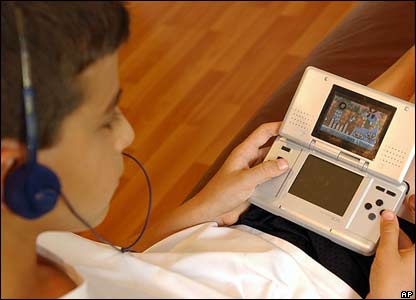
This is where mobile comes in. We all know the benefits of m-learning functionality, such as providing just essential information, having web capabilities to interact not only with others, but use tools like social media and researching on the web, and sharing resources is a big deal. Even the nature of m-learning is beneficial, because good m-learning design breaks things up in to small pieces than if it was done as a regular desktop course or classroom lesson. With m-learning, a child can record the class while attempting to take notes, and listen to it later while doing homework, rewinding parts of the lecture while rewriting or filling in missing information in notes.

I know for me, it was a big deal to be able to manipulate my studies to make them mobile. I would use the Microsoft OneNote app on my iPad to do initial drafts of homework assignments during my lunch hour, and then sync up my notes so that I could pull them onto my laptop later to clean them up more on my laptop at home. I could watch video or listen to a podcast on my iPad or iPhone, stop it and restart a section if I didn’t quite catch it–or even just stop so I could catch up writing notes first, then continue. You can’t do that so easily in a classroom. I could pace myself much better, and as a result, my retention was better because I could review details as needed.

This is really important for Aspies as they want to take in everything, and very often it hard to keep up because we are still deciphering and translating information given in our heads while the information keeps feeding. Sometimes our brains can’t process quite as quickly, so by the time we have a piece of information processed and we are ready for the next bit, instead of one new piece of information, then next five have happened. Keeping up and forcing oneself to keep up with the pace can be mentally grueling and exhausting. It’s not that we don’t have the mental capacity to understand the information, but rather that our internal processors are different. It’s like having last year’s processing chip in your computer instead of the latest and greatest. It’s not that the chip can’t handle it at all, but rather at a different pace. If you can gamify the information, then the information is learned on a subconscious level, and just like any video game, new skills are attained little by little as you proceed higher and higher in a game. It’s really THAT simple.

So, for you instructional designers, educational technologists and technical communicators that don’t think that gamification or m-learning makes that much of a difference–IT DOES. Believe me! Keep m-learning and gamification in mind. It not only lends itself well to typical learners, but can go miles farther for those with special needs.

Posted in Uncategorized

e-Learning – A Growing Field For Technical Writers | Immerse CMS

Read this article:
e-Learning – A Growing Field For Technical Writers | Immerse CMS.

This great little article makes a point that I’ve been trying to make on my own quest to find an e-learning positions. In no way am I putting down instructional designers, but as a trained technical communicator, I know that technical writers have the right stuff to be effective in writing for e-learning. Technical writers most often create user documentation and training manuals. With some creativity, imagination, and some quick learning of the basics of instructional design, technical writers can be quite capable of writing up e-learning content.

Now, with the advent of m-learning, the skills to be able to curate content and whittle it down to comprehensible, short yet clear information for smartphones and tablets will be vital. Technical writers are used to working with a mountain of information, and paring it down to the essential information needed to learn how to make something work or take a next step. Isn’t that a valuable skill to have as an instructional designer?

As more e-learning and especially m-learning programs expand, technical communicators are truly going to be needed to help bring things up to speed quickly to keep up with constantly emerging new mobile technologies.

So, if you are looking for a new instructional designer, think about giving a technical writer a chance. I’m sure there are plenty of them (including me especially) who would jump at the chance to write training materials in a new and exciting way, and technical writers already have most of the skills needed. The instructional design will come…most of the essential concepts aren’t that difficult. Give technical writers a chance!