
Posted in Uncategorized

Am I missing the TechComm party?

STC-Philadelphia Chapter members attending the 2014 STC Summit--including me!
STC-Philadelphia Chapter members attending the 2014 STC Summit–including me!

I’ll come out and say it–I like going to conferences. It’s a great opportunity to learn new information that can hopefully be applied upon my return from the conference. It’s also fantastic opportunity to meet–and later reunite with–tech comm friends whom you’ve previously met either in person or through social media. In the last few years, I found that going to conferences were a great way to truly immerse yourself in the tech comm culture. I’ve said repeatedly that when I’m with my fellow tech comm people, I feel like I’m with my “clan” because I belong with them much more than other groups I’ve been with.

But lately, I’ve started to feel a bit critical about conferences. I’m sure you are thinking, “Why would you be critical about them if you like them so much?”

First, there’s the cost. I know there’s a cost to doing anything, but geez, if it weren’t for waived fees due to volunteering, speaking, or other related work for a given conference, I wouldn’t have been able to go to many of them! It’s expensive! I know that some companies will pay for those travel, accomodation and conference fees, but mine won’t. I’m a consultant who works for an agency. If I don’t work, I don’t get paid. The company where I consult wouldn’t pay because I’m not an employee. So for the days that I’m at the conference, I lose pay (even though I’m doing professional development for myself that they can’t offer), and I end up spending almost the same amount as I would have earned during that time away–and again, that’s even with the waived fees I’ve mentioned earlier.

Second, there’s time. Conferences are usually just a few days, but when they are all over the country, and very few near me, it’s not only the cost to go somewhere far away, but also the time that’s needed to fly somewhere and back. For me going to the US West coast, that’s about two days right there. I applaud those who are coming from farther distances overseas, who can afford and make it over here, as it’s not only a huge cost, but a huge time commitment as well. Again, being an hourly contractor, I can’t take too much time off, or it affects my income.

Third, perhaps I’ve attended just enough in these years, but it seems like the same stuff is being talked about over and over. Like I said, maybe it just me. I know that sometimes topics need to be repeated because there are always new people who want to learn, and there can be a shift in interests. For me, I tried to delve into almost everything, and where my professional concentrations and interests lie…I’m not finding anything radically new. It’s more about reinforcing ideas I’ve learned before or experienced by trial and error. Nothing wrong with that. I also find that while a big push right now seems to making sure that silos are torn down between different departments and tech comm pushing for more visibility in company culture, it’s not exactly happening from my standpoint. It’s hard to be a one-woman army against a global company (although I’m still trying and am happy when I achieve a small success).  Should I be looking at new topics to learn about at future conferences? Maybe. I’ve also attended sessions where it’s something that I’m interested in, but in the end I can’t apply it, which is frustrating. For example, in content strategy, there seems to be a big push into content marketing, and the company I’m working for is still trying to grasp the basics of content strategy, so how can that help me at this point?Like I said, perhaps that’s my problem, and not the problem of the conferences.

Lastly, the best part of conferences is the worst part too–socializing. There were a few conferences recently that I would have liked to have attended. They were within my field, I’d been to one of them before, and I knew lots of the people who were attending. So many of these attendees are people whose company I enjoy very much, both as professional colleagues and as friends. When I go to a conference, it’s a fantastic opportunity for all those tech comm introverts to hang out together, and feel comfortable being themselves with no one questioning them. I know I can always find someone to hang out with at conferences, and I’ve made so many fantastic friends. So what’s the problem? When they go to the conferences and I can’t, I see all the photos and posts on social media about the great time they are having, and well…I feel left out. I know that sounds childish, but it’s true. I don’t get out much as it is, so conferences are a great way for me to get out an socialize with my tech comm friends, and truly enjoy myself in a relaxed atmosphere with people who can talk about life and “shop” and it’s all interesting to me. When I see everyone else going to these events and I can’t, I’m back to being the kid sitting in the corner feeling left out.  I hate it.  Again, that might be my personal issue, but I got the sense that I have some tech comm friends who also couldn’t go to some of these conferences this year had the same aching to be there too, but couldn’t, and felt left out. I know we were missed, as those who attended told us that they missed us–and I appreciate that, but it’s just not the same.

There are SO many conferences during the course of a year between STC local, regional, and national events, as well as independent conferences like Lavacon, IDW, Intelligent Content Conferences, GALA, TC-UK and so many more, nobody could possibly have the time or money to attend all of them.  Heck, so many are popping up these days, it’s even a struggle to choose which ones to attend! Being a working mom, I definitely don’t have time for all of them. The two that I missed this month were not only because of time and money in general, but because of the big project I’m working on at work needs my undivided time during my work hours because of an upcoming due date, and the load of work that needs to be done. I couldn’t break away even if I wanted to unless I wanted to fall severely behind in my work and work weekends and nights once I got home.  Even the few I went to last year had consequences for me going away when I did.

So what’s a person to do? I think the social aspect of it all gets to me the most right now. I truly enjoy the company of technical communicators, and I wish I could spend more time with them. I can’t even attend the local STC meetings for my chapter each month because of distance and time (not so much the cost). Yet, I see several of my tech comm friends always out and about at various conferences during the year, and I wonder how they can pull it off based on the issues I mentioned above?

I’m still grateful for social media to keep me in touch with all these great people I meet at conferences who have become my friends. But I still have to pick and choose conferences, going forward. I might not make it to the same conferences every year, partially because I want to check out new venues and paths. I’ve only committed to attending my local STC chapter’s regional conference so far , but I’m thinking of checking out another this year. I’ll most likely go to the STC Summit, but I don’t know that for sure. I’m thinking of seeing if I could do one overseas (Europe) instead of two on the West Coast, depending on what I can save up and swing financially.  I like travelling, andt I need to expand my horizons a little bit.

In the end, maybe it’s my inexperience that makes conferences tough for me. I’m always wanting to learn new things, and I know conferences do their best to bring new information to the tech comm masses. I can easily say without reservation that I have learned things that I could bring back and made me a stronger technical communicator. But how many can you attend before you feel like you’ve heard something before, or because it comes from people who are WAY more experienced than you, you’ll never completely “get it” or never have a chance to experience what they’ve done anytime soon? This is the frustration that haunts me.  For me, conferences are the best option for professional development, and yet it’s hard to get excited about some of them. Personal burnout? Maybe. Yet, I ache to see my tech comm friends, because I enjoy seeing them so much. It’s a dilemma.

For those of you who have been technical communicators for a much longer time than me, how do you do it? How do you choose? How are you able to work with the time and cost issues, as well as finding conferences that will engage you other than socially? Let’s talk about it in the comments.


Posted in Uncategorized

One Morning with Google Glass Was Enough for Me!

Here I am with my Google Glass package, sad that the experience wasn't more, and the price was significantly less.
Here I am with my Google Glass package, sad that the experience wasn’t more, and the price was significantly less.

As disappointed as I was that I’d have to return my Google Glass because it really wasn’t in the budget, I knew there was a 30-day trial to use Glass, so my husband suggested that perhaps I should give the trial a whirl, and if I still liked it, I could purchase it again later when the price goes down. I wasn’t keen on the idea because I was afraid that if I liked the product enough, I’d be reluctant to return it. Despite his encouragement to try Glass first, my husband didn’t help the cause, as he’d constantly be emailing me negative articles about Glass.

Nonetheless, I decided that I’d forge ahead and give Glass a try. I didn’t even last one morning.

Upon receipt of my Google Glass, the Glass didn’t have enough charge to even set up my account on the device out of the box, so I had to charge it overnight. Even with an overnight charge, it was only at 88%. Something’s not right with that. You’d think that with such a small device that a) there would be just enough charge in it to set it up, at least, and b) that charging it overnight would put it at 100%. So, not a good start, but by the next morning, 88% was enough power to be able to set the device up.

Now, I hate to compare apples to oranges, but I couldn’t help but make mental notes of how much the experience was nothing like dealing with an Apple mobile device. Yes, I know that Glass is not a smartphone, but it does connect to one’s smartphone, after all. I’ve done the set-up of my son’s Android smartphone (and I will admit, I’m no Android expert) and set-up 4 iPhones and 2 iPads over the years, so I think I have a good idea of what a good out-of-the box experience should be.  I’m also fairly adept at figuring out new technology, and have been the “tech person” in my family for decades, even before digital technology was mainstream. Add to those credentials that I am a technical communicator, so figuring out how to set a digital wearable device should be par for the course.

When I used an iPhone for the first time, I could figure out everything instantly. Apple walks you through set-up directly on the device, and nothing extra has to be done on another device paired up to it. Google Glass had some directions in the viewing screen (for lack of a better term), but it took me a while to set the device up so that it could connect to my phone and read the QR code that the app had to read to connect and activate the account. I had also read the Google Glass online help files on my laptop as I was doing this. It’s not a good sign, to me, if I have to read the website simultaneously while setting the device up. Even then, the directions weren’t that great. It assumed that everything would go smoothly, so set-up would be a snap. However, mine was not, and I couldn’t find any answers to problems I had.

Eventually, I did figure out how to get Glass set-up. I was connected to my Google account, and ready to go. It was early in the morning, and I decided to try it out, let me son see how it worked, and my husband was curious to see how it worked, too, even if he was the naysayer against it.  Because I didn’t want to accumulate too much personal content on the device, I tried to be careful about not taking video or photos, as I needed to learn how to download apps and manuever the device first.  My son liked what he saw, and I had him do the instruction, “OK, Glass, Google Minecraft,” and it did. He liked it. But, being that he is a rambunctious 12 year old boy, I didn’t want him wearing this expensive device for long. It was then my husband’s turn.

polish-chicken-11
This is a Polish chicken. And this is what my hair looked like that morning (more or less).

Before I could try to instruct him on how to manuever the device, my husband decided that he already knew how to use it based on viewing the Saturday Night Live skit from a while back. I scolded him for just trying to do things randomly, and I wanted him to give them back to me if he wasn’t going to give me a chance to explain how to use them properly–based on my limited knowledge at that point. The next thing I know, he proclaims, “OK, Glass, take a picture.”  In full glory, in my rumpled NJIT pajamas, angry face, and Polish chicken hair because I had not gotten ready for the day, he had a photo of me. I was not happy about that. He then asked, “If I wanted to send this, what would I do?” At this point in the story, he and I differ on the account, but since it’s my blog, I’m telling it my way.  He started to say, “Would you say, ‘OK, Glass, send an email…’?” and when he realized that he’d actually be sending an email, it opened up to THAT PHOTO.  “Oops!” he claimed, and tried to back out of it. He did say, “Cancel,” a few times, but nothing happened. But somehow, the photo did get sent, and it was sent to the first person listed on my Google + list, whom I don’t know personally! How embarrassing! I had to get on my laptop later, and send a note to her in Google+ explaining the situation, that I wasn’t sending a photo of a crazy, angry bag lady on purpose, etc.  By that time the Glass was confiscated,  that was enough to get me on the wrong foot with the device even further.

After everyone had left for school and gone off to the office, I had a little time to myself to try to figure more about this. One of the biggest flaws I saw with this device is that it’s not intuitive. As I mentioned, the set-up was not smooth at all. I found that I couldn’t figure out for the life of me how to delete the photo or the Google search from the Glass unless I reset the device back to factory settings. That can’t be right.  Additionally, I couldn’t figure out how to get to a screen to add apps. Again, that doesn’t make sense. So, I went back to the Google Glass Help online to try to figure that out. I couldn’t find any instructions on how to add apps. Additionally, I saw that there were less than two dozen apps available at all! Geez, that doesn’t seem like a lot. I know that this is a product that’s still in development, but you’d think that after a year, Google would have more apps than what I saw.

So, when I took into account how the product wasn’t intuitive, had very few apps, had no ability to delete things (I was able to delete the photo in my Google account via my laptop, but shouldn’t be), plus the exorbitant price, I succumbed to what my husband had been telling me all along. It wasn’t right for me.  So, I called Google to ask for the return labels so I could send it back and get my full refund.

Believe me, I was really frustrated with this product. Although my family thought it was cool, they also felt that it wasn’t so easy to figure out how to use it seamlessly, and we’re all fairly technical–even my son. But for something that was the price of two new iPad Air devices or laptops that had much more functionality, I had one funny pair of electronic eyeglasses that didn’t do a whole lot.  The experience was disappointing, and I didn’t want to pursue it further–that’s how frustrating it was in one morning.  To quote my husband, “If Apple had come out with these instead of Google, it would be cheaper and it would be a completely different experience.” This is coming from a guy who’s very reluctant to use Apple products in the first place, and he even came to this conclusion. The sad thing is, he’s right. When watching that SNL skit again after this experience, my experience wasn’t too different, except the character in the skit got apps on his Glass, at least. The scary thing is, that skit was done a year ago, and nothing has changed since that time!

Despite this less than stellar experience with emerging technology, I think if the price came down significantly, the intuitiveness of the product was better–including understanding how to delete content and add apps, and there were more apps to use, then I’d definitely reconsider getting Glass again in the future. The product isn’t ready for primetime, in my opinion. Even the iPhone had more features on it when it first came out in the first year than this has.  I initially got interested in Glass after seeing my friend, Marta Rauch of Oracle, using them, and seeing her presentations about the product’s many capabilities. I wouldn’t have rushed to purchase the product and have a chance to use them if I didn’t believe that there was a true potential in the product. I think Marta has more of a chance to play with them and see the potential because she uses them professionally as well as personally. Part of her job is seeing how Glass can be integrated in projects and products that she’s working on at Oracle. I don’t have any such projects or products I’m trying to develop.  And as I said, I do think there is potential for a wearable smart device.

I don’t think Google Glass in its current state, however, is the product for me right now. Once some of these issues are fixed, I’ll see about giving it another try. Believe me, I’m really disappointed, but at least I can get my money back, and Google is being fairly cool about me returning it. And yes, I’ve given them this feedback–twice.

Do you think I didn’t give it a chance? Do you think I was crazy to even try it in the first place? What do you think about such devices? You can put your response in the comments section below.


Posted in Uncategorized

Is it a tech toy or an investment?

google-glass-rachel-king-2948When the one-day opportunity to order Google Glass came up recently, I jumped on it. I had tried on Marta Rauch‘s pair a couple months ago, and had seen her presentations about it, and fell in love with them. This was wearable technology I could use, as far as I was concerned! I was able to order the Glass I wanted, and was very excited about it…until I told my husband. I didn’t tell him how much it cost, but I did tell him that I bought them. He totally flipped out, but not in a good way. He felt that whatever I did spend on them, it was too much money for a “toy”. I’m earning some good money now, and I felt it was an investment–I’d like to explore how they are used, and how technical communication and m-learning would be part of the wearable technology experience for myself. But no.  I cancelled the order, as he had a good point about the cost being too high. Even so, I’m really sad about missing out on this opportunity.

Financial considerations aside, it got me thinking about technological “toys”, and what’s truly a “toy” versus adopting early technology, albeit at a high price initially. I’ve heard Neil Perlin talk about how he had some of the earliest portable computers around–nothing like the laptops of today–that cost a small fortune even by today’s standards. Sure, it’s outdated and obsolete technology now, but so are a lot of other technologies that were around just a few years ago. Children today don’t know what a Walkman is, or that telephones used to actually have a cord and you actually used a dial mechanism to connect your phone to another phone. Heck, pay phones are pretty much obsolete now.  What did people think when the first iPhone or the first flip phone came out? Those are obsolete now, too.  So, sure, perhaps Google Glass is a very expensive “toy”, but how does anyone know if perhaps I was really an early adopter and I’d be ahead of the curve for knowing how to make it work and use it for practical reasons if I had actually gotten one?

I remember when I got my first iPad–it was an iPad 2. I had saved up, and asked anyone who was going to be getting me a gift for my birthday, holidays, etc. to give me gift cards to Best Buy so I could purchase it.  I was so thrilled when I got it, and my husband thought that was a waste of money. He insisted that I already had a laptop, and didn’t need an iPad, that again–it was just a toy. I insisted that yes, there were “toy” elements to it, but I considered it “computing lite”, where I could do many tasks that I normally do, but the ones that didn’t necessarily need my laptop to be powered up. Then, about a year later, I was fortunate enough to win an iPad3 so I could upgrade. My husband had insisted that I sell my old one, but for all his moaning that I should get rid of it, guess who’s been using it for almost two years now? Yep, him. It’s still a little bit of a “toy” to him, but he’s a news junkie, and he loves to read different news sources and some light research on it when he’s not using his desktop (nope, he doesn’t even own a laptop). So, it’s not going anywhere. My iPad has gone with me all over the country–on vacation, to conferences, and has entertained me when I don’t need to be in front of my laptop. I’ve gotten my money’s worth out of mine multi-fold. And yet…I feel like this is the same situation.

Of the emerging techologies that are coming out, whether they are wearables or something else, what do you think is a tech “toy” and what do you think could be the next big thing, or a step towards the next big thing? 3-D printers and Google Glass have my attention–I would love to own both of them. What has your attention? Add your thoughts to the comments below.

Posted in Uncategorized

Adobe Day @ Lavacon 2013: Scott Abel’s 5 Technologies Tech Comm Can’t Ignore

voodoodonutsignI realized as I was writing this post that this would be my 500th post on TechCommGeekMom. Who knew that so much information and thought could accumulate through original posts and curated content?  I’m also very close to my all-time 15,000 hits mark (only a few hits away at this writing). I wouldn’t have believed you if you told me that I’d hit these benchmarks when I started this blog, but of course, I’m going to keep going! I debated about what I should write for my 500th post–whether to finish my Adobe Day coverage or do something else, and in the end, it seems fitting to finish my Adobe Day coverage, because in many respects, knowing and writing about the presentation of Scott Abel, aka “The Content Wrangler”, shows how far I’ve come already in my tech comm journey from beginner to covering internationally known presenters.

Scott is one of the most prolific and vocal speakers out there on the conference circuit speaking about content–whether it be content management or other technical communication topics.  It also seems like he has written the forewords of many of the best tech comm books out there. He’s everywhere! To boot, he’s an accomplished DJ, and I found myself “bonding” with him over dance remixes and mash-ups while at Lavacon, because I always enjoy when he posts either his mash-ups or his favorite mash-ups on Facebook. (I’ll be writing a post about the relationship between tech comm and dance mash-ups in the near future.)  He is a person who is full of so much kinetic energy that you wonder when he’s going to explode, but he doesn’t. Even the time I saw him at the STC Summit last spring with a bad cold, he was still more on top of his game than a lot of people would be on a good day.  Much like Val Swisher, my love for all things Scott Abel also knows no bounds.  He knows how to stir things up at times, but there is no denying that in his frenetic pace of delivering a presentation, you learn SO much. I’m lucky that he’s so kind to be one of my cheerleaders!

ScottAbel
Scott Abel checking his files before his presentation

So when it came to thinking of a garden in Portland to use as an analogy to Scott, I had to deviate. In my mind, he’s the Voodoo Doughnuts shop located about four or five blocks away from the Chinese Garden. Scott’s talks always have lines going out the door, and like many of the Voodoo Doughnuts themselves, the unique flavors dispensed open your mind up to new and delicious possibilities and ideas, and you come back wanting more (hence, more long lines!).  They are both crazy and sweet at the same time. You can’t beat that combination.

Scott was the keynote speaker for Adobe Day as well as the moderator of the discussion panel later in the event. Scott’s topic for his talk was called, “Five Revolutionary Technologies Technical Communicators Can’t Afford To Ignore.”  If Joe Gollner went fast during his presentation, then Scott went at lightning speed, so my notes below are the highlights.

Scott started by telling us that translation is going to be an important part of automated content going forward. It’s important to understand that for the web, the World Wide Web (WWW) is equal to the “land of opportunity.” The WWW can reach a global market reaching new consumers. As American users, we forget that 96% of web users are not in the US. We don’t all speak English globally. In fact, less than 6% of the global population speaks English well, but don’t necessarily read or write it well.

Scott’s list of the five technologies the Tech Comm can’t ignore were as follows:

1) Automated Translation
Why would be need automated translation? We write for the *worldwide* web.  There are over 6000 languages in the world, so translation is a big deal for a global reach and global connection. We need to recognize that content is written for both machines and humans. Even though we write for both machines and humans, we need to write for machines first, as they are the “gatekeepers” of content, such as for searches. Everything goes through the machine first. We need to recognize that writing rules learned in elementary school are no longer sufficient for a world in which language science is needed.  We need to examine our content from the vantage point of a rules-processing engine and ensure it’s optimized for machine translation.

2) Automated Transcription
Automated transcription involves software that translates speech to text for machine use. Without transcription, content is locked and hidden from view. Transcription allows for better searchability of content.  Scott recommended Koemei as a good transcription software tool for video and general transcription, as it can help transform editable content into other languages.

3) Terminology Management
Terminology management controls words in a central place, namely the words used the most and used consistently for branding, products, etc. Terminology management is important for consistency as well as for regulatory reasons. This is an instance where seeking a global content strategist is needed to help standardize processes.  It’s best to adopt a terminology management system, such as Adobe partner and Scott’s suggestion, Acrolinx.

4) Adaptive content
Adaptive content is content that is structured and designed to adapt to the needs of your customer; it’s about substance of the content. Adaptive content adapts to the devices, e.g. laptops, GPS, and smartphones.  Customers are demanding exceptional experiences, so we need to meet their expectations, so it’s up to responsive designers to meet that challenge. Adaptive content makes it possible to publish to multiple platforms and devices.  It is content separated from formatting information. By allowing authors to focus on what they do best, adaptive content makes content findable and reuseable by others who need it. We need to rethink content, as the move to adaptive content involves work, but the ROI (return on investment) can be realized in months instead of years.

5) Component Content Management
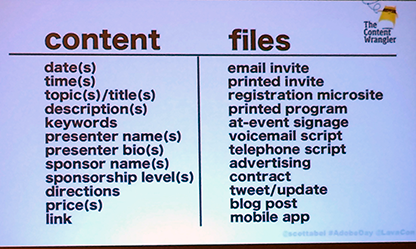
Component content management systems are needed. They focus on the storing of content components that are used to assemble documents. Components can be in all sizes, and can be photos, video, and text. It’s about managing CONTENT not FILES.

Scott provided these slides as his example to show this:

ScottAbel_ExampleA ScottAbel_ExampleB

Structured content, combined with a component content management system, supports personalized content and  targeted marketing, which in turn increases response rates. In this end, this process can save money! The key is to remember that all customers are not the same! Reusing content without the “copy and paste” methods produce the best results. You can ensure that content is consistent by seeking a content strategist who understands content and is a technologist. Implement a component management system. Scott suggested checking out Astoria Software for a good component content management system. 

At this point, Scott’s talk had pretty much finished, but in answering audience questions, he pointed out that there’s a lot more than just these five technologies to watch. He suggested that we should look out for wireless electricity, flexible surfaces, more wireless devices, wearable computing, and augmented reality as well. He also said that in order to mature as a discipline, we need to be content craftspeople, content designers and content engineers. We need to leverage using content and code. We need to think more like engineers, and less like writers and editors. Even websites that are very localized still need to be written for global purposes to improve the English used for the native speakers as well. Controlled vocabulary helps all end users!

Scott covered a LOT of information in a short amount of time, and he set the tone for the rest of the session, as the presentations that followed repeated much of the same information. (This is a good thing, because then we know that the information is valid, coming from several experienced technical communicators!)

Scott posted on Twitter than his presentation was available on SlideShare, but I have it below.

And as always–Scott, if I misinterpreted or misquoted any of the information I summarized above, please let us know in the comments!