Posted in Uncategorized

Word Up! ain’t just a Cameo song: A TechCommGeekMom book review

Cameo-Word_Up!Being that I came of age in the late 1980s, my immediate thought when I hear the words, “Word Up!” is the Cameo song playing with all its funkalicious glory.  But now, “Word Up!” has a new meaning for me as well.

I’ve just completed reading an advanced copy of the book, Word Up!: How to Write Powerful Sentences and Paragraphs (And Everything You Build From Them) by Marcia Riefer Johnston. Marcia and I met back at the Adobe Day event at Lavacon last October, and since then we’ve bonded over several interests, including our love of writing. I had first heard that Marcia was in the process of writing this book during the Adobe Day event, so when she asked me to read and possibly review the book, I was thrilled that she considered me as someone who could provide a constructive critique. When she sent me the copy, she stipulated, “[Please write] any kind of review you feel inspired to write: short, long, thumbs down, thumbs up. Or write nothing. No expectations, no strings.”

WordUp-cover-AFTEROkay, Marcia, I’m going to take you on your word about that!

So, I prepared to truly dig in to see if I could pick this book apart, and to find reasons why someone should read this book and have it in his or her library of writing resources.

Unlike most readers, I do have the advantage of knowing the author, so I found myself reading the book in her voice. Even if I hadn’t heard Marcia’s voice in my head, the casual, jovial tone and language she used throughout the book sounded very natural to me. Someone who has never met Marcia will enjoy this book very much as well, and would read it the same way I did. I enjoy her casual approach to this formal subject, and her sense of humor was infused into each chapter!

Marcia wrote in her chapter titled, “Mastering the Art of Knowing Your Audience”,

“…I find it satisfying to write for a reader whom I can imagine fully and accurately. Writing for someone I know–someone real or imagined, someone just like me in many ways or in few–is like making a gift for a friend. While I’m working on it, whatever it is, I confidently imagine the recipient opening it and saying, “Yes!”

I am happy to say that I had this “Yes!” response she described as I read this book. I write as if I’m talking to friends that share the same passions as I do, so to read that Marcia composes her words in the same way as I do was a revelation, and I was glad to see she made this recommendation.

Throughout the book, Marcia addresses common sticking points in writing as well as some that are not quite as obvious. One of the difficulties in reading any style guide is that the information can be rather dry since it is very factual. Dry and factual can be boring. Fortunately, Marcia doesn’t do this. With each chapter, she paints each new layer upon the last one, slowly building upon each topic so that the reader can see the big picture that writing is full of color and light. She uses everyday and personal examples which illuminate the point she’s making for a particular chapter much more apparent. In the process of reading this book, I ended up learning several tips that have helped me fine-tune my own writing.

Word Up! starts with a section that addresses common grammatical errors that just about everyone uses in one way or another.  Once those details are conquered, the second section of the book takes the basics up to an intermediate level, where further common grammatical errors, sentence structure, and paragraph building are addressed. The last section of the book ties everything together, teaching the reader how to be his or her own editor, and learning the fundamentals of technical writing, even for a creative writer. The last chapter itself shows Marcia dissecting one of her own essays apart using all the tools provided in the book. (Sorry for the spoilers!)

I’ll give you an example. How often, either in speech or writing, do you use the word, “just?” I have to admit, I do it ALL the time. It seems like a catch-all to emphasize the immediacy of an event’s occurrence. Marcia shows the reader how to avoid using the word as often as possible. Some other themes covered in the book include the proper use of metaphors, how to use contrast in a sentence, how to avoid the verb “to be” and most of its conjugations whenever possible, writing for one’s audience, and the importance of continually revising one’s content.  While these topics are just a sampling of what Marcia covers, there is so much more!

As you may or may not know, I teach a technical writing class on behalf of World Learning to students from various Microsoft offices in Asia. While I was reading Word Up!, I kept thinking that this would be a great book to recommend to my students. My students are often technical managers who are seeking some help to sharpen their business and technical writing.  World Learning has provided me with a great curriculum that I have found to be very thorough, and actually ran parallel to the information that Marcia provided in Word Up!. In fact, Word Up! provides more information in a compact volume than I do over the weeks that I teach the course.

I’m definitely going to add this book to the resources list that I provide at the end of the course. I know it will supplement the classwork effectively in a highly approachable manner that will be easy for my students to understand.  Having the reinforcement of the material in a relaxed, humorous, and informative way will help the students retain the information much better than remembering my lectures alone.

So, as you build your writing resources library to include copies of the Chicago Manual of Style, Strunk and White‘s Elements of Style, and Fowler’s Modern English Usage, be sure to add this new book to the collection. I guarantee you will find it an incredibly accessible writing resource, and I suspect it is destined to be one of the classic style guides in years to come.

The book will be released on April 27, 2013, which is also National Tell A Story Day, and available through Amazon and other fine book retailers. Click on the title below to find out more information about how to order this fine tome.

Word Up! How to Write Powerful Sentences and Paragraphs (And Everything You Build from Them)
ISBN: 978-0-9858203-0-5
Publisher: Northwest Brainstorms Publishing

**Disclaimer note: I did not receive any compensation for writing this review, and did my best to provide an unbiased review even though I know the author. **

Posted in Uncategorized

Is English an International Language? – Part 1

Bookmark and Share
English: Hypothetical flag quartering the Brit...
English: Hypothetical flag quartering the British and American flags. (Photo credit: Wikipedia)

I mentioned a while ago that I had several writing projects that were coming up, and the first of them is now published! I was asked by the STC-PMC to write a two-part article about the differences and similarities between American and British English. Of course, I think there’s much more to that simple debate, and this is a favorite topic of mine, so I gladly accepted the challenge. The bigger challenge was to try not to write an entire book!

To find the original article, see the January/February 2013 edition of the STC-PMC Newsletter here.

The article itself is below:


Is English an International Language?
Part 1

Is English an international language? Yes…and no. There is no question that English is a predominant global language. Half the world’s technical and scientific periodicals are written in English, as is eighty percent of the information stored in the world’s computers. There is no question that English is the most prominent language on the Internet, which has contributed to its continued spread around the world.

However, among English speakers, there can be huge differences, as if English speakers from different countries actually spoke different languages. The argument is often made that those who speak English do speak the same base language with just a few different spellings or colloquial idioms now and then. This is only partially true. While most of the world thinks of English in terms of American or British English, there’s also Canadian, Indian, Australian, New Zealander and South African versions of English to consider among others. Each version of English has further nuances that distinguish itself from another version. For the most part, an Australian can understand a South African, an American can understand a New Zealander, and someone from India can understand someone from the UK. But there will be moments that any one of those speakers could elicit a bewildered “EH?” amongst themselves in understanding.

Since most countries that speak English as the dominant language or a second language are former British colonies or Commonwealth countries, British English is usually the standard taught in schools. The exception to this, of course, is American English, which is usually taught in the United States and much of Central and South America as a second language. Even so, between American and British English, one would think that with a few small exceptions, they are essentially the same language, right?

What many Americans don’t realize is that British English has enough nuances that in several cases, we can’t understand our British brethren, and vice versa. For example, if a person came up to you in London and mentioned that he had a mate who sold so many crisps from his lorry that the crisps were falling out the boot and bonnet, would you know what that person meant? If you’ve watched a lot of BBC America or read enough books from the UK (as I have), then you might. An American would have to translate what the Londoner said, which was that he had a buddy who sold potato chips out of his truck, and the chips were falling out of the trunk and hood. Another example would be that if an American said that he would lose his pants over a financial deal, a Brit would misunderstand it to mean that the American would be losing his underwear over the deal, as “pants” is used to refer to underwear instead of “trousers” in the UK. Those are just two of many examples of how Brits and Americans don’t necessarily understand each other.

This divide is an important consideration in technical communications. Single-sourcing and translation are a large and continually growing component of technical communications. While software is becoming more intuitive about translating written content into different languages, it’s not flawless. Using a standard commonality in the language would be desired as a result.


See the March/April issue for Part 2.

Posted in Uncategorized

Do you speak the Queen’s English? It’s a Rhetorical Question.

William and Kate,
aka The Duke and Duchess of Cambridge

I’ve been a big royalty follower for 30 years. It started the weekend before the wedding of the Prince of Wales and Lady Diana Spencer, and it hasn’t stopped since that time. Nor has my interest in royals been limited to just the Brits. I’ve always been fascinated by any royals, no matter the nationality, and keep up with the “royal gossip” reading Hello Magazine online.

So, what does this have to do with anything, especially something related to technical communications? A friend of mine found the following article in the Telegraph, which talks about how the received pronunciation of how the Duke of Cambridge’s elders speak is starting to change to a more modern pronunciation, with less crispness and precision than in the past–more like how the Duchess of Cambridge and many average Brits speak.

Prince William’s cut-glass accent is a little less polished than Kate Middleton’s

To me, this fact is of notable significance. English, like any other language, is a constantly evolving language. While the same base language is spoken among those claiming to speak English, there are significant differences not only in pronunciation, but also in how it’s used. Those speaking English in India, Australia, and New Zealand greatly differentiate from their fellow speakers in Canada, the U.S. or South Africa. Heck, just within my own state of New Jersey, there are different pronunciations of certain words! Different vocabularies and different expressions are used often, but the foundation of the language is the same. This also applies to other languages as well that are used globally like Spanish and French.

This is an important thing to note, as rhetoric is a good part of technical communications. How language is presented in spoken word, whether by a recording, audio file or video file, can make a difference as to whether the message being delivered is clear to the audience.  This also has an impact on the translation in technical communications. Recalling Val Swisher’s talk on Adobe Day, the choice of words when writing documentation that needs to be translated into other languages is critical. Using expressions or colloquialisms is frowned upon, as often these expressions cannot be translated directly.

However, I’ve also seen this happen within different English dialects. For the past two months, I’ve been teaching a virtual technical and business writing course to Asian-based employees of a very large global software company. Of all the students I had, only one was a native English speaker. Knowing that typically British English is used outside the Americas to learn English, I did my best to adapt my vocabulary accordingly. (Good thing I’m such an Anglophile and watch a lot of British television these days!) Even with that, I could hear from my students–who usually spoke English well–that certain nuances from their particular locales still came through their speech, and I don’t mean just accents.  Students from India and Singapore were much more formal with their words and phrase choices than their colleagues based in Korea or Kuala Lumpur. There’s nothing wrong with that, but merely an observation.  I also thought about how American English has changed. If one watches an American film made in the 1930s or 1940s, much of the rhetoric used was very different from today, much like the American equivalent of the Queen’s English described in the article above. There are still very good speakers in the U.S, but that crispness of speech is more relaxed and modern.

For me, I think my rhetoric holds up decently enough. I know that I will slide into some bad habits now and then, but not too often. I don’t have a pronounced “Jersey” accent that’s put forth on television shows, but I am a native Jersey Girl through and through. (You can judge for yourself on the home page of my e-portfolio, where I’m featured in a video for NJIT’s MSPTC program.) One of my younger sisters is an actress, and while she has had extensive elocution lessons, she doesn’t necessarily have a particular accent, especially a “Jersey” accent. So when a famous British actor met her years ago and spoke with her at a book signing, he swore she was from Sweden and not from New Jersey!

As we become more globally aware, thanks to Internet connectivity, we need to become more aware of how we communicate to each other rhetorically to make sure that we understand each other as clearly as possible. As technical communicators, we should be setting the standards and leading the way for others.

So as you speak to fellow English speakers that you know locally and globally, how does your rhetoric stand up to the rest?

Posted in Uncategorized

Adobe Day at LavaCon 2012 Roundup!

This post is just a quick summary of the Adobe Day at LavaCon 2012 series from this past week. As you see, there was so much information that it took six posts to try to summarize the event!

Being in Portland, Oregon was great. It was my first trip there, and being a native Easterner, my thoughts pushed me to that pioneer spirit of moving westward in this country. Once there, I saw a hip, young, modern city, continuing to look towards the future.  The information I gathered at Adobe Day was general information that was endorsement-free, and practical information that I can use going forward as a technical communicator, and that by sharing it, I hope that others in the field will equally take on that pioneering spirit to advance what technical communications is all about, and bring the field to the next level.

To roundup the series, please go to these posts to get the full story of this great event. I hope to go to more events like this in the future!

As I said, I really enjoyed the event, and learned so much, and enjoyed not only listening to all the speakers, but also enjoyed so many people who are renowned enthusiasts and specialists in the technical communications field and talking “shop”. I rarely get to do that at home (although it does help to have an e-learning developer in the house who understands me), so this was a chance for me to learn from those who have been doing this for a while and not only have seen the changes, but are part of the movement to make changes going forward.

I hope you’ve enjoyed this series of blog posts. I still have many more to come–at least one more that is inspired by my trip out to Portland, and I look forward to bringing more curated content and commentary to you!

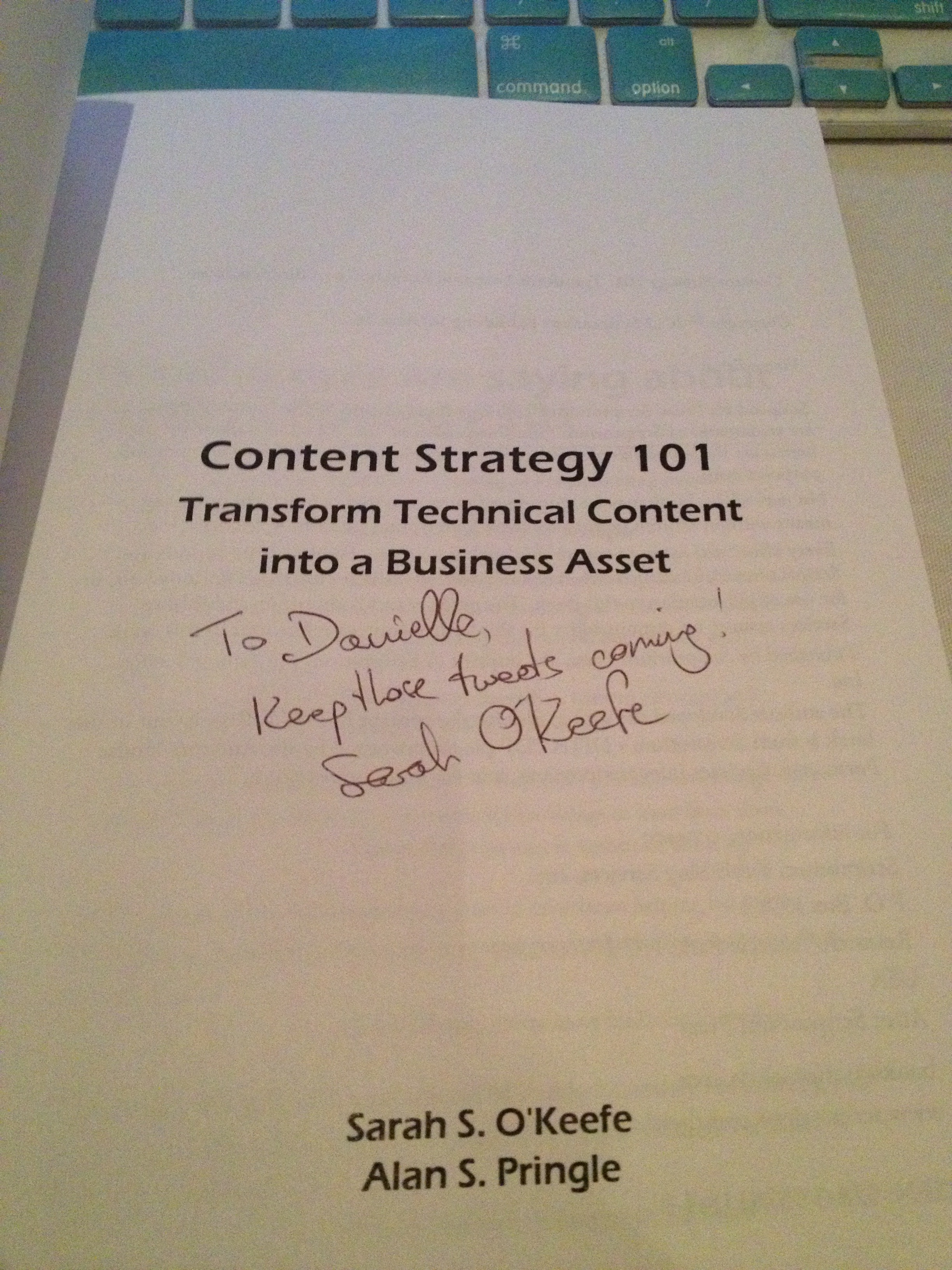
The autograph from my copy of
Sarah O’Keefe’s book,
Content Strategy 101.
Awesome!
Posted in Uncategorized

Adobe Day Presentations: Part IV – Val Swisher asks, “Are You Global Ready?”

Val Swisher
of Content Rules, Inc.

Following a short break after Joe Welinske’s talk about Multi-screen Help Authoring, Val Swisher took to the stage.

Val is the founder of Content Rules, Inc., and she spoke about eight simple rules for technical communicators to follow to make content global-ready–now! Her specialty is doing translation work, so she knows a thing or two about making content ready for a global market. As she went through each rule, she would explain the impact of the rules and why the rules were in place, although some were self-explanatory.

The rule she listed were as follows:

Rule 1: Not all errors are created equal. Some can cost you thousands of dollars!
This is one of those obvious rules. Taking the time to write content carefully as well as making sure proper editing is done is a necessity. Even one small typo can make a difference.

Rule 2: Creative Writing is a myth. Standardize.
Val’s point with this rule is that superfluous writing is not necessary. Keeping content clear, concise, cogent and correct is especially important in translation, and allows for better reuse of content.

Rule 3: Real copy editors don’t do it without a terminology manager. 
It is vital to use the same terms for certain words, especially for translation purposes. For example, the words “puppy”, “dog”, and “canine” all refer to the same animal, but are clearly different words, even though they essentially mean the same thing. In translation, there are times that this much word variation for a single item isn’t available in a different language, so choosing one word as the referential term is recommended. It keeps terminology within the content–especially if reusing content–consistent.  Style guides are, unfortunately, not followed as often as they can be. A system is needed to manage terminology and help prevent problems like this example from occurring.

Rule 4: Have you got translation memory (a translation database)? Your vendors do. Use it. It keeps content standardized and saves money.
This is another fairly self-explanatory rule. I was not aware, since I’m not in the translation business, that there are such things as translation databases. From what I could understand how it works (and someone please correct me if I’m wrong), a translation database has features that when a specific turn-of-phrase is used on one language, there is a specific translation for that combination of words into another language. When a translation is done, the database looks for that word combination and translates it accordingly. This, again, allows for consistency in translations between the different language editions of content.  As a technical communicator who does translations, Val is saying that if you don’t have such a database in place, you should have one because in the long run, it will standardized content and save money.

Rule 5: Don’t complain about quality of your tech writers. You agreed to outsource docs to ___ in the 1st place.
Val pointed out that while there are good outsource resources for writing and translation out there, sometimes the quality is not as good as keeping it in house or closer to home, especially if the content is written by someone whose first language is not English. Good quality source material is key! Having good quality source material helps control costs, especially with translation!

Rule 6: If you write flabby copy, even the nicest vendors will email you a bill for localization that will astound you.
Again, this comes back to having quality content in place. Val’s point was that if you do write weak content that is difficult to translate because it is not quality content, even one’s best clients will send you a bill for the translation for localization purposes, and the bill will be VERY HIGH. Again, having quality content saves money!

Rule 7: Get rid of extra adjectives and superlative words! Delay this product launch, and there’s no next product launch.
This rule is a strong recommendation related again to how content should be written. The use of extra adjectives, adverbs and other superlative words do not enhance the content. Using such words that have to be rewritten or translated can delay a product going out, and for a client, that can be a deal-breaking move. By delaying the product due to not meeting a deadline due to overdue time for translation, and there will be no next time being able to help with a product launch. Obviously, that would be bad business.

Rule 8: Translation is a team sport. You want to work alone? Become an accountant.
While this rule elicited a laugh from the audience, it was a point well taken. Teamwork is KEY! A better source of English content will result between source writers and translators if they work together.

Val was asked the question at the end of her presentation, “What alternative tools for style guides are on the market?” She responded that there are lots of software tools out there, but to be careful about push technology within those software items.

More information can be found at Val’s website, http://www.contentrules.com  and her free e-book is available by e-mailing her at vals@contentrules.com.

I found this presentation rather fascinating, especially since Val presented it with a sense of humor. But her point was clear. Content needs to be as precise as possible when it will be reused and especially when used in translation for consistency. By following her basic rules, costs can be controlled, and the quality of the content can only get better.

I thought about what it takes to do translation, searching my own memory banks from when I almost minored in French during my undergrad years and had to do translations, to the present day watching my husband translate literature written in German to Spanish for a group he’s been involved with for years, to my own struggles to translate what I want to say to my in-laws into my broken Spanish. Translation is not an easy task, but when thinking about translating my English thoughts into another language, it can get tricky because of the turn of phrase or colloquialisms used from area to area. Even in talking to my husband about the topic, he will say that there are different idioms used between Spanish speaking countries, although Spanish will still be relatively “standard.” Being from Ecuador, he can still understand someone from Spain, Mexico or Argentina as much as an American can understand someone from the UK, Canada, or the Australia. But I’ve even found in my own teaching of a business and technical writing course to a corporate group in Asia is that English taught globally is not consistent due to the source English being from different countries, so I have to go and set the record straight.  I can certainly appreciate where consistency and choice of words can lead to better quality content and communication in the long term.

The next presentation, and the last in this series: Adobe Day Presentations: Part V – Mark Lewis and DITA Metrics.