I’ve mentioned on a few occasions that with the completion of my contract at BASF, I would have to figure out what my next move would be. Job hunting is something that I dread, especially since the region where I live doesn’t have much opportunity unless I go out of my way to travel far to the cities. I’m in a position where I can’t move due to my son’s education for now, so I had to figure out what the best move for me would be. Thanks to my husband’s support, and my mom setting the example for me when I was younger, I decided that perhaps I’d make a go of it on my own. I’m tired of working through agencies or “the man”.
Let’s celebrate!
So, on July 4th, 2015, I officially launched my own business. I figured that it would be appropriate to declare my status as an independent contractor on (American) Independence Day. While many of you have read on LinkedIn that I’m working as a Content Marketing Strategist for Information Development World, that is my first contract, which started a big before my official launch.
My company is called Dair Communications, and it already has a barebones website that needs a little tweaking (my husband is helping me set the website up, as he’s a developer and wanted to help, as he should). I chose “Dair” because it’s Gaelic for “Oak“, and I’ll leave it to your imagination what words are evoked when using that description. There are also sentimental reasons for the use of “dair” stemming from my heritage, so it seemed appropriate. The other connotaction is that the word “dair” sounds like the English word, “dare”, so I’d like to think that I’m doing something daring by breaking out on my own, and that I would dare to try new and creative solutions for my clients. Hence–do you DAIR? 😉
Many of my readers have asked me to blog about being an independent contractor. I will do my best! I know that I will be doing a lot to help out with The Content Wrangler blog and Information Development World for the next several months, and I will share some of those projects and observations with you. You might not see quite as many TechCommGeekMom entries as before as I transition into this new adventure, but I’m not going away anytime soon.
It’s great to see so many of my readers are as excited as I am about going to this year’s Information Development World conference. This event, organized by Scott Abel, The Content Wrangler, and Val Swisher, Content Rules, takes place September 30 – October 2, 2015 in San Jose, CA. It’s jam-packed with awesome presentation topics (over 80 presentations, case studies, and panel discussions to choose from), plus eight full-day skills development workshops, and two floors of exhibition space. It’s a content creator’s paradise!
Wouldn’t it be cool if you could attend for free?
You can! Here’s how.
1.Login to your Twitter account.
2.Post a tweet explaining why you should should receive a free ticket to the event. Creativity counts!
3.Include these two identifiers (@InfoDevWorld and #WhyMe) in your tweet.
One lucky TechCommGeekMom reader will win a free All-Access pass to the event. The All-Access pass includes your selection of one pre-conference full-day skills development workshop on September 30 and unlimited access to the conference, October 1 and 2. It also includes light breakfast, lunch, coffee breaks, and snack breaks daily.
Restrictions:The free All-Access pass to the conference does not include transportation costs (airfare, train, car, parking) nor does it include accommodations or dinner at the event.
You can enter as often as you like until 1:00 PM EDT on July 15th. I’ll then tally all the entries, and pick a winner within the next day or so after that!
So what are you waiting for? Commence Tweets……NOW!
I received this nice little message in my blog’s notifications:
Yes, that’s right! There are 1000 posts on this blog!
Some posts are gems! Some are duds! Some are somewhere in between! But over three years, content has been curated and content has been written on the topics of m-learning, e-learning, all things tech comm….the addition of digital marketing more recently…with some geeky tech stuff thrown in as well. There’s something for just about everybody here!
Have you taken a look at some of the past content? I’ve been here for more than three years, folks–look at the archive links on the right-hand column. Take a look in the search and see if there are any posts on a topic you are interested in.
I’ll see about getting another 1000 posts up ASAP, okay? Enjoy!
“It’s just a dream to go to Information Development World, so I can learn more about content strategy! C’mon gang, let’s go!” says Barbie.
Last year, I was really disappointed that I couldn’t go to the inaugural Information Development World (IDW) conference in San Jose, CA. I knew, since it’s produced by The Content Wrangler and Content Rules, that it would be a top-notch event. After reading all the reviews and commentary from my friends and content strategy colleagues about how great the event was, I was even more disappointed that I wasn’t able to go.
But it’s different this year! This year, I’M GOING! I’m pretty excited about this, because I know this is a conference that is definitely geared towards content strategists who are like me–someone who not only does content strategy, but also does content management, web design, user strategy, works with customer experience, and has a love of localization and globalization issues as well. Of course, the event is also covering other topics like content marketing, data and analytics, digital publishing, and content engineering. The point of this conference is to help those who touch content in any way, shape, or form and want to enhance the customer experience through content experiences. Sounds like my kind of conference, as if it was custom-made for someone like me who is still building her content-based career!
I like that there are several workshops and presentations–80 in all–to choose from. I’m sure there will the dilemma of which ones to choose at a given time slot! While looking at the IDW schedule as it’s posted at this writing, there are several sessions I will have a hard time deciding between that I’d really like to see. For example, how does one decide between Work Smarter Not Harder – Remove the Guesswork from Content Creation and By the Numbers: Making the Case for Reuse Based on Facts during the same time slot? Or how can this former Barbie aficianado miss the Mattel Case Study: Maintaining Barbie’s Brand Fidelity Region to Region presentation? I know I’ll have to make some tough decisions between a lot of excellent topics that I’d really like to learn more about. The fortunate thing for all those who attend is that this group of presenters is the “cream of the crop”. I’ve seen several of the presenters and workshop instructors in action before, so I know that this will be time well-spent, and I will come home with my head buzzing with many great ideas and new concepts to digest!
The main focus of IDW is customer-centric–which is something that will help a lot of information developers. Having originally come from a customer service/client services background before I entered the IT/techcomm world, I tend to have a better understanding than most people, so it comes a little more naturally to me. Today, content strategy really is all about personalization and making content speak to customers in a way that it feels like the content is talking to each customer specifically. That’s not an easy task. The goal of IDW is to help everyone get a much better understanding of how this is done, and how to make it work most efficiently so that content works for you, not against you. How could you not want to learn about that?
I’m not going to miss out this year. I’m going, and it would take a lot to stop me from going. There’s too much to learn and great content strategists to meet–why would I pass this up again? I’m not making the same mistake twice! It’s a fantastic investment in ME and what I can bring to my clients.
Have you registered for IDW yet? If so, great! If not, what are you waiting for? Register today!
TechCommGeekMom in front of the main building at the National University of Ireland (NUI) at Galway.
I’m now back from my 10-day trip to Ireland, and it was certainly an adventure. While there are parts of the US that have bilingual signs around due to the large Hispanic populations in areas, I think I had gotten used to hearing Spanish enough that I don’t think much about it. (I do live in a bilingual household, thanks to my Ecuadorian husband, after all.)
So it was interesting to be in a European country for the first time in about 15 years and making adjustments to both a different version of English, as well as listening to another language I had never really listened to before!
Since Ireland is a former British colony and it’s so close to Great Britain, I had to turn the “British English” switch on in my head. Using that tactic certainly helped to bridge the gap of my understanding of people and things around me. While it’s practically a sin to compare British English to Irish English, since the two islands are so close together, the language similarities are enough that you can’t deny the connection. It’s little things like asking where the “loo” is, or seeing a sign at a store saying they are “stockists” (versus Americans saying “dealers”), or that instead of “Help Wanted” signs, you see “Required”. It’s these little nuances that you find to be important to know what people are talking about.
A sign on one of the lawns at NUI-Galway. Notice that the Gaeilge is before the English, and that this seems to be a universal rule at many college greens!
I spent half of my time in Dublin and half my time in County Galway. The famous Irish brogue isn’t that strong in Dublin, but it’s certainly stronger as you move westward. What makes much of it stand out is the pronunciation of English words with the “-th” in it. For example, the number after “one, two…” is “tree”, not “three”. It takes a little getting used to hearing, and I’ve had to stifle a giggle now and then, but you get used to it. There are a few slightly rolling “R” sounds as well, but they aren’t as clear as those “tr-” sounds. Otherwise, at least in Dublin, the accent is not that strong. You could easily mistake someone (until you hear some of those slight nuances) for being American, as compared to a London/British accent.
In Galway or the Aran Islands in western Ireland, which I spent the other half of my visit, the Gaeilge (Irish language) brogue was much stronger, and my listening skills were truly put to the test. I made sure that my flat American accent was as crisp and clear as possible as well, to make sure that I was understood and didn’t slur my words as much as I would if I was back at home, although it was easy for me to slip into a slight brogue myself.
Gaeilge is an interesting language, because for the first time in my life, I couldn’t figure out the phonetics or understand bits and pieces of it. I suppose that since it’s not a Latin-based or Slavic-based language like those I’ve studied (but never quite mastered) over my lifetime, I had nothing to compare it to. One thing I’ve always tried to do is pronounce another language decently enough not to be laughed at, and usually I can do this with Spanish, French, Polish, Russian, or some other common European languages. But Gaeilge–forget it! I couldn’t figure it out at all. My favorite example is from travelling on Irish Rail. As we approached each stop, the speakers would announce the arrival in Gaeilge first, then in English. I swear that “Iarnród Éireann” (which means “Irish Rail”) sounded like, “Here nor there” every time I heard it, which I thought was ironically kind of amusing.
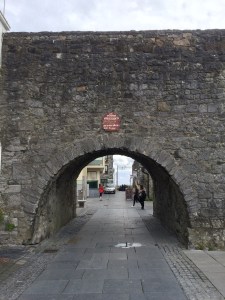
The Spanish Arch in Galway. The sign above the arch reads: AN PÓIRSE SPÁINNEACH The Spanish Arch ONE OF FOUR ARCHES BUILT IN 1584.
Through the combination of trying to employ my British English and attempting to understand some Gaeilge, I was able to navigate around Ireland without any significant issues. But I also found that culturally, Ireland is trying to still find its identity. I know there has been a very big movement nationally to bring Gaeilge and Irish culture back into predominance, especially with the 100th anniversary of the 1916 revolution just a year away. But at the same time, as a former British colony that played a huge part in British history and has a very long love-hate relationship with the country, the British influence was still rather clear. So, I think Ireland is still trying to figure out if it likes being a former British colony, especially since it still imports many of its goods, stores, and media from Britain, or if there is still a huge grudge against them. It was hard to tell sometimes.
This was a great opportunity to put my views about localization and globalization into practice as a content strategist. I know that the lack of good navigational signage was another thing that was lacking–I couldn’t find my way around if it weren’t for my handy-dandy iPhone with me helping me with maps and directions! Even so, when there were signs, most of the time they were rather clear, which was refreshing to see. I was glad for that.
I will be returning to Ireland in July to attend the 2015 IEEE ProComm in Limerick. Having been through Ireland now, I know the “drill” and have a better idea of what to expect when I arrive in this new town. I know what to ask and look for to satisfy my needs. It makes me want to visit more countries, and see how they handle localization and globalization issues with signage and other media. I think it’d expand my knowledge to be something that I’ll better understand going forward, especially with English-language countries. After all, this was a trip that definitely proved that all dialects of English are not alike!
What do you think? Should English-language speakers try to homogenize the language more for better understanding? Put your comments below.










 TechCommGeekMom
You must be logged in to post a comment.