Posted in Uncategorized

An American in Ireland: An experience in globalization and localization

TechCommGeekMom in front of the main building at the National University of Ireland (NUI) at Galway.

I’m now back from my 10-day trip to Ireland, and it was certainly an adventure. While there are parts of the US that have bilingual signs around due to the large Hispanic populations in areas, I think I had gotten used to hearing Spanish enough that I don’t think much about it. (I do live in a bilingual household, thanks to my Ecuadorian husband, after all.)

So it was interesting to be in a European country for the first time in about 15 years and making adjustments to both a different version of English, as well as listening to another language I had never really listened to before!

Since Ireland is a former British colony and it’s so close to Great Britain, I had to turn the “British English” switch on in my head. Using that tactic certainly helped to bridge the gap of my understanding of people and things around me. While it’s practically a sin to compare British English to Irish English, since the two islands are so close together, the language similarities are enough that you can’t deny the connection.  It’s little things like asking where the “loo” is, or seeing a sign at a store saying they are “stockists” (versus Americans saying “dealers”), or that instead of “Help Wanted” signs, you see “Required”. It’s these little nuances that you find to be important to know what people are talking about.

A sign on one of the lawns at NUI-Galway. Notice that the Gaeilge is before the English, and that this seems to be a universal rule at many college greens!

I spent half of my time in Dublin and half my time in County Galway. The famous Irish brogue isn’t that strong in Dublin, but it’s certainly stronger as you move westward. What makes much of it stand out is the pronunciation of English words with the “-th” in it. For example, the number after “one, two…” is “tree”, not “three”. It takes a little getting used to hearing, and I’ve had to stifle a giggle now and then, but you get used to it. There are a few slightly rolling “R” sounds as well, but they aren’t as clear as those “tr-” sounds. Otherwise, at least in Dublin, the accent is not that strong. You could easily mistake someone (until you hear some of those slight nuances) for being American, as compared to a London/British accent.

In Galway or the Aran Islands in western Ireland, which I spent the other half of my visit, the Gaeilge (Irish language) brogue was much stronger, and my listening skills were truly put to the test. I made sure that my flat American accent was as crisp and clear as possible as well, to make sure that I was understood and didn’t slur my words as much as I would if I was back at home, although it was easy for me to slip into a slight brogue myself.

Gaeilge is an interesting language, because for the first time in my life, I couldn’t figure out the phonetics or understand bits and pieces of it. I suppose that since it’s not a Latin-based or Slavic-based language like those I’ve studied (but never quite mastered) over my lifetime, I had nothing to compare it to. One thing I’ve always tried to do is pronounce another language decently enough not to be laughed at, and usually I can do this with Spanish, French, Polish, Russian, or some other common European languages. But Gaeilge–forget it! I couldn’t figure it out at all.  My favorite example is from travelling on Irish Rail. As we approached each stop, the speakers would announce the arrival in Gaeilge first, then in English. I swear that “Iarnród Éireann” (which means “Irish Rail”) sounded like, “Here nor there” every time I heard it, which I thought was ironically kind of amusing.
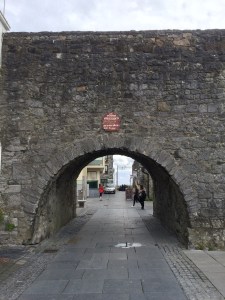
The Spanish Arch in Galway.
The sign above the arch reads:
AN PÓIRSE SPÁINNEACH
The Spanish Arch
ONE OF FOUR ARCHES BUILT IN 1584.

Through the combination of trying to employ my British English and attempting to understand some Gaeilge, I was able to navigate around Ireland without any significant issues. But I also found that culturally, Ireland is trying to still find its identity. I know there has been a very big movement nationally to bring Gaeilge and Irish culture back into predominance, especially with the 100th anniversary of the 1916 revolution just a year away. But at the same time, as a former British colony that played a huge part in British history and has a very long love-hate relationship with the country, the British influence was still rather clear. So, I think Ireland is still trying to figure out if it likes being a former British colony, especially since it still imports many of its goods, stores, and media from Britain, or if there is still a huge grudge against them. It was hard to tell sometimes.

This was a great opportunity to put my views about localization and globalization into practice as a content strategist. I know that the lack of good navigational signage was another thing that was lacking–I couldn’t find my way around if it weren’t for my handy-dandy iPhone with me helping me with maps and directions! Even so, when there were signs, most of the time they were rather clear, which was refreshing to see.  I was glad for that.

I will be returning to Ireland in July to attend the 2015 IEEE ProComm in Limerick. Having been through Ireland now, I know the “drill” and have a better idea of what to expect when I arrive in this new town. I know what to ask and look for to satisfy my needs. It makes me want to visit more countries, and see how they handle localization and globalization issues with signage and other media. I think it’d expand my knowledge to be something that I’ll better understand going forward, especially with English-language countries. After all, this was a trip that definitely proved that all dialects of English are not alike!

What do you think? Should English-language speakers try to homogenize the language more for better understanding? Put your comments below.


Posted in Uncategorized

Assessing old libraries–where’s the content audit?

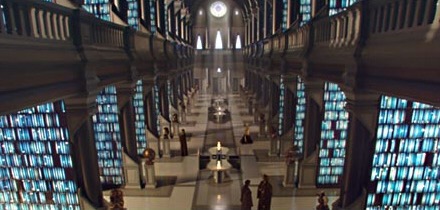
Does this look a little familiar? This is the Jedi Academy Library. Taking from the old to the new, for sure.

One of the first places that I went to during my holiday in Ireland was to University of Dublin, Trinity College. Why would I visit there? Trinity College is a world-famous university the likes of my “hometown” of Princeton or more close by, Oxford or Cambridge. The renowned Book of Kells exhibit is at the college, and part of the tour is the university’s Old Library. When people see photos of the Old Library, they recognize it instantly, and it’s a book lover’s fantasy room with books stacked from floor to ceiling on two floors. Rumor has it that the library of the Jedi Academy in the Star Wars films was based on the look of this library. To see the room in person is truly a sight to see.

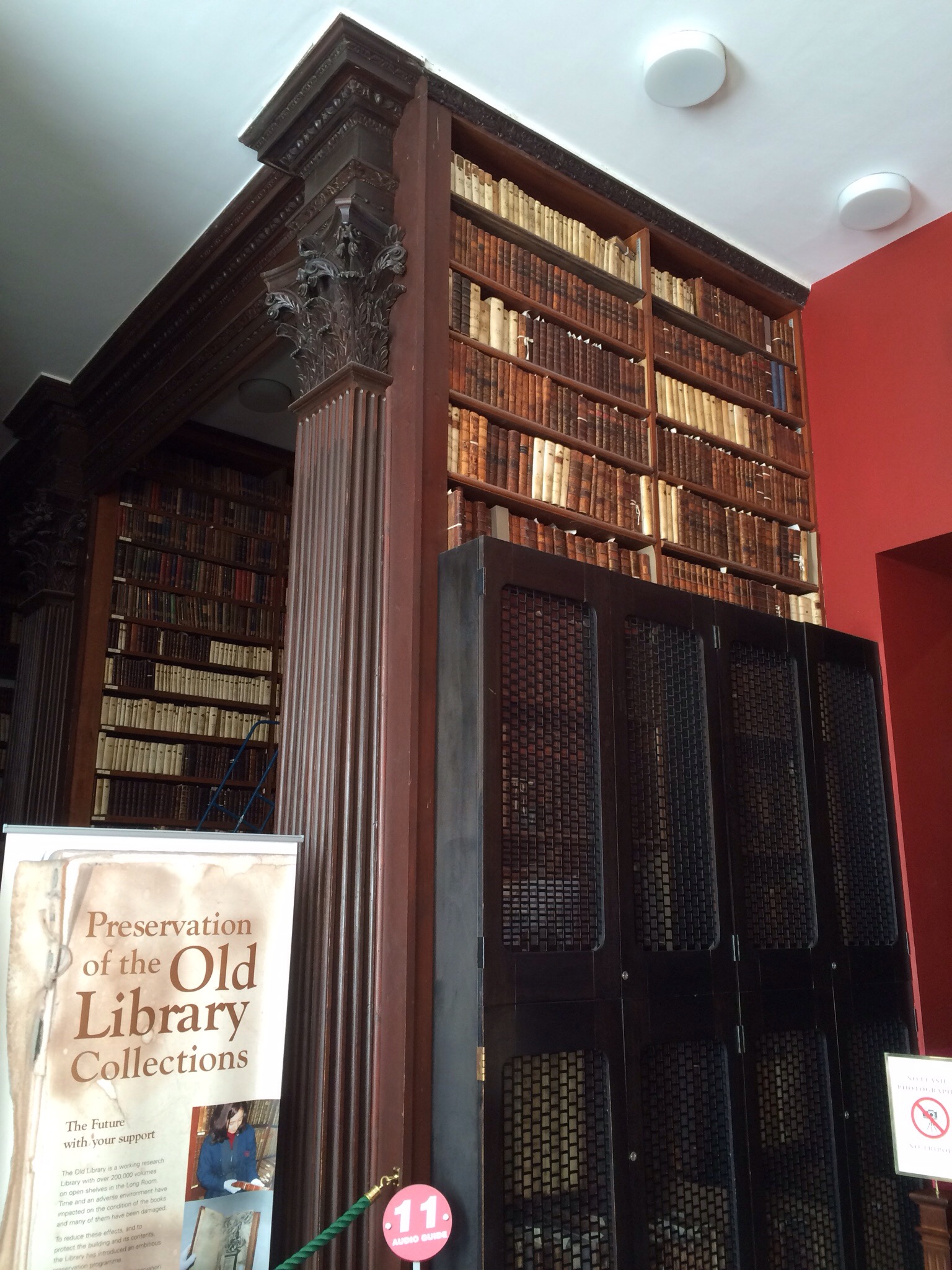
This is just before the entrance of the library.

At the entrance of the library, there were several shelves of dusty books stacked in bookcases that reached to the ceiling, with a sign in front (as seen in the photos) that restoration work was still being done to preserve the library and its contents. To put this photo in perspective, I’m guessing that the door well, which you can barely see from the right corner, is a normal-to-tall door well of about 8 feet tall, and the rope blocking these shelves barely seen on the bottom right is the normal hip height, so the ceiling has to be at least a good 13-14 feet to the top! As you can see, there are even a lot of books here!

Inside the Old Library, looking towards the entrance.

Once in the Old Library itself, I looked at all the old books, marvelling at the sheer enormity of so many books in one place. I wondered how old some of these books were! The historian in me wanted to find cool books to see perspectives from another day and age, and lovingly leaf through pages of an old book. Then the technical communicator in me stepped in and took over my brain. I wondered if anyone could still access and read these books at all. I wondered if any of it had been digitized for current use, because all of the books looked like decorations now. How do we know what books are still in here? Had anyone done an audit? How relevant is any of the information? What is worth keeping in some form, and which items are, as I said before, purely decoration or kept in perpetuity? The historian in my returned in my head, wishing I could head up a restoration project of this kind to digitize every last book in that room. Why, if most likely 99% it is outdated? It’s because in auditing the content, sometimes you find a gem of information or data that has gotten lost in the shuffle, and ends up being a great piece of information that provides the missing piece to a puzzle.

TechCommGeekMom selfie in the Old Library.

In this modern age, this is something I think we need to keep in mind. Content audits are important in a content strategy. You don’t want to include information that isn’t relevant anymore, naturally. That’s a waste of space and the end-reader’s user of time. That’s logical. However, should you throw away all the information once you have deemed it non-usable at this time? I don’t think so. There will come a day when the manual of an old product will be needed to service that item–as an antique, and the manual will be helpful. Understanding our content past, just like any other piece of literature or antique artifact, is a connection to understanding how we have progressed, how we can improve, and where we have made mistakes. It can also provide clues to why we have the content we have now–did someone leave something out in more recent versions that might have been thought to be irrelevant during that edition, but older editions are relevant now? You never know unless you get the entire picture, and see what treasures you may have at your fingertips. They could be the key to success.

What do you think? Is keeping old content–at least, archiving it–a worthy endeavour? Post your comments below.

Posted in Uncategorized

Online Student Again, Part 11: I passed! 

“Alright then, you’ve proven that you aren’t a total pudding brain. Now, I want you to learn geo-quantum astrophysics next,” says the Doctor.

After a delay due to server hacks at Rutgers University, I finally got my grades while I was vacationing in Ireland. My final grade was a B+ for my Digital Marketing class! While in recent years, I have had a reputation of having a straight A average with my grad school level classes, I was not disappointed in this grade. As I may have mentioned in a previous post, I got an 82% on my final exam. The test was one where it was one shot at 50 multiple choice questions. If I hadn’t studied the quizzes and taken the quizzes multiple times to practice (they weren’t graded), I wouldn’t have passed. Most of the questions on the test were the same as the quizzes! So there’s that. Some of the questions, as they were worded, were NOT easy. Even so, with the fact that I got an 82/100, I was greatly relieved.

As for my Capstone project which involved more work and thought towards the practical application of the information we learned, I got a 95/100, or an A. I was happy about this, as this is the part of the grade I actually fretted over more. I knew it would be difficult, because I didn’t have any clear cut projects from work or situations to base my digital marketing strategy on. So, in my mind, this was an educated shot in the dark. I decided that I would base my project on something that was real for me. I’ve mentioned that I had been thinking of starting my own consulting business, and so I based my project on the idea of my proposed reality–I needed to come up with a plan to promote my fledgling company to gain brand recognition and acquire customers. That’s fairly straightforward. As I’ve mentioned many times before, I understood how to approach the digital part of the strategy, but not as clear with the marketing. So, I did the best I could, and labored over this project. It paid off. The commentary of what was missing was minimal, mostly about re-evaluating after gaining clients and reassessing the stats taken based on that. That makes sense, but let me get some clients first!

So, once the exam was averaged with the Capstone, I got an 88.5% for the class, also known as a B+. Considering that this was not an easy subject for me to study, I still think I did well. I did not think much of giving equal weight to the test and Capstone then averaging the grades. The test, while it tested students on concepts, wasn’t well written and it was not really practical. Ultimately, the Capstone project was a practical use of the information and more of a projection of what I’d really have to do in “real life”, thus it should have been worth more, because these kinds of strategies are what need to be brought into the real world. So in my mind, while it’s not official, I still got an A for the class because that was what I got for the Capstone.

So there you have it. I got a B+.

Would I take this course again? Probably. The experience was very different from doing my online Masters at NJIT. My studies at NJIT were much more structured and directed than this course at Rutgers. This online digital marketing course was 10 modules of about 10 videos per module. The information in the modules was excellent, and the instructors were top notch. I wouldn’t trade that. When I was able to go to the “virtual office hours”, the instructors were approachable.  However, I had to stay super-disciplined in watching all the videos (3-4 hours’ worth of information that could be dry content at times) every week. I didn’t have the chance to interact with fellow students almost at all to exchange ideas. It wasn’t as rich of an experience as I had enjoyed with NJIT. Despite the lesser things about this course’s delivery, I know that I will definitely use this information going forward.

So, I will shortly receive my mini-MBA in Digital Marketing from Rutgers soon in the mail. I suppose the question will be–what will the next course I take be, and when? I don’t know yet. I’m the eternal learner, so I look forward to that answer, too.

Posted in Uncategorized

Taking a break…in Ireland!

I'm looking forward to exploring Galway on my own. Looks like my kind of town!
I’m looking forward to exploring Galway on my own. Looks like my kind of town!

Hello readers,

As of the date this post is published, I will be taking a bit of a break here for a while. As I write this, I’m about to leave today for a 10 day trip to Ireland. I’ll be in Dublin for half the week, and then in Galway and the Aran Islands for the other half of the week. I’m very excited, and even a little nervous. I haven’t been out of the US since September 2000, and Ireland is a new country for me to visit. I’m sure I’ll get over the culture shock quickly, and I usually understand the accent as I have my GPS set to an Irish male voice speaking. 😉

Understandably, this is the first real vacation I’ve taken where there’s no husband or son, and no tech comm conference involved in many years! The history geek in me is going to be let loose to enjoy and soak up the culture! While there, I will still have my handy-dandy iPad, and if inspiration hits to write a blog post or curate a cool article, I will. But it’s not a high priority. I’ll also have my handy iPhone, and I’m planning on taking plenty of photos and video, and most likely much of it will end up on social media.

I’m still waiting for my final grade for my Rutgers course. I still haven’t heard back, and I think much of it has to do with Rutgers’ servers going down for long stretches this past week due to cyber-attacks. (That’s very reassuring, isn’t it?)

I also have a lot of exciting things going  on once I return from my trip coming up, which I’ll discuss more when I get back. Some of the news isn’t official yet, so I have to wait to say anything, but I’m anxious to share with you!

salthill2
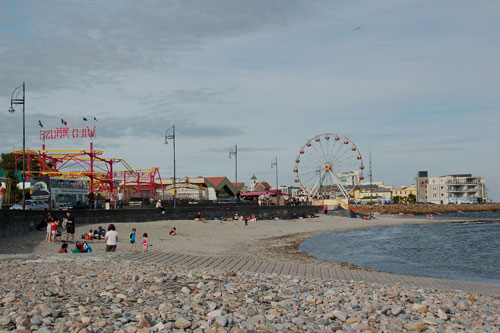
Salthill beach, here I come!

So, enjoy your first half of May 2015. I’ll be missing the warm weather of New Jersey and the late arrival of Spring while it’s expected to be cooler and rainy in Ireland. I guess the tradeoff is that even in the cooler weather, Galway City is just a 20 minute walk to the beach, so I can literally saying that I plan to have some beach time! 😀 It’s time for some rest and relaxation–the rest of 2015 is going to be busy, so I need to re-charge and clear my brain for a bit!

Talk to you soon!


Posted in Uncategorized

Content Content Podcast – Fire fingers featuring Danielle Villegas – episode 3

fast-typing-fingersEd Marsh of ContentContent has a new podcast out, and it features me! Who would’ve guessed? Ed and I recorded this on April 11, 2015, and had a great time recording our conversation. We could’ve gone on for hours! (Or at least I could’ve gone on for hours, LOL.)

Check out the podcast, and be sure to check out more of what Ed has on ContentContent. He’s got good stuff there! Enjoy!

Content Content Podcast – Fire fingers featuring Danielle Villegas – episode 3