Posted in Uncategorized

What did you do to get that Tech Comm job?

MH900431660As the news continues to spread that I finally got a full-time job after a year of searching, one of my friends from Adobe suggested that I should write a post about how I got the job, with the purpose of encouraging others that they, too, can find a tech comm job.

Well, I won’t lie. It wasn’t easy. And my path may not be the right path for everyone, but I think there are some universal elements that can be recommended here. As this blog has often been a testament of my job searching woes and questioning what seemed to work and what didn’t, all I can do is recall what seemed to work for this particular interview that got me the job, and what lead me to that moment. In a nutshell, it was a lot of hard work.

Let me first start by bringing this recent article to your attention:

Employers may be aggravating the ‘skills gap’

The article explains that in the US, while there isn’t a lack of unemployed workers, there is a lack of skilled workers in specific professions, and that employer demands of finding such workers instead of making a small investment in training otherwise competent workers is contributing to the problem. Gone are the days when, if you had half a brain and could learn how to do things, your employer would hire you and train you on that specialty. Most of my career was done this way. After college, I had a degree in hand, and could show that I could speak, write well, and think on my feet, so I was trained as a consumer affairs rep for a national manufacturing company. I would pick up different skills as I went from job to job, learning and gaining skills as I went along, eventually even shifting from a client services career to an IT career. But when I returned to the workforce after a brief stint away to be a stay-at-home mom, I found that wasn’t always the case anymore. In the last year or two, I can tell you that I KNOW this isn’t true anymore, or it’s a rarity. The article above mentions the loss of the time honored tradition of apprenticeships, something that may need to have a comeback. I supposed that internships are similar to apprenticeships, but they are far and few between as it is, especially for a mom like myself trying to get back into the workforce to help the family finances. Most are for school credit, instead of a small wage to learn a skill or craft. Possibly good for some students, but not that good for the rest of us who have to support ourselves or family.

In a sense, I had to create my own apprenticeship. In economic hard times, necessity is the mother of invention, and this mother needed to invent a new career out of necessity. My first full-time job after the onset of motherhood gave me the direction–technical communications. From there, I had to figure out how to better establish myself as a technical communicator, and eventually become one in the field.

So as not to bore you with my long story of how I finally arrived at this moment of getting a job, I’ll cut to the chase of what I think helped me in the end.

1) Don’t be afraid of being a multi-specialist or generalist. I know that several weeks ago, I questioned this, because this seemed to be a huge roadblock for me. In the end, it was the fact that I was a multi-specialist, I think, that picqued the employer’s interest. Yes, I could work on a CMS system, but I also know a lot about m-learning, social media, web design and yes, I can write. I think that the more I discussed what I knew about each topic, the more I could see eyes of the interviewers light up.

2) Create an e-portfolio of your work. This was really helpful for me. As much as I could say that I could write, create audio and video files, understood web design, and understand social media, I had PROOF. My e-portfolio could provide samples of most of my skills so that employers could see for themselves. While my e-portfolio originally started as my capstone project for graduate school, it has been enhanced and appended several times after graduation to appeal to prospective employers as well as those who just want to understand my work.

3) Get an education. You don’t necessarily need to go out and get a Masters degree like I did, but if you feel deficient in any field and there is any course available that will allow you to gain some new skills, take advantage of it. Even if I had only taken that first introductory course in grad school, I feel like I would have gotten ahead more than if I didn’t take that class. I knew when I was first unemployed that I had a lot to catch up with when it came to technology, so I took advantage of my state’s re-employment program that allowed workers to enhance their skills.  It paid for the first three courses of my graduate certificate that eventually was transferred into my degree. But there are lots of great courses too, at local community colleges, continuing education programs, and oh yeah–online! Learning more always gives you more to provide a prospective employer.

If you are looking for a technical communications position specifically, there are several accredited schools who offer online programs for certificates, undergraduate degrees, and graduate degrees. Look at the ID/TC Education Resources in the menu bar above for some suggestions. Being a product of one of these online degree programs, I do recommend NJIT’s MSPTC program, as it did help me get to where I am and prepared me for this.

Or, educate yourself, and teach yourself a new skill. Take advantage of trial offers to use software you haven’t used before, but see what is prevalent in the field. For me, it was Adobe’s Technical Communications Suite. (As a technical communicator, you can try it out too if you click on the ad on the right column at the top!)

4) Get involved in social media. While I had always been someone keeping up with friends and family through social media, I also made a conscious decision during my job search to use social media to gain an advantage in the workforce. How? If I could keep up with trends going on in the field, then I could speak more competently about changes going on in the field than if I just stayed stagnant where I left off. In the past year, I’ve learned so much about technical communications and e-learning/m-learning issues that were never discussed in the classroom. Also, don’t be afraid to start a blog like this one. It allows others to understand how your mind thinks as well as what is important to you. It’s a great addition to the e-portfolio. It can also be a resource in finding positions as well, as many employers and groups are posting job vacancies through social media channels now.

5) Get a part-time job in the meantime. While I was trying to find that great full-time job, I actually held two short-term part-time jobs. One was as an assistant webmaster to a local academic publisher, and the other was teaching a virtual course in technical and business writing to a corporate office in Asia. While they weren’t exactly traditional tech comm jobs per se, they both helped me keep some of my skills fresh, and let me look at other industries beyond those I already had experienced.

6) Network with other tech comm professionals. You always hear how one should network, and it’s true. Just so you know, networking does NOT come naturally to me at all–not even close. In fact, I really don’t like networking, but I forced myself to do it, and I’m glad I did. I signed up with the STC while still a student, and attended one or two events that were local to me, and I was able to make some valuable connections. Similarly, networking is an extension of social media.  While I did use social media to educate myself on the latest topics of the field, I also used it to get to know other tech comm professionals. When I went to Adobe Day at Lavacon a couple months ago, it allowed me to instantly connect with more people because I had gotten to know them online, and for that, I’m grateful.  I’ve also kept in contact with my professors and several classmates through social media, and that’s helped with networking as well.  While it wasn’t the case for this particular job, my last full-time job came about from networking with a classmate who helped get my resume in front of the right person at her office. Even the teaching job was found because one of my professors posted it on LinkedIn. You never know what connections you can make that will either lead to a job, or provide you with an excellent support system to help get you through.

7) Create a functional resume instead of a chronological one. I had a recruiter tell me that a chronological resume that I was submitting wasn’t telling him anything about my abilities, especially since my career was going in a zig-zag direction between jobs. On top of that, my last two jobs, which were part-time, didn’t really say much about my ability as a technical communicator necessarily. He suggested that I create a functional resume rather than a chronological resume to send out to his clients. I balked at first (which I often do when I think I already have something good), but I did it anyway, and I’m glad I did. This is part of what the recent interviewers liked most. I was able to lay out what skills I had in both a broad sense, and then with specific examples of what I did with those skills. The places where I did them and when I did them didn’t matter as much as me being able to do them. My actual skills were able to shine more than where I was last. I still have a chronological resume for those that insist on that type, but more often, I would sent the functional one instead, and I got a better response for jobs that were more in line with what I was looking for as a result.

I’m sure there are plenty of other factors that contributed to me landing this position, but I think these seven items were key for me, and they can easily apply to someone else.

In the end, it boils down to making an effort to put yourself out there, not only with resumes on various job engine websites, but also making something of yourself that can make you stand out a little more, thus providing you with that slight edge over someone else that can land you the position. If you don’t put yourself out there, then no one will ever know who you are or what you are capable of, and that’s self-defeating. Even after taking a year to get a job, I would still pursue all of these steps to seek a job, as I know they are steps that do give me an edge above the rest.

If you are job searching for a technical communications or instructional design position, try some of these if you haven’t already, and good luck!


Posted in Uncategorized

What you so afraid of? Part II – The Tech Comm Edition

torchwood_jacktorturedI’ve been reflecting a lot, lately, into what makes me continue to pursue a technical career, especially in technical communications. I’ve been thinking about what I’ve been doing in the last year to stay on top of trends and issues in the technical communications field, because the last thing that a prospective employer needs is someone who is stuck in his or her own ways, never learning and never progressing. Technology is constantly changing, and both technical communications at-large as well as the e-learning world are both in the flux of a “revolution”–a revolution that reflects that these fields are in the process of changing and revitalizing in order to keep up with modern thought and technological advances. One of the reason I try to stay as active as possible in social media is to stay on top of those trends and have an understanding of the current issues and advances in these fields so that I can go into a job understanding what the needs of a company are in order to help that company move forward.

And yet, it seems like there are so many companies, from my own observation, that are terrified of change and progress. Is it too much too soon? Perhaps it is. I’ve talked about this topic before at length specifically in regard to how the m-learning revolution is trying to make headway in the e-learning field in my post, “What Are You So Afraid Of?” back in July 2012. But as my most recent experiences personally have been more tech comm related, I’m starting to think that this fear of progress extends to the tech comm world as well.

I remember a big part of what was mentioned at the Adobe Day panel was the idea that as technical communicators, we understand the value of our work better than the higher-ups in managerial positions, and it’s our duty, in many respects to make sure that these higher-ups understand that value and the ROI (return on investment) that using structured content and other tools at a technical communicator’s disposal will benefit the company in the long run.  When I’ve gone on interviews or worked at various jobs, I talk about the advances that are going on involving mobile technology and how companies need to keep up with this fast-growing technology. While the interviewers or other people I speak with are impressed with my knowledge and agree the changes need to be made, the argument made is that the higher-ups, who don’t understand this value of technical communications as well as we do, insist on sticking with old ways, and slowing down progress for the sake of comfort levels. It’s a “Don’t fix what ain’t broken”-kind of mentality. I know that sometimes budgets can limit how soon progress is made, because ever-changing technological advances can be expensive, especially if one is always trying to keep up with the latest and greatest. But I also know that spending a lot of money on ancient systems that aren’t keeping up with current technology and even supporting such ancient technology and methods that aren’t even supported today is throwing money away too. Would we even have smartphones or cell phones if we settled for landline phones only? Would microprocessing computers have even been invented if we settled for manual typewriters long ago? Settling for the old doesn’t really benefit anyone, especially global companies that want to stay ahead of the competition.

The photo above is a favorite character on one of my favorite TV series, “Torchwood,” named Captain Jack. Captain Jack is generally a fearless guy, especially since he has some sort of capability where he cannot die. In that sense, when up against some sort of danger personally, he’s got nothing to lose at all. But since he’s lived for so long, he also respects the past and understands the full impact of his actions and how they affect others. Despite having nothing to lose by his actions, he’s actually the conservative one when it comes to making decisions, basing his actions on what he knows and what he researches first. He is cautious, but he’s not against trying something new if it makes sense. If you see him with a facial expression like the one he has above, you KNOW that something REALLY bad is going on, and it has greater repercussions beyond himself.

There are times that I have that same feeling, at least in my own mind.  While I respect that certain systems work and work well, and I know I’m not the most experienced technical communicator out there, I’ve done some due diligence, and again, I try to keep up with what’s going on in the world so that I’m ready to keep up with the latest advances and thought in the field. When I hear that companies are hesitant to budge from an old way of thinking, I feel frustrated. How are these companies supposed to keep their standings as world-class, advanced companies when their communications are not cutting edge, or at least up-to-date? Again, I understand that executive managers have to look at the full picture and work within budgets, but with a world that is going mobile faster than anyone can keep up with, why aren’t big companies even attempting to keep up even a little bit? Just as I had mentioned in the last article on this topic relating to m-learning mentioned above, I see it occurring in tech comm itself as well, with companies not keeping up with the latest version of how documentation outputs have to be changed to keep up with mobile technology. There is little risk with proven methods.

As a global economy–not just in the United States–we are trying to emerge from one of the biggest financial crises in economic history. Looking back at history, it’s usually during these times of economic woe that some of the greatest leaps in technology and business have been made, using great intellect and creativity to push things forward when resources were scarce. This is a time of emergence again. There are so many companies that have taken the leap forward to help take us to the next step. Smartphone and tablet manufacturers have brought us the next means of gathering information and providing communication between us. In turn, software manufacturers, like Adobe with TCS 4 and MadCap with Flare, among others, have provided us with tools to help take the content that technical communicators write to a new level of efficiency and flexibility among all the new mobile devices in the world while still keeping up with desktop capabilities.  If any companies embrace any of the changes that are going on in the technical communications field, they can deliver bigger and better communications thus benefitting from the changes, not being hindered by them.

So, what are you so afraid of, corporate world? Help technical communicators help you. Even the smallest step forward will be step towards a better future for your company.

Posted in Uncategorized

Adobe Day at LavaCon 2012 Roundup!

This post is just a quick summary of the Adobe Day at LavaCon 2012 series from this past week. As you see, there was so much information that it took six posts to try to summarize the event!

Being in Portland, Oregon was great. It was my first trip there, and being a native Easterner, my thoughts pushed me to that pioneer spirit of moving westward in this country. Once there, I saw a hip, young, modern city, continuing to look towards the future.  The information I gathered at Adobe Day was general information that was endorsement-free, and practical information that I can use going forward as a technical communicator, and that by sharing it, I hope that others in the field will equally take on that pioneering spirit to advance what technical communications is all about, and bring the field to the next level.

To roundup the series, please go to these posts to get the full story of this great event. I hope to go to more events like this in the future!

As I said, I really enjoyed the event, and learned so much, and enjoyed not only listening to all the speakers, but also enjoyed so many people who are renowned enthusiasts and specialists in the technical communications field and talking “shop”. I rarely get to do that at home (although it does help to have an e-learning developer in the house who understands me), so this was a chance for me to learn from those who have been doing this for a while and not only have seen the changes, but are part of the movement to make changes going forward.

I hope you’ve enjoyed this series of blog posts. I still have many more to come–at least one more that is inspired by my trip out to Portland, and I look forward to bringing more curated content and commentary to you!

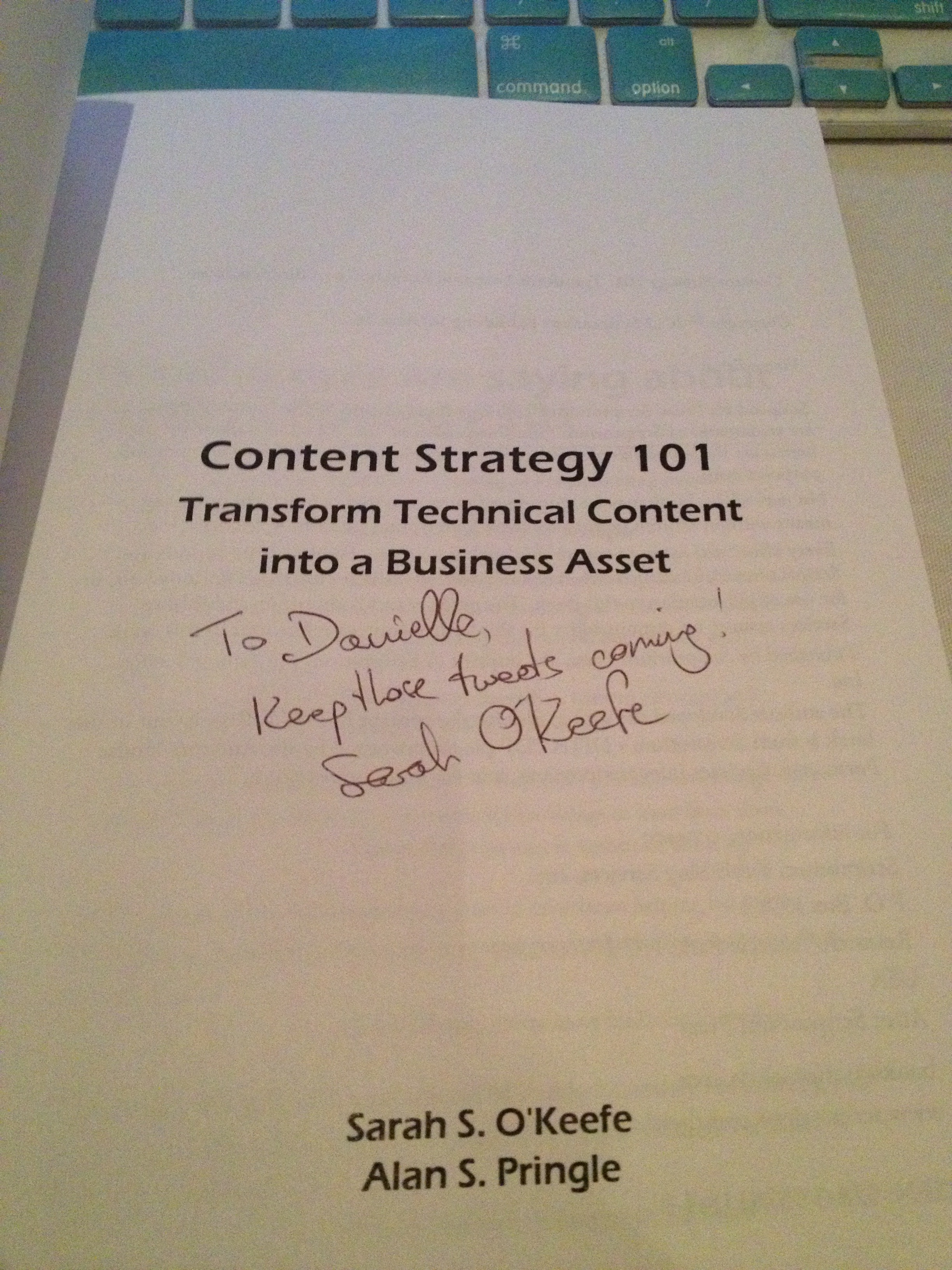
The autograph from my copy of
Sarah O’Keefe’s book,
Content Strategy 101.
Awesome!
Posted in Uncategorized

Adobe Day Presentations: Part V – Mark Lewis and DITA Metrics

After Val Swisher spoke about being global ready in today’s tech comm market, the final speaker of the morning, Mark Lewis, took the stage to speak about DITA Metrics.

Mark literally wrote the book about how DITA metrics are done, titled, DITA Metrics 101. Mark explained that ROI (return on investment) and business value are being talked about a lot right now in the business and tech comm worlds, so it’s worth having a basic understanding of how DITA metrics work.

Now, I have to admit, I know NOTHING about how any tech comm metrics are done, let alone how DITA metrics are done, so I listened and interpreted the information as best as I could. (Mark, if you are reading this, please feel free to correct any information below in the comments!)

Mark began by explaining that content strategy applies to the entire ENTERPRISE of a business, not just the technical publications. There are lots of ways to measure tracking through various means, including XML. Traditional metrics involved measing the cost of page, and the type of topic would be gauged by guideline hours. For example, a document outlining step by step procedures would equal four to five hours per write up of this type of procedure. Traditional metrics looked at the cost of the project through the measure of an author or a team’s output of pages, publications per month. It doesn’t measure the quality of the documents, but it concerned more with quantity instead of quality.

Mark referenced several studies which he based the information in his book, especially a paper done by the Center for Information-Development Management, titled, “Developing Metrics to Justify Resources,” that helped to explain how XML-based metrics are more comprehensive. (Thanks, Scott Abel, for retweeting the link to the study!)

XML-based metrics, Mark pointed out, uses just enough DITA information, concerning itself instead with task, concept and reference within documentation. XML-based metrics can now track the cost of a DITA task topic, showing the relationship between occurrences, cost per element, and total number of hours. The cost of a DITA task topic is lower because referenced topics can be reused, up to 50%!  For comparision, Mark said that you can look at the measurement of an author by measuring the number of pages versus the amount of reusable content of a referenced component. The shift is now in the percentage of reused content rather than how many pages are being used. Good reuse of content saves money, and ROI goes up as a result!

Mark introduced another metric-based measurement, namely through the perceived value of documents as a percentage of the price of a product or R&D (research and development), as well as looking at the number of page views per visit.  Marked warned the audience to be careful of “metrics in isolation” as it can be an opportunity loss, a marketing window. He clarified that page hits are hard to determine, because hit statistics could either mean the reader found what they wanted, or didn’t want that information. We have no way of knowing for sure. If technical communicators are not reusing content, this can make projects actually last longer, hence producing more cost.

Mark emphasized that through metrics, we can see that reuse of content equals saving money and time. Productivity measures include looking at future needs, comparing to industry standards, how it affects costs, etc. He suggested looking at the Content Development Life Cycle of a project, and how using metrics can help to determine how reuse or new topics cost in this process. By doing this, the value of technical communications become much more clear and proves its value to a company or client.

I have to admit, as I said before, I don’t know or understand a lot about the analytical part of technical communication, but what Mark talked about made sense to me. I always thought that measuring the value of an author based on page output rather than the quality of the writing didn’t make sense. Part of that is because as a newer technical communicator, I might take a little longer to provide the same quality output as someone who is more experienced, but that doesn’t mean that the quality is any less. So measuring pages per hour didn’t make sense. However, if consistency in reusing content is measured instead throughout all documentation, then the quality, in a sense, is being analyzed and it can be measured on how often information is referred or used outside that particular use. Using DITA makes a lot of sense in that respect.

More information about DITA metrics can be found on Mark’s website, DITA Metrics 101.

I hope you’ve enjoyed this series of all the Adobe Day presenters. They all contributed a lot of food for thought, and provided great information about how we as technical communicators should start framing our thought processes to product better quality content and provide value for the work that we do. I gained so much knowledge just in those few hours, and I’m glad that I could share it with you here on TechCommGeekMom.

Posted in Uncategorized

Adobe Day Presentations: Part IV – Val Swisher asks, “Are You Global Ready?”

Val Swisher
of Content Rules, Inc.

Following a short break after Joe Welinske’s talk about Multi-screen Help Authoring, Val Swisher took to the stage.

Val is the founder of Content Rules, Inc., and she spoke about eight simple rules for technical communicators to follow to make content global-ready–now! Her specialty is doing translation work, so she knows a thing or two about making content ready for a global market. As she went through each rule, she would explain the impact of the rules and why the rules were in place, although some were self-explanatory.

The rule she listed were as follows:

Rule 1: Not all errors are created equal. Some can cost you thousands of dollars!
This is one of those obvious rules. Taking the time to write content carefully as well as making sure proper editing is done is a necessity. Even one small typo can make a difference.

Rule 2: Creative Writing is a myth. Standardize.
Val’s point with this rule is that superfluous writing is not necessary. Keeping content clear, concise, cogent and correct is especially important in translation, and allows for better reuse of content.

Rule 3: Real copy editors don’t do it without a terminology manager. 
It is vital to use the same terms for certain words, especially for translation purposes. For example, the words “puppy”, “dog”, and “canine” all refer to the same animal, but are clearly different words, even though they essentially mean the same thing. In translation, there are times that this much word variation for a single item isn’t available in a different language, so choosing one word as the referential term is recommended. It keeps terminology within the content–especially if reusing content–consistent.  Style guides are, unfortunately, not followed as often as they can be. A system is needed to manage terminology and help prevent problems like this example from occurring.

Rule 4: Have you got translation memory (a translation database)? Your vendors do. Use it. It keeps content standardized and saves money.
This is another fairly self-explanatory rule. I was not aware, since I’m not in the translation business, that there are such things as translation databases. From what I could understand how it works (and someone please correct me if I’m wrong), a translation database has features that when a specific turn-of-phrase is used on one language, there is a specific translation for that combination of words into another language. When a translation is done, the database looks for that word combination and translates it accordingly. This, again, allows for consistency in translations between the different language editions of content.  As a technical communicator who does translations, Val is saying that if you don’t have such a database in place, you should have one because in the long run, it will standardized content and save money.

Rule 5: Don’t complain about quality of your tech writers. You agreed to outsource docs to ___ in the 1st place.
Val pointed out that while there are good outsource resources for writing and translation out there, sometimes the quality is not as good as keeping it in house or closer to home, especially if the content is written by someone whose first language is not English. Good quality source material is key! Having good quality source material helps control costs, especially with translation!

Rule 6: If you write flabby copy, even the nicest vendors will email you a bill for localization that will astound you.
Again, this comes back to having quality content in place. Val’s point was that if you do write weak content that is difficult to translate because it is not quality content, even one’s best clients will send you a bill for the translation for localization purposes, and the bill will be VERY HIGH. Again, having quality content saves money!

Rule 7: Get rid of extra adjectives and superlative words! Delay this product launch, and there’s no next product launch.
This rule is a strong recommendation related again to how content should be written. The use of extra adjectives, adverbs and other superlative words do not enhance the content. Using such words that have to be rewritten or translated can delay a product going out, and for a client, that can be a deal-breaking move. By delaying the product due to not meeting a deadline due to overdue time for translation, and there will be no next time being able to help with a product launch. Obviously, that would be bad business.

Rule 8: Translation is a team sport. You want to work alone? Become an accountant.
While this rule elicited a laugh from the audience, it was a point well taken. Teamwork is KEY! A better source of English content will result between source writers and translators if they work together.

Val was asked the question at the end of her presentation, “What alternative tools for style guides are on the market?” She responded that there are lots of software tools out there, but to be careful about push technology within those software items.

More information can be found at Val’s website, http://www.contentrules.com  and her free e-book is available by e-mailing her at vals@contentrules.com.

I found this presentation rather fascinating, especially since Val presented it with a sense of humor. But her point was clear. Content needs to be as precise as possible when it will be reused and especially when used in translation for consistency. By following her basic rules, costs can be controlled, and the quality of the content can only get better.

I thought about what it takes to do translation, searching my own memory banks from when I almost minored in French during my undergrad years and had to do translations, to the present day watching my husband translate literature written in German to Spanish for a group he’s been involved with for years, to my own struggles to translate what I want to say to my in-laws into my broken Spanish. Translation is not an easy task, but when thinking about translating my English thoughts into another language, it can get tricky because of the turn of phrase or colloquialisms used from area to area. Even in talking to my husband about the topic, he will say that there are different idioms used between Spanish speaking countries, although Spanish will still be relatively “standard.” Being from Ecuador, he can still understand someone from Spain, Mexico or Argentina as much as an American can understand someone from the UK, Canada, or the Australia. But I’ve even found in my own teaching of a business and technical writing course to a corporate group in Asia is that English taught globally is not consistent due to the source English being from different countries, so I have to go and set the record straight.  I can certainly appreciate where consistency and choice of words can lead to better quality content and communication in the long term.

The next presentation, and the last in this series: Adobe Day Presentations: Part V – Mark Lewis and DITA Metrics.