Posted in Uncategorized

What Does Knitting Have To Do With TechComm and m-Learning?

I’m so glad that this is now my 200th post on this blog! TechCommGeekMom has come a long way since it started out as a class project in grad school, now hasn’t it? For this particular post, I’d like to share my thoughts on something that I’ve been thinking about for the past two weeks or so.  It reveals one of my hobbies to you, but hopefully you’ll like the analogy.

As you’ve seen in the subject line of this post, I’m going to be talking about knitting and how it relates to tech comm and m-learning. Now, I know what you are going to say. Knitting is for grandmothers who make ugly stuff for everyone, and you are obligated to wear it when she comes over and visits. You couldn’t be wrong. Knitting has had a huge upsurge in the last ten or so years, and more and more people are adopting it as a hobby. It goes back to the 9-11 attacks, when people were trying to get back to a sense of security and home. I think with economic times, it’s also a relatively easy and inexpensive hobby to have (unless you are a true diehard like some of us).

Knitters these days make more than clothing items, accessories and toys, but it’s become an artform unto itself. (Ever hear of yarn bombing?)  I can’t remember when I started knitting exactly…but I’m guessing it was around 2004 or 2005. I know I was knitting in 2006 when I went to California for a convention for the now defunct Body Shop At Home businesses, and met Anita Roddick, as there’s photographic evidence of knitting in my hands during the event. In any case, it gave me a chance to learn something new that spoke a whole other language of its own, had a different vocabulary, and I got to work with all sorts of colors and textures in the process. For someone with sensory integration issues, it’s a great outlet for sight and touch. Even the rhythm of knitting up something has a calming effect, and following patterns forces my brain to focus.

So what does all this have to do with tech comm and m-learning? Well, as I thought about it,  there’s definitely an analogy that could be made about the benefits of knitting and how they lend themselves to these topics.  All this first came to me after I had spent the day at Adobe Day, and later took a small soujourn into the city of Portland with four fabulous technical communicators who also happen to be knitters. They had invited me to go on a yarn crawl with them (similar to a pub crawl, but in search of high quality yarn instead of libations), and I readily accepted. We only made it to one store, but we had a great time checking out all the high-end yarns and knitting notions available.

Pardon us drooling over the yarn!
Five technical communicators who
are also knitters! We know!
At KnitPurl, Portland, OR, during LavaCon
L to R: Sharon Burton, me, Sarah O’Keefe,
Marcia R. Johnston, and Val Swisher

As I reflected on Adobe Day, one of the big themes of the morning was the idea of using structured content. Without structured content, all of one’s content could fall apart and lose strength. An architecture needs to be created to make it work. Well, knitting is like that. If one doesn’t follow a pattern, and just knits in a freestyle, haphazard manner, instead of a nice jumper/sweater, one could end up with a garment with no neck hole and three sleeves. Without the structure of a pattern, and even reusing good content (or stitches, or groupings of stitches describing appropriate methods for structure), the whole thing falls apart. The beauty, too, of reusable content in content management, just as in a knitting pattern, content that is produced well, is solid, and the reader can understand clearly and concisely will produce good results, and can be recombined effectively in different instances without losing its meaning.  Take a look at a sweater or knit scarf you might have. You’ll find that each stitch makes sense, even when you look at different pattern of how the cuffs and collar differ from the sleeves and the body. But it all fits together.  In my mind, this is how reusable content can be used.  Very tight, well written content can be reused in different combinations without losing its context and form if done correctly.

The other way I thought of the analogy of knitting again had to do with how one learns how to knit, and how it relates to m-learning. Knitting fair-isle sweaters, Aran sweaters or lace shawls doesn’t come on the first day of learning how to knit. Heck, I’m even still learning how to do all these techniques! It comes with learning a foundation–namely the knit stitch and the purl stitch–and building upon that foundation. Any piece of knitting you see is all a matter of thousands of knit and purl combinations to make the item. But first, one has to master the simple knit and purl stitches by learning how to understand how to gauge the tension between the needles, the yarn and your fingers. Once that is mastered, then learning how to read the “codes” or the knitting language of K2, P2, S1 (that’s knit two, purl two, slip one), for example, then the real fun begins. Knitters have to pay attention to details in the directions, because knitting can be a long task. Except for tiny baby sweaters or sweaters for dolls or stuffed animals, I don’t know any sweater that could be hand knit in a single day, even if it was done from the time the knitter woke up until the time the knitter went to bed. It just couldn’t happen, even for a fairly experienced knitter.  So, each part of the knitted pattern must be learned or read in chunks so the knitter can understand where he or she left off.  Talk to me about lace patterns especially, and it’ll make more sense. But each technique takes time to master, and most knitters learn these techniques a little bit at a time. Whether a knitter is self-taught or taught in a conventional learning environment, nobody learns all there is to know about the most advanced knitting techniques on the first day. Just getting knitting and purling down takes a while. It’s an arduous task to learn to knit and knit well, and to be patient enough to see a pattern all the way through.

Just like in m-learning, things need to be learned in small chunks for comprehension. Information has to be short and to the point so that the reader, just like the knitting pattern reader, can take that information, mentally digest it, and then work out how to use the information. There is definitely trial and error in both m-learning and knitting; if one doesn’t succeed, then it’s possible to go back and try to re-learn the information and correct it, and in doing so, retains the information better.

Now, if one happens to be BOTH a technical communicator AND a knitter, then these are easy concepts. Reusing content, breaking down information into smaller portions for better learning retention, structuring the content appropriately and consistency comes both with our words and our stitches.

A variety of tools can be used in either case to create the content. For technical communicators, it’s the use of different software tools that help us achieve our goal. For knitters, different sized needles, different kinds of yarns and other tools can be used in the process. Is there only one way of doing things? Of course not. Is there any single tool that will do the job? Generally, no. This is the beauty of both technical communication and knitting. In the end, the most important tool is the mind, because without the individual mind, creativity and intellect cannot be expressed. When all of these tools and factors work together, it is possible to create a fantastic piece of work. When this combination of factors aren’t followed, it can look pretty disastrous.

So, next time you see someone with a pair of knitting needles in their hands, look carefully at the workflow that person is following. You might learn something from it.


Posted in Uncategorized

Flame Wars need not apply.

I had planned for this post to be something a little more lighthearted, but my plan was changed when I received my first insulting comment on this blog. It came in, and made accusations that proved that the person hadn’t read the blog post carefully, and additionally made insult of my relationship with Adobe. I was shaken up by this comment, because it was meant to be insulting, and in no way was the criticism constructive in any way. I was taken aback by it, and when I told my husband about it, he replied, “This is ‘typical’ internet behavior these days… don’t take it personally.” I knew he was right, and but still…it truly bothers me. It certainly doesn’t seem like professional behavior.

I choose my words carefully on this blog. Every entry is not written off the cuff, and I take a lot of time to write and edit each post. I do my best to be as diplomatic as possible when writing, even if I have a very strong opinion about something. I do my best not to insult anyone or anything. I try to dish constructive criticism when I feel it’s necessary. My intentions are to put forward my own thoughts as a new technical communicator who is trying to make her way into the field, and share ideas that I find interesting or educational. If I curate something from the web from my ScoopIt account, it’s because I found something worthy of sharing with my TechCommGeekMom audience.

This blog started out as a class project in graduate school, and it has taken off to have a life of its own. I don’t claim to be an expert. I don’t claim to be highly experienced. I don’t claim that I am familiar with everything that is related to tech comm. I try to be humble with what I do or don’t know. Yes, I have some knowledge and experience, but if you want to read commentary from someone more experienced who is an “expert” in the field, please, be my guest. You can go elsewhere.

I do write a lot about Adobe on my blog, and I feel that I need to clarify that, because if this one individual is questioning it, perhaps others are as well. My current relationship with Adobe was something that happened to me by surprise. I have always been a fan of Adobe products, even before this association happened. I’ve been using Adobe products for the last 15 or so years. I wrote a case study in grad school supporting Adobe’s business practices with Flash a year ago–well before I ever started this blog. So, when Adobe contacted me several months ago, it was a total shock. It was really out of nowhere for me. All I did was promote my blog and a post on my blog that called out Adobe and its competitors for making it a little difficult for students to get their hands on tech comm software. I never expected anyone to respond. If the MadCap Software, the makers of Flare, had responded the way that Adobe had, I’m sure I would be a Flare advocate right now. Same with the makers of Lectora and Articulate. I’m new, and when I wrote that fateful post, I just knew that these software packages have the same main function, and that I needed to learn this kind of software to get a job. Plain and simple.

Out of the many companies that I named in that blog post, Adobe was the only one that actually responded. As I said, I didn’t expect ANYONE to respond– it was just a fairly well articulated rant, if I do say so myself. Evidently, someone at Adobe thought so too, and wanted to help. Since I already liked their products, how could I not respond favorably to them? When offered the chance to do a webinar for their Thought Leadership series, that shocked me as well. What the heck did I have to offer or to say? I’ve been told that because I’m new to the TC world, it was because I had a fresh perspective of the field, and it was great to get a new opinion in the mix. From there, Adobe has provided me with opportunities such as sitting in on a conference call previewing products, attending a pre-conference event hosted by them at a major tech comm conference, and promoting my blog to a global audience. Did I ask them to do that? No, not at all. Am I going to take advantage of such opportunities? Well, I would be very stupid not to do that, especially since it’s still very early in my tech comm career!

Adobe is an advertiser on my page, but they aren’t paying me a salary. I am not employed by Adobe at all. (Although I wish I was! I’d be a great product evangelist!) I would love to have additional advertisers on this blog, as I totally embrace diversity in products and software if it helps get the job done. If Apple, Google, Microsoft, MadCap, Lectora, Articulate, TechSmith or any other software or hardware vendor wants to establish a business partnership to advertise on my blog, I welcome the opportunity! These are among the best of the best, and there are plenty of others out there as well that I’d be happy to include. Adobe happens to be the first to take advantage of my offer there on the right column.

Adobe is like the Doctor Who in my life. They came in unexpectedly, have taken me places and given me opportunities that I would not have had without them, and so there is a certain amount of loyalty they’ve earned from me. Is that so wrong in that context? I don’t think so. Unless they do something really ugly and downright horrible to me, I have no reason not to support them, especially in light of them supporting me and this very young blog that’s only 7 months old. They have never told me or asked me what to write on this blog. They have supported my independent thinking. This is not an Adobe blog. Perhaps it leans towards a “fan blog” sometimes, but it’s not solely concentrated on this.

TechCommGeekMom addresses technical communications, m-learning, e-learning and educational technology from my perspective as a new technical communications professional who is trying to make her way into this field and make a difference. While TechCommGeekMom is meant to be a place where I can share my thoughts and concerns, others can as well. Differing opinions are welcome if they are done in a fair and constructive manner. This blog is meant to embrace and discuss the best practices in the tech comm and e-learning fields as they move forward. If you don’t like what you read, that’s your prerogative, and you can go elsewhere. But I’m not going to change how I write or who I am for anyone. I hope that my regular readers, as well as newer readers, will appreciate my position, and embrace it by continuing to visit this blog.

As a mom, I’d like to quote Thumper in the movie, Bambi,

Posted in Uncategorized

LavaCon 2012 Recap | Write Techie

See on Scoop.itM-learning, E-Learning, and Technical Communications

Having returned from LavaCon this year, I am more confident in the field of technical communication. Here are my first thoughts on the conference!


I only attended the Adobe Day pre-conference event, but I came away with the same feelings! This is a nice, short piece on LavaCon. 
–techcommgeekmom 

See on writetechie.com

Posted in Uncategorized

The Crazy Facts About Apple’s Role In Education | Edudemic

See on Scoop.itM-learning, E-Learning, and Technical Communications

Found this thanks to @lawrencerenaldo. Great article by @Edudemic with infographic by MDG Advertising and The Register. 


–techcommgeekmom

See on edudemic.com

Posted in Uncategorized

Adobe Day at LavaCon 2012 Roundup!

This post is just a quick summary of the Adobe Day at LavaCon 2012 series from this past week. As you see, there was so much information that it took six posts to try to summarize the event!

Being in Portland, Oregon was great. It was my first trip there, and being a native Easterner, my thoughts pushed me to that pioneer spirit of moving westward in this country. Once there, I saw a hip, young, modern city, continuing to look towards the future.  The information I gathered at Adobe Day was general information that was endorsement-free, and practical information that I can use going forward as a technical communicator, and that by sharing it, I hope that others in the field will equally take on that pioneering spirit to advance what technical communications is all about, and bring the field to the next level.

To roundup the series, please go to these posts to get the full story of this great event. I hope to go to more events like this in the future!

As I said, I really enjoyed the event, and learned so much, and enjoyed not only listening to all the speakers, but also enjoyed so many people who are renowned enthusiasts and specialists in the technical communications field and talking “shop”. I rarely get to do that at home (although it does help to have an e-learning developer in the house who understands me), so this was a chance for me to learn from those who have been doing this for a while and not only have seen the changes, but are part of the movement to make changes going forward.

I hope you’ve enjoyed this series of blog posts. I still have many more to come–at least one more that is inspired by my trip out to Portland, and I look forward to bringing more curated content and commentary to you!

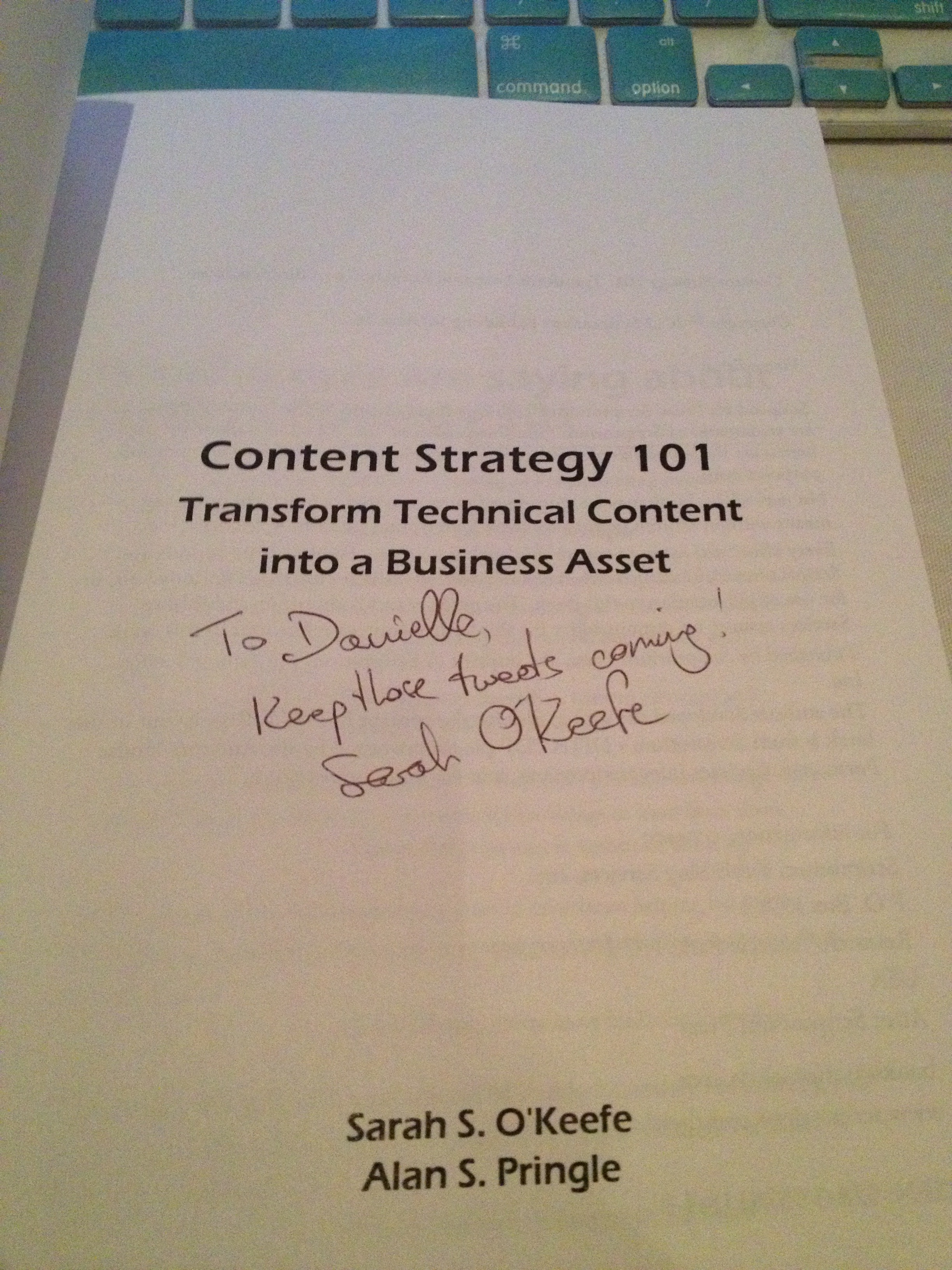
The autograph from my copy of
Sarah O’Keefe’s book,
Content Strategy 101.
Awesome!