

Photo from http://japanesegarden.com/learn-more/gardens/flat/
As I’m going backwards in my Adobe Day reviews, the second presentation of the day was by Joe Gollner. Joe is another prolific speaker in the world of technical communications, but I really hadn’t even heard him do a presentation before. I had seen him in last year’s Adobe Day at Lavacon on the panel discussion, but he was one of many voices in that discussion, so it was hard to determine what his presentations would be like. I was pleased to find that his talk was as top caliber as the other presenters (which was no surprise, really).
It is fairly well known that Joe earned a degree in philosophy, and he’s known to be quite thoughtful in his presentations. I had the chance to chit chat with him after his talk, and found that his quiet demeanor was rather enjoyable–although in my “fangirl” moment, I don’t remember a thing we talked about. (Ha ha on me!) So when I looked at the various gardens in Portland that I could use to describe Joe, I chose the Japanese Garden. On the Japanese Garden’s website, it describes the garden as a place in which “…the desired effect is to realize a sense of peace, harmony, and tranquility and to experience the feeling of being a part of nature. In a deep sense, the Japanese garden is a living reflection of the long history and traditional culture of Japan.” Similarly, Joe talked about technical communication in a zen-like way that the evolution of technical communication was a natural one that continues worldwide.
Joe’s presentation was about the changing role of the technical communicator within the integrated product lifecycle. He started the talk by asking the question of how do we deploy content to help with other aspects of business, and reach out to customers? His answer was that we need to adapt our conclusions. Joe mentioned Peter Drucker‘s book, The Practice of Management from 1954, in which Drucker spoke of the drive towards specialized components with variety as the order of the day at that time. Drucker understood in 1954 that the global economy would require standardized parts with flexible and dynamic assembly. The global economy calls for continuous process improvement that is maximized, automated, and makes dynamically tailored products. Joe emphasized that there’s no escape from the need to standardize and automate content.
In today’s market, portability and processability is key. Using XML to distribute content is central to the way business is conducted. It’s influential in technical interoperability, electronic data exchanges, social media integration, responsible web design, internet commerce, and supply chain automation. Thomas Friedman‘s book, The World is Flat, specifically focused on the levelling effects of XML. XML enabled supply chain automation, so it drove the ability to massively distribute manufacturing and distribution of products.
XML changed the way world works. XML is not a secret! To prove his point, Joe posted the following slide:
 Around those spokes, any business will go through the activities of governance, acquisition, delivery, and operation. We need to understand this applies to consumer products, complex systems, or data systems/big data. No trade-offs are allowed! Efficiency is measured as quality, cost, and speed. What this means for knowledge workers is that specialization is in order, and it does pose challenges in how we communicate. There are new and more challenging communication problems to be solved. Not only do we need to make technology understandable to users, but we need to make technology understandable at all in the first place.
Many companies need to understand for themselves what their own products do so they understand what they truly are. But many companies use the “silo” model of creating content, and the problem with the silo model is that it’s old, tired and broken, and can’t keep up with modern issues. Joe showed us this chart:
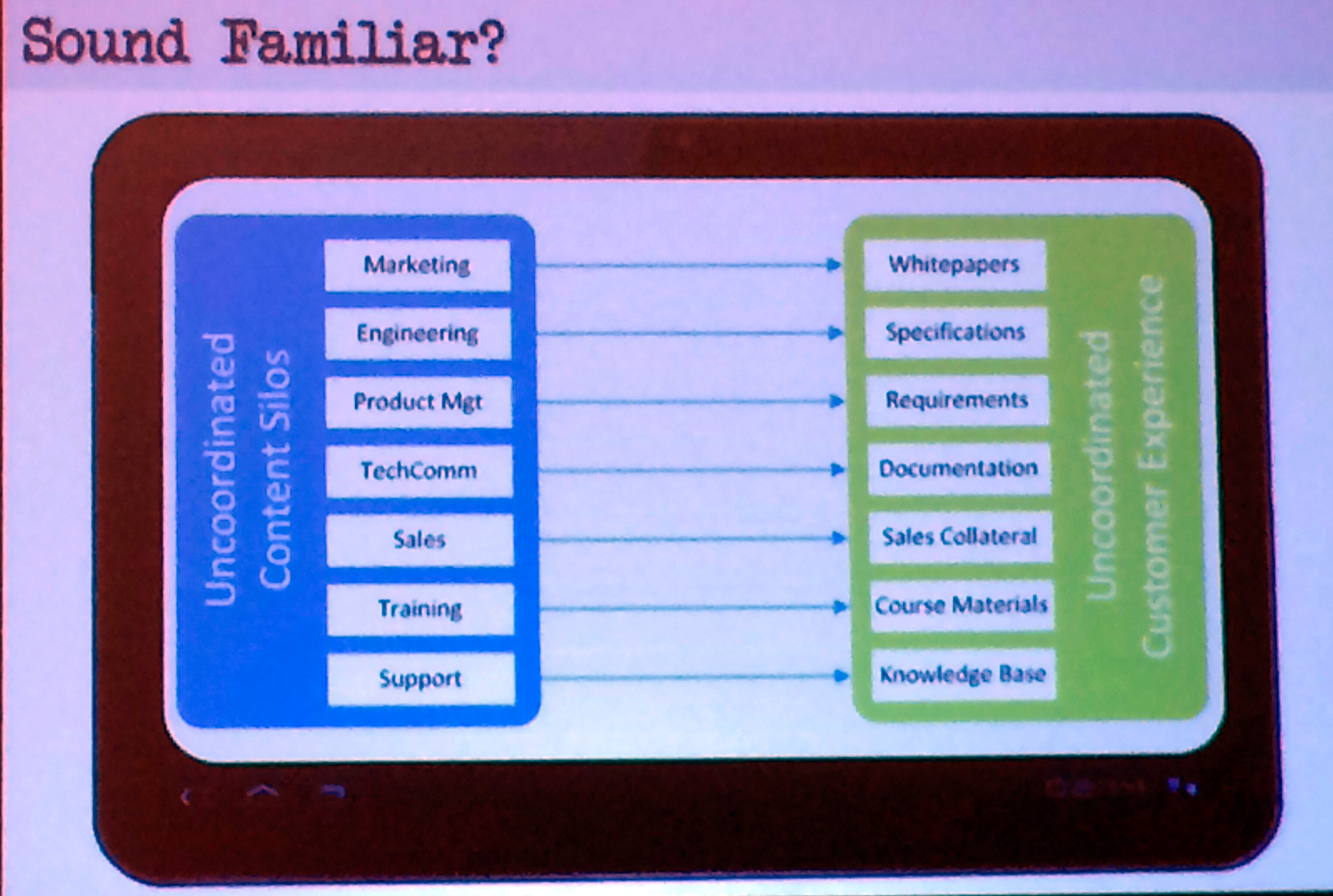 Joe pointed out that the details in this chart show that sometimes content “silos” and customer experience don’t align correctly. What can we, as content professionals, do to help fix this?

Joe cited a case study that was done using Massively Integrated Systems (MSI), a market leading software company. It compared Agile versus Lean practices of MSI. Agile success led to general failure, because if Agile was embraced, then the company embarked on aggressive innovation, thus it ran straight into the complexity of their own product and of their customers’ environments . The company developed specialist departments, but these types of teams find it harder to communicate with each other. The groups didn’t understand each other’s language, goals, constraints, and approaches, and it showed. The roots of the Lean process were in Training within Industry (TWI), a World War II initiative to mobilize US industry. It was all about communication during Cold War engineering that were powered by these practices, but it dissipated in the 1980s. The Lean process worked better.
Joe’s conclusion was that current practices aren’t sustainable. Content is placed in the center of the integrated product lifecycle (see spoke diagram above). Content is potential information, and is needed for effective information, processes, and products. There are many specializations to choose from as technical communication specialists. Joe asked the question, “Is adaption an option?” His response was a definitive NO. He believes that competitive pressures make reintegrating the product lifecycle mandatory. He gave the example of his daughter becoming a “cyberian” rather than a librarian, and she has a new job title of “meta-dor” due to this quickly changing world. Technical communicators will make themselves a visible part of the solution.
While I found Joe’s presentation informative, I actually have to disagree slightly with what he’s saying about becoming a specialist. Because I’ve been in the job market fairly recently (and might be again soon due to my contract ending), I feel that while you can have a main specialty in tech comm, it’s better to be a multi-specialist. Joe had spoken about how the “silo” groups couldn’t speak each others’ language, and that’s because of specialization. By being a multi-specialist, this allows a technical communicator to be multi-lingual, in a manner of speaking. Because I understand the nature of social media, content management, user interface design, and technical writing, I can fit into any of those positions as needed. Even in my current job as a “web publisher”, having those multiple “languages” and abilities served me well beyond knowing only content management. Understanding the other “languages” of those specialties–provided more technical communicators are also multi-specialists–will help to bring about that standardization of language needed between the groups. Perhaps it’s a more diplomatic or ambassadorial viewpoint on my part.
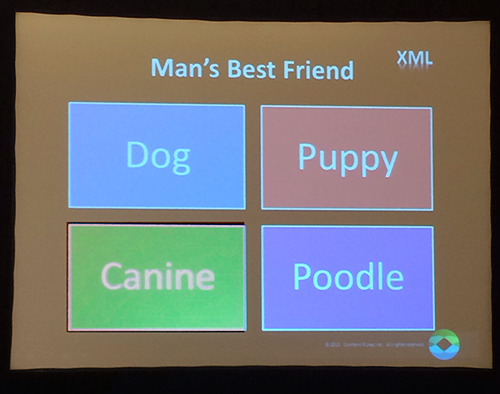
Still, I do agree with him that there is a need for standardization of language that needs to come about, and XML can be an important part of making that happen for better customer experience.
(Joe, if you are reading this, please feel free to correct or comment on my notes here in the comments below.)








 TechCommGeekMom
You must be logged in to post a comment.