In order for us to communicate effectively with each other, we need to have a shared terminology.
Danielle M. Villegas‘s insight:
I saw that Val Swisher had posted this on LinkedIn. Excellent article that affects all technical communicators, not just the content managers. One of the reasons that I try to stay involved in social media is so that I know what the latest "lingo" of the trade is, and terminology of responsibilities, requirements, and even job titles gets confusing. Case in point: my brother is an architect. What kind? The kind that draws and creates buildings–physical structures like office buildings, houses, and airports. Because "architect" is used so much in the IT world now, he’s had to figure out how to change his job description because of "information architects" and the like. Not that IAs should change their titles, but the point is that as content changes, and the strategy and management of said content changes, terminology is going to change. Val talks about that in detail here very well, as she always does.
A day after Steve Ballmer choked up at his final shareholder’s meeting as Microsoft CEO, the questions began anew: Should Bill Gates return to lead the company?Gates has repeatedly said he’s not
Danielle M. Villegas‘s insight:
I have to say, I agree with this article. Microsoft used to be the powerhouse software company, and now, it’s just…not. There are good people working at Microsoft, mind you, but I think a few at the top (some of whom have left or asked to leave) mucked things up. Like Steve Jobs did with Apple, I think the original visionary needs to come back and straighten up the mess. Bill’s had a chance to look at things from the outside as well as the inside, so I’m sure he can provide the insight to get the company back to its former glory. (And even though I’m a huge iPad and iPhone fan, I’m still a PC girl. Can’t help it.)
As Georg Petschnigg, one of FiftyThree’s founders, puts it, a stylus gives you the chance to “think with your hands.”
Danielle M. Villegas‘s insight:
This seems like a fairly cool little gadget. While there are plenty of stylus tools out there for iPad, this one is made for the Paper app, which is a fairly popular drawing app. I like how it has the ability to act almost like a real pencil in that you can write AND erase with it, and use it as if it were a real pencil. As it says at the bottom of the article, just image if it could be used in other apps eventually for note taking and such. Yes, good old fashioned paper and pen/pencil can do the trick too, but this is the next stage of making it more like a "real" experience as compared to the stylus tools we are currently used to using. I can see where this would be great for kids, albeit an expensive one, but at least there would be no mess when the artwork was done! It would also be a good tool for kids who need a little help with fine motor skills, since it’s a slightly chunky tool, so there would be better grip while the kids could use the iPad.
Coin is a new device that can hold and be used like the cards you already carry.
Danielle M. Villegas‘s insight:
Have you seen this? Check out the video on this website. This definitely looks like interesting technology. I’m very tempted to be an early adopter for this. Heaven knows I carry too much myself, and I wouldn’t mind finding a way to not carry so much information via so many cards. This really looks cool!
I realized as I was writing this post that this would be my 500th post on TechCommGeekMom. Who knew that so much information and thought could accumulate through original posts and curated content? I’m also very close to my all-time 15,000 hits mark (only a few hits away at this writing). I wouldn’t have believed you if you told me that I’d hit these benchmarks when I started this blog, but of course, I’m going to keep going! I debated about what I should write for my 500th post–whether to finish my Adobe Day coverage or do something else, and in the end, it seems fitting to finish my Adobe Day coverage, because in many respects, knowing and writing about the presentation of Scott Abel, aka “The Content Wrangler”, shows how far I’ve come already in my tech comm journey from beginner to covering internationally known presenters.
Scott is one of the most prolific and vocal speakers out there on the conference circuit speaking about content–whether it be content management or other technical communication topics. It also seems like he has written the forewords of many of the best tech comm books out there. He’s everywhere! To boot, he’s an accomplished DJ, and I found myself “bonding” with him over dance remixes and mash-ups while at Lavacon, because I always enjoy when he posts either his mash-ups or his favorite mash-ups on Facebook. (I’ll be writing a post about the relationship between tech comm and dance mash-ups in the near future.) He is a person who is full of so much kinetic energy that you wonder when he’s going to explode, but he doesn’t. Even the time I saw him at the STC Summit last spring with a bad cold, he was still more on top of his game than a lot of people would be on a good day. Much like Val Swisher, my love for all things Scott Abel also knows no bounds. He knows how to stir things up at times, but there is no denying that in his frenetic pace of delivering a presentation, you learn SO much. I’m lucky that he’s so kind to be one of my cheerleaders!
Scott Abel checking his files before his presentation
So when it came to thinking of a garden in Portland to use as an analogy to Scott, I had to deviate. In my mind, he’s the Voodoo Doughnuts shop located about four or five blocks away from the Chinese Garden. Scott’s talks always have lines going out the door, and like many of the Voodoo Doughnuts themselves, the unique flavors dispensed open your mind up to new and delicious possibilities and ideas, and you come back wanting more (hence, more long lines!). They are both crazy and sweet at the same time. You can’t beat that combination.
Scott was the keynote speaker for Adobe Day as well as the moderator of the discussion panel later in the event. Scott’s topic for his talk was called, “Five Revolutionary Technologies Technical Communicators Can’t Afford To Ignore.” If Joe Gollner went fast during his presentation, then Scott went at lightning speed, so my notes below are the highlights.
Scott started by telling us that translation is going to be an important part of automated content going forward. It’s important to understand that for the web, the World Wide Web (WWW) is equal to the “land of opportunity.” The WWW can reach a global market reaching new consumers. As American users, we forget that 96% of web users are not in the US. We don’t all speak English globally. In fact, less than 6% of the global population speaks English well, but don’t necessarily read or write it well.
Scott’s list of the five technologies the Tech Comm can’t ignore were as follows:
1) Automated Translation
Why would be need automated translation? We write for the *worldwide* web. There are over 6000 languages in the world, so translation is a big deal for a global reach and global connection. We need to recognize that content is written for both machines and humans. Even though we write for both machines and humans, we need to write for machines first, as they are the “gatekeepers” of content, such as for searches. Everything goes through the machine first. We need to recognize that writing rules learned in elementary school are no longer sufficient for a world in which language science is needed. We need to examine our content from the vantage point of a rules-processing engine and ensure it’s optimized for machine translation.
2) Automated Transcription
Automated transcription involves software that translates speech to text for machine use. Without transcription, content is locked and hidden from view. Transcription allows for better searchability of content. Scott recommended Koemei as a good transcription software tool for video and general transcription, as it can help transform editable content into other languages.
3) Terminology Management
Terminology management controls words in a central place, namely the words used the most and used consistently for branding, products, etc. Terminology management is important for consistency as well as for regulatory reasons. This is an instance where seeking a global content strategist is needed to help standardize processes. It’s best to adopt a terminology management system, such as Adobe partner and Scott’s suggestion, Acrolinx.
4) Adaptive content
Adaptive content is content that is structured and designed to adapt to the needs of your customer; it’s about substance of the content. Adaptive content adapts to the devices, e.g. laptops, GPS, and smartphones. Customers are demanding exceptional experiences, so we need to meet their expectations, so it’s up to responsive designers to meet that challenge. Adaptive content makes it possible to publish to multiple platforms and devices. It is content separated from formatting information. By allowing authors to focus on what they do best, adaptive content makes content findable and reuseable by others who need it. We need to rethink content, as the move to adaptive content involves work, but the ROI (return on investment) can be realized in months instead of years.
5) Component Content Management
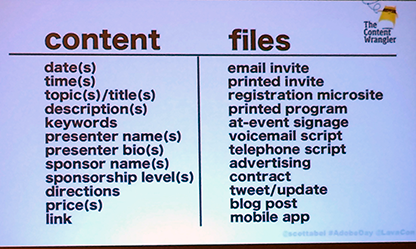
Component content management systems are needed. They focus on the storing of content components that are used to assemble documents. Components can be in all sizes, and can be photos, video, and text. It’s about managing CONTENT not FILES.
Scott provided these slides as his example to show this:
Structured content, combined with a component content management system, supports personalized content and targeted marketing, which in turn increases response rates. In this end, this process can save money! The key is to remember that all customers are not the same! Reusing content without the “copy and paste” methods produce the best results. You can ensure that content is consistent by seeking a content strategist who understands content and is a technologist. Implement a component management system. Scott suggested checking out Astoria Software for a good component content management system.
At this point, Scott’s talk had pretty much finished, but in answering audience questions, he pointed out that there’s a lot more than just these five technologies to watch. He suggested that we should look out for wireless electricity, flexible surfaces, more wireless devices, wearable computing, and augmented reality as well. He also said that in order to mature as a discipline, we need to be content craftspeople, content designers and content engineers. We need to leverage using content and code. We need to think more like engineers, and less like writers and editors. Even websites that are very localized still need to be written for global purposes to improve the English used for the native speakers as well. Controlled vocabulary helps all end users!
Scott covered a LOT of information in a short amount of time, and he set the tone for the rest of the session, as the presentations that followed repeated much of the same information. (This is a good thing, because then we know that the information is valid, coming from several experienced technical communicators!)
Scott posted on Twitter than his presentation was available on SlideShare, but I have it below.
And as always–Scott, if I misinterpreted or misquoted any of the information I summarized above, please let us know in the comments!










 TechCommGeekMom
You must be logged in to post a comment.