Hi Everyone, My apologies for the delay in blogging since my last post. I have been busy launching my workshop on how to transition from e-Learning to m-Learning. Now that this workshop is up-and-r…
Danielle M. Villegas‘s insight:
As always, my m-learning mentor, RJ Jacquez, is on the cutting edge again (no pun intended, since he’s using a hockey analogy in his post). I’ve seen this issue crop up at several places where I’ve either worked or interviewed. Mobile–whether it’s for e-learning or otherwise–is just not on corporate radar, and it really should be! Companies that aren’t looking at mobile will be falling behind soon enough, if they aren’t falling behind already. Mobile is taking over, and it’s really important to try to stay ahead of the game instead of trying to catch up.
It’s easy for a designer or developer to lose sight of what the purpose of a website is. Most people, when asked why they have a website for their busin…
Danielle M. Villegas‘s insight:
Websites are so much more! This is just the icing of what it’s NOT. –techcommgeekmom
Today we introduce our second regular guest blogger, Danielle Villegas, also known as TechCommGeekMom. Danielle is attending the STC Summit for the first time this year, so we’ve asked her to blog about her expectations and excitement approaching the Summit, plus her experiences at the Summit…
Danielle M. Villegas‘s insight:
This is my first in a series that I’m writing for the "STC Notebook" blog, which is "the official voice of STC and the tech comm community." I’m excited to be writing for the STC official blog–it’s a huge honor! Please stay tuned for the next installments!
Hidden features, reduced discoverability, cognitive overhead from dual environments, and reduced power from a single-window UI and low information density. Too bad.
Danielle M. Villegas‘s insight:
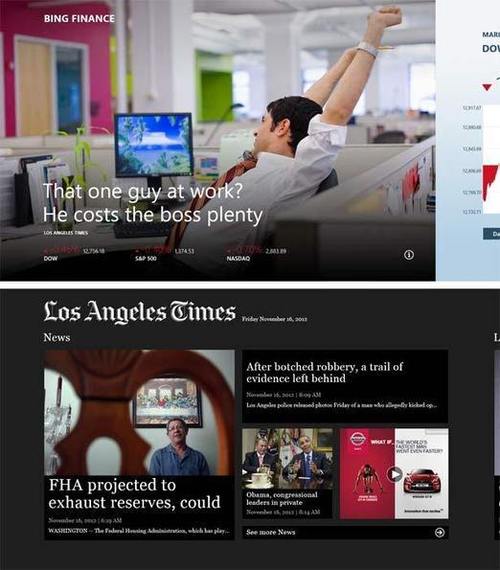
Jakob Nielsen is at it again. I found this article thanks to a friend of a friend on LinkedIn. My friend was asking about Windows 8, trying to get a feel for whether is was worth the switch, and another friend of hers recommended this article, and it’s a good one. I think without going as in-depth as Nielsen did, even just with some of the perusing I’ve done at my local Microsoft stores had me leery of the product. I’m usually the first to jump onboard with a new OS from Microsoft, and for the first time, I’m actually hesitating and truly hedging on doing the upgrade. I’m very much a PC person when it comes to my heavy duty computing needs, but I’m really still not sure about Windows 8. This article justifies my instincts a bit.
English: Hypothetical flag quartering the British and American flags. (Photo credit: Wikipedia)
I mentioned a while ago that I had several writing projects that were coming up, and the first of them is now published! I was asked by the STC-PMC to write a two-part article about the differences and similarities between American and British English. Of course, I think there’s much more to that simple debate, and this is a favorite topic of mine, so I gladly accepted the challenge. The bigger challenge was to try not to write an entire book!
Is English an international language? Yes…and no. There is no question that English is a predominant global language. Half the world’s technical and scientific periodicals are written in English, as is eighty percent of the information stored in the world’s computers. There is no question that English is the most prominent language on the Internet, which has contributed to its continued spread around the world.
However, among English speakers, there can be huge differences, as if English speakers from different countries actually spoke different languages. The argument is often made that those who speak English do speak the same base language with just a few different spellings or colloquial idioms now and then. This is only partially true. While most of the world thinks of English in terms of American or British English, there’s also Canadian, Indian, Australian, New Zealander and South African versions of English to consider among others. Each version of English has further nuances that distinguish itself from another version. For the most part, an Australian can understand a South African, an American can understand a New Zealander, and someone from India can understand someone from the UK. But there will be moments that any one of those speakers could elicit a bewildered “EH?” amongst themselves in understanding.
Since most countries that speak English as the dominant language or a second language are former British colonies or Commonwealth countries, British English is usually the standard taught in schools. The exception to this, of course, is American English, which is usually taught in the United States and much of Central and South America as a second language. Even so, between American and British English, one would think that with a few small exceptions, they are essentially the same language, right?
What many Americans don’t realize is that British English has enough nuances that in several cases, we can’t understand our British brethren, and vice versa. For example, if a person came up to you in London and mentioned that he had a mate who sold so many crisps from his lorry that the crisps were falling out the boot and bonnet, would you know what that person meant? If you’ve watched a lot of BBC America or read enough books from the UK (as I have), then you might. An American would have to translate what the Londoner said, which was that he had a buddy who sold potato chips out of his truck, and the chips were falling out of the trunk and hood. Another example would be that if an American said that he would lose his pants over a financial deal, a Brit would misunderstand it to mean that the American would be losing his underwear over the deal, as “pants” is used to refer to underwear instead of “trousers” in the UK. Those are just two of many examples of how Brits and Americans don’t necessarily understand each other.
This divide is an important consideration in technical communications. Single-sourcing and translation are a large and continually growing component of technical communications. While software is becoming more intuitive about translating written content into different languages, it’s not flawless. Using a standard commonality in the language would be desired as a result.






 TechCommGeekMom
You must be logged in to post a comment.